
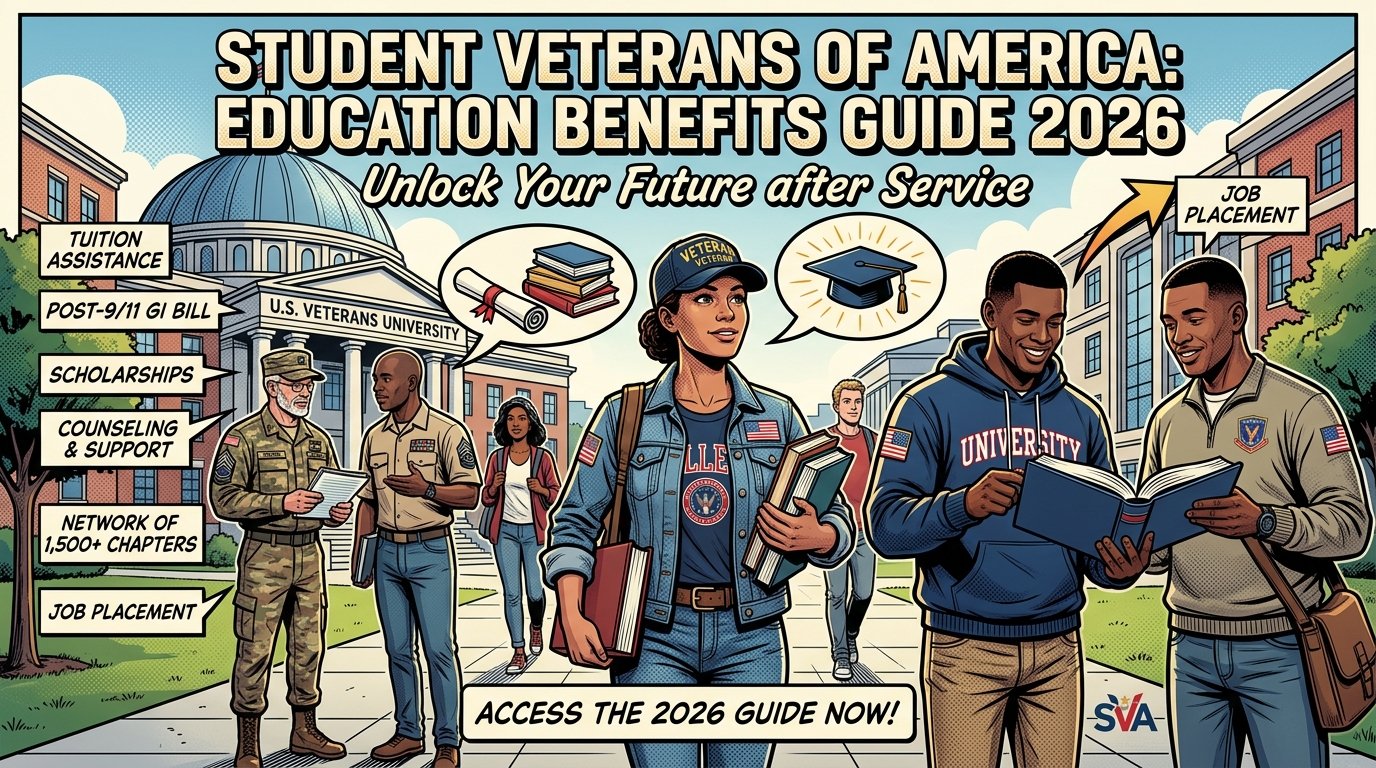
Student Veterans of America: Education Benefits Guide
Student Veterans of America (SVA) is a national nonprofit founded in 2008 that supports student veterans through a network of more than 1,600 campus chapters in all 50 states and four countries overseas, representing nearly 600,000 student veterans. SVA does not administer GI Bill benefits — the U.S. Department of Veterans Affairs does. Instead, SVA provides peer support, leadership development, advocacy, scholarships, and campus-based community for veterans using VA education benefits. Veterans apply for GI Bill benefits through VA.gov using VA Form 22-1990.
Quick Facts
| Item | Details |
|---|---|
| Benefit | Campus chapters, peer support, leadership programs, scholarships, national advocacy |
| Eligibility | Student veterans, active duty, Guard, Reserve, military-connected students, dependents |
| Application | Join or start a chapter at studentveterans.org/chapters; apply for VA benefits at VA.gov |
| Processing Time | SVA chapter application: 1–2 business days; VA GI Bill application: 30–45 days |
| Official Agency | Student Veterans of America (nonprofit); U.S. Department of Veterans Affairs (benefits) |
| Required Forms | VA Form 22-1990 (GI Bill); DD-214; SVA chapter charter requirements |
| Updated For | 2026 |
What Is Student Veterans of America?
Student Veterans of America is a 501(c)(3) nonprofit organization founded in 2008 by a grassroots coalition of GI Bill users who saw that their education benefits no longer aligned with the realities of the higher education system they entered. SVA is the only veteran service organization solely devoted to helping veterans in higher education.

What SVA Is — and What It Is Not
SVA is:
A campus-based peer support network
A national advocacy organization for student veterans
A provider of scholarships, leadership training, and career resources
A connector between student veterans and campus administrators

SVA is not:
A government agency
A VA benefits processor
A GI Bill administrator
SVA does not determine GI Bill eligibility, process claims, or issue payments. Those functions belong to the Veterans Benefits Administration (VBA) within the U.S. Department of Veterans Affairs.
Why SVA Matters
An estimated 840,000 students currently use GI Bill benefits, and nearly 600,000 of them attend institutions with an SVA chapter. SVA chapters function as hubs of peer support, leadership development, and institutional engagement — often the first point of contact for veterans navigating enrollment, benefits, academic challenges, and transition stress.
SVA Programs and Services
SVA offers programming at the local, regional, and national levels:
| Program | What It Provides |
|---|---|
| Campus Chapters | Peer support, community, leadership opportunities, campus advocacy |
| Regional Summits | Leadership workshops, best practice sharing, networking across chapters |
| National Conference (NatCon) | Largest annual gathering of student veterans; training and networking |
| Washington Week | Flagship national advocacy program; meetings with lawmakers |
| Leadership Institute | Immersive training for nearly 100 chapter leaders annually through competitive application |
| SVA Career Center | Connects student veterans to degree-relevant roles while enrolled |
| Scholarships | Partner-funded awards ranging from $2,000 to $12,000 |
How SVA Relates to VA Education Benefits
Veterans May Qualify for Extra Benefits
Check available financial assistance, healthcare programs and other opportunities that may apply to you.
Check EligibilitySVA does not replace or administer VA education benefits. It helps veterans use them more effectively and advocates for policy changes when benefits fall short.
The Division of Responsibilities
| Function | SVA | VA |
|---|---|---|
| Determine GI Bill eligibility | No | Yes |
| Process GI Bill applications | No | Yes |
| Issue housing and tuition payments | No | Yes |
| Provide peer support on campus | Yes | No |
| Advocate for benefit improvements | Yes | No |
| Offer scholarships | Yes | No |
| Help veterans navigate campus resources | Yes | No |
SVA’s Policy Priorities
SVA advocates on specific legislative issues that affect student veterans’ benefits. Its 2026 priorities include:
Revising the Monthly Housing Allowance (MHA) for online students to equal the national median BAH rate for an E-5 with dependents
Defending the improved 90/10 Rule, which counts VA and DoD education benefits as federal education funds
Extending the period VA can continue paying housing allowances during school closures from four weeks to eight
Supporting the Take Care of America’s Veterans Act, which includes monthly housing allowance parity for online courses over the summer and digital communication options for VA education benefits
SVA testified before Congress in March 2026 that today’s student veterans arrive on campus older, frequently with families, often balancing employment and caregiving alongside coursework. Its policy recommendations are designed to align federal benefits with those realities.
VA Education Benefit Programs: Complete Comparison
Veterans using education benefits have several programs to choose from. The right program depends on your service history, disability status, and educational goals.
| Program | Chapter | Who Qualifies | What It Covers | Online Application |
|---|---|---|---|---|
| Post-9/11 GI Bill | 33 | 90+ days active duty after Sept. 10, 2001 | Full in-state tuition, MHA, book stipend | VA Form 22-1990 |
| Montgomery GI Bill — Active Duty | 30 | 2+ years active duty; $1,200 contribution | Flat monthly stipend | VA Form 22-1990 |
| Montgomery GI Bill — Selected Reserve | 1606 | 6-year Guard/Reserve commitment | Lower monthly stipend | VA Form 22-1990 |
| Veteran Readiness & Employment | 31 | 10%+ service-connected disability with employment barrier | Tuition, books, subsistence allowance; no tuition cap | VA Form 28-1900 |
| Survivors’ & Dependents’ Educational Assistance | 35 | Spouses/children of permanently disabled or deceased veterans | Tuition and monthly stipend | VA Form 22-5490 |
Post-9/11 GI Bill (Chapter 33): The Primary Benefit
The Post-9/11 GI Bill is the most comprehensive VA education benefit. It covers full in-state tuition at public colleges, up to **$30,908.34 per year** at private or foreign schools for the 2026–2027 academic year, a monthly housing allowance, and an annual book stipend of up to $1,000.
Eligibility Tiers
Your benefit percentage depends on your length of active-duty service:
| Active Duty Service | Benefit Level |
|---|---|
| 1,095+ days (36 months), or Purple Heart, or 30 continuous days with SC disability discharge | 100% |
| 910–1,094 days (30–35 months) | 90% |
| 730–909 days (24–29 months) | 80% |
| 545–729 days (18–23 months) | 70% |
| 180–544 days (6–17 months) | 60% |
| 90–179 days (90 days–5 months) | 50% |
The Post-9/11 GI Bill requires an honorable discharge — a general discharge under honorable conditions does not meet Chapter 33’s rule.
Housing Allowance Rates for 2026–2027
| School Type | Monthly Housing Allowance |
|---|---|
| Campus-based (in-person) | Up to $2,522 (national average) |
| Foreign school | $2,522 |
| Exclusively online training | $1,261 |
The online-only rate is half the national average. This is a critical distinction for student veterans who take all courses online — a common mistake that reduces housing payments.
Montgomery GI Bill — Active Duty (Chapter 30)
The Montgomery GI Bill provides a flat monthly stipend rather than tuition payment. For the 2025–2026 rate period (effective October 1, 2025, through September 30, 2026), the full-time rate is $2,518 per month.
Veterans who contributed $1,200 during service and served at least two years of active duty may qualify. Most veterans who are eligible for both programs choose the Post-9/11 GI Bill because the total value is typically higher, especially with the housing allowance.
Montgomery GI Bill — Selected Reserve (Chapter 1606)
Available to Guard and Reserve members with a six-year service obligation, this program pays a lower monthly rate: $493 per month full-time for the 2025–2026 rate period.
Veteran Readiness and Employment (Chapter 31 / VR&E)
VR&E is a separate program for veterans with service-connected disabilities that limit their ability to work. It provides tuition, books, and a subsistence allowance with no tuition cap. Eligibility requires an other-than-dishonorable discharge and a service-connected rating of at least 10% with a serious employment barrier, or 20% with an employment barrier. Apply using VA Form 28-1900.
Survivors’ and Dependents’ Educational Assistance (Chapter 35)
Spouses and children of veterans who are permanently and totally disabled from service-connected causes, or who died from service-connected causes, may qualify for DEA benefits. Apply using VA Form 22-5490.
The Rudisill Decision: Up to 48 Months
The Supreme Court’s 2024 decision in Rudisill v. McDonough confirmed that veterans with two or more qualifying periods of active duty — one qualifying for the Montgomery GI Bill and another for the Post-9/11 GI Bill — may access up to 48 months of combined education benefits. Previously, the VA limited such veterans to 36 months. The 48-month aggregate cap still applies; veterans cannot use both programs simultaneously.
How to Apply for VA Education Benefits
Applying for GI Bill benefits is a separate process from joining SVA. Here are the steps.
Step 1: Determine Your Eligibility
Review your active-duty service length and discharge characterization. The Post-9/11 GI Bill requires an honorable discharge; VR&E requires an other-than-dishonorable discharge.
Step 2: Apply Online Using VA Form 22-1990
Go to VA.gov and select “Apply for Education Benefits”
Answer the questions under “Find your Education Benefits Form” — you will be routed to Form 22-1990 for GI Bill benefits
Complete and submit the form online
VA will process your request in approximately 30–45 days
Step 3: Receive Your Certificate of Eligibility (COE)
VA will mail your COE to the address you provided. This document confirms your benefit level and entitlement length. Provide it to your school’s certifying official.
Step 4: Work With Your School’s Certifying Official
Your school’s VA certifying official submits enrollment certifications to VA each term. This triggers your tuition payment and housing allowance.
Step 5: Verify Enrollment Monthly
If you are using the Montgomery GI Bill, you must verify your enrollment monthly to receive payments. Post-9/11 GI Bill recipients generally do not need to verify monthly unless VA requests it.
Required Documents
DD-214 (Certificate of Release or Discharge from Service)
High school diploma or equivalent (for some programs)
College acceptance letter or enrollment verification
For dependents: VA file number of the veteran or service member
SVA Scholarships and Financial Assistance
SVA partners with major corporations and foundations to offer scholarships specifically for student veterans. These awards supplement GI Bill benefits and can cover costs that VA benefits do not.
2026 SVA Scholarship Programs
| Scholarship | Award Amount | Who Qualifies | Partner |
|---|---|---|---|
| RTX Patriot Scholarship | $10,000 | U.S. Army veterans | RTX |
| RTX SPY-6 Scholarship | $10,000 | U.S. Navy veterans in engineering, operations, logistics | RTX |
| John Edelman Scholarship | $10,000 | Student veterans pursuing mental health counseling | John Edelman |
| Northrop Grumman Foundation STEM Scholarship | $2,000 | Undergraduate student veterans in STEM fields | Northrop Grumman |
| NBC Universal Scholarship | $12,000 | Veterans entering entertainment industry | NBC Universal |
For the 2026 RTX Patriot and SPY-6 Scholarships, four recipients were awarded $10,000 each to support their continued education.
Other Veteran Scholarships to Consider
VFW Sports Clips Help a Hero Scholarship — up to $5,000 for service members and veterans
Edith Nourse Rogers STEM Scholarship — extension of VA education benefits for veterans pursuing STEM degrees
Common Mistakes With Scholarship Applications
Not applying because you have GI Bill benefits. Scholarships can cover costs GI Bill does not, including housing gaps, technology, and childcare.
Missing deadlines. SVA scholarship applications typically open in spring and close in summer.
Not tailoring the essay. Generic applications perform poorly.
Overlooking smaller awards. A $2,000 STEM scholarship still reduces debt.
How to Join or Start an SVA Chapter
SVA chapters are student-led organizations on college campuses. Joining an existing chapter is simple. Starting a new one requires several steps.
Joining an Existing Chapter
Any student enrolled in at least one credit who is a veteran, reservist, National Guard member, active-duty service member, dependent, or supporter of the military may join. You do not need to be a veteran.
Starting a New Chapter: Step-by-Step
Understand the mission. Review SVA’s chapter-building best practices and business planning resources.
Connect with your campus community. Identify stakeholders, gauge interest, and build relationships with school administrators.
Establish your network. National Headquarters requires three points of contact: a student veteran contact (Chapter Leader), an administration contact (Group Advisor), and a chapter email contact.
Apply for recognition as an official student organization on your campus. Contact Student Life administration for specific requirements.
Create a governing document. A constitution or set of bylaws is a prerequisite to becoming an official chapter.
Apply for SVA membership at studentveterans.org/chapters. Applications are reviewed within 1–2 business days.
Minimum Requirements to Charter an SVA Chapter
An official governing document or plan to operate your chapter
Recognition by your institution as a registered student organization
An elected group of student leaders (president, vice president, etc.)
A member of your faculty or staff serving as an advisor
What Chapters Provide
Peer-to-peer support and community
Leadership development opportunities
Access to NatCon, Washington Week, and Leadership Institute
Connection to SVA’s national network and career center
A voice in campus decisions affecting student veterans
Common Mistakes Student Veterans Make
Student veterans are almost twice as likely as traditional students to change their major multiple times. Even with GI Bill funding, many graduate with student loan debt — partly due to lack of preparation and advising.
GI Bill Mistakes That Cost Money
Taking all online classes without understanding MHA rules. Online-only students receive $1,261 per month in 2026–2027, half the national average campus rate.
Not verifying enrollment monthly (Montgomery GI Bill recipients). Missed verification means missed payments.
Withdrawing from classes mid-term. VA may reduce benefits and create a debt for overpayment.
Receiving an incomplete grade. VA reduces benefits for that term and may create a debt.
Not having a career goal. Without direction, benefits may be spent on a degree you do not use.
Skipping FAFSA. Even with GI Bill benefits, veterans may qualify for Pell Grants or other need-based aid.
Choosing a school without checking its VA approval. Some programs are not VA-approved.
Campus Transition Mistakes
Isolating from campus life. Student veterans who do not connect with an SVA chapter or similar group report higher rates of isolation.
Not seeking accommodations early. Disability services can provide testing accommodations, note-taking support, and priority registration.
Waiting too long to ask for help. Financial aid offices, veterans centers, and SVA chapters exist to help.
FAFSA and Dependency Status
Veterans and active-duty service members serving for purposes other than training are considered independent students for federal financial aid purposes. This means your parents’ income is not counted, which typically increases eligibility for need-based aid. Complete the FAFSA even if you have GI Bill benefits.
Financial Aid Beyond the GI Bill
GI Bill benefits are generous but not unlimited. Here are additional funding sources student veterans should know about.
Federal Financial Aid
| Source | What It Provides | How to Apply |
|---|---|---|
| Pell Grant | Need-based grant; does not require repayment | FAFSA |
| Federal Supplemental Educational Opportunity Grant | Need-based grant for undergraduates | FAFSA |
| Federal Work-Study | Part-time employment while enrolled | FAFSA |
| Direct Loans | Subsidized and unsubsidized loans | FAFSA |
Yellow Ribbon Program
The Yellow Ribbon Program helps cover tuition at private colleges and universities that exceed the Post-9/11 GI Bill cap. Schools voluntarily contribute a portion of the difference, and VA matches that contribution.
Eligibility: Veterans must qualify for the Post-9/11 GI Bill at the 100% benefit tier. This includes veterans who served at least 36 months of active duty after September 10, 2001.
How it works: If a private school’s tuition exceeds the annual cap ($30,908.34 for 2026–2027), the school contributes a dollar amount, and VA matches it. The combined contribution can cover the full remaining tuition, depending on the school’s agreement.
What to do next: Contact your school’s certifying official to confirm participation and the amount of Yellow Ribbon funding available.
State Veterans Benefits
Many states offer additional education benefits for veterans and dependents:
Tuition waivers at state colleges and universities
Scholarships for dependents of disabled or deceased veterans
National Guard tuition assistance programs
Property tax exemptions that free up funds for education
Check your state’s veterans affairs agency for available programs.
Common Questions
What is Student Veterans of America?
Student Veterans of America is a nonprofit organization founded in 2008 that supports student veterans through 1,600+ campus chapters in all 50 states and four countries. SVA provides peer support, leadership development, scholarships, and national advocacy for veterans in higher education.
Does SVA provide GI Bill benefits?
No. SVA does not administer GI Bill benefits. The U.S. Department of Veterans Affairs processes GI Bill applications, determines eligibility, and issues payments. SVA helps veterans navigate benefits and advocates for policy improvements.
How do I apply for GI Bill benefits?
Apply online at VA.gov using VA Form 22-1990. Select “Apply for Education Benefits,” answer the eligibility questions, and submit the form. VA processes applications in approximately 30–45 days. You will receive a Certificate of Eligibility by mail.
How do I join an SVA chapter?
Contact your campus veterans office or search for an SVA chapter at your school. Membership is open to veterans, service members, Guard, Reserve, dependents, and supporters. You do not need to be a veteran to join.
How do I start an SVA chapter on my campus?
Complete the chapter application at studentveterans.org/chapters. You need a governing document, campus recognition as a student organization, elected student leaders, and a faculty or staff advisor. Applications are reviewed within 1–2 business days.
What is the Post-9/11 GI Bill housing allowance rate for 2026?
For campus-based programs, the maximum monthly housing allowance is $2,522 for 2026–2027. Online-only students receive $1,261 per month, which is half the national average. Foreign school students also receive $2,522.
What scholarships does SVA offer?
SVA offers scholarships ranging from $2,000 to $12,000, funded by partners including RTX, Northrop Grumman, NBC Universal, and John Edelman. Awards support Army veterans, Navy veterans, STEM students, mental health counselors, and veterans entering entertainment.
Can I use GI Bill benefits for online school?
Yes. The Post-9/11 GI Bill covers online programs, but the housing allowance is reduced to $1,261 per month for exclusively online training. Choose at least one in-person class when possible to receive the full campus rate.
What is the Rudisill decision?
The Supreme Court’s 2024 Rudisill v. McDonough decision allows veterans with qualifying service under both the Montgomery GI Bill and Post-9/11 GI Bill to access up to 48 months of combined benefits. Previously, VA limited such veterans to 36 months.
Does SVA help with VA disability claims?
No. SVA focuses on education benefits and campus support. For disability claims, contact an accredited Veterans Service Organization (VSO) or the VA directly at 1-800-827-1000.
Can dependents join SVA?
Yes. SVA chapters are open to military-connected students, including spouses, children, and dependents of veterans and service members. Many chapters also welcome students who support the military community.
What is VR&E and who qualifies?
Veteran Readiness and Employment (Chapter 31) is a program for veterans with service-connected disabilities that limit employment. Eligibility requires a 10% rating with a serious employment barrier or a 20% rating with an employment barrier. Apply using VA Form 28-1900.
How does the Yellow Ribbon Program work?
The Yellow Ribbon Program helps cover private school tuition exceeding the GI Bill cap. Schools contribute a portion, and VA matches it. Veterans must qualify for the Post-9/11 GI Bill at the 100% tier to participate.
What is the biggest mistake student veterans make?
The biggest mistake is not understanding how enrollment status affects housing payments. Taking all online classes reduces MHA by half, and withdrawing from a class mid-term can create a VA debt. Always confirm your rate of pursuit with your certifying official.
Key Takeaways
Student Veterans of America is a nonprofit with 1,600+ campus chapters; it does not administer GI Bill benefits.
The Post-9/11 GI Bill covers full in-state tuition, up to $30,908.34/year at private schools, plus housing and book stipends for 2026–2027.
Online-only students receive $1,261/month in housing allowance — half the $2,522 national average for campus-based programs.
Apply for GI Bill benefits at VA.gov using VA Form 22-1990; processing takes 30–45 days.
SVA scholarships range from $2,000 to $12,000, funded by RTX, Northrop Grumman, NBC Universal, and others.
Starting an SVA chapter requires a governing document, campus recognition, elected leaders, and a faculty advisor.
The Rudisill decision allows up to 48 months of combined GI Bill benefits for veterans with multiple qualifying service periods.
Student veterans are independent for FAFSA purposes; complete the FAFSA even with GI Bill benefits.
VR&E (Chapter 31) provides uncapped tuition for veterans with service-connected disabilities and employment barriers.
The Yellow Ribbon Program bridges the gap between GI Bill tuition caps and private school costs.
Official Resources
Student Veterans of America — studentveterans.org
U.S. Department of Veterans Affairs — va.gov
VA Education Benefits — va.gov/education
VA GI Bill Comparison Tool — va.gov/gi-bill-comparison-tool
VA Form 22-1990 — va.gov/find-forms
VA Form 28-1900 (VR&E) — va.gov/find-forms
Federal Student Aid (FAFSA) — studentaid.gov
IRS — irs.gov



🇺🇸 IMPORTANT DISCLAIMER – Veterans Benefits Information
This site provides general information about U.S. Department of Veterans Affairs (VA) benefits for educational and informational purposes only.
- Not Official: We are NOT affiliated with, endorsed by, or connected to the U.S. Department of Veterans Affairs (VA), the Veterans Benefits Administration (VBA), the Veterans Health Administration (VHA), or any other government agency.
- No Legal/Financial Advice: The content on this website is for informational purposes only and does not constitute legal, financial, or medical advice. VA benefits rules change frequently – always consult with an accredited Veterans Service Officer (VSO) or a qualified professional for your specific situation.
- Official Sources: For official, binding information and to apply for benefits, always visit official .gov websites: VA.gov, Benefits.VA.gov, or SSA.gov.
- No Data Collection: This site does not collect, store, or process any personal information. It does not have login forms, contact forms, or any system to capture user data. We never ask for your Social Security Number, bank details, or any personal information.
- 🚨 Scam Alert: The VA and other government agencies never charge fees for benefit applications. If anyone asks for money to "process" your VA claim, it is a scam. Report it to the VA Office of Inspector General at VA.gov/OIG.
- Advertising: This site uses third-party advertising (Adsterra) to cover operational costs. We do not endorse or guarantee any products or services advertised.
📌 Information provided as of June 2026. Always verify current eligibility and rules with official .gov sources.
This site is not affiliated with the U.S. Department of Veterans Affairs or any government agency. All information is for educational purposes only. Please visit VA.gov for official information.
