

Veterans Benefits Guide 2026: State-by-State Eligibility Explained
Featured Answer: VA benefits fall into two categories: federal benefits (identical in all 50 states) and state benefits (which vary widely). In 2026, the VA disability COLA is 2.8%, with 100% disability paying $3,938.58 monthly. States add property tax exemptions, income tax breaks, and education benefits worth thousands per year.
Quick Facts
| Item | Details |
|---|---|
| Benefit | Federal and state veterans benefits |
| Eligibility | Varies by program—service-connected disability, income, age, or service era |
| Application | VA Form 21-526EZ (disability); VA Form 10-10EZ (health care); state forms for state benefits |
| Processing Time | 90–180 days (VA disability); same-day enrollment (VA health care) |
| Official Agency | U.S. Department of Veterans Affairs (VA); State Departments of Veterans Affairs |
| Required Forms | DD-214, VA Form 21-526EZ, VA Form 10-10EZ |
| Updated For | December 1, 2025 – November 30, 2026 |
What Are Veterans Benefits in 2026?
Direct Answer: Veterans benefits are programs administered by the federal government and individual states to compensate, support, and provide services to those who served in the U.S. military. Federal benefits are uniform nationwide. State benefits vary dramatically—some states offer full property tax exemptions, while others offer minimal support.

The U.S. Department of Veterans Affairs (VA) administers the majority of federal benefits, including disability compensation, pension, health care, education, home loans, and survivor benefits. These programs are authorized under Title 38 of the U.S. Code and apply equally to veterans in every state.

State-level benefits are administered by each state’s Department of Veterans Affairs or equivalent agency. These benefits stack on top of federal benefits and can add tens of thousands of dollars in annual value.
Why State of Residence Matters
The single most important fact for veterans evaluating their benefits: your federal VA disability rate does not change based on where you live. A veteran rated 100% in Texas receives the same $3,938.58 monthly as a veteran rated 100% in California. The difference comes entirely from state-level benefits—property tax exemptions, income tax treatment, education waivers, and other programs.
Federal Veterans Benefits: What All Veterans Receive
Direct Answer: Federal veterans benefits are identical in all 50 states. The core federal benefits include VA disability compensation, VA pension, VA health care, GI Bill education benefits, VA home loans, and life insurance.
2026 VA Disability Compensation Rates
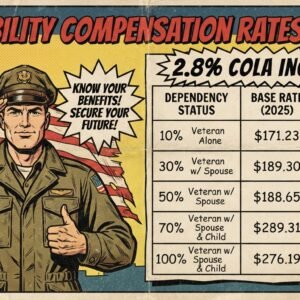
The 2026 COLA is 2.8%, effective December 1, 2025. These rates apply to all veterans nationwide regardless of state of residence.
| Disability Rating | 2026 Monthly Rate (Veteran Alone) |
|---|---|
| 10% | $180.42 |
| 20% | $356.66 |
| 30% | $552.47 |
| 40% | $795.84 |
| 50% | $1,132.90 |
| 60% | $1,435.02 |
| 70% | $1,808.45 |
| 80% | $2,102.15 |
| 90% | $2,362.30 |
| 100% | $3,938.58 |
Veterans May Qualify for Extra Benefits
Check available financial assistance, healthcare programs and other opportunities that may apply to you.
Check EligibilitySource: Federal Register, 91 FR 7386, effective December 1, 2025
2026 VA Pension Rates
VA pension is a needs-based program for wartime veterans with limited income and net worth. The 2026 income limits are:
| Status | Annual Income Limit |
|---|---|
| Veteran with no dependents | $19,836 |
| Veteran with spouse or children | $26,663 |
The net worth limit for pension eligibility in 2026 is $163,699. A single veteran may receive up to $17,441 annually in basic pension. Veterans requiring aid and attendance may qualify for up to $29,093 annually.
2026 VA Health Care Eligibility
VA health care enrollment is divided into 8 priority groups. Priority Groups 1–5 have no copayments for medical care. Priority Groups 6 and 7 have copayments for care and medications.
| Priority Group | Who Qualifies |
|---|---|
| Group 1 | Veterans rated 50% or more service-connected; Medal of Honor recipients |
| Group 2 | Veterans rated 30% or 40% service-connected |
| Group 3 | Former POWs; Purple Heart recipients; veterans rated 10%–20% |
| Group 4 | Veterans receiving VA pension or housebound benefits |
| Group 5 | Veterans with income below VA national income threshold |
| Group 6 | Veterans who served in specific locations/periods |
| Group 7 | Veterans who agree to pay copayments |
| Group 8 | Veterans with income above VA means test threshold |
Source: VA Health Care Benefits Overview 2026
2026 GI Bill Education Benefits
The Post-9/11 GI Bill monthly housing allowance (MHA) is based on the school’s ZIP code and E-5 with dependents BAH rate. For the 2026–2027 academic year:
| School Type | 2026–2027 Monthly Rate |
|---|---|
| Foreign school | $2,522.00 |
| Exclusively online training | $1,261.00 |
| In-person (varies by ZIP) | Up to $3,600+ (e.g., NYC, San Diego) |
Source: VA/Military.com GI Bill rate tables
2026 VA Home Loan Limits
For 2026, the standard VA loan limit in most U.S. counties is $832,750, up from $806,500 in 2025. High-cost counties allow up to $1,249,125. Veterans with full entitlement—first-time buyers or those who paid off previous VA loans—have no loan limit.
Source: FHFA conforming loan limits, effective January 1, 2026
State-by-State Benefits: How Eligibility Changes
Direct Answer: State benefits fall into four main categories: property tax exemptions, income tax treatment, education benefits, and additional programs. Every state offers at least some benefits, but the value varies by thousands of dollars per year.
Category 1: Property Tax Exemptions
Property tax exemptions are the most valuable state benefit for disabled veterans. At least 22 states offer a full property tax exemption for 100% disabled veterans.
States With Full Property Tax Exemption at 100% Disability
| State | Exemption Details | Income Limit |
|---|---|---|
| Texas | Full exemption on residence homestead; no cap on home value | None |
| Florida | Full exemption for P&T veterans; surviving spouse inherits | None |
| Alabama | Full exemption on primary residence | None |
| Arkansas | Full exemption for 100% P&T veterans | None |
| Michigan | Full exemption for 100% disabled veterans | None |
| New Jersey | Full exemption for 100% disabled veterans | None |
| Virginia | Full exemption on primary residence (up to 1 acre) for 100% P&T | None |
| South Carolina | Full exemption on primary residence | None |
Sources: State statutes and veterans benefits guides, verified 2026
States With Partial or Graduated Exemptions
| State | Exemption Type | Details |
|---|---|---|
| California | Assessed value exclusion | Up to $150,000+ (adjusted annually) |
| New York | Tiered exemption | 15% base + 10% combat + disability percentage (up to 75%); new full exemption for P&T effective October 2026 |
| Illinois | Graduated by rating | Full exemption at 70%+ (first $250,000 EAV); partial at 30%+ |
| Arizona | Graduated by rating | Full at 100%; partial reductions at lower ratings |
| Ohio | Fixed-dollar reduction | $50,000+ at 100% |
| Georgia | Dollar exemption | $85,645+ for 100% rating |
Sources: New York State Department of Taxation and Finance; Illinois SHEVD program
Texas: The Most Generous Property Tax Benefit
Texas provides a 100% property tax exemption on the residence homestead of veterans rated 100% disabled by the VA. This applies to all taxing units—county, city, school district, and special districts. There is no cap on the home’s value. Surviving spouses of veterans who died from service-connected conditions (including burn pit exposure) also qualify for a full exemption.
For partially disabled veterans, Texas offers graduated exemptions:
10%–29% disability: $30,000 exemption
30%–49% disability: $40,000 exemption
50%–69% disability: $50,000 exemption
70%+ disability: $60,000+ exemption
Source: Texas Tax Code, as amended by 2025 legislation
Florida: No Income Tax Plus Full Exemption
Florida offers a full property tax exemption on the homestead of veterans rated 100% permanent and total. Florida has no state income tax, so VA disability compensation and military retirement pay face no state taxation. Surviving spouses may transfer the exemption to a new primary residence (up to 120% of the previous exemption amount).
Veterans aged 65 or older with a combat-related disability of 10% or more receive a property tax discount equal to their disability percentage. Those confined to wheelchairs qualify for a separate exemption.
Source: Florida Statutes 196.081, 196.082, 196.091
Category 2: State Income Tax Treatment
Direct Answer: Nine states have no state income tax at all, meaning VA disability and military retirement pay are automatically untaxed. Twenty-eight additional states exempt military retirement pay from state income tax.
States With No Income Tax
Alaska, Florida, Nevada, New Hampshire, South Dakota, Tennessee, Texas, Washington, Wyoming.
Source: TurboTax state tax guide, 2026
States That Exempt Military Retirement Pay (With Income Tax)
These 28 states have a state income tax but do not tax military retirement benefits:
Alabama, Arizona, Arkansas, Connecticut, Hawaii, Illinois, Indiana, Iowa, Kansas, Louisiana, Maine, Massachusetts, Michigan, Minnesota, Mississippi, Missouri, Nebraska, New Jersey, New York, North Carolina, North Dakota, Ohio, Oklahoma, Pennsylvania, Rhode Island, South Carolina, West Virginia, Wisconsin.
Source: TurboTax, verified 2026
States That Partially Tax Military Retirement
Colorado, Delaware, Georgia, Idaho, Kentucky, Maryland, New Mexico, Oregon, Virginia, West Virginia, and the District of Columbia tax military retirement benefits partially.
California note: Beginning in tax year 2025 (filed 2026), California allows a $20,000 exclusion of military retired pay from state income tax.
Category 3: Education Benefits by State
Many states offer tuition waivers, scholarships, or in-state tuition rates for veterans and their dependents. Key examples:
| State | Education Benefit |
|---|---|
| Texas | Hazlewood Act: Free tuition at public colleges for veterans and dependents |
| California | Fee waivers at community colleges; Cal Vet tuition fee waiver |
| Illinois | Illinois Veterans Grant: Tuition waiver at public universities |
| New York | Veterans Tuition Awards; dependents of deceased/disabled veterans |
| Florida | Florida Bright Futures scholarships; tuition waivers for Purple Heart recipients |
These state education benefits stack with federal GI Bill benefits. Veterans should contact their state Department of Veterans Affairs to confirm specific eligibility.
How to Apply for Federal and State Benefits
Direct Answer: Apply for federal benefits through VA.gov using VA Form 21-526EZ (disability) or VA Form 10-10EZ (health care). Apply for state benefits through your county or state veterans affairs office using state-specific forms.
Federal Application Steps
File an Intent to File (VA Form 21-0966) — Preserves your effective date for up to one year.
Gather evidence — Medical records, service treatment records, buddy statements, and nexus letters.
Complete VA Form 21-526EZ — The application for disability compensation. Available online at VA.gov.
Submit your claim — Online, by mail, fax, or in person at a VA Regional Office.
Attend your C&P Exam — If the VA schedules one.
Receive your decision — With your rating, effective date, and monthly rate.
State Application Steps
Contact your state or county veterans affairs office — Every state has a Department of Veterans Affairs or equivalent.
Confirm eligibility requirements — Property tax exemptions often require specific ratings and documentation.
Obtain your VA rating decision letter — This is the key document for most state benefits.
Submit state-specific forms — To your county assessor (property tax) or state veterans affairs office.
Meet state deadlines — Most property tax exemptions must be filed by March 1 or before the tax year begins.
Required Documents
| Document | Purpose |
|---|---|
| DD-214 | Proof of military service and discharge character |
| VA rating decision letter | Proof of disability rating |
| Proof of residency | State benefits require state residency |
| Property deed | For property tax exemptions |
| Marriage/birth certificates | For dependent benefits |
Latest Rule Changes for 2026
Direct Answer: The 2026 COLA is 2.8%. The SGA limit increased to $1,620 monthly. Several states expanded veterans benefits in 2025 legislation, including new exemptions in Texas, New York, and Florida.
Key 2026 Changes
| Change | Details |
|---|---|
| VA COLA | 2.8% effective December 1, 2025 |
| VA pension income limits | $19,836 (single) / $26,663 (with dependents) |
| Net worth limit | $163,699 |
| VA home loan limit | $832,750 standard; $1,249,125 high-cost |
| GI Bill online MHA | $1,261.00/month for 2026–2027 |
| Texas surviving spouse exemption | New 100% exemption for spouses of veterans who died from service-connected conditions (including burn pits) |
| New York P&T exemption | New full exemption for permanently and totally disabled veterans, effective October 1, 2026 |
| California military retirement exclusion | $20,000 state income tax exclusion beginning tax year 2025 |
Sources: Federal Register; state legislation
Common Mistakes Veterans Make With State Benefits
Direct Answer: The most common mistake is assuming state benefits are automatic. Property tax exemptions, income tax exclusions, and education waivers require application and documentation.
Top Mistakes to Avoid
Assuming property tax exemptions are automatic — They require an application through your county assessor with proof of disability.
Missing state filing deadlines — Most property tax exemptions must be filed by March 1 or before the tax year begins.
Not updating your address after moving — State benefits are based on residency; moving to a new state requires reapplication.
Failing to apply for benefits at 50% or 70% disability — Many states offer partial exemptions below 100%. Don’t wait for a 100% rating.
Not coordinating federal and state benefits — State benefits stack with federal benefits. Applying for one does not affect the other.
Overlooking surviving spouse benefits — Many state property tax exemptions transfer to surviving spouses, but require separate application.
Common Questions
1. Do VA disability rates vary by state?
No. The VA pays the same base disability compensation rate regardless of your state of residence. A veteran rated 100% in Texas receives the same $3,938.58 monthly as a veteran rated 100% in California. State benefits add additional value on top of the federal rate.
2. Which state has the best benefits for disabled veterans?
Texas and Florida consistently rank highest. Texas offers a full property tax exemption with no cap on home value, no state income tax, and the Hazlewood Act education benefit. Florida offers a full homestead exemption, no state income tax, and the exemption transfers to surviving spouses.
3. Is VA disability compensation taxable?
No. VA disability compensation is tax-free at the federal level under 38 U.S. Code § 5301. Most states also exempt it from state income tax. Nine states have no income tax at all. Military retirement pay is taxed differently—most states exempt it, but some partially tax it.
4. How do I apply for a state property tax exemption?
Contact your county tax assessor’s office. You will typically need your VA rating decision letter, DD-214, proof of residency, and the property deed. Most states require filing by March 1 or before the tax year begins. Exemptions are not automatic.
5. What is the VA health care priority group system?
VA health care enrollment is divided into 8 priority groups. Priority Groups 1–5 have no copayments. Priority Groups 6 and 7 have copayments. Your priority group is determined by disability rating, income, and other factors. Veterans rated 50% or more are in Priority Group 1.
6. Does the 2026 COLA apply to all VA benefits?
The 2.8% COLA applies to VA disability compensation, VA pension, and Dependency and Indemnity Compensation (DIC). It also applies to SSDI. The COLA became effective December 1, 2025, and first appeared in the December 31, 2025 payment.
7. Can I receive VA benefits in a state I just moved to?
Yes, but you may need to reapply for state-specific benefits. Federal benefits transfer automatically when you move. State benefits like property tax exemptions, education waivers, and income tax exclusions require residency and a new application in your new state.
8. What is the VA pension income limit for 2026?
For 2026, a veteran with no dependents must have annual income below $19,836 to qualify for VA pension. A veteran with a spouse or dependent children must have income below $26,663. The net worth limit is $163,699.
9. Do surviving spouses qualify for state veterans benefits?
Yes, many states extend property tax exemptions to surviving spouses. In Texas, surviving spouses of veterans who died from service-connected conditions receive a 100% property tax exemption. In Florida, the exemption transfers to the surviving spouse. Requirements vary by state.
10. What is the VA home loan limit for 2026?
The standard VA loan limit in most U.S. counties is $832,750 for 2026, up from $806,500 in 2025. High-cost counties allow up to $1,249,125. Veterans with full entitlement—first-time buyers or those who paid off previous VA loans—have no loan limit.
Key Takeaways
Federal VA benefits are identical in all 50 states. Your disability rate does not change based on where you live.
The 2026 COLA is 2.8%. A 100% disabled veteran receives $3,938.58 monthly, tax-free.
Texas and Florida offer the most generous state benefits, including full property tax exemptions and no state income tax.
Property tax exemptions are not automatic. You must apply through your county assessor with your VA rating decision and DD-214.
Nine states have no income tax, automatically exempting VA disability and military retirement pay.
At least 22 states offer full property tax exemptions at 100% disability. Many more offer partial exemptions at 50%–70%.
VA health care priority groups determine copayments. Groups 1–5 have no copayments; Groups 6–7 do.
**The 2026 VA home loan limit is $832,750** for most counties, up to $1,249,125 in high-cost areas.
Surviving spouses often qualify for transferred state benefits, but must apply separately.
State benefits stack with federal benefits. Applying for one does not reduce the other.
Official Resources
VA Disability Compensation: VA.gov/disability
VA Disability Compensation Rates: VA.gov/disability/compensation-rates
VA Pension: VA.gov/pension
VA Health Care Enrollment: VA.gov/health-care
Post-9/11 GI Bill Rates: VA.gov/education/benefit-rates
VA Home Loans: VA.gov/housing-assistance
VA Form 21-526EZ: VA.gov/forms/21-526ez
VA Form 10-10EZ: VA.gov/forms/10-10ez
Texas Veterans Commission: tvc.texas.gov
Florida Department of Veterans Affairs: floridavets.org
New York State Division of Veterans’ Services: veterans.ny.gov



🇺🇸 IMPORTANT DISCLAIMER – Veterans Benefits Information
This site provides general information about U.S. Department of Veterans Affairs (VA) benefits for educational and informational purposes only.
- Not Official: We are NOT affiliated with, endorsed by, or connected to the U.S. Department of Veterans Affairs (VA), the Veterans Benefits Administration (VBA), the Veterans Health Administration (VHA), or any other government agency.
- No Legal/Financial Advice: The content on this website is for informational purposes only and does not constitute legal, financial, or medical advice. VA benefits rules change frequently – always consult with an accredited Veterans Service Officer (VSO) or a qualified professional for your specific situation.
- Official Sources: For official, binding information and to apply for benefits, always visit official .gov websites: VA.gov, Benefits.VA.gov, or SSA.gov.
- No Data Collection: This site does not collect, store, or process any personal information. It does not have login forms, contact forms, or any system to capture user data. We never ask for your Social Security Number, bank details, or any personal information.
- 🚨 Scam Alert: The VA and other government agencies never charge fees for benefit applications. If anyone asks for money to "process" your VA claim, it is a scam. Report it to the VA Office of Inspector General at VA.gov/OIG.
- Advertising: This site uses third-party advertising (Adsterra) to cover operational costs. We do not endorse or guarantee any products or services advertised.
📌 Information provided as of June 2026. Always verify current eligibility and rules with official .gov sources.
This site is not affiliated with the U.S. Department of Veterans Affairs or any government agency. All information is for educational purposes only. Please visit VA.gov for official information.
