
SSDI for Veterans in 2026: What You Need to Know
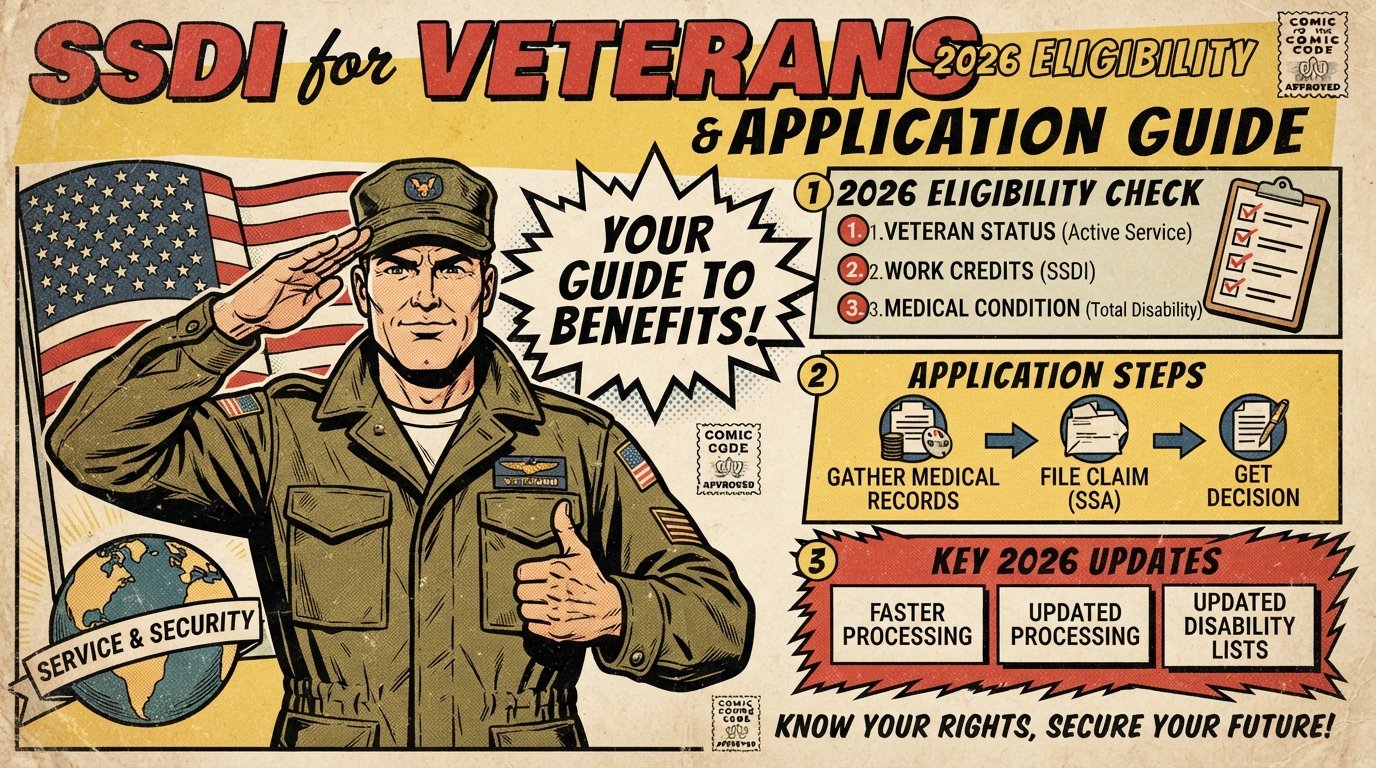
Social Security Disability Insurance (SSDI) is a federal program for workers who cannot work due to a disability. Veterans can receive SSDI and VA disability compensation at the same time with no offset between them. SSDI eligibility depends on work credits and the ability to work, not on military service connection. The 2026 SGA limit is $1,690 monthly for non-blind applicants.
Quick Facts
| Item | Details |
|---|---|
| Benefit | Social Security Disability Insurance (SSDI) |
| Eligibility | Enough work credits; disability preventing substantial work for 12+ months |
| Application | SSA.gov online, by phone (1-800-772-1213), or at a local SSA office |
| Processing Time | 3–5 months initial; appeals 12–24 months |
| Official Agency | Social Security Administration (SSA) |
| Required Forms | SSA-16 (disability application), medical records, work history |
| Updated For | 2026 (SGA $1,690/month; work credit $1,890) |
What Is SSDI?
SSDI is a monthly cash benefit paid by the Social Security Administration to people who cannot work because of a disability that has lasted or is expected to last at least 12 months or result in death. Unlike VA disability compensation, SSDI does not require the disability to be connected to military service.

SSDI vs. VA Disability: Key Differences
| Feature | SSDI | VA Disability Compensation |
|---|---|---|
| Administered by | Social Security Administration | Department of Veterans Affairs |
| Service connection required? | No | Yes |
| Work credits required? | Yes | No |
| Disability standard | All-or-nothing (can’t work at SGA level) | Graduated 0–100% rating |
| Work limits | Yes — cannot exceed SGA | No work limit (except TDIU) |
| Tax status | Taxable (depends on income) | Tax-free |
| Counted as income for SSI? | Yes | Yes |
| Counted as income for SSDI? | No | No |
| 2026 max monthly | ~$4,018 (varies by earnings) | $3,938.58 (100%, no dependents) |
| Family benefits | Auxiliary benefits to spouse + children | Dependent additions for spouse + children |
Source: VA.gov, SSA.gov, Warriors Fund
The Core Rule: SSDI and VA Disability Don’t Offset Each Other

SSDI payments are not reduced because you receive VA disability compensation, and VA disability compensation is not reduced because you receive SSDI. These are separate programs run by separate agencies with separate rules. The VA does not count SSDI as income for VA disability purposes, and SSA does not count VA disability compensation as earned income for SSDI purposes.
Who Qualifies for SSDI?
You must meet both medical and non-medical requirements. The non-medical requirement is that you must have enough work credits and be “insured” for SSDI. The medical requirement is that you must have a condition that prevents you from engaging in substantial gainful activity (SGA) for at least 12 months or is expected to result in death.
Work Credits: The Non-Medical Requirement
To qualify for SSDI, you generally need 40 work credits, 20 of which must have been earned in the last 10 years. Workers earn up to four credits per year. In 2026, you earn one work credit for every $1,890 in covered earnings, and you hit the four-credit maximum at $7,560 in annual earnings.
Special rules for veterans:
Military service wages count toward Social Security work credits.
You may have earned special extra earnings on your record for active duty service.
Younger workers may qualify with fewer credits based on their age at disability onset.
Veterans May Qualify for Extra Benefits
Check available financial assistance, healthcare programs and other opportunities that may apply to you.
Check EligibilityCheck your work credits at my Social Security (ssa.gov/myaccount) or by calling SSA at 1-800-772-1213.
The 2026 SGA Limit: What Counts as “Substantial Work”
SSA uses the substantial gainful activity (SGA) threshold to determine whether you are working at a level that disqualifies you from SSDI. In 2026, the monthly SGA limit is $1,690 gross for non-blind applicants and $2,830 for statutorily blind applicants.
| Category | 2026 Monthly SGA Limit |
|---|---|
| Non-blind applicants | $1,690 |
| Statutorily blind applicants | $2,830 |
Important: VA disability compensation is NOT counted as earned income for SGA purposes. You can receive any amount of VA disability compensation and still qualify for SSDI as long as you are not working above SGA.
What Is the Date Last Insured (DLI)?
Your DLI is the date your SSDI coverage ends. SSA must find that your disability started on or before your DLI. Typically, you remain insured for five years after you stop working. If your DLI has passed, you may not qualify for SSDI even if you are disabled now.
If You Don’t Have Enough Work Credits
If you lack sufficient work credits for SSDI and have limited income and assets, you may qualify for Supplemental Security Income (SSI). However, VA disability compensation counts as income for SSI and will reduce your SSI payment or make you ineligible. The 2026 individual SSI income limit is $994 per month.
Decision Path: SSDI or SSI?
| Question | Answer | What to Do |
|---|---|---|
| Do you have 40 work credits (20 in last 10 years)? | Yes | Apply for SSDI |
| Do you have 40 work credits (20 in last 10 years)? | No | Consider SSI if income/assets are limited |
| Are you working above SGA ($1,690/month)? | Yes | You likely do not qualify for SSDI |
| Are you working above SGA ($1,690/month)? | No | You may qualify for SSDI |
SSDI for Veterans: The Expedited Processing Advantage
Veterans with a 100% Permanent and Total (P&T) VA rating can receive expedited processing of their SSDI claims. Since March 2014, SSA has had a dedicated initiative for 100% P&T veterans. To receive expedited processing, identify yourself as a “Veteran rated 100% P&T” when initiating your SSDI application and provide your VA rating notification letter to SSA.
Wounded Warriors Expedited Processing
Veterans who received disabling mental or physical health injuries while on active duty on or after October 1, 2001 are eligible for expedited SSI/SSDI application processing. The injury does not need to have occurred during combat operations. When applying, inform SSA that your injury occurred while on active duty.
The PACT Act and SSDI
The PACT Act expanded VA health care and disability benefits for veterans exposed to toxic substances. While the PACT Act does not directly change SSDI rules, it can strengthen your SSDI claim by providing additional medical evidence and documentation of service-connected conditions. A 100% P&T rating from the VA (which the PACT Act may help you achieve) triggers expedited SSDI processing.
How to Apply for SSDI
You can apply online at SSA.gov, by calling 1-800-772-1213, or at your local SSA office. The online application takes about 30–60 minutes to complete.
Step-by-Step Application Process
Check your work credits at ssa.gov/myaccount to confirm you are insured for SSDI.
Gather your medical evidence — treatment records, test results, doctor’s notes, and VA medical records.
Gather your work history — employer names, dates, and job duties for the last 5 years.
File your application — online at SSA.gov is fastest. Identify yourself as a veteran, and if applicable, as “100% P&T” or “Wounded Warrior” for expedited processing.
Complete the Adult Disability Report (Form SSA-3368) and the Work History Report (SSA-3369).
Attend any consultative exams SSA schedules — missing them can delay or derail your claim.
Track your claim through your my Social Security account.
Documents You Need
Social Security number
Proof of age (birth certificate)
DD214 or military discharge papers
W-2 forms or self-employment tax returns for the last year
Medical records and treatment history
Names and contact information for doctors, hospitals, and clinics
List of medications and dosages
VA rating decision letter (if applicable)
Common Mistakes in SSDI Applications
Not identifying as a veteran — you lose access to expedited processing.
Incomplete work history — SSA needs 5 years of employer details.
Missing medical records from VA providers — VA treatment records are strong evidence.
Not attending consultative exams — SSA may deny your claim.
Assuming a VA rating guarantees SSDI approval — it does not. SSA makes its own decision.
The SSDI Appeals Process
If your initial SSDI application is denied, you have four levels of appeal:
| Appeal Level | What It Is | Timeline |
|---|---|---|
| Reconsideration | A new review by someone who wasn’t involved in the first decision | 2–4 months |
| Administrative Law Judge (ALJ) Hearing | A hearing before an ALJ | 12–18 months |
| Appeals Council | Reviews the ALJ’s decision | 6–12 months |
| Federal Court | Lawsuit in federal district court | 12–24 months |
Most veterans who are denied eventually win at the ALJ hearing level. Having a representative — an attorney or a disability advocate — significantly increases your chances of success.
SSDI Waiting Period
There is a five-month waiting period before SSDI benefits begin. The first payment is generally for the sixth full month after SSA determines your disability began. However, if you have a terminal illness or qualify for Compassionate Allowances, SSA may expedite payments.
How SSDI Works With Other Veteran Benefits
SSDI and VA Disability Compensation
They stack with no offset. You can receive full SSDI and full VA disability compensation at the same time. Neither benefit reduces the other. VA disability compensation is not counted as earned income for SSDI, and SSDI is not counted as income for VA disability compensation.
SSDI and VA Pension
They are different programs with different rules. VA pension is a needs-based benefit for wartime veterans with limited income. SSDI counts as income for VA pension purposes and will reduce your VA pension payment. If your SSDI income exceeds the VA pension income limit, you may lose VA pension eligibility.
SSDI and TDIU
TDIU (Total Disability based on Individual Unemployability) is a VA benefit that pays veterans at the 100% rate if they cannot work due to service-connected disabilities. You can receive SSDI and TDIU at the same time. The evidentiary overlap between SSDI and TDIU means proof used for one can support the other, including through secondary service connection and VA appeals lanes.
SSDI and Military Retirement
Military retirement pay and SSDI do not offset each other. You can receive both in full. SSDI converts to Social Security retirement benefits at full retirement age, so the amount continues.
SSDI and Medicare
After 24 months of receiving SSDI, you become eligible for Medicare regardless of your age. This can supplement VA health care or provide coverage for care VA does not cover. You can enroll in Medicare Parts A and B while keeping VA health care.
Comparison: Which Benefits Stack and Which Offset
| Benefit Combination | Offset? | Notes |
|---|---|---|
| SSDI + VA disability compensation | No offset | Both paid in full |
| SSDI + TDIU | No offset | Evidentiary overlap is common |
| SSDI + Military retirement | No offset | Both paid in full |
| SSDI + VA pension | Offset | SSDI counts as income for VA pension |
| SSDI + SSI | Offset | SSDI counts as income for SSI |
| SSDI + Medicare | N/A | Eligible after 24 months on SSDI |
SSDI Payment Dates and Amounts
SSDI payments are made on a specific day each month based on your birth date:
| Birth Date | Payment Date |
|---|---|
| 1st–10th | Second Wednesday of the month |
| 11th–20th | Third Wednesday of the month |
| 21st–31st | Fourth Wednesday of the month |
2026 SSDI Average and Maximum Amounts
The maximum SSDI benefit in 2026 is approximately $4,018 per month for someone who earned the maximum taxable amount for decades. The average SSDI benefit is much lower — around $1,580 per month. Your actual amount depends on your lifetime earnings history.
Family Benefits
SSDI provides auxiliary benefits to your spouse and minor children. Each dependent may receive up to 50% of your SSDI benefit, subject to a family maximum. A spouse caring for a child under 16, or a spouse aged 62 or older, may qualify. Children under 18 (or up to 19 if in high school) generally qualify.
Compassionate Allowances: Fast-Track for Severe Conditions
The Compassionate Allowances (CAL) program identifies claims involving the most serious medical conditions and flags them for expedited review. As of August 2026, the CAL list includes 314 medical conditions, with 14 conditions added in 2026.
Conditions Relevant to Veterans
ALS (Amyotrophic Lateral Sclerosis) — also presumptively connected to military service by VA
Certain aggressive cancers — including acute leukemia and certain lymphomas
Early-onset Alzheimer’s disease
End-stage renal disease
Severe PTSD with psychotic features — may qualify in some cases
How to Request Compassionate Allowances Consideration
When you apply for SSDI, clearly state your specific diagnosis and reference the matching condition on SSA’s CAL list. Provide complete medical records, including VA treatment records, diagnostic test results, and specialist evaluations. Recent medical records are especially important for confirming a CAL diagnosis quickly.
Common Questions
1. Can I receive SSDI and VA disability at the same time?
Yes. SSDI and VA disability compensation are separate programs with no offset between them. VA disability does not reduce your SSDI payment, and SSDI does not reduce your VA compensation. You must qualify for each program separately based on its own rules.
2. Does VA disability affect SSDI eligibility?
No. VA disability compensation is not counted as earned income for SSDI purposes. SSA only looks at whether you are working above the SGA threshold ($1,690/month in 2026). Receiving VA disability does not affect your SSDI eligibility.
3. What is the SGA limit for 2026?
The substantial gainful activity (SGA) limit is $1,690 per month for non-blind applicants and $2,830 per month for statutorily blind applicants. If you earn more than this from work, you generally will not qualify for SSDI.
4. How many work credits do I need for SSDI?
Generally, you need 40 work credits, with 20 earned in the last 10 years. Younger workers may qualify with fewer credits. In 2026, you earn one credit for every $1,890 in covered earnings, up to four credits per year.
5. Does a 100% VA rating automatically qualify me for SSDI?
No. SSDI has its own definition of disability based on your ability to work, not your VA rating. However, if you have a 100% Permanent and Total (P&T) VA rating, SSA will expedite the processing of your SSDI claim.
6. How long does SSDI take?
Initial SSDI decisions typically take 3–5 months. If you appeal, an ALJ hearing can add 12–18 months, and further appeals can extend the process to 2–3 years. Veterans with 100% P&T ratings or Wounded Warrior status receive expedited processing.
7. What is the Date Last Insured?
Your Date Last Insured (DLI) is the date your SSDI coverage ends. You generally remain insured for five years after you stop working. SSA must find that your disability began on or before your DLI for you to qualify for SSDI.
8. Can I work while receiving SSDI?
You can work while receiving SSDI, but there are limits. During the Trial Work Period (TWP), you can earn any amount for nine months without losing benefits. After the TWP, you must stay below the SGA limit ($1,690/month in 2026) to continue receiving SSDI.
9. What is the five-month waiting period?
SSDI has a five-month waiting period from the date SSA determines your disability began. Your first SSDI payment is for the sixth full month of disability. This waiting period does not apply to SSI benefits.
10. Does SSDI qualify me for Medicare?
Yes. After 24 months of receiving SSDI, you become eligible for Medicare regardless of your age. You can have both Medicare and VA health care. Medicare may cover services VA does not, and VA may cover services Medicare does not.
11. What is the difference between SSDI and SSI?
SSDI is based on your work history and Social Security tax contributions. SSI is a needs-based program for people with limited income and assets. SSDI has no income limit (other than SGA from work); SSI has strict income limits ($994/month in 2026 for individuals). VA disability counts as income for SSI but not for SSDI.
12. What happens to SSDI at retirement age?
SSDI automatically converts to Social Security retirement benefits at your full retirement age (66–67, depending on your birth year). The amount stays the same. You do not need to reapply.
13. Can I get SSDI for PTSD?
Yes. PTSD and other mental health conditions can qualify for SSDI if they prevent you from working at a substantial level for at least 12 months. SSA evaluates mental health conditions under its own listing criteria. VA treatment records and a strong medical history are important evidence.
14. What is the maximum SSDI benefit in 2026?
The maximum SSDI benefit in 2026 is approximately $4,018 per month for someone who earned the maximum taxable amount for decades. The average benefit is around $1,580 per month. Your actual amount depends on your lifetime earnings.
15. Do I need a lawyer for SSDI?
You do not need a lawyer to file an initial SSDI application. However, if you are denied and appeal to an ALJ hearing, having a representative — an attorney or disability advocate — significantly increases your chances of success. Most representatives work on contingency and are paid only if you win.
Key Takeaways
SSDI and VA disability stack with no offset. You can receive both in full. Neither benefit reduces the other.
2026 SGA limit: $1,690/month for non-blind applicants; $2,830/month for statutorily blind applicants.
Work credits: Generally 40 credits, with 20 in the last 10 years. Earn one credit per $1,890 in 2026.
Expedited processing: Veterans with 100% P&T VA ratings and Wounded Warriors (injured on active duty after 9/11/01) receive faster SSDI decisions.
SSDI is all-or-nothing: You either qualify (can’t work at SGA level) or you don’t. VA disability uses a graduated 0–100% rating.
VA disability is not counted as income for SSDI. You can receive any amount of VA compensation and still qualify for SSDI.
SSDI counts as income for SSI and VA pension. These needs-based programs are reduced by SSDI payments.
Medicare after 24 months: SSDI recipients become eligible for Medicare after 24 months, regardless of age.
Compassionate Allowances: 314 conditions qualify for expedited SSDI review, including ALS, certain cancers, and early-onset Alzheimer’s.
Appeals: Four levels — Reconsideration, ALJ Hearing, Appeals Council, Federal Court. Most veterans who appeal eventually win at the ALJ level.
Official Resources
SSA.gov — Social Security Administration; apply for SSDI, check work credits, and manage benefits
SSA.gov/people/veterans — SSA’s dedicated veterans page
SSA.gov/myaccount — Check your Social Security statement and work credits
SSA Publication EN-64-125 — “Social Security Disability and Veterans Affairs Disability — How Do They Compare?”
VA.gov — Department of Veterans Affairs benefits information
VA.gov/disability — VA disability compensation information
SSA.gov/benefits/disability — SSDI application and eligibility
SSA.gov/benefits/disability/apply-child — SSDI for children
Medicare.gov — Medicare information for SSDI recipients
Medicaid.gov — Medicaid information
USA.gov — Government benefits finder
IRS.gov — Tax information for Social Security and VA benefits



🇺🇸 IMPORTANT DISCLAIMER – Veterans Benefits Information
This site provides general information about U.S. Department of Veterans Affairs (VA) benefits for educational and informational purposes only.
- Not Official: We are NOT affiliated with, endorsed by, or connected to the U.S. Department of Veterans Affairs (VA), the Veterans Benefits Administration (VBA), the Veterans Health Administration (VHA), or any other government agency.
- No Legal/Financial Advice: The content on this website is for informational purposes only and does not constitute legal, financial, or medical advice. VA benefits rules change frequently – always consult with an accredited Veterans Service Officer (VSO) or a qualified professional for your specific situation.
- Official Sources: For official, binding information and to apply for benefits, always visit official .gov websites: VA.gov, Benefits.VA.gov, or SSA.gov.
- No Data Collection: This site does not collect, store, or process any personal information. It does not have login forms, contact forms, or any system to capture user data. We never ask for your Social Security Number, bank details, or any personal information.
- 🚨 Scam Alert: The VA and other government agencies never charge fees for benefit applications. If anyone asks for money to "process" your VA claim, it is a scam. Report it to the VA Office of Inspector General at VA.gov/OIG.
- Advertising: This site uses third-party advertising (Adsterra) to cover operational costs. We do not endorse or guarantee any products or services advertised.
📌 Information provided as of June 2026. Always verify current eligibility and rules with official .gov sources.
This site is not affiliated with the U.S. Department of Veterans Affairs or any government agency. All information is for educational purposes only. Please visit VA.gov for official information.
