
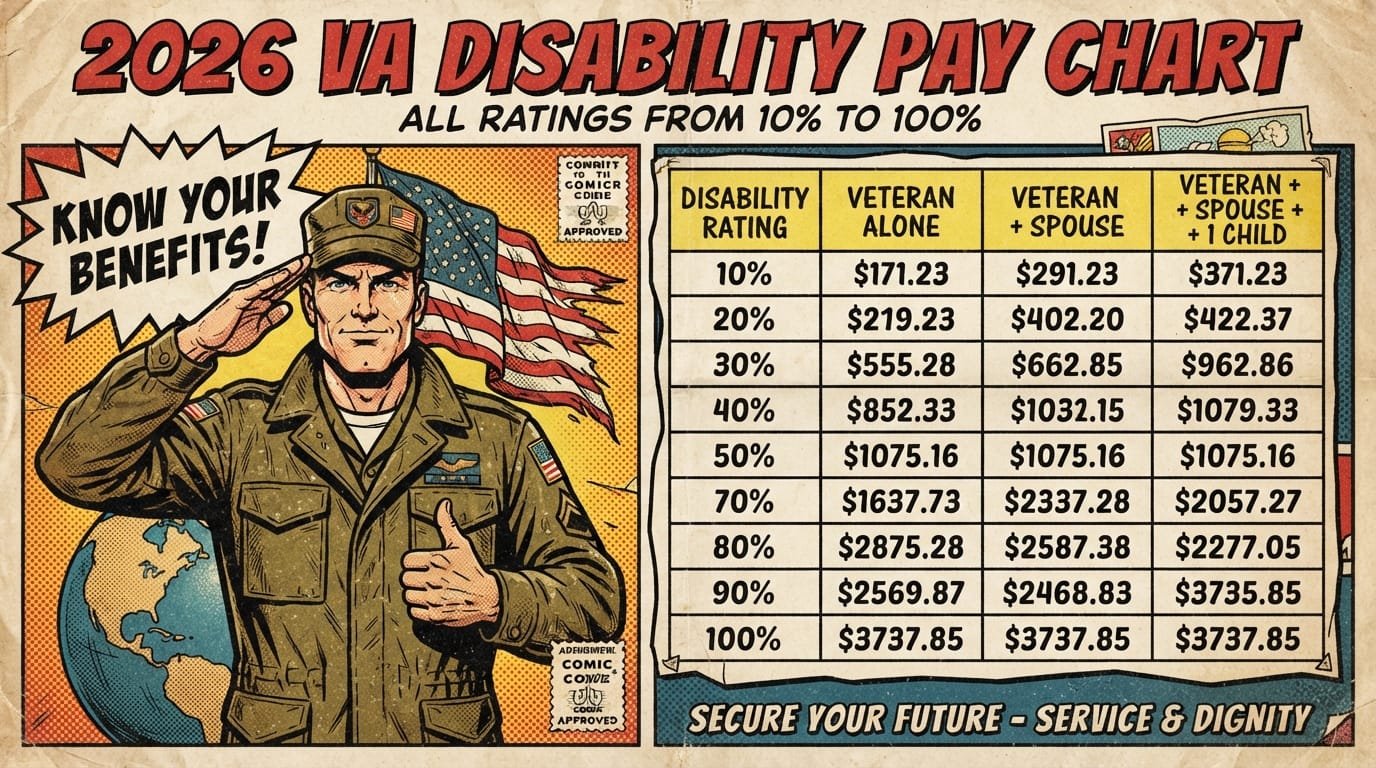
VA Disability Pay Chart 2026: What You Need to Know
VA disability compensation in 2026 ranges from $180.42 monthly at a 10% rating to $3,938.58 at 100% for a Veteran alone. The 2.8% COLA increased all rates effective December 1, 2025. VA disability compensation is tax-free at both the federal and state levels in all 50 states, though state property tax exemptions vary significantly.
Quick Facts
| Item | Details |
|---|---|
| Benefit | VA disability compensation (tax-free monthly payment) |
| Eligibility | Service-connected disability with honorable discharge |
| Application | VA Form 21-526EZ online at VA.gov |
| Processing Time | 78.6–80.7 days average (2026) |
| Official Agency | U.S. Department of Veterans Affairs (VA) |
| Required Forms | VA Form 21-526EZ, DD214, medical records |
| Updated For | 2026 (2.8% COLA effective December 1, 2025) |
2026 VA Disability Rates Without Dependents
VA disability compensation is a tax-free monthly payment for Veterans with service-connected disabilities. The table below shows the 2026 monthly rates for a Veteran alone with no dependents, based on the official VA compensation rate tables effective December 1, 2025.

Official 2026 VA Disability Compensation Rates
| Disability Rating | Monthly Rate (Veteran Alone) |
|---|---|
| 10% | $180.42 |
| 20% | $356.66 |
| 30% | $552.47 |
| 40% | $795.84 |
| 50% | $1,132.90 |
| 60% | $1,435.02 |
| 70% | $1,808.45 |
| 80% | $2,102.15 |
| 90% | $2,362.30 |
| 100% | $3,938.58 |
Source: VA.gov official compensation rate tables, 91 FR 7386

Veterans rated 10% or 20% do not receive higher rates even if they have dependents. Dependent additions begin at the 30% rating level.
2026 VA Disability Rates With Dependents
Veterans rated 30% or higher may receive additional compensation for a dependent spouse, children, and parents. The table below shows combined monthly rates for common dependent situations in 2026.
2026 VA Disability Rates With Spouse Only
| Disability Rating | Veteran Alone | With Spouse |
|---|---|---|
| 30% | $552.47 | $617.47 |
| 40% | $795.84 | $882.84 |
| 50% | $1,132.90 | $1,241.90 |
| 60% | $1,435.02 | $1,566.02 |
| 70% | $1,808.45 | $1,961.45 |
| 80% | $2,102.15 | $2,277.15 |
| 90% | $2,362.30 | $2,559.30 |
| 100% | $3,938.58 | $4,158.17 |
Source: claim.vet, 2026 VA Disability Pay Rates
2026 VA Disability Rates With Spouse and One Child
| Disability Rating | With Spouse + 1 Child |
|---|---|
| 30% | $666.47 |
| 40% | $947.84 |
| 50% | $1,322.90 |
| 60% | $1,663.02 |
| 70% | $2,074.45 |
| 80% | $2,406.15 |
| 90% | $2,704.30 |
| 100% | $4,318.99 |
Source: claim.vet, 2026 VA Disability Pay Rates
2026 VA Disability Rates With Spouse and Two Children
| Disability Rating | With Spouse + 2 Children |
|---|---|
| 30% | $698.47 |
| 40% | $990.84 |
| 50% | $1,376.90 |
| 60% | $1,728.02 |
| 70% | $2,150.45 |
| 80% | $2,493.15 |
| 90% | $2,802.30 |
| 100% | $4,428.10 |
Veterans May Qualify for Extra Benefits
Check available financial assistance, healthcare programs and other opportunities that may apply to you.
Check EligibilitySource: claim.vet, 2026 VA Disability Pay Rates
Added Amounts for Additional Dependents
| Dependent Type | Monthly Addition |
|---|---|
| Each additional child under 18 | $109.11 |
| Each additional child over 18 in school | $352.17 |
| Spouse receiving Aid and Attendance | $181.24–$201.40 |
Source: VA Disability Hub, 100% VA Disability Rating
2026 VA Disability Rates With Parents
Veterans rated 30% or higher with dependent parents may receive additional compensation. The table below shows combined rates for common parent-dependent situations.
2026 VA Disability Rates With One or Two Parents
| Disability Rating | Veteran + 1 Parent | Veteran + 2 Parents | Spouse + 1 Parent | Spouse + 2 Parents |
|---|---|---|---|---|
| 30% | $605.15 | $657.84 | $669.47 | $723.16 |
| 40% | $865.38 | $934.93 | $952.84 | $1,022.38 |
| 50% | $1,220.35 | $1,307.81 | $1,329.94 | $1,417.40 |
| 60% | $1,540.38 | $1,645.75 | $1,672.10 | $1,777.47 |
| 70% | $1,931.73 | $2,055.01 | $2,084.51 | $2,207.80 |
| 80% | $2,242.28 | $2,382.43 | $2,417.20 | $2,557.34 |
| 90% | $2,520.36 | $2,678.41 | $2,717.40 | $2,875.45 |
| 100% | $4,114.81 | $4,291.06 | $4,334.41 | $4,510.65 |
Source: 2026 VA Disability Rates & Pay Charts, home.army.mil
2026 TDIU Rates
TDIU (Total Disability based on Individual Unemployability) pays Veterans at the 100% rate even if their combined rating is less than 100%. You may qualify if you have one condition rated at 60% or higher, or multiple conditions totaling 70% or higher with at least one at 40% or higher, and you cannot maintain substantially gainful employment.
TDIU Monthly Rate (Veteran Only)
| Benefit | 2026 Monthly Rate |
|---|---|
| TDIU (Veteran Alone) | $3,938.58 |
| TDIU with dependents | Same as 100% dependent rates |
Source: claim.vet, 2026 VA Disability Pay Rates
2026 VA Special Monthly Compensation (SMC) Rates
Special Monthly Compensation (SMC) is additional tax-free compensation for Veterans with severe disabilities. SMC rates range from SMC-K ($139.87 monthly) for loss of use of a creative organ to SMC-R2 ($9,826.88+ monthly) for Veterans requiring the highest level of care.
2026 SMC Rates for Veterans Without Children
| SMC Level | Monthly Rate (Veteran Alone) |
|---|---|
| SMC-K | $139.87 |
| SMC-L | $4,900.83 |
| SMC-L½ | $5,154.00 |
| SMC-M | $5,408.55 |
| SMC-M½ | $5,780.00 |
| SMC-N | $6,152.64 |
| SMC-N½ | $6,514.00 |
| SMC-O | $6,877.12 |
| SMC-S (Housebound) | $4,408.53 |
| SMC-R1 | $9,826.88 |
| SMC-R2 | $11,271.67 |
Source: VA.gov official SMC rate tables, effective December 1, 2025
SMC-K and SMC-Q Rates
SMC-K and SMC-Q are special rate variations that may be added to your basic SMC rate. The 2026 SMC-K rate is $139.87 monthly. This covers loss or loss of use of a creative organ, a thumb, or similar disabilities.
SMC Rates With Spouse
| SMC Level | With Spouse (No Parents or Children) |
|---|---|
| SMC-L | $5,120.42 |
| SMC-L½ | $5,373.59 |
| SMC-M | $5,628.14 |
| SMC-M½ | $5,999.59 |
| SMC-N | $6,372.23 |
| SMC-S | $4,628.12 |
Source: VA.gov official SMC rate tables, effective December 1, 2025
2026 COLA Increase: What Changed
The 2026 COLA increase is 2.8%, effective December 1, 2025. The first payment with the increased rate was issued December 31, 2025. This matches the Social Security cost-of-living adjustment for 2026.
2025 vs. 2026 VA Disability Rate Comparison
| Disability Rating | 2025 Monthly Rate | 2026 Monthly Rate | Monthly Increase |
|---|---|---|---|
| 10% | $175.51 | $180.42 | $4.91 |
| 20% | $346.95 | $356.66 | $9.71 |
| 30% | $537.42 | $552.47 | $15.05 |
| 40% | $774.16 | $795.84 | $21.68 |
| 50% | $1,102.04 | $1,132.90 | $30.86 |
| 60% | $1,395.93 | $1,435.02 | $39.09 |
| 70% | $1,759.19 | $1,808.45 | $49.26 |
| 80% | $2,044.89 | $2,102.15 | $57.26 |
| 90% | $2,297.96 | $2,362.30 | $64.34 |
| 100% | $3,831.30 | $3,938.58 | $107.28 |
Source: CCK Law, 2026 VA Disability Pay Rates and Cost-of-Living Adjustment
VA Disability Pay by State: Tax Treatment
VA disability compensation is completely tax-free at the federal level under 38 U.S.C. § 5301 and is also generally exempt from state income tax in all 50 states. The key differences between states are property tax exemptions and military retirement pay treatment.
State Income Tax Treatment of VA Disability Compensation
VA disability compensation is not subject to state income tax in any state. This is largely automatic because most states follow federal adjusted gross income calculations, and VA disability compensation is excluded from federal gross income.
| Tax Treatment | States |
|---|---|
| No state income tax | Alaska, Florida, Nevada, New Hampshire (no wage tax), South Dakota, Tennessee, Texas, Washington, Wyoming |
| Exempt VA disability compensation | All 50 states |
State Property Tax Exemptions for Disabled Veterans
Property tax exemptions are state-level benefits, not VA benefits. The VA does not issue the exemption — your local assessor’s office does, based on VA documentation.
Full Property Tax Exemption States (100% P&T)
| State | Exemption Details |
|---|---|
| Texas | Full exemption for 100% P&T, no cap on home value |
| Florida | Full exemption for 100% P&T |
| Alabama | Full exemption on homestead property |
| Arkansas | Full exemption for 100% P&T |
| South Carolina | Full exemption for 100% P&T |
| Virginia | Full exemption for 100% P&T or TDIU, no income test |
| Pennsylvania | Full exemption for 100% P&T (financial need required) |
| New York | Full exemption for 100% P&T |
Source: veteranshelpgroup.com, VA Disability Property Tax Exemptions by State 2026
Partial Property Tax Exemption States
| State | Typical Rating Required | Exemption Type |
|---|---|---|
| California | 100% or TDIU | Tiered (basic exemption: $180,671) |
| Illinois | 70%+ | Full or partial depending on rating |
| Minnesota | 70%+ | Partial (larger exclusion at 100%) |
| Arizona | 100% P&T | Partial (capped amount) |
| Alaska | 50%+ | Partial (value reduction) |
Source: veteranshelpgroup.com, VA Disability Property Tax Exemptions by State 2026
Notable 2026 State Changes for Veterans
| State | Change |
|---|---|
| Georgia | Military retirement exclusion increased to $65,000, available at any age |
| California | New $20,000 military retirement exclusion (income limits apply) |
| New York | New 100% property tax exemption for permanently and totally disabled Veterans |
| South Carolina | Full military retirement exemption effective 2025 |
| New Hampshire | Joined no-income-tax states in 2025 |
Source: Military Transition Toolkit, 2026 State Tax Changes
States That Do Not Tax Military Retirement Pay
As of 2026, 38 of 50 states take zero state income tax on military retirement pay — 9 have no state income tax at all, and 29 more have an income tax but fully exempt military retired pay.
| Category | States |
|---|---|
| No state income tax | Alaska, Florida, Nevada, New Hampshire, South Dakota, Tennessee, Texas, Washington, Wyoming |
| Full exemption with income tax | Alabama, Arizona, Arkansas, Connecticut, Hawaii, Illinois, Indiana, Iowa, Kansas, Kentucky, Louisiana, Maine, Michigan, Nebraska, New Jersey, New York, North Carolina, North Dakota, and others |
| Partial exemption | California ($20,000), Colorado ($15,000–$24,000), Delaware ($12,500), Georgia ($65,000), and others |
Source: vetcalc.org, States That Don’t Tax Military Retirement Pay 2026
VA Disability Payment Dates in 2026
VA disability compensation is paid on the first business day of each month. If the first falls on a weekend or federal holiday, payment is issued the preceding business day.
2026 VA Disability Payment Schedule
| Month | Payment Date |
|---|---|
| January | January 2 (January 1 is a holiday) |
| February | February 2 |
| March | March 2 |
| April | April 1 |
| May | May 1 |
| June | June 1 |
| July | July 1 |
| August | August 3 (August 1 is a Saturday) |
| September | September 1 |
| October | October 1 |
| November | November 2 (November 1 is a Sunday) |
| December | December 1 |
VA pays benefits beginning the first day of the month following the effective date. For example, if your effective date is January 15, VA will begin paying benefits as of February 1.
How to Apply for VA Disability Compensation
File an Intent to File on VA.gov to lock in your effective date for potential back pay.
Gather evidence — service records, medical records, DD214, and buddy statements.
File VA Form 21-526EZ online at VA.gov, by mail, fax, in person, or with a Veterans Service Organization (VSO).
Attend your C&P exam — missing it is the fastest way to a denial.
Track your claim through VA.gov or the VA mobile app.
VA is streamlining VA Form 21-526EZ from 15 pages to 5 pages, projected to be available December 2026. Completion time drops from 25 minutes to approximately 15 minutes.
Documents You Need
DD214 or military discharge papers
Service treatment records
Medical records and treatment history
Nexus letter connecting your condition to service
Buddy statements from fellow service members
VA rating decision letter (if applicable)
Common Mistakes in VA Disability Claims
Not filing an Intent to File — you lose potential back pay to the date of your informal claim.
Only claiming obvious injuries — claim all service-connected conditions, including secondary conditions.
Missing the C&P exam — VA may deny the claim.
No nexus letter — a medical opinion connecting your condition to service strengthens the claim.
Not appealing a denial — three review options are available.
VA Decision Review Process
If you disagree with a VA decision, you have three options:
| Review Option | What It Is | New Evidence? | Required Form |
|---|---|---|---|
| Supplemental Claim | A reviewer determines whether new evidence changes the decision | Yes | VA Form 20-0995 |
| Higher-Level Review | A senior reviewer examines the case | No | VA Form 20-0996 |
| Board Appeal | A Veterans Law Judge reviews the case | Yes (within 90 days) | VA Form 10182 |
You can file a Supplemental Claim at any time. If more than one year has passed since the decision, a Supplemental Claim is your only option.
Common Questions
1. What is the 2026 VA disability rate for 100%?
A Veteran with a 100% disability rating and no dependents receives $3,938.58 per month in 2026. With a spouse, the rate increases to $4,158.17. With a spouse and one child, it’s $4,318.99. These rates reflect a 2.8% COLA effective December 1, 2025.
2. How much does VA disability pay at 50% in 2026?
A 50% disabled Veteran receives $1,132.90 monthly with no dependents, $1,241.90 with a spouse, $1,322.90 with a spouse and one child, and $1,376.90 with a spouse and two children.
3. Does VA disability pay depend on which state you live in?
The federal VA disability compensation rate is the same in all 50 states, D.C., and U.S. territories. However, state property tax exemptions, military retirement pay tax treatment, and other state-level benefits vary significantly.
4. Is VA disability compensation taxable in 2026?
No. VA disability compensation is completely tax-free at both the federal level (38 U.S.C. § 5301) and the state level in all 50 states. You do not report it on your tax return and do not pay income tax on it.
5. What is the SMC rate for 2026?
SMC rates in 2026 range from SMC-K at $139.87 monthly to SMC-R2 at $11,271.67 monthly for a Veteran alone. SMC-S (Housebound) pays $4,408.53. SMC-L pays $4,900.83, and SMC-M pays $5,408.55.
6. How do I get a 100% VA disability rating?
You must have service-connected disabilities that combine to a 100% rating under VA’s disability rating schedule. Alternatively, you may qualify for TDIU if you cannot maintain substantially gainful employment due to service-connected conditions, even if your combined rating is less than 100%.
7. What states have the best VA disability tax benefits?
Nine states have no state income tax at all: Alaska, Florida, Nevada, New Hampshire, South Dakota, Tennessee, Texas, Washington, and Wyoming. Texas and Florida offer full property tax exemptions for 100% P&T Veterans. Virginia also offers a full exemption for 100% P&T with no income test.
8. How long does a VA disability claim take in 2026?
The average time to complete a disability claim was 78.6–80.7 days as of 2026, down from 141.5 days in January 2025 — a 43% reduction. DIC claims improved from 163 days to 73 days.
9. What is the VA disability back pay effective date?
The effective date is generally the date VA received your claim or the date entitlement arose, whichever is later. If you file within one year of discharge, it can be the day following discharge. VA pays benefits starting the first day of the month following the effective date.
10. Do dependents increase VA disability pay at 10% or 20%?
No. Veterans rated 10% or 20% do not receive higher rates even if they have a dependent spouse, child, or parent. Dependent additions begin at the 30% rating level.
11. What is TDIU and how much does it pay in 2026?
TDIU (Total Disability based on Individual Unemployability) pays at the 100% rate even if your combined rating is less than 100%. The 2026 TDIU rate is $3,938.58 monthly for a Veteran alone, with dependent additions at the same rates as 100%.
12. Are there cost-of-living adjustments for VA disability in 2026?
Yes. The 2026 COLA is 2.8%, effective December 1, 2025. This matches the Social Security cost-of-living adjustment. VA is required by law to match the percentage of COLA made to Social Security benefits.
13. What is the 2026 VA clothing allowance?
If a skin medicine, prosthetic, or orthopedic device related to a service-connected disability damages clothes, VA may pay $1,053.19 to replace damaged clothing. Applications must be submitted on or before August 1, 2026.
14. What is the 2026 VA automobile allowance?
Veterans with a service-connected disability that prevents driving may receive up to $27,074.99 toward a specially equipped vehicle. Effective October 1, 2025. Auto grants are now available every 10 years.
15. How do I appeal a VA decision in 2026?
You have three options: Supplemental Claim (new evidence, VA Form 20-0995), Higher-Level Review (no new evidence, VA Form 20-0996), or Board Appeal (Veterans Law Judge, VA Form 10182). You can file a Supplemental Claim at any time; after one year, it’s your only option.
Key Takeaways
2026 COLA: 2.8% increase effective December 1, 2025; rates range from $180.42 (10%) to $3,938.58 (100%) monthly.
Dependent additions: Begin at the 30% rating level; 10% and 20% ratings do not receive dependent supplements.
SMC rates: Range from $139.87 (SMC-K) to $11,271.67 (SMC-R2) monthly for a Veteran alone in 2026.
Federal tax-free: VA disability compensation is exempt from federal income tax under 38 U.S.C. § 5301.
State tax-free: All 50 states exempt VA disability compensation from state income tax.
Property tax exemptions: Full exemptions for 100% P&T Veterans in Texas, Florida, Alabama, Arkansas, South Carolina, Virginia, Pennsylvania, and New York.
Military retirement pay: 38 of 50 states take zero state income tax on military retirement pay in 2026.
Payment dates: VA pays on the first business day of each month; if the first falls on a weekend or holiday, payment is the preceding business day.
TDIU: Pays at the 100% rate ($3,938.58) even if your combined rating is less than 100%.
Processing times: Disability claims average 78.6–80.7 days in 2026, a 43% reduction from 2025.
Official Resources
VA.gov — Official VA benefits information and applications
VA Disability Compensation Rates — va.gov/disability/compensation-rates
VA Special Monthly Compensation Rates — va.gov/disability/compensation-rates/special-monthly-compensation-rates
VA Decision Reviews — va.gov/decision-reviews
VA Form 21-526EZ — va.gov/find-forms/about-form-21-526ez
IRS.gov — Tax information for Veterans
Medicare.gov — Medicare information
Medicaid.gov — Medicaid information
USA.gov — Government benefits finder



🇺🇸 IMPORTANT DISCLAIMER – Veterans Benefits Information
This site provides general information about U.S. Department of Veterans Affairs (VA) benefits for educational and informational purposes only.
- Not Official: We are NOT affiliated with, endorsed by, or connected to the U.S. Department of Veterans Affairs (VA), the Veterans Benefits Administration (VBA), the Veterans Health Administration (VHA), or any other government agency.
- No Legal/Financial Advice: The content on this website is for informational purposes only and does not constitute legal, financial, or medical advice. VA benefits rules change frequently – always consult with an accredited Veterans Service Officer (VSO) or a qualified professional for your specific situation.
- Official Sources: For official, binding information and to apply for benefits, always visit official .gov websites: VA.gov, Benefits.VA.gov, or SSA.gov.
- No Data Collection: This site does not collect, store, or process any personal information. It does not have login forms, contact forms, or any system to capture user data. We never ask for your Social Security Number, bank details, or any personal information.
- 🚨 Scam Alert: The VA and other government agencies never charge fees for benefit applications. If anyone asks for money to "process" your VA claim, it is a scam. Report it to the VA Office of Inspector General at VA.gov/OIG.
- Advertising: This site uses third-party advertising (Adsterra) to cover operational costs. We do not endorse or guarantee any products or services advertised.
📌 Information provided as of June 2026. Always verify current eligibility and rules with official .gov sources.
This site is not affiliated with the U.S. Department of Veterans Affairs or any government agency. All information is for educational purposes only. Please visit VA.gov for official information.
