
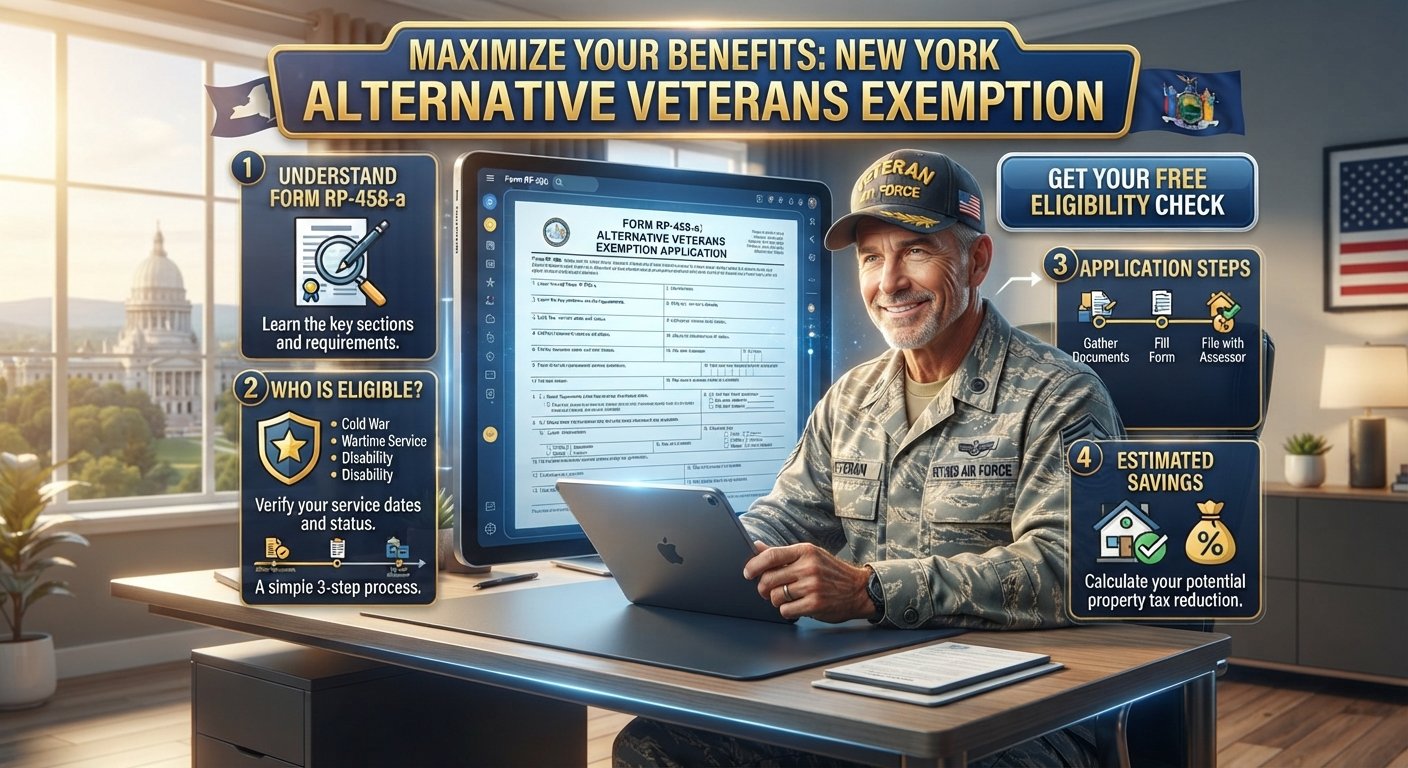
New York Veterans Property Tax Exemption by Disability Rating: The Complete 2026 Guide
New York veterans with a service-connected VA disability rating can reduce their property taxes through the Alternative Veterans Exemption. The disability benefit equals 50% of your VA disability rating multiplied by your home‘s assessed value, subject to local maximums. A new law also allows municipalities to offer a full property tax exemption for veterans rated 100% permanently and totally disabled.
Quick Facts
| Item | Details |
|---|---|
| Benefit | Property tax reduction based on VA disability rating percentage |
| Eligibility | Wartime veteran with service-connected VA disability rating |
| Application | Form RP-458-a to local assessor |
| Processing Time | Varies by municipality; deadline typically March 1 |
| Official Agency | NYS Department of Taxation and Finance; local assessor |
| Required Forms | Form RP-458-a; DD-214; VA disability rating documentation |
| Updated For | 2026 guidelines; new 100% P&T exemption available October 2026 |
How the Disability Rating Calculation Works
The Alternative Veterans Exemption reduces your property’s assessed value by an amount equal to 50% of your VA service-connected disability rating. This percentage reduction is then applied to your assessed value, subject to local maximum limits.

For example, if you have a 50% VA disability rating, you receive a 25% reduction in assessed value (50% × 50% = 25%). If your home is assessed at $200,000, the exemption reduces your taxable value by $50,000.
Disability Rating to Exemption Percentage
| VA Disability Rating | Exemption Percentage |
|---|---|
| 10% | 5% |
| 30% | 15% |
| 50% | 25% |
| 70% | 35% |
| 90% | 45% |
| 100% | 50% |

The maximum dollar amount of the disability exemption varies by taxing jurisdiction. Each county, city, town, village, and school district sets its own maximum, ranging from $40,000 to $250,000 or more.
Combined with Wartime and Combat Benefits
The disability exemption is additional to the wartime and combat zone exemptions. A veteran who served during wartime receives a 15% reduction, plus 10% if they served in a combat zone, plus the disability percentage. These stack together, subject to the local maximum.
Which Properties Qualify
The exemption applies to your primary residence only. The property must be used exclusively for residential purposes. If part of the property is used commercially, the assessor may apportion the exemption to the residential portion only.
Cooperative apartments may qualify if the municipality has adopted the local option to extend the exemption to co-ops.
New Law: Full Exemption for 100% Permanently and Totally Disabled Veterans
Veterans May Qualify for Extra Benefits
Check available financial assistance, healthcare programs and other opportunities that may apply to you.
Check EligibilityA new law signed in 2025 allows municipalities to provide a full property tax exemption for veterans rated 100% permanently and totally disabled by the VA. This exemption goes beyond the existing 50% disability calculation—it exempts the entire assessed value from taxation.
What Changed
Previously, even a 100% disabled veteran received only a 50% reduction in assessed value under the Alternative Veterans Exemption (100% × 50% = 50%). The new law permits local governments to offer a full 100% exemption instead.
The legislation authorizes counties, cities, towns, villages, and school districts to adopt a local law or resolution offering this full exemption. Participation is optional for each taxing jurisdiction.
Key Requirements
To qualify for the full exemption, you must:
Be discharged or released under honorable conditions
Be considered by the VA to be permanently and totally disabled as a result of military service
Provide VA documentation specifically stating permanent and total disability
The requirement for a VA housing grant or Individual Unemployability status was removed, expanding eligibility.
Effective Date
The new exemption applies to assessment rolls based on taxable status dates occurring on or after October 1, 2026. Applications and instructions are being developed by the NYS Department of Taxation and Finance.
Local Implementation Status
Municipalities must opt in to offer the full exemption. For example, Albany County introduced legislation in August 2026 to adopt the full exemption for 100% permanently and totally disabled veterans. Veterans should contact their local officials to advocate for adoption in their community.
Who Qualifies for the Disability Exemption
You qualify for the disability portion of the Alternative Veterans Exemption if you meet three basic criteria: veteran status, qualifying service, and a VA service-connected disability rating.
Veteran Status Requirements
You must be a veteran who served in the U.S. Armed Forces, including the Army, Navy, Air Force, Marines, and Coast Guard. Veterans who received an honorable discharge or a discharge under honorable conditions qualify.
Career members of the armed forces may qualify if they meet specific reenlistment and service duration criteria. Reserve component members who received honorable discharge may also qualify.
Qualifying Service Periods
The Alternative Veterans Exemption is available only to veterans who served during a designated time of war or received an expeditionary medal. The qualifying periods include:
| Conflict | Dates |
|---|---|
| World War II | Dec 7, 1941 – Dec 31, 1946 |
| Korean War | June 27, 1950 – Jan 31, 1955 |
| Vietnam War | Feb 28, 1961 – May 7, 1975 |
| Persian Gulf Conflict | Aug 2, 1990 – Present |
Veterans who served only during peacetime may qualify for the Cold War Veterans Exemption instead, which also includes a disability benefit calculated at 50% of the VA rating.
VA Disability Rating Documentation
You must submit official VA documentation showing your service-connected disability rating. Acceptable documents include your VA decision letter, benefit summary letter, or rating decision. The document must clearly state the disability percentage.
Primary Residence Requirement
The property must be your primary residence. You cannot claim the exemption on a rental property, investment property, or second home. If you move, you must re-file the exemption application for the new property.
Required Documents for Application
Gather these documents before submitting your exemption application to your local assessor.
Documentation Checklist
| Document | Purpose |
|---|---|
| Form RP-458-a | Application for Alternative Veterans Exemption |
| DD-214 or military records | Proves honorable discharge and service dates |
| VA disability rating letter | Proves service-connected disability percentage |
| Proof of primary residence | Deed, tax bill, or utility bill |
| Proof of ownership | Deed or title showing you own the property |
If you need copies of your military records, contact the National Personnel Records Center in St. Louis or order online through the National Archives.
Form RP-458-a
This is the application form for the Alternative Veterans Exemption. Submit it to your local assessor‘s office. Once approved, the exemption continues automatically in future years unless your disability rating changes or you move.
When to Re-File
You must re-file Form RP-458-a if:
You move to a new property
Your VA service-connected disability rating changes
You change from one exemption type to another
How to Apply: Step-by-Step Process
Apply for the disability exemption through your local assessor’s office. The process is straightforward but has strict deadlines.
Step 1: Confirm Your Municipality Offers the Exemption
Not all taxing jurisdictions offer the Alternative Veterans Exemption at the same maximum amounts. Some have opted to reduce or disallow certain benefits. Contact your assessor to confirm what‘s available in your area.
Step 2: Gather Required Documentation
Obtain your DD-214 and VA disability rating letter. If you need copies of your military records, request them from the National Personnel Records Center.
Step 3: Complete Form RP-458-a
Download and complete the application form. The form asks for your military service details, VA disability rating, and property information.
Step 4: Submit to Your Assessor Before the Deadline
In most communities, the deadline is March 1. However, some cities and counties have different deadlines. Confirm with your assessor. Late applications are generally not accepted for that tax year.
Step 5: Receive Determination
Your assessor will review your application and issue a determination. If approved, the exemption appears on your next property tax bill.
Processing Timeline
The assessor typically processes exemption applications before the tax roll is finalized. The exemption takes effect for the tax year following approval. There is no fee to apply.
Common Mistakes Veterans Make
Avoid these errors to ensure your exemption is approved without delay.
Missing the March 1 Deadline
Most municipalities enforce a strict March 1 deadline for exemption applications. Missing it means waiting another year. Confirm your local deadline—it varies in some cities.
Assuming 100% Rating Means 100% Exemption
Under the traditional Alternative Veterans Exemption, a 100% VA rating yields only a 50% reduction in assessed value. The full exemption for 100% P&T veterans is a new, optional benefit that municipalities must adopt separately.
Not Reporting Rating Changes
If your VA disability rating increases, you may qualify for a larger exemption. If it decreases, your exemption may need to be reduced. Report changes to your assessor by re-filing Form RP-458-a.
Claiming on Non-Primary Residence
The exemption applies only to your primary residence. Claiming it on a rental or vacation property can result in penalties and repayment of incorrectly granted exemptions.
Forgetting to Re-File After Moving
The exemption does not transfer to a new property. You must file a new application for each property you own and occupy as your primary residence.
Common Questions
How is the New York veterans property tax exemption calculated for disability?
The disability exemption equals 50% of your VA disability rating multiplied by your home’s assessed value. If you have a 60% VA rating, you receive a 30% reduction in assessed value, subject to your municipality‘s maximum dollar limit.
Does a 100% VA disability rating mean I pay no property taxes in New York?
Not automatically. Under the traditional exemption, a 100% rating yields a 50% assessed value reduction. A new law allows municipalities to offer a full exemption for 100% permanently and totally disabled veterans, but each local government must opt in.
What is the maximum exemption amount?
Maximums vary by taxing jurisdiction. The state authorizes several tiers, ranging from $40,000 to $250,000 or more in assessed value. Your local assessor can tell you the maximum in your area.
Can I claim the disability exemption and the wartime exemption together?
Yes. The disability exemption is additional to the wartime (15%) and combat zone (10%) exemptions. They stack, subject to the local maximum. You can also claim the Cold War exemption if you don’t qualify for the Alternative Veterans Exemption.
What documents do I need to prove my disability rating?
Submit your VA decision letter or benefit summary letter showing your service-connected disability percentage. The document must be official VA documentation. A printout from VA.gov or eBenefits is generally acceptable.
What is the deadline to apply?
The deadline is typically March 1 in most New York communities. However, some cities and counties have different deadlines. Confirm with your local assessor’s office. Late applications are not accepted.
Do I need to reapply every year?
No. Once approved, the exemption continues automatically as long as you remain in the same home and your disability rating does not change. You must re-file if you move or your rating changes.
Can surviving spouses claim the disability exemption?
The unremarried surviving spouse of a veteran may be eligible for the exemption the veteran was receiving. The disability portion may continue under certain conditions. Contact your assessor for specific guidance.
What if my municipality doesn‘t offer the full 100% exemption?
Participation is optional. Contact your local elected officials to encourage adoption. Albany County, for example, introduced legislation in 2026. Veterans can attend municipal meetings and advocate for the benefit.
Does the exemption apply to school taxes?
It depends on the taxing jurisdiction. School districts must opt in to offer the exemption. Some municipalities offer it for county, town, and village taxes but not school taxes. Check with your assessor.
Key Takeaways
Disability exemption equals 50% of your VA rating applied to assessed value, subject to local maximums
100% VA rating yields 50% assessed value reduction under the traditional exemption
New law allows full exemption for 100% permanently and totally disabled veterans, but municipalities must opt in
Deadline is typically March 1; confirm with your local assessor
Wartime, combat, and disability benefits stack together up to the local maximum
Primary residence requirement applies; investment properties do not qualify
Re-file if you move or your rating changes
New full exemption applies to assessment rolls on or after October 1, 2026
Contact local officials to advocate for adoption of the 100% P&T exemption
Surviving spouses may qualify for continued exemption benefits
Official Resources
NYS Department of Taxation and Finance — Veterans Exemptions — tax.ny.gov/pit/property/exemption/vetexempt.htm
Alternative Veterans Exemption Overview — tax.ny.gov/pit/property/exemption/altvetoverview.htm
Form RP-458-a — Available through your local assessor
NYS Department of Veterans’ Services — veterans.ny.gov
National Personnel Records Center — archives.gov

🇺🇸 IMPORTANT DISCLAIMER – Veterans Benefits Information
This site provides general information about U.S. Department of Veterans Affairs (VA) benefits for educational and informational purposes only.
- Not Official: We are NOT affiliated with, endorsed by, or connected to the U.S. Department of Veterans Affairs (VA), the Veterans Benefits Administration (VBA), the Veterans Health Administration (VHA), or any other government agency.
- No Legal/Financial Advice: The content on this website is for informational purposes only and does not constitute legal, financial, or medical advice. VA benefits rules change frequently – always consult with an accredited Veterans Service Officer (VSO) or a qualified professional for your specific situation.
- Official Sources: For official, binding information and to apply for benefits, always visit official .gov websites: VA.gov, Benefits.VA.gov, or SSA.gov.
- No Data Collection: This site does not collect, store, or process any personal information. It does not have login forms, contact forms, or any system to capture user data. We never ask for your Social Security Number, bank details, or any personal information.
- 🚨 Scam Alert: The VA and other government agencies never charge fees for benefit applications. If anyone asks for money to "process" your VA claim, it is a scam. Report it to the VA Office of Inspector General at VA.gov/OIG.
- Advertising: This site uses third-party advertising (Adsterra) to cover operational costs. We do not endorse or guarantee any products or services advertised.
📌 Information provided as of June 2026. Always verify current eligibility and rules with official .gov sources.
This site is not affiliated with the U.S. Department of Veterans Affairs or any government agency. All information is for educational purposes only. Please visit VA.gov for official information.
