
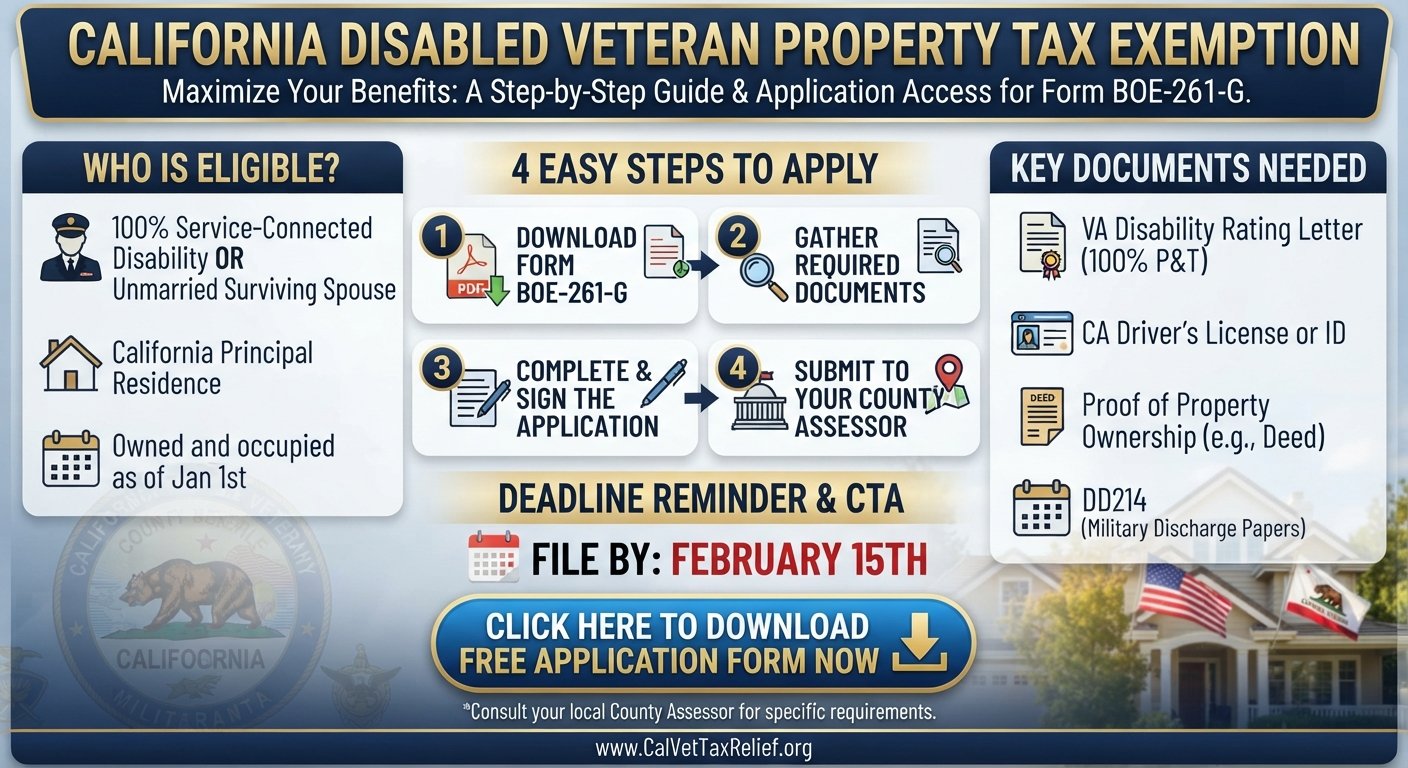
California Disabled Veteran Property Tax Exemption: What You Need to Know
California provides a property tax exemption on the primary residence of veterans rated 100% disabled due to a service-connected injury or disease. The basic exemption for 2026-27 is $180,671 regardless of income. Veterans with household income of $81,131 or less qualify for the higher low-income exemption of $271,009. Unmarried surviving spouses may also qualify.
Quick Facts
| Item | Details |
|---|---|
| Benefit | Property tax exemption on primary residence |
| Eligibility | Veterans rated 100% disabled or unemployable due to service-connected injury |
| Application | Form BOE-261-G to county assessor |
| Processing Time | Varies by county; typically 30-60 days |
| Official Agency | California State Board of Equalization / County Assessor |
| Required Forms | BOE-261-G (Claim for Disabled Veterans’ Property Tax Exemption) |
| Updated For | 2026-27 Tax Year |
What Is the California Disabled Veteran Property Tax Exemption?
The California disabled veteran property tax exemption is a reduction in the assessed value of a qualifying veteran’s primary residence for property tax purposes. Under California Revenue and Taxation Code Section 205.5, veterans who are rated 100% disabled due to a service-connected injury or disease qualify for this exemption.

This is not a complete elimination of property taxes in most cases. It is an exemption that reduces the taxable assessed value of the home by a specified amount. The exemption amount may cover the full assessed value in cases where the home’s value is below the exemption threshold.

Why this matters: California property values and tax rates are among the highest in the nation. For disabled veterans living on fixed incomes, this exemption can save thousands of dollars annually. Based on a 1.2% tax rate, the basic exemption saves approximately $2,168 per year, while the low-income exemption saves approximately $3,252 per year.
What veterans should do next: Contact your county assessor to confirm current exemption amounts and obtain Form BOE-261-G.
Who Qualifies for the California Disabled Veteran Exemption?
To qualify for the California disabled veteran property tax exemption, a veteran must meet all of the following requirements:
VA Disability Rating: Be rated by the U.S. Department of Veterans Affairs as 100% disabled due to a service-connected injury or disease, OR be compensated at the 100% rate due to individual unemployability (TDIU).
Specified Disability Categories: Qualify under one of these categories:
Blind in both eyes
Lost the use of two or more limbs
Totally disabled as a result of injury or disease incurred in military service
Honorable Discharge: Have received a discharge under other than dishonorable conditions.
Property Ownership: Own the property for which the exemption is claimed.
Primary Residence: The property must be the veteran’s principal place of residence.
California Property: The property must be located in California.
Who Does Not Qualify
Veterans with disability ratings below 100% (unless compensated at 100% due to unemployability)
Veterans who do not own their primary residence
Veterans whose property is not used as their principal residence
Veterans who received a dishonorable discharge
Understanding the Two Exemption Levels
California offers two levels of the disabled veteran property tax exemption. The level you qualify for depends on your household income.
| Exemption Level | Income Limit | 2026-27 Exemption Amount | Estimated Tax Savings |
|---|---|---|---|
| Basic | No income limit | $180,671 | ~$2,168 |
| Low-Income | $81,131 or less | $271,009 | ~$3,252 |
Veterans May Qualify for Extra Benefits
Check available financial assistance, healthcare programs and other opportunities that may apply to you.
Check EligibilityNote: Exemption amounts and income limits are adjusted annually for inflation by the California State Board of Equalization. Contact your county assessor for the most current figures.
Basic Exemption
The basic exemption is available to all qualifying veterans regardless of income. It requires a one-time filing. Once granted, the exemption remains in continuous effect unless eligibility changes.
Low-Income Exemption
The low-income exemption provides a higher exemption amount for veterans whose household income does not exceed the annual limit. This exemption requires annual filing by February 15 to certify continued income eligibility.
What Income Counts for the Low-Income Exemption?
Household income includes all income received by the claimant and all other household members during the last calendar year. According to the California State Board of Equalization, household income includes:
Wages, salaries, tips, and other employee compensation
Social Security benefits (including Medicare premium deductions)
Railroad retirement benefits
Interest and dividends
Pensions, annuities, and disability retirement payments
Rental income
Net income from a business
Unemployment insurance benefits
Workers’ compensation for temporary disability
Sick leave payments
Income Exclusions
The following are NOT counted as household income:
Gifts and inheritances in excess of $300 (except between household members)
Life insurance proceeds that exceed expenses
Veterans’ benefits received from the Veterans Administration (unless otherwise specified)
Nontaxable gain from the sale of a residence
Important: Recent legislation (SB 56) proposes to exclude VA disability compensation from the household income calculation for determining eligibility for the low-income exemption. Check with your county assessor for current rules.
How to Apply for the California Disabled Veteran Exemption
Step-by-Step Application Process
Step 1: Obtain Form BOE-261-G
Download the Claim for Disabled Veterans’ Property Tax Exemption (Form BOE-261-G) from the California State Board of Equalization website or request it from your county assessor’s office.
Step 2: Complete the Application
Fill out all required sections of Form BOE-261-G. The form requires information about the veteran, the property, and the disability rating.
Step 3: Gather Required Documents
You will need:
VA Rating Decision Letter showing 100% disability rating or unemployability determination with effective date
DD-214 showing discharge under other than dishonorable conditions
Proof of ownership (grant deed or property tax bill)
For low-income applicants: Completed Disabled Veterans Low Income Worksheet with household income documentation
Step 4: Submit Your Application
Mail the completed claim form and supporting documents to the address on the claim form (your county assessor’s office).
Step 5: Wait for Processing
The county assessor will review your application and notify you of their decision.
Application Deadline
The filing deadline varies depending on the exemption type:
Basic Exemption: File by December 31 for the tax year in which you seek relief
Low-Income Exemption: File annually between January 1 and February 15
Late Claims: Claims filed after February 15 but before December 10 may receive 80-90% of the exemption
Supplemental Assessment: File within 30 days of the Notice of Supplemental Assessment
Required Documents for California Disabled Veteran Exemption
| Document | Purpose | Notes |
|---|---|---|
| Form BOE-261-G | Application for exemption | Required for all applicants |
| VA Rating Decision Letter | Proves 100% disability rating | Must include effective date |
| DD-214 | Proves character of service | Must show other than dishonorable discharge |
| Proof of Ownership | Confirms property ownership | Grant deed or tax bill |
| Low Income Worksheet | For low-income exemption | Required annually |
| Marriage Certificate | For surviving spouse applicants | Proves relationship to veteran |
| Death Certificate | For surviving spouse applicants | Required if applying as surviving spouse |
| DIC Letter | For surviving spouse applicants | May substitute for VA rating letter |
Common mistake: Submitting a VA letter that does not clearly state the effective date of the 100% rating. The county assessor needs this date to determine when the exemption should begin.
Surviving Spouse Benefits in California
Who Qualifies as a Surviving Spouse?
The unmarried surviving spouse of a qualifying disabled veteran may continue receiving the exemption if:
The veteran qualified for the exemption during their lifetime, OR
The veteran would have qualified if they had been alive on January 1, 1977, OR
The veteran died from a service-connected injury or disease
Required Documents for Surviving Spouse
Surviving spouses must provide additional documentation:
Marriage certificate
Death certificate or Report of Casualty (if veteran died in active service)
Dependency and Indemnity Compensation (DIC) Letter with effective date (may substitute for VA Rating Decision Letter)
Remarriage Disqualification
If a surviving spouse remarries, they lose eligibility for the exemption. There is no exception to this rule.
Continued Eligibility
Surviving spouses must continue to:
Own the property
Occupy the property as their principal residence
Remain unmarried
Filing Deadlines and Late Claims
Annual Filing Requirements
| Exemption Type | Filing Frequency | Deadline |
|---|---|---|
| Basic | One-time | December 31 of first year |
| Low-Income | Annual | February 15 |
Late Filing Penalties
If you miss the February 15 deadline for the low-income exemption:
Claims filed February 16 to December 10: 80-90% of exemption
Claims filed after December 10: Applies to next fiscal year
Retroactive Filings
California law allows retroactive filings in some cases, up to a total of eight years. This means if you qualified for the exemption in prior years but did not file, you may be able to claim refunds for those years.
California vs. Other States: Disabled Veteran Property Tax Benefits
| State | 100% Disabled Veteran Benefit | Income Limits | Surviving Spouse Benefit |
|---|---|---|---|
| California | $180,671-$271,009 exemption | Low-income tier available | Yes (if not remarried) |
| Texas | Full exemption | None | Full exemption |
| Florida | Full exemption | None | Full exemption |
| Virginia | Full exemption | None | Full exemption |
| New York | Partial exemption | Varies | Partial exemption |
California’s exemption differs from states like Texas and Florida that offer complete exemptions. However, California’s exemption amounts are among the highest partial exemptions in the nation.
Proposed Changes to California Disabled Veteran Exemption
SB 296 (Archuleta)
Senate Bill 296 proposes significant changes to the disabled veteran exemption. Under the bill:
Veterans with 100% disability ratings would receive a 50% exemption on their primary residence
Veterans with household income below a specified threshold would receive a 100% exemption
Unmarried surviving spouses would receive the same exemption amount the veteran would have received if alive
The exemption would apply for lien dates from January 1, 2026, through January 1, 2032
Status: As of 2026, this bill has not been enacted into law. Check with your county assessor for current requirements.
AB 2022
Assembly Bill 2022 proposes a full property tax exemption for 100% disabled veterans regardless of income, from January 1, 2027, to January 1, 2032. The bill would also extend the exemption to unmarried surviving spouses.
Status: Pending in the California Legislature.
Common Mistakes When Applying for the California Exemption
Missing the annual filing deadline for low-income exemption: The low-income exemption requires annual filing by February 15. Missing this deadline reduces your exemption percentage.
Insufficient VA documentation: The VA letter must show the effective date of your 100% rating. Without this date, the assessor cannot determine when the exemption should begin.
Forgetting to file for the basic exemption: The basic exemption requires a one-time filing. It does not happen automatically.
Not notifying the assessor of changes: If you sell your home, rent it out, or your eligibility changes, you must notify the assessor. The exemption terminates if title changes or the property is no longer your primary residence.
Assuming the exemption covers the full property value: In most cases, the exemption reduces assessed value but does not eliminate all property taxes. Only if your home’s assessed value is below the exemption amount would you pay zero taxes.
Not applying for retroactive refunds: If you qualified in prior years but did not file, you may be able to claim refunds for up to eight years.
Appealing a Denied Exemption Application
If your application for the California disabled veteran property tax exemption is denied, you have options:
Step 1: Request an Explanation
Contact your county assessor to understand why your application was denied.
Step 2: Provide Additional Documentation
If the denial was due to missing or unclear documents, you may be able to resolve the issue by providing additional information.
Step 3: File an Assessment Appeal
If you disagree with the denial, you can file an assessment appeal with your county assessment appeals board. Deadlines vary by county.
Step 4: Seek Assistance
The California State Board of Equalization Taxpayers’ Rights Advocate Office provides guidance on property tax appeals.
Common Questions
1. Do I need to reapply for the California disabled veteran exemption every year?
The basic exemption requires only a one-time filing. The low-income exemption requires annual filing by February 15 each year to certify continued income eligibility.
2. What is the deadline to apply for the California disabled veteran exemption?
For the basic exemption, file by December 31 of the year in which you seek relief. For the low-income exemption, file between January 1 and February 15 annually. Late claims may receive reduced exemption amounts.
3. Can I receive the exemption on a second home or rental property?
No. The exemption applies only to your principal place of residence. You must own and occupy the property as your primary residence.
4. What happens to the exemption if my spouse dies?
If you are the unmarried surviving spouse, the exemption carries over to you as long as you continue to own and occupy the property and do not remarry.
5. Can I transfer the exemption if I move to a new home in California?
The exemption applies to your primary residence. If you move, you must file a new claim with the county assessor where your new home is located. The exemption does not transfer automatically.
6. Is there an income limit for the California disabled veteran exemption?
The basic exemption has no income limit. The low-income exemption requires household income of $81,131 or less for 2026-27 (adjusted annually).
7. What documentation do I need from the VA?
You need a VA Rating Decision Letter showing 100% disability rating or unemployability determination with the effective date. You also need a DD-214 showing discharge under other than dishonorable conditions.
8. Can I apply for the exemption before purchasing a home?
The exemption applies once you own and occupy the property as your primary residence. You can file after closing on the home, with the exemption applying from the date you establish residency.
9. What happens if I remarry as a surviving spouse?
If you remarry, you lose eligibility for the exemption. There is no exception to this rule.
10. How much is the California disabled veteran exemption for 2026?
For 2026-27, the basic exemption is $180,671. The low-income exemption is $271,009 for veterans with household income of $81,131 or less.
11. Does the exemption cover personal property taxes?
No. The disabled veteran exemption applies only to real property taxes on your primary residence. Personal property is taxed separately.
12. What is Proposition 19 and how does it affect veterans?
Proposition 19 allows severely disabled veterans to transfer their base year value to a replacement property anywhere in California, regardless of the new property’s value. This transfer can be done up to three times.
Key Takeaways
California offers a property tax exemption on the primary residence for veterans rated 100% disabled due to service-connected injuries
The basic exemption for 2026-27 is $180,671 with no income limit
The low-income exemption for 2026-27 is **$271,009** for veterans with household income of $81,131 or less
Unmarried surviving spouses may qualify for the same exemption
Apply using Form BOE-261-G through your county assessor
The basic exemption requires one-time filing; the low-income exemption requires annual filing by February 15
Retroactive filings may be allowed up to eight years
The exemption does not transfer automatically if you move—you must file a new claim
Proposed legislation (SB 296, AB 2022) could expand the exemption to cover full property value
There are no income limits for the basic exemption
Official Resources
California State Board of Equalization: boe.ca.gov
BOE Publication 800-7 (Disabled Veterans’ Exemption): Available through BOE
Form BOE-261-G: Available through county assessor or BOE website
California State Board of Equalization Tax Help for Veterans: boe.ca.gov
VA Benefits Hotline: 1-800-827-1000
USA.gov Veterans Benefits: usa.gov/veterans-benefits

🇺🇸 IMPORTANT DISCLAIMER – Veterans Benefits Information
This site provides general information about U.S. Department of Veterans Affairs (VA) benefits for educational and informational purposes only.
- Not Official: We are NOT affiliated with, endorsed by, or connected to the U.S. Department of Veterans Affairs (VA), the Veterans Benefits Administration (VBA), the Veterans Health Administration (VHA), or any other government agency.
- No Legal/Financial Advice: The content on this website is for informational purposes only and does not constitute legal, financial, or medical advice. VA benefits rules change frequently – always consult with an accredited Veterans Service Officer (VSO) or a qualified professional for your specific situation.
- Official Sources: For official, binding information and to apply for benefits, always visit official .gov websites: VA.gov, Benefits.VA.gov, or SSA.gov.
- No Data Collection: This site does not collect, store, or process any personal information. It does not have login forms, contact forms, or any system to capture user data. We never ask for your Social Security Number, bank details, or any personal information.
- 🚨 Scam Alert: The VA and other government agencies never charge fees for benefit applications. If anyone asks for money to "process" your VA claim, it is a scam. Report it to the VA Office of Inspector General at VA.gov/OIG.
- Advertising: This site uses third-party advertising (Adsterra) to cover operational costs. We do not endorse or guarantee any products or services advertised.
📌 Information provided as of June 2026. Always verify current eligibility and rules with official .gov sources.
This site is not affiliated with the U.S. Department of Veterans Affairs or any government agency. All information is for educational purposes only. Please visit VA.gov for official information.
