
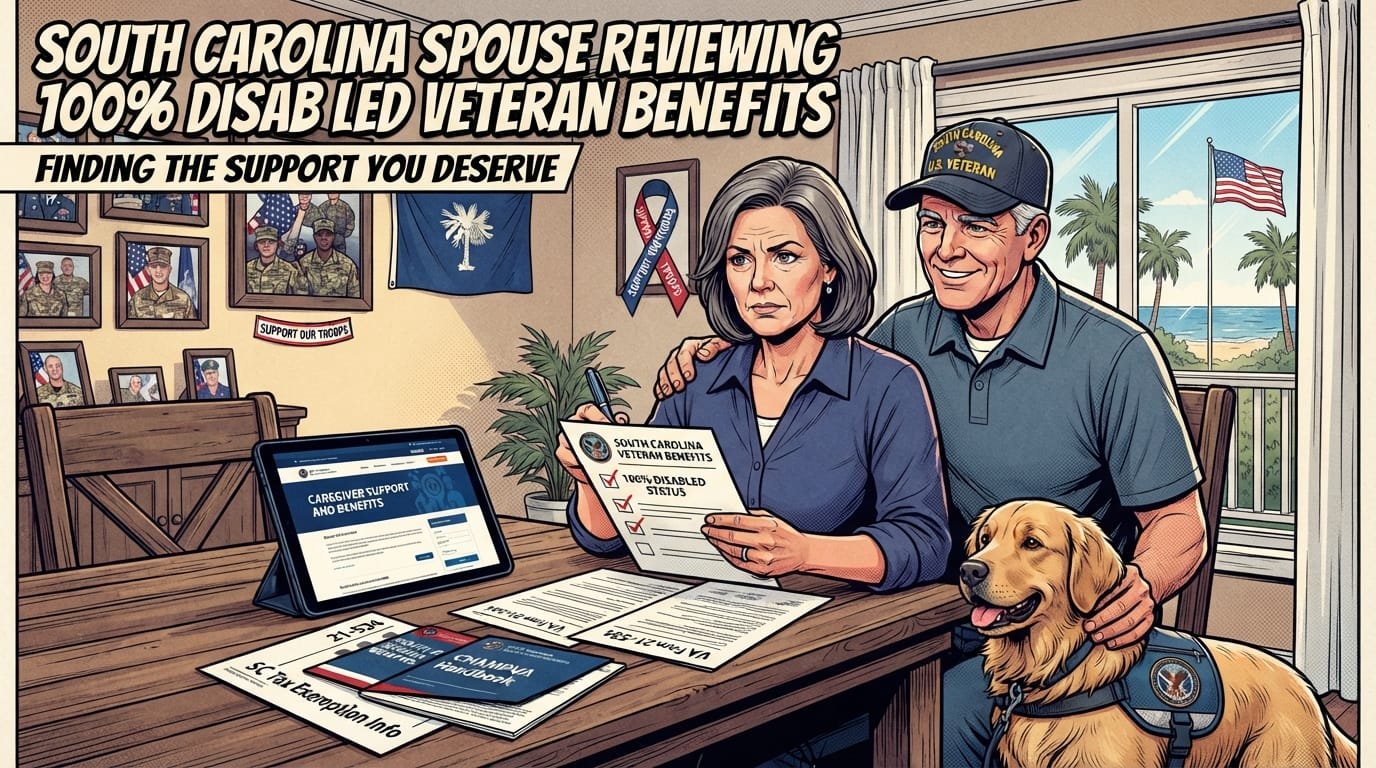
100 Percent Disabled Veteran Benefits for Spouse in South Carolina
Spouses of 100% permanently and totally disabled veterans in South Carolina can access DIC (if the veteran has passed), CHAMPVA health care, Chapter 35 education benefits, a full property tax exemption on the primary residence, a vehicle tax exemption, and free state park access. The property tax exemption is transferable to a surviving spouse and does not require the veteran to have applied for it first.
| Item | Details |
|---|---|
| Benefit | Survivor benefits, health care, education, property tax exemption, vehicle exemption |
| Eligibility | Spouses and surviving spouses of veterans rated 100% P&T service-connected |
| Application | Varies by benefit; property tax via SCDOR, VA benefits via VA.gov |
| Processing Time | Property tax exemption: 4–6 weeks; VA claims: 30–90+ days |
| Official Agency | VA, SCDOR, South Carolina DVA |
| Required Forms | DD-214, VA rating decision, marriage certificate, deed, vehicle registration |
| Updated For | 2026 rates, SC legislative changes |
What Benefits Are Available to Spouses of 100% Disabled Veterans in South Carolina?
Spouses of veterans rated 100% permanently and totally disabled by the VA qualify for a combination of federal and South Carolina state benefits. The most significant are the property tax exemption, CHAMPVA health care, and Chapter 35 education benefits. Surviving spouses retain several of these benefits after the veteran’s death.

The key distinction is between benefits available while the veteran is living and benefits that become available after the veteran’s death. The property tax exemption is unique because a surviving spouse can claim it immediately, even if the veteran never applied. CHAMPVA and Chapter 35 are available to the spouse while the veteran is alive. DIC only becomes available after the veteran’s death.

Why this matters: A 100% P&T rating unlocks benefits that can save a family thousands of dollars per year. The property tax exemption alone can eliminate the entire property tax bill on a primary residence. CHAMPVA provides comprehensive health coverage for spouses who cannot use TRICARE. Chapter 35 pays for education and training.
What spouses should do next: Gather the veteran’s VA rating decision letter, DD-214, and marriage certificate. Contact your county assessor for the property tax exemption and the South Carolina Department of Revenue for vehicle exemption. Apply for CHAMPVA and Chapter 35 through VA.gov.
Federal Benefits for Spouses of 100% Disabled Veterans
Federal benefits are administered by the U.S. Department of Veterans Affairs. The three most important for spouses of 100% P&T veterans are DIC, CHAMPVA, and Chapter 35.
Dependency and Indemnity Compensation (DIC)
DIC is a monthly tax-free payment to surviving spouses and dependents of veterans whose death was service-connected or who were rated 100% disabled for a qualifying period. The 2026 basic DIC rate for a surviving spouse is $1,699.36 per month.
Veterans May Qualify for Extra Benefits
Check available financial assistance, healthcare programs and other opportunities that may apply to you.
Check EligibilityAn additional $360.85 per month is added if the veteran was rated 100% disabled for at least eight continuous years immediately preceding death, and the surviving spouse was married to the veteran for those same eight years. This is known as the “eight-year rule.”
Who qualifies for DIC:
Surviving spouse of a service member who died on active duty
Surviving spouse of a veteran whose death was service-connected
Surviving spouse of a veteran rated 100% P&T for at least 10 years before death, or five years from discharge if less than 10 years
DIC eligibility rules for spouses:
Married the veteran before January 1, 1957, OR
Married within 15 years of the veteran’s discharge if the death was service-connected, OR
Were married to the veteran for at least one year, OR
Had a child with the veteran and lived together continuously until death
What spouses should do next: Apply for DIC using VA Form 21-534EZ. You can apply online at VA.gov, by mail, or in person at a VA regional office. The Anchorage VA Regional Benefit Office processes claims for Alaska, but South Carolina claims go through the Columbia VA Regional Office.
CHAMPVA (Civilian Health and Medical Program of the Department of Veterans Affairs)
CHAMPVA is a comprehensive health care program for spouses, surviving spouses, and dependent children of veterans rated 100% permanently and totally disabled. It provides coverage for mental health services, inpatient and outpatient care, prescription medications, transplants, ambulatory surgery, family planning, and maternity care.
Who qualifies for CHAMPVA:
Spouse or dependent child of a veteran rated 100% P&T from a service-connected disability
Surviving spouse or dependent child of a veteran who died from a service-connected disability
Surviving spouse or dependent child of a veteran who was 100% P&T at the time of death
Critical limitation: You cannot be eligible for TRICARE. If you are eligible for or enrolled in TRICARE, you cannot get CHAMPVA benefits. This means spouses of active-duty service members do not use CHAMPVA.
CHAMPVA coverage changes: As of May 2024, CHAMPVA beneficiaries have access to audio-only telehealth, no caps on mental health and substance use visits, and no deductibles or cost-sharing for FDA-approved contraceptive services. This expansion is particularly important for rural beneficiaries.
Surviving spouse remarriage rules:
If you remarry on or after your 55th birthday, you keep CHAMPVA benefits
If you remarry before age 55, benefits end on the date of remarriage
If a pre-55 remarriage ends, you may qualify for CHAMPVA again
What spouses should do next: Apply for CHAMPVA using VA Form 10-10d. Applications can be submitted online at VA.gov, by mail, or by fax. Processing typically takes 30–60 days.
Chapter 35 (Survivors’ and Dependents’ Educational Assistance)
Chapter 35 provides education and training benefits for spouses and children of veterans who are permanently and totally disabled due to a service-connected disability, or who died from a service-connected disability. Benefits can be used for college degree programs, certificate programs, apprenticeships, and on-the-job training.
Who qualifies for Chapter 35:
Spouse or child of a veteran rated 100% P&T from a service-connected disability
Spouse or child of a veteran who died from a service-connected disability
Spouse or child of a service member missing in action or captured in the line of duty for more than 90 days
Chapter 35 benefits for spouses:
Up to 45 months of education benefits
Must be married to the veteran at the time of death or when the disability was incurred
Benefits available for up to 10 years from the eligibility date
If you remarry, eligibility may be affected
What spouses should do next: Apply for Chapter 35 using VA Form 22-5490. You can apply online at VA.gov or by mail. Once approved, you will receive a Certificate of Eligibility.
Other Federal Benefits
VA Burial Benefits: Both veteran and spouse are eligible for burial in a VA national cemetery at no cost. A small fee applies for the spouse.
Aid and Attendance: Spouses of veterans rated 30% or higher may qualify for Aid and Attendance benefits if they require help with daily activities.
Survivor Benefit Plan (SBP): Military retirement Survivor Benefit Plan payments are tax-free in South Carolina.
South Carolina Property Tax Exemption for Spouses
South Carolina offers a complete property tax exemption on the primary residence for veterans rated 100% permanently and totally disabled and their surviving spouses. The exemption covers the home and up to five acres of land.
What the Exemption Covers
Home and land: Up to five acres
Vehicles: Two private passenger vehicles owned or leased by the veteran or the spouse
Surviving spouse: One vehicle and the home if sole ownership was acquired from the deceased veteran
How the Exemption Works for Surviving Spouses
The 2024 legislation expanded the property tax exemption in a way that directly benefits surviving spouses. Under the new law:
Surviving spouses can claim the exemption immediately in the same manner as the veteran
The spouse does not need the veteran to have applied for or claimed the exemption
The exemption is retroactive to 2022 and based on the year the veteran acquired the property
If the veteran was rated 100% P&T for any part of the year, the surviving spouse is entitled to the exemption for the entire year
This is a significant change. Previously, a surviving spouse might have been denied the exemption if the veteran never applied. The 2024 law closes that gap.
Important limitation: The exemption does not apply to Medal of Honor recipients or former prisoners of war under these expanded rules. Those groups have their own exemption rules.
Property Tax Exemption Comparison
| Category | Exemption Amount | Surviving Spouse Eligibility |
|---|---|---|
| 100% P&T Veteran | Full exemption on home + 5 acres | Yes — immediately, regardless of veteran’s prior application |
| Medal of Honor Recipient | Full exemption on home + 1 acre | Yes — if sole ownership inherited |
| Prisoner of War | Full exemption on home + 1 acre | Yes — if sole ownership inherited |
| Disabled Veteran (Under 100%) | $50,000 homestead exemption | Yes — if spouse is 65+ or disabled |
What spouses should do next: Apply online through MyDORWAY at dor.sc.gov. You will need the tax map number, deed information, property address, and supporting documentation. Applications take 4–6 weeks to process. You can check the status at dor.sc.gov/property-exemption-status-check.
South Carolina Vehicle Tax Exemption for Spouses
South Carolina exempts up to two private passenger vehicles from property tax for veterans rated 100% permanently and totally disabled. The exemption extends to the spouse under specific conditions.
How the Vehicle Exemption Works
Two vehicles can be exempt if owned or leased by the veteran or the spouse of the disabled veteran
Vehicles solely in the spouse’s name qualify if: the spouse resides with the disabled veteran, the vehicle is registered at the same address, and the vehicles count toward the two-vehicle limit
Surviving spouse: One private passenger vehicle owned or leased by the spouse is exempt for their lifetime or until remarriage
Vehicles held in trust qualify if the veteran or surviving spouse is the income beneficiary and uses the vehicle
How to Apply for the Vehicle Exemption
Obtain a certificate from your county service officer or the Veterans Administration verifying total and permanent disability
File the certificate with the South Carolina Department of Motor Vehicles
The exemption applies to property tax years beginning after 2024
What spouses should do next: Visit your county auditor’s office or the SCDMV to file the disability certificate. Bring the veteran’s VA rating decision letter and DD-214.
South Carolina Income Tax Benefits for Spouses
South Carolina does not tax military retirement pay. This benefit extends to surviving spouses and includes DIC payments.
Military Retirement Income
All military retirement pay included as taxable income is exempt from South Carolina Individual Income Tax, regardless of the recipient’s age. This applies to:
Military retirement pay
Survivor Benefit Plan (SBP) payments
DIC payments received by surviving spouses
The exemption has no cap and no earned-income requirement. Starting with tax year 2022, the cap on military retirement deductions was eliminated entirely.
Reserve and National Guard: Retirement income paid by the U.S. government for service in the reserves or National Guard is also exempt. The non-taxable portion is determined by the ratio of time served in the Guard/Reserve to total military service.
What spouses should do next: When filing South Carolina state taxes, deduct all military retirement income included in your taxable income. If you receive DIC or SBP payments, those are also deductible. Consult a tax professional if you have questions about how to report these benefits.
South Carolina Education Benefits for Spouses
South Carolina offers education benefits for spouses and dependents of 100% disabled veterans, in addition to the federal Chapter 35 program.
In-State Tuition
South Carolina charges resident tuition at public colleges, universities, and technical colleges to:
Active-duty members stationed in the state and their dependents
Honorably discharged veterans and their dependents
Covered individuals using federal education assistance
For covered individuals using VA education benefits, there is no durational residency requirement — you need only live in South Carolina while enrolled.
Free Tuition for Dependents
Children of service members who were killed in the military or died from a service-connected disability, or who were POW/MIA, totally disabled, or Medal of Honor/Purple Heart recipients, may receive free tuition at a state institution. This benefit applies to children, not spouses.
MyCAA Scholarship
The Military Spouse Career Advancement Account (MyCAA) provides up to $4,000 for education and training for spouses of active-duty service members in pay grades E-1 to E-9, W-1 to W-3, and O-1 to O-3. The sponsor must be on Title 10 military orders. This is a federal program, not a state program.
What spouses should do next: Contact the veterans affairs office at your chosen South Carolina college or university. Bring your DD-214, VA rating decision, and marriage certificate. For Chapter 35 benefits, apply through VA.gov using VA Form 22-5490.
South Carolina Recreation Benefits for Spouses
South Carolina offers recreational benefits for 100% disabled veterans and their spouses, including free hunting and fishing licenses and discounted state park access.
Hunting and Fishing Licenses
Veterans who are totally disabled receive free hunting and fishing licenses. The South Carolina Department of Natural Resources issues a three-year Disability Recreational Hunting and Fishing License at no cost to residents who are determined totally disabled under qualifying programs.
The license includes:
State Hunting License
Freshwater Fishing License
Saltwater Fishing License
Big Game Permit
WMA Permit
State Duck Stamp
Spouse eligibility: The disability license is issued to the qualifying individual. Spouses may hunt and fish under their own licenses.
State Park Access
The South Carolina All Park Passport is available at half price for 100% disabled residents of South Carolina and active members of the South Carolina National Guard. The passport provides access to all South Carolina state parks.
Veterans rated 100% P&T may enter any state park without charge upon presentation of an identification card from the county veterans affairs officer stating permanent and total disability. The passport program is separate and offers additional benefits.
What spouses should do next: For hunting and fishing licenses, contact the SCDNR at (803) 734-3833 or visit dnr.sc.gov. For the park passport, visit southcarolinaparks.com/park-passports or contact your county veterans affairs office.
How to Apply for South Carolina Spouse Benefits
Applying for benefits involves multiple agencies. The process varies by benefit type.
Step-by-Step Application Process
Step 1: Gather required documents.
Veteran’s DD-214 (discharge papers)
VA rating decision letter showing 100% P&T status with effective date
Marriage certificate
Government-issued photo ID
Property deed (for property tax exemption)
Vehicle registration and title (for vehicle exemption)
Step 2: Apply for property tax exemption.
Apply online through MyDORWAY or submit Form PT-401-I by mail
Include tax map number, deed information, and supporting documentation
Processing time: 4–6 weeks
Step 3: Apply for vehicle tax exemption.
Obtain a disability certificate from your county service officer
File the certificate with the SCDMV
Bring vehicle registration and title
Step 4: Apply for CHAMPVA.
Complete VA Form 10-10d
Submit online at VA.gov, by mail, or by fax
Include the veteran’s VA rating decision and marriage certificate
Step 5: Apply for Chapter 35 education benefits.
Complete VA Form 22-5490
Submit online at VA.gov
Include the veteran’s VA rating decision and marriage certificate
Step 6: Apply for DIC (surviving spouses only).
Complete VA Form 21-534EZ
Submit online at VA.gov or by mail to the VA regional office
Include the veteran’s DD-214, marriage certificate, and death certificate
Common Mistakes Spouses Make with SC Veteran Benefits
Not applying for the property tax exemption because the veteran never applied. The 2024 law allows surviving spouses to claim the exemption regardless of whether the veteran applied.
Missing the effective date on the VA letter. The property tax exemption starts from the effective date of the disability rating. Make sure your VA letter includes this date.
Registering the vehicle only in the spouse’s name without meeting the conditions. The vehicle must be registered at the same address as the disabled veteran and count toward the two-vehicle limit.
Assuming CHAMPVA works with TRICARE. If you are eligible for TRICARE, you cannot use CHAMPVA. Verify your TRICARE eligibility before applying.
Letting the surviving spouse remarry before age 55. This ends CHAMPVA benefits. Remarrying on or after age 55 preserves them.
Not filing for DIC within the time limits. DIC claims can be filed at any time, but retroactive benefits are limited. Apply as soon as possible after the veteran’s death.
Ignoring the annual renewal requirements for some benefits. Some property tax exemptions require annual renewal. Check with your county assessor.
Common Questions
What benefits does a spouse of a 100% disabled veteran get in South Carolina?
Spouses can access CHAMPVA health care, Chapter 35 education benefits, a full property tax exemption on the primary residence, a vehicle tax exemption, free state park access, and in-state tuition at public colleges. Surviving spouses may also qualify for DIC and retain the property tax exemption.
Does the spouse of a 100% disabled veteran have to pay property tax in South Carolina?
No. The primary residence of a veteran rated 100% permanently and totally disabled is fully exempt from property tax, up to five acres. The surviving spouse can claim the exemption immediately, regardless of whether the veteran applied for it.
What is the income limit for the South Carolina disabled veteran property tax exemption?
There is no income limit for the 100% P&T property tax exemption. The exemption is based on disability rating, not income.
Can a surviving spouse claim the property tax exemption if the veteran never applied?
Yes. Under legislation signed in 2024, surviving spouses can immediately claim the exemption in the same manner as the veteran, regardless of whether the disabled veteran applied for or claimed the exemption.
What is CHAMPVA and who qualifies?
CHAMPVA is a health care program for spouses, surviving spouses, and dependent children of veterans rated 100% permanently and totally disabled. You must not be eligible for TRICARE. CHAMPVA covers mental health services, inpatient and outpatient care, prescriptions, and maternity care.
How much is DIC for a surviving spouse in 2026?
The basic DIC rate for a surviving spouse in 2026 is $1,699.36 per month. An additional $360.85 is added if the veteran was rated 100% disabled for at least eight continuous years before death and the spouse was married for those same eight years.
Does South Carolina tax military retirement pay for surviving spouses?
No. All military retirement pay, including Survivor Benefit Plan payments and DIC, is exempt from South Carolina Individual Income Tax, regardless of the recipient’s age.
How do I apply for the South Carolina property tax exemption?
Apply online through MyDORWAY at dor.sc.gov. You will need the tax map number, deed information, property address, and supporting documentation. Applications take 4–6 weeks to process. You can also submit Form PT-401-I by mail.
Can a spouse use Chapter 35 education benefits?
Yes. Spouses of veterans rated 100% permanently and totally disabled qualify for Chapter 35 benefits, providing up to 45 months of education and training. Benefits are available for up to 10 years from the eligibility date.
Does the surviving spouse lose benefits if they remarry?
For CHAMPVA, remarrying on or after age 55 preserves benefits. Remarrying before 55 ends them. For DIC, remarriage after age 55 preserves benefits. For the property tax exemption, remarriage may affect eligibility. Check with the specific agency.
What vehicle exemptions are available for spouses?
Two private passenger vehicles can be exempt if owned or leased by the veteran or the spouse. Vehicles solely in the spouse’s name qualify if the spouse resides with the veteran and the vehicle is registered at the same address. Surviving spouses can exempt one vehicle for life or until remarriage.
How long does it take to get the property tax exemption approved?
Property tax exemption applications through SCDOR take 4–6 weeks to process. You can check the status online at dor.sc.gov/property-exemption-status-check using your confirmation code or SSN.
Key Takeaways
Spouses of 100% P&T veterans in South Carolina get a full property tax exemption on the primary residence and up to five acres, plus a vehicle tax exemption for two vehicles.
Surviving spouses can claim the property tax exemption immediately, regardless of whether the veteran ever applied. This was expanded by 2024 legislation.
CHAMPVA provides comprehensive health care for spouses of 100% P&T veterans, but only if they are not eligible for TRICARE.
Chapter 35 provides up to 45 months of education benefits for spouses and children of 100% P&T veterans.
**DIC pays $1,699.36 per month in 2026** for surviving spouses, with an additional $360.85 if the eight-year rule is met.
South Carolina does not tax military retirement pay, SBP, or DIC, regardless of the recipient’s age.
The 100% P&T property tax exemption has no income limit and covers the home and up to five acres.
Vehicle exemption applies to two vehicles owned or leased by the veteran or spouse, and one vehicle for surviving spouses for life or until remarriage.
Recreation benefits include free hunting and fishing licenses for totally disabled veterans and half-price state park passports.
Application for the property tax exemption takes 4–6 weeks and can be done online through MyDORWAY.
Official Resources
VA Dependency and Indemnity Compensation: va.gov/family-member-benefits/dependency-indemnity-compensation
CHAMPVA Benefits: va.gov/family-and-caregiver-benefits/health-and-disability/champva
Chapter 35 Education Benefits: va.gov/family-and-caregiver-benefits/education-and-careers/dependents-education-assistance
South Carolina Department of Revenue — Property Tax Exemptions: dor.sc.gov/tax/exempt-property
SCDOR Property Exemption Application: dor.sc.gov/individuals-property-exemption-application
South Carolina DVA: scdva.sc.gov
SCDNR Disability Hunting and Fishing License: dnr.sc.gov
South Carolina State Parks Passport: southcarolinaparks.com/park-passports
VA Form 21-534EZ (DIC Application): va.gov/find-forms/about-form-21-534ez
VA Form 10-10d (CHAMPVA Application): va.gov/find-forms/about-form-10-10d

🇺🇸 IMPORTANT DISCLAIMER – Veterans Benefits Information
This site provides general information about U.S. Department of Veterans Affairs (VA) benefits for educational and informational purposes only.
- Not Official: We are NOT affiliated with, endorsed by, or connected to the U.S. Department of Veterans Affairs (VA), the Veterans Benefits Administration (VBA), the Veterans Health Administration (VHA), or any other government agency.
- No Legal/Financial Advice: The content on this website is for informational purposes only and does not constitute legal, financial, or medical advice. VA benefits rules change frequently – always consult with an accredited Veterans Service Officer (VSO) or a qualified professional for your specific situation.
- Official Sources: For official, binding information and to apply for benefits, always visit official .gov websites: VA.gov, Benefits.VA.gov, or SSA.gov.
- No Data Collection: This site does not collect, store, or process any personal information. It does not have login forms, contact forms, or any system to capture user data. We never ask for your Social Security Number, bank details, or any personal information.
- 🚨 Scam Alert: The VA and other government agencies never charge fees for benefit applications. If anyone asks for money to "process" your VA claim, it is a scam. Report it to the VA Office of Inspector General at VA.gov/OIG.
- Advertising: This site uses third-party advertising (Adsterra) to cover operational costs. We do not endorse or guarantee any products or services advertised.
📌 Information provided as of June 2026. Always verify current eligibility and rules with official .gov sources.
This site is not affiliated with the U.S. Department of Veterans Affairs or any government agency. All information is for educational purposes only. Please visit VA.gov for official information.
