
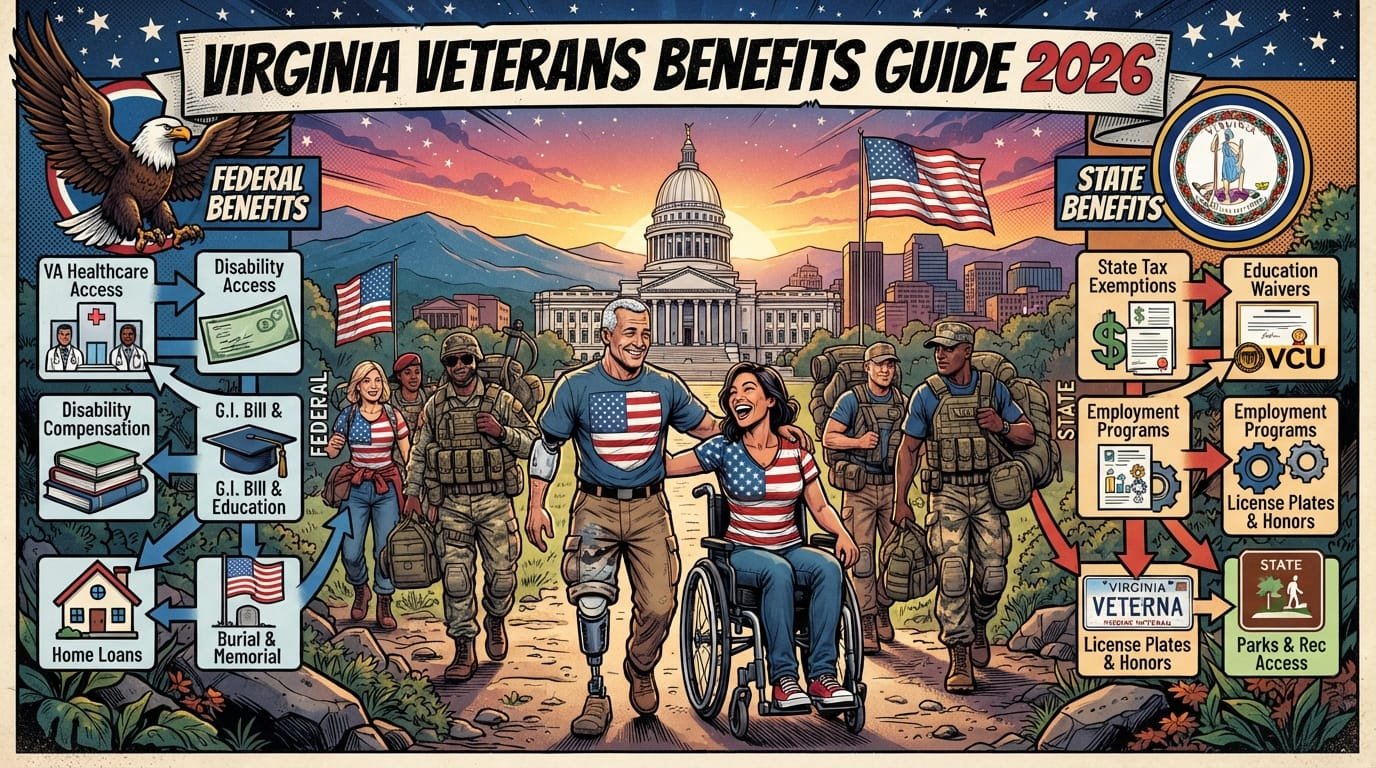
Virginia Veterans Benefits Guide 2026: What You Qualify For
Virginia veterans qualify for federal VA benefits including disability compensation, pension, healthcare, and education programs, plus state-specific benefits such as a full property tax exemption for 100% permanently and totally disabled veterans, a military retirement income subtraction, and tuition waivers for dependents. Virginia is home to approximately 690,000 veterans, and the Virginia Department of Veterans Services operates more than 50 locations statewide to assist with claims.
| Item | Details |
|---|---|
| Benefit | Federal VA benefits + Virginia state veterans benefits |
| Eligibility | Veterans, active duty, National Guard, Reservists, surviving spouses, dependents |
| Application | VA.gov for federal; DVS offices or local revenue offices for state |
| Processing Time | Federal disability claims: 100–150 days average; state tax exemptions: varies by locality |
| Official Agency | U.S. Department of Veterans Affairs; Virginia Department of Veterans Services (DVS) |
| Required Forms | VA Form 21-526EZ (disability); VA Form 20-0995 (supplemental claim); state forms vary |
| Updated For | Tax year 2026; VA disability rates effective December 1, 2025 |
How Virginia Veterans Benefits Work
Virginia veterans benefits operate on two levels: federal benefits administered by the U.S. Department of Veterans Affairs and state benefits administered by the Virginia Department of Veterans Services. Federal benefits are available to eligible veterans nationwide, while Virginia state benefits require Virginia residency and, in many cases, a specific VA disability rating.

Virginia consistently ranks among the most veteran-friendly states. The state does not tax VA disability compensation, offers a full property tax exemption for veterans rated 100% permanent and total, and provides tuition waivers for dependents of severely disabled or deceased service members. Starting in tax year 2026, Virginia will remove the $40,000 cap on military retirement income that can be subtracted from state taxable income, allowing eligible veterans to subtract the full amount of their military benefits.

The Virginia Department of Veterans Services (DVS) advocates for Virginia veterans by assisting with the development, submission, and tracking of claims related to disability compensation, VA pensions, survivor benefits, and related appeals. All services are provided free of charge. DVS operates more than 50 locations across the Commonwealth. Eligibility for most federal and state benefits is based on discharge from active military service under other than dishonorable conditions. Current and former members of the Reserves and National Guard may be eligible for certain benefits, such as home loan guarantees and education, if they meet time-in-service and other criteria.
Veterans who served as members of the Army, Navy, Air Force, Marine Corps, Coast Guard, Space Force, or as commissioned officers of the U.S. Public Health Service or the National Oceanic and Atmospheric Administration, and their dependents, are eligible for Virginia DVS services.
Federal VA Disability Compensation in 2026
VA disability compensation is a monthly tax-free payment to veterans who got sick or injured while serving in the military, or whose service made an existing condition worse. The Veterans Benefits Administration pays it under 38 U.S.C. Chapter 11. The amount depends on your combined rating, not on income, savings, or whether you work.
The 2026 rates took effect December 1, 2025. The 2026 COLA was 2.8%, applied to veterans by Public Law 119-42. A veteran with a 100% disability rating without dependents receives $3,291.06 monthly, an increase of roughly $107 per month compared to the previous year.
2026 VA Disability Compensation Rates
| VA Rating | Veteran Alone | With Spouse | With 1 Child Only | With Spouse and 1 Child |
|---|---|---|---|---|
| 10% | $180.42 | $180.42 | $180.42 | $180.42 |
| 20% | $356.66 | $356.66 | $356.66 | $356.66 |
| 30% | $552.47 | $617.47 | $596.47 | $666.47 |
| 40% | $795.84 | $882.84 | $853.84 | $947.84 |
| 50% | $1,132.90 | $1,241.90 | $1,205.90 | $1,327.90 |
| 60% | $1,645.75 | $1,778.75 | $1,724.75 | $1,873.75 |
| 70% | $2,078.43 | $2,237.43 | $2,171.43 | $2,344.43 |
| 80% | $2,382.43 | $2,567.43 | $2,481.43 | $2,680.43 |
| 90% | $2,675.60 | $2,887.60 | $2,788.60 | $3,013.60 |
| 100% | $3,291.06 | $3,529.06 | $3,417.06 | $3,668.06 |
Veterans May Qualify for Extra Benefits
Check available financial assistance, healthcare programs and other opportunities that may apply to you.
Check EligibilityVeterans rated 10% or 20% receive the same amount with or without dependents. Add-ons begin at 30%. You cannot draw compensation and pension for the same period; under 38 CFR 3.700, VA pays only the greater benefit.
VA Pension in 2026: What Low-Income Wartime Veterans Should Know
VA pension is a need-based benefit for wartime veterans with low income and limited net worth who are 65 or older, permanently and totally disabled, in a nursing home, or receiving Social Security disability. No service-connected condition is needed.
In 2026, the Veterans Pension program provides a single veteran up to $17,441 annually. Veterans who require assistance with daily activities or who are more seriously disabled may qualify at increased household rates up to $21,313 annually, or aid and attendance rates up to $29,093 annually.
Survivors Pension provides a surviving spouse with no dependents up to $15,311 annually in 2026. Surviving spouses with no dependents may also qualify at increased household rates up to $17,902 annually, or aid and attendance rates up to $22,304 annually when they require assistance with daily activities.
VA Pension vs. Disability Compensation
| Feature | VA Disability Compensation | VA Pension |
|---|---|---|
| Basis | Service-connected disability | Financial need |
| Taxable? | No | No |
| Income Limits | None | Yes |
| Net Worth Limits | None | Yes |
| Age Requirement | None | 65+ or disabled |
| Wartime Service | Not required | Required |
| Application Form | VA Form 21-526EZ | VA Form 21P-527EZ |
PACT Act 2026 Updates for Virginia Veterans
The PACT Act significantly expanded VA health care and disability benefits for veterans exposed to burn pits, Agent Orange, and other toxic substances. VA is expected to receive 281,366 more claims in 2026 than in 2025 due to the overwhelming response to PACT Act outreach efforts. As of December 16, 2025, VA has received 3.2 million PACT Act-related claims since August 10, 2022, of which more than 3.0 million have been processed and completed.
The PACT Act added three new geographical locations and time periods associated with radiation exposure, two new presumptive conditions associated with herbicide exposure, and more than 20 categories of presumptive diseases associated with exposure to burn pits and other toxic substances. VA also modified examination requirements when there is a toxic exposure risk activity.
VBA continues to leverage automation to improve claims processing. In 2025, Individual Longitudinal Exposure Record and Individual Exposure Summary reports began being automatically uploaded into VBMS, reducing manual steps. Auto-populate functionality became available for five of six categories of questions within the TERA Memorandum.
Who Qualifies Under the PACT Act
You may qualify for PACT Act benefits if you:
Served in Vietnam, the Gulf War, or Post-9/11 locations during specified periods
Were exposed to burn pits, Agent Orange, radiation, or other toxic substances
Have a condition on VA’s presumptive list
Served in a location or role that involved toxic exposure risk activity
What Veterans Should Do Next
Review your service history for toxic exposure risk
File a claim for any presumptive condition using VA Form 21-526EZ
Request a TERA memorandum if you have exposure risk activity
Contact a DVS benefits office for free claim assistance
Submit a supplemental claim if previously denied
Virginia State Tax Benefits for Veterans
Virginia offers several state tax benefits that reduce the financial burden on veterans and their families. These include income tax exemptions on military retirement, property tax exemptions, and vehicle tax relief.
Virginia Military Retirement Income Subtraction
Starting in 2023, Virginia veterans over the age of 55 receive a partial subtraction of their military retirement from state income taxes. For tax year 2026, House Bill 2700 proposes removing the current cap of $40,000 of military benefits that may be subtracted from Virginia taxable income, allowing the total amount of military benefits to be subtracted from such income.
House Bill 588, introduced January 13, 2026, also proposes to gradually increase the allowable military benefit subtractions over several tax years, ultimately allowing for complete subtraction of military benefits starting from January 1, 2026. This would provide substantial tax relief to veterans and their families.
VA disability compensation is never subject to state income tax in Virginia.
Virginia Property Tax Exemption for 100% Disabled Veterans
Virginia provides a 100% exemption from local real estate tax on the principal residence, plus up to one acre of land it occupies, for any veteran rated 100% service-connected permanent and total by the VA. There is no income test for this exemption. Surviving spouses of eligible veterans who do not remarry are also eligible to continue the exemption.
The statewide cost of the exemption has grown from $8 million in 2011 to an estimated $416 million in 2026, and is projected to approach $600 million by 2028. This reflects both the increasing number of qualifying veterans and rising property values across Virginia.
Apply through your local commissioner of the revenue or assessor’s office with your VA documentation establishing the permanent and total rating. Relief is prorated for applicants who become disabled or purchase a home after January 1, 2026.
Virginia Vehicle Tax Exemption
Veterans with specially adapted vehicles to accommodate their disabilities are exempt from paying vehicle taxes. A separate provision exempts one vehicle from local personal property tax for qualifying disabled veterans. The disability must be the loss or loss of use of a leg, arm, or hand, or the veteran must be 100% permanently and totally disabled.
Virginia HB 94, approved March 31, 2026, extends the current exemption from annual vehicle registration fees for disabled veterans or their unremarried surviving spouse to eligible vehicles displaying a standard passenger license plate.
Virginia Education Benefits for Veterans and Dependents
Virginia offers multiple education benefits for veterans, dependents, and surviving family members. These programs can cover tuition, fees, and provide stipends at Virginia public colleges and universities.
Virginia Military Survivors and Dependents Education Program (VMSDEP)
The VMSDEP provides up to eight semesters of tuition-free education at Virginia public colleges, universities, and Eastern Virginia Medical School for children (ages 16-29) and spouses of veterans rated 90% or more permanently disabled or killed/MIA/POW due to military service. It covers all tuition and mandatory fees, plus a stipend. The total value ranges from $40,000 to $120,000 or more.
Virginia must be the service member’s home of record for at least five years before application. Current appropriations cover the 2024-2026 biennium through June 30, 2026, totaling roughly $125 million annually for FY 2025 and FY 2026.
Without reauthorization in the next state budget cycle, tuition waiver guarantees and stipends will expire mid-2026. The Preserving VMSDEP Task Force, co-chaired by the Secretary of Education and the Secretary of Veterans and Defense Affairs, was established through Executive Directive 7 to review eligibility changes and recommend program improvements.
Virginia National Guard State Tuition Assistance Program (STAP)
STAP awards conditional grants each semester to eligible Virginia National Guard service members who apply. The program provides up to $8,000 per year in tuition assistance for members enrolled at accredited public or nonprofit private institutions of higher education in Virginia.
The funding cap for Spring 2026 is set at up to $4,500, reduced from the previous semester’s $10,000 cap due to a surge in program enrollment. Participation nearly doubled after STAP returned to a grant model. Schools bill the Department of Military Affairs directly, so students do not pay upfront.
Eligibility requires a minimum two-year remaining obligation to the Virginia National Guard, completion of Basic Military Training or ROTC Advanced Camp, and satisfactory performance under Guard regulations. Service members incur a two-year commitment upon completion of the last assisted term.
Post-9/11 GI Bill in Virginia
The Post-9/11 GI Bill (Chapter 33) helps pay for school or job training if you served on active duty after September 10, 2001. Eligible veterans and dependents may receive up to 36 months of benefits, including tuition and fees, books and supplies, and a monthly housing allowance. The maximum in-state tuition payment rate effective August 1, 2026, is $30,908.34 for tuition costs paid directly to the school.
Veterans and dependents eligible for the Post-9/11 GI Bill may also qualify for the Yellow Ribbon Program at participating Virginia institutions, which can cover additional tuition costs beyond the GI Bill cap.
Education Benefits Comparison
| Program | Who Qualifies | Benefit | Duration |
|---|---|---|---|
| VMSDEP | Dependents of 90%+ P&T veterans, KIA, MIA, POW | Full tuition + fees + stipend | 8 semesters |
| STAP | Virginia National Guard members | Up to $8,000/year | Per semester |
| Post-9/11 GI Bill | Post-9/11 active duty veterans | Tuition + MHA + books | 36 months |
| In-State Tuition | Veterans and dependents | In-state rates at public colleges | Continuous |
Virginia Housing Benefits for Veterans
Virginia provides housing support to veterans through state-run care centers, grant programs, and federal VA home loan guarantees. These programs address both immediate housing needs and long-term accessibility modifications.
Virginia VA Home Loans
Eligible Virginia veterans and service members can buy a home with zero down payment and no private mortgage insurance, with no loan limit for those with full entitlement. Veterans with reduced entitlement have county-based limits ranging from $832,750 to $1,249,125 in high-cost Northern Virginia.
VA loan benefits include no down payment, no PMI, competitive interest rates, and flexible qualification requirements. Veterans qualify after 90 consecutive days of wartime service or 181 days of peacetime service. Under VA rules, builders can contribute up to 4% in seller concessions.
Virginia Housing Granting Freedom Accessibility Modification Grants
Virginia Housing provides grants of up to $6,000 per residence to help Virginia veterans and service members disabled by line-of-duty injuries make their homes more accessible. Funds can be used for ramps, grab bars, widened doorways, roll-in showers, and other accessibility modifications.
Virginia Veterans Care Centers
Virginia operates state veterans care centers providing in-patient skilled nursing care, Alzheimer’s/memory care, and short-term rehabilitative care. Facilities are located in Roanoke (Sitter & Barfoot), Richmond, Virginia Beach, and Fauquier County (Puller Center). The centers accept VA per diem, Medicaid, Medicare, and private pay. Priority is given to veterans with service-connected disabilities.
To qualify for admission, veterans must have been an active-duty service member with an honorable discharge, be a Virginia resident at the time of admission, and need skilled nursing care as determined by a physician.
Specially Adapted Housing Grants
The VA provides Specially Adapted Housing grants for veterans with certain service-connected disabilities. In 2026, those eligible for a SAH grant ($126,526) would be permitted to use up to $50,961 for temporary residence adaptation, and those eligible for a SHA grant ($25,349) would be permitted to use up to $9,000.
Virginia Healthcare Benefits for Veterans
Virginia veterans have access to federal VA healthcare and state-specific behavioral health and support programs. The Virginia Veteran and Family Support Program is a key resource for veterans regardless of discharge status.
Virginia Veteran and Family Support (VVFS) Program
The VVFS Program provides free behavioral health support, peer counseling, care coordination, and crisis intervention for veterans, Guard/Reserve members, and their families. It covers combat stress, PTSD, military sexual trauma, TBI, substance use treatment, housing assistance, and benefits counseling.
VVFS serves veterans of any era who are Virginia residents regardless of military discharge status, members of the Virginia National Guard, members of the Armed Forces Reserves, transitioning service members, and family members and caregivers. No disability rating or honorable discharge is required.
Services include assessment of individual and family needs, linkages to medical and behavioral health resources, connections to financial and benefits services, outreach and support to military-connected individuals in the criminal justice system, and peer recovery support services. Contact: 855-4VA-VETS.
VA Healthcare Enrollment
Virginia veterans may qualify for VA healthcare based on their service history, disability rating, income, and other factors. The PACT Act expanded eligibility for veterans exposed to toxic substances. As of 2026, 47% of PACT Act filers are receiving VA healthcare for PACT Act presumptive conditions.
To enroll, veterans should complete VA Form 10-10EZ online at VA.gov, by phone, or in person at a VA medical center. Virginia VA medical centers are located in Richmond, Hampton, Salem, and Martinsburg (WV, serving Northern Virginia).
Virginia Employment and Career Benefits
Virginia Works offers job referral, job training, and job placement assistance to veterans from all periods of military service through a statewide network of offices. Veterans can contact veterans.services@virginiaworks.gov for more information.
Mission to Hire: Virginia 100 Veteran Hiring Pledge
Launched July 24, 2026, this 100-day statewide campaign brings together agencies and community partners to connect veterans with employers. The Virginia 100 aims to secure commitments from 100 employers to hire veterans and military spouses. VirginiaHasJobs.com/Veterans provides access to career tools and supports for the veteran and military family community.
Virginia Values Veterans (V3) Program
The V3 Program offers free virtual employer training events on nationally recognized best practices in recruiting and hiring military job seekers and military spouses. V3-certified employers can receive technical assistance and support to establish veteran retention plans. HB 2736, passed in 2026, extends V3 program eligibility to military spouses.
Military Education and Workforce Initiative (MEWI)
MEWI delivers a full range of services across transition and employment, education programs. The initiative partners with Virginia Works to connect veterans with career opportunities and training programs.
Survivor and Dependent Benefits in Virginia
Surviving spouses, children, and dependent parents of deceased veterans may qualify for federal and state benefits. Virginia offers specific protections for surviving spouses of veterans who died in the line of duty.
Dependency and Indemnity Compensation (DIC)
DIC provides a monthly tax-free benefit for survivors of veterans who died in the line of duty or due to their service-connected disabilities. There are no income restrictions for eligible surviving spouses and children. The basic monthly rate for a surviving spouse in 2026 is $1,699.36. VA also provides an additional allowance of $421 per child above the spouse rate.
When there is no surviving spouse, VA provides benefits to a surviving child in their own right. The maximum monthly rate is $717.50 in 2026 for one child, reduced incrementally when there is more than one eligible child.
Survivors Pension
Survivors Pension provides a monthly tax-free benefit for surviving spouses of wartime veterans whose income and net worth are within yearly limits. In 2026, a surviving spouse with no dependents can receive up to $15,311 annually. Increased household rates up to $17,902 annually or aid and attendance rates up to $22,304 annually are available when the surviving spouse requires assistance with daily activities or has a more serious disability.
Virginia Property Tax Exemption for Surviving Spouses
Surviving spouses of veterans rated 100% permanent and total who do not remarry may continue the full real estate tax exemption on their principal residence. HB 2737, effective January 1, 2025, authorizes localities to provide a total exemption from real property taxes regardless of assessed value for surviving spouses of members of the armed forces who died in the line of duty.
Virginia Education Benefits for Survivors
VMSDEP provides tuition-free education at Virginia public colleges and universities for spouses and children of veterans who were killed, are missing in action, or taken prisoner. The program covers up to eight semesters of tuition and mandatory fees.
How to Apply for Virginia Veterans Benefits
Applying for veterans benefits in Virginia involves different processes depending on whether you are seeking federal or state benefits. The Virginia DVS provides free assistance with federal claims.
Step-by-Step: Filing a Federal VA Disability Claim
Gather your records — DD-214, service treatment records, VA medical records, and private medical records
Complete VA Form 21-526EZ — Application for Disability Compensation and Related Compensation Benefits
Submit online at VA.gov or through a DVS benefits office
Attend your C&P exam — VA will schedule a Compensation and Pension examination
Receive your decision — VA typically processes claims in 100–150 days
If denied, file a supplemental claim using VA Form 20-0995
Step-by-Step: Applying for Virginia Property Tax Exemption
Confirm your VA rating — You must be rated 100% permanent and total
Obtain your VA rating decision letter showing permanent and total status
Contact your local commissioner of the revenue or assessor’s office
Submit required documentation — VA rating letter, proof of residency, property deed
Receive your exemption — Applied to your property tax bill
Surviving spouses — Must file separately and provide proof of non-remarriage
Step-by-Step: Applying for VMSDEP
Verify eligibility — Veteran must be rated 90%+ P&T, KIA, MIA, or POW
Confirm Virginia home of record — Service member must have claimed Virginia for at least 5 years
Complete the VMSDEP application through the DVS website
Provide documentation — VA rating decision, DD-214, birth certificate (for children), marriage certificate (for spouses)
Receive approval and enrollment certification — Submit to your Virginia public college or university
Contact DVS — vmsdep@dvs.virginia.gov or (804) 225-2083
State Tax Subtraction Application
For the military retirement income subtraction, eligible veterans should file Virginia Schedule ADJ with their state income tax return. Starting in tax year 2026, the full amount of military benefits may be subtractable if HB 2700 is enacted. Consult a tax professional or the Virginia Department of Taxation for current guidance.
VA Appeals Process: What to Do If Denied
If VA denies your claim, you have the right to appeal. The Appeals Modernization Act provides three decision review options: Supplemental Claim, Higher-Level Review, and Board Appeal.
Supplemental Claim (VA Form 20-0995)
A Supplemental Claim allows you to submit new and relevant evidence for VA to consider. The average processing time is 4–5 months. You have one year from the date of your decision notice to file to preserve your earliest possible effective date.
Higher-Level Review (VA Form 20-0996)
A Higher-Level Review involves a more senior VA adjudicator reviewing your case based on the existing evidence. You cannot submit new evidence. Processing typically takes 4–5 months.
Board Appeal (VA Form 10182)
You have three options for a Board Appeal:
Direct Review — A Veterans Law Judge reviews your appeal based on the evidence already in your file. No new evidence or hearing. The Board aims to decide within 365 days.
Evidence Submission — You submit new evidence within 90 days of filing. The Board aims to decide within 550 days.
Hearing — You meet with a Veterans Law Judge. New evidence can be submitted at the hearing or within 90 days after. Processing may take several years.
You must file a Board Appeal within one year of your decision notice. For contested claims, the deadline is 60 days.
Appeals Comparison Table
| Option | New Evidence | Hearing | Average Time |
|---|---|---|---|
| Supplemental Claim | Yes | No | 4–5 months |
| Higher-Level Review | No | No | 4–5 months |
| Board Appeal — Direct | No | No | ~365 days |
| Board Appeal — Evidence | Yes | No | ~550 days |
| Board Appeal — Hearing | Yes | Yes | 12–24+ months |
Common Questions
How much is VA disability compensation in 2026?
VA disability compensation in 2026 ranges from $180.42 per month for a 10% rating to $3,291.06 per month for a 100% rating without dependents. Rates increased 2.8% effective December 1, 2025. Veterans with dependents receive additional compensation at ratings of 30% and above.
Does Virginia tax military retirement pay in 2026?
Virginia taxes military retirement pay but allows a subtraction. For tax year 2026, HB 2700 proposes removing the $40,000 cap, allowing the full amount of military benefits to be subtracted from Virginia taxable income for veterans aged 55 and older. VA disability compensation is never taxed by Virginia.
Who qualifies for the Virginia property tax exemption?
Veterans rated 100% service-connected permanent and total by the VA qualify for a full exemption from local real estate tax on their primary residence plus up to one acre. There is no income test. Surviving spouses who do not remarry may continue the exemption.
What is VMSDEP and who is eligible?
VMSDEP provides up to eight semesters of tuition-free education at Virginia public colleges for children (ages 16-29) and spouses of veterans rated 90% or more permanently disabled or killed/MIA/POW. Virginia must be the service member’s home of record for at least five years.
How do I apply for Virginia veterans benefits?
Apply for federal benefits at VA.gov or through a Virginia DVS benefits office. For state benefits like the property tax exemption, contact your local commissioner of the revenue. DVS provides free assistance with all claims.
What is the PACT Act and how does it affect Virginia veterans?
The PACT Act expands VA healthcare and disability benefits for veterans exposed to burn pits, Agent Orange, and other toxic substances. VA has received 3.2 million PACT Act-related claims since August 2022. Virginia veterans can file claims for presumptive conditions.
How long does a VA disability claim take in 2026?
VA typically processes disability claims in 100–150 days. PACT Act claims have increased volume, with VA forecasting 281,366 more claims in 2026 than 2025. Filing online and submitting complete records can speed processing.
Can surviving spouses keep the Virginia property tax exemption?
Yes. Surviving spouses of veterans rated 100% permanent and total who do not remarry may continue the full real estate tax exemption. They must file separately with their local commissioner of the revenue and provide proof of non-remarriage.
What is the Virginia National Guard State Tuition Assistance Program?
STAP provides up to $8,000 per year in tuition assistance to eligible Virginia National Guard members. The Spring 2026 cap was reduced to $4,500 due to increased enrollment. Eligibility requires a two-year remaining service obligation and completion of Basic Military Training.
Does Virginia offer free healthcare to veterans?
Virginia does not offer free healthcare to all veterans, but the VVFS Program provides free behavioral health support, peer counseling, and care coordination regardless of discharge status. VA healthcare enrollment is available to eligible veterans through VA Form 10-10EZ.
What is the deadline to appeal a VA decision?
You have one year from the date of your VA decision notice to file a Supplemental Claim, Higher-Level Review, or Board Appeal. Filing within one year preserves your earliest possible effective date for back pay.
How do I contact the Virginia Department of Veterans Services?
Visit dvs.virginia.gov or call 1-804-786-0286. DVS operates more than 50 benefits offices across Virginia. The VVFS Program can be reached at 855-4VA-VETS.
Key Takeaways
Virginia veterans qualify for federal VA disability compensation ranging from $180.42 to $3,291.06 monthly in 2026, plus state-specific tax and education benefits.
Virginia offers a full property tax exemption on the primary residence plus one acre for veterans rated 100% permanent and total, with no income test.
Starting in tax year 2026, Virginia may remove the $40,000 cap on military retirement income subtraction for veterans aged 55 and older.
VMSDEP provides up to eight semesters of tuition-free education for dependents of veterans rated 90%+ P&T, KIA, MIA, or POW.
The PACT Act has driven 3.2 million claims since August 2022, with VA expecting 281,366 more claims in 2026 than 2025.
VA disability claims typically process in 100–150 days; appeals offer three lanes: Supplemental Claim, Higher-Level Review, or Board Appeal.
Surviving spouses may continue the property tax exemption if they do not remarry and can qualify for DIC at $1,699.36 monthly in 2026.
The Virginia DVS provides free claim assistance at more than 50 locations statewide; call 1-804-786-0286 or visit dvs.virginia.gov.
VVFS Program offers free behavioral health support to veterans of any era regardless of discharge status; contact 855-4VA-VETS.
Virginia National Guard members can receive up to $8,000 annually through STAP, with a Spring 2026 cap of $4,500.
Official Resources
U.S. Department of Veterans Affairs — va.gov
Virginia Department of Veterans Services — dvs.virginia.gov
VA Disability Compensation — va.gov/disability
VA Pension — va.gov/pension
VA Healthcare Enrollment — va.gov/health-care
VA Appeals — va.gov/decision-reviews
Social Security Administration — ssa.gov
IRS — irs.gov
Medicare — medicare.gov
Medicaid — medicaid.gov
Virginia Department of Taxation — tax.virginia.gov
Virginia Housing — virginiahousing.com
Virginia Works — virginiaworks.gov



🇺🇸 IMPORTANT DISCLAIMER – Veterans Benefits Information
This site provides general information about U.S. Department of Veterans Affairs (VA) benefits for educational and informational purposes only.
- Not Official: We are NOT affiliated with, endorsed by, or connected to the U.S. Department of Veterans Affairs (VA), the Veterans Benefits Administration (VBA), the Veterans Health Administration (VHA), or any other government agency.
- No Legal/Financial Advice: The content on this website is for informational purposes only and does not constitute legal, financial, or medical advice. VA benefits rules change frequently – always consult with an accredited Veterans Service Officer (VSO) or a qualified professional for your specific situation.
- Official Sources: For official, binding information and to apply for benefits, always visit official .gov websites: VA.gov, Benefits.VA.gov, or SSA.gov.
- No Data Collection: This site does not collect, store, or process any personal information. It does not have login forms, contact forms, or any system to capture user data. We never ask for your Social Security Number, bank details, or any personal information.
- 🚨 Scam Alert: The VA and other government agencies never charge fees for benefit applications. If anyone asks for money to "process" your VA claim, it is a scam. Report it to the VA Office of Inspector General at VA.gov/OIG.
- Advertising: This site uses third-party advertising (Adsterra) to cover operational costs. We do not endorse or guarantee any products or services advertised.
📌 Information provided as of June 2026. Always verify current eligibility and rules with official .gov sources.
This site is not affiliated with the U.S. Department of Veterans Affairs or any government agency. All information is for educational purposes only. Please visit VA.gov for official information.
