

Florida Veteran Homestead Exemption Eligibility
Florida offers multiple property tax exemptions for veterans and surviving spouses, ranging from a $5,000 assessed value reduction for those with a 10% service-connected disability to a full property tax exemption for veterans with a total and permanent service-connected disability. Eligibility requires permanent Florida residency, an honorable discharge, and homestead status on the property. Applications must be submitted by March 1 of the tax year.
Quick Facts
| Item | Details |
|---|---|
| Benefit | $5,000 assessed value reduction OR full property tax exemption depending on disability rating |
| Eligibility | Honorably discharged Florida resident veteran with 10%+ service-connected disability; or total/permanent disability; surviving spouses may qualify |
| Application | Apply with county Property Appraiser by March 1 |
| Processing Time | Applications reviewed for upcoming tax year; automatic renewal thereafter |
| Official Agency | County Property Appraiser’s Office |
| Required Forms | DR-501 (Property Tax Exemption); DR-501DV (for combat-disabled veterans age 65+); DR-501V (tentative eligibility verification) |
| Updated For | 2026 Tax Year; new qualifying military operations added for 2026 |
Understanding Florida Veteran Property Tax Exemptions
Florida provides several property tax exemptions for veterans. These are not the same as the standard Homestead Exemption—they are additional benefits available to qualifying veterans and their surviving spouses. The exemption you qualify for depends on your VA disability rating and other factors.

Why These Exemptions Matter
Property taxes can be a significant expense for homeowners. For veterans living on fixed incomes, these exemptions provide meaningful financial relief. A full exemption eliminates property taxes entirely, while the $5,000 reduction lowers the taxable value of your home, reducing your annual tax bill.
Types of Veteran Exemptions

Florida law provides four primary veteran-related property tax exemptions. Each has different eligibility requirements.
| Exemption Type | Benefit | Eligibility | Statute |
|---|---|---|---|
| Disabled Veteran (10%+) | $5,000 assessed value reduction | 10%+ service-connected disability | FS 196.24 |
| Total & Permanent Disability | Full property tax exemption | 100% total & permanent service-connected disability | FS 196.081 |
| Combat-Disabled Veteran Age 65+ | Full property tax exemption | Age 65+, combat-related disability | FS 196.082 |
| Wheelchair Veteran | Full property tax exemption | Service-connected total disability, requires wheelchair, specially adapted housing | FS 196.091 |
$5,000 Exemption for Veterans with 10%+ Disability (FS 196.24)
This exemption provides a $5,000 reduction in the assessed value of your homestead property. It is available to:
Veterans honorably discharged with a service-connected disability rating of 10% or higher
The unremarried surviving spouse of an eligible veteran who was a Florida resident at the time of death
While $5,000 may seem modest, it represents meaningful recognition of service and can reduce your annual property tax bill.
Full Exemption for Total & Permanent Disability (FS 196.081)
This is the most significant benefit for severely disabled veterans. It provides a full exemption from all ad valorem taxes on your homestead property. To qualify:
Honorably discharged from the armed forces
Service-connected total and permanent disability (100% VA rating)
Permanent Florida resident as of January 1 of the tax year
Must own and occupy the property as a homestead
Veterans May Qualify for Extra Benefits
Check available financial assistance, healthcare programs and other opportunities that may apply to you.
Check Eligibility“Total and permanent disability” means an impairment that renders a person unable to engage in any substantial gainful occupation and that is reasonably certain to continue throughout life.
The exemption also extends to:
The unremarried surviving spouse of a qualifying veteran
The surviving spouse of a veteran who died from service-connected causes while on active duty
Carryover and Transfer Rights: If a qualifying veteran predeceases their spouse, the exemption carries over as long as the spouse remains on the property and does not remarry. If the spouse sells the property, they may transfer the exemption to a new homestead, not to exceed the amount granted on the most recent tax roll.
Full Exemption for Veterans Age 65+ with Combat-Related Disability (FS 196.082)
Veterans age 65 or older with a combat-related disability may qualify for a full property tax exemption. Requirements include:
Age 65 or older as of January 1
Permanent Florida resident
Honorably discharged
Combat-related disability (10% or higher)
VA documentation confirming the disability is combat-related
The exemption carries over to the unremarried surviving spouse who holds title and continues to reside on the property.
Full Exemption for Wheelchair Veterans (FS 196.091)
This exemption provides full property tax exemption for veterans who:
Have a service-connected total disability
Are required to use a wheelchair for transportation
Have received or are receiving special pecuniary assistance for specially adapted housing from the VA
If the veteran predeceases their spouse, the exemption carries over to the spouse as long as they continue to reside on the property and do not remarry.
Late Application Provision: Veterans may apply before receiving VA documentation. Upon receipt of documentation, the exemption is granted retroactively to the original application date, with excess taxes refunded for up to four years.
Who Qualifies
Veteran Eligibility Requirements
To qualify for any veteran exemption in Florida, you must:
Be a permanent Florida resident as of January 1 of the tax year
Have been honorably discharged from military service
Own and occupy the property as your homestead
Have a service-connected disability meeting the minimum rating (10% for most exemptions)
Apply for the exemption with your county Property Appraiser
Surviving Spouse Eligibility
Unremarried surviving spouses of qualifying veterans may be eligible for the same exemptions the veteran would have received. Key points:
The veteran must have been a Florida resident at the time of death
The spouse must continue to reside on the homestead property
The spouse must not remarry
For spouses of veterans who died on active duty from service-connected causes, a VA letter certifying the death is required
Income Limits and Age Requirements
Florida’s veteran property tax exemptions do not have income limits. The only age-related requirement is for the combat-disabled veterans exemption (age 65+).
How to Apply
Step-by-Step Application Process
Confirm Homestead Exemption: You must already have a Homestead Exemption on your property before applying for veteran exemptions.
Gather Required Documentation:
VA letter or award letter confirming service-connected disability and percentage
DD214 or other proof of honorable discharge
Proof of permanent Florida residency
For combat-related exemption: documentation identifying the disability as combat-related
Complete the Application Forms:
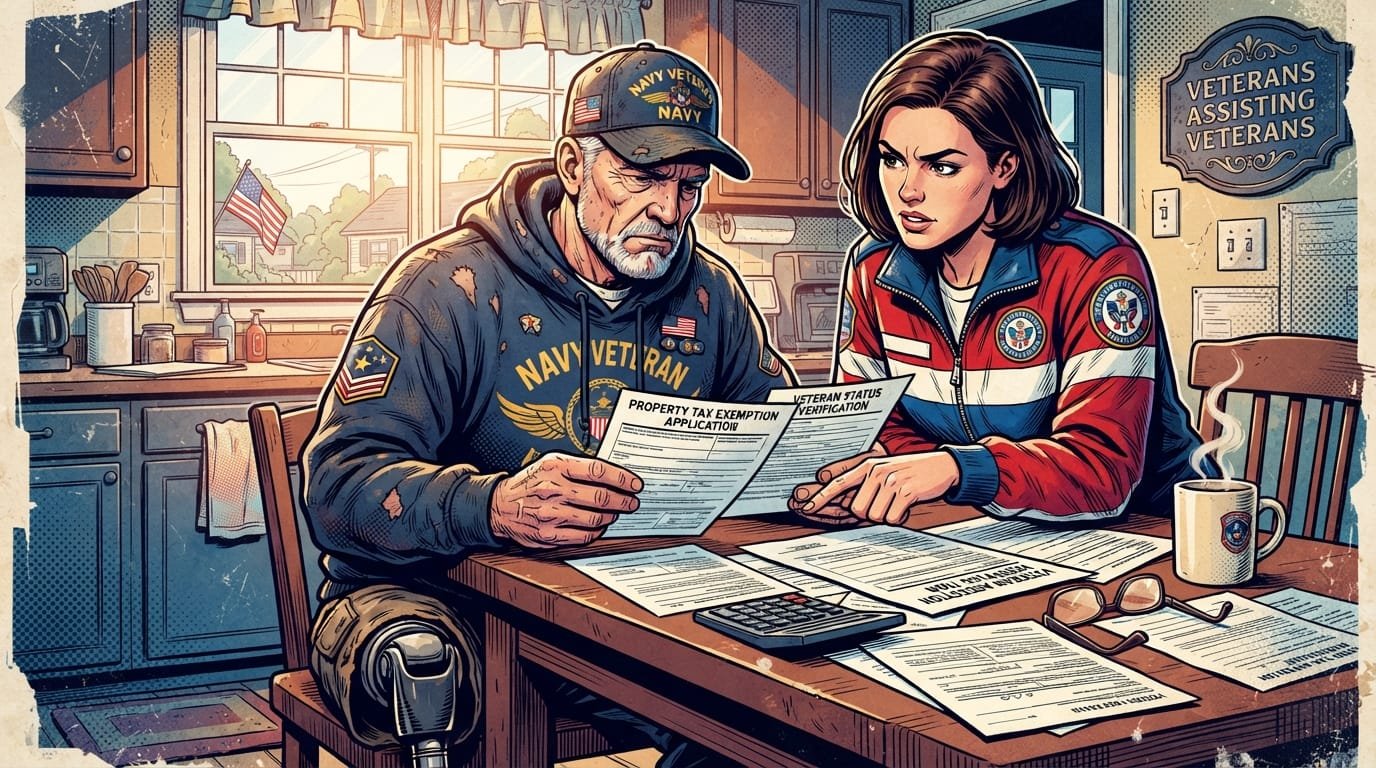
DR-501: Property Tax Exemption application (select “Veteran disabled 10% or more” or “Service-connected totally and permanently disabled veteran”)
DR-501DV: For veterans age 65+ with combat-related disability
DR-501V: Tentative Eligibility Verification (for pre-purchase eligibility checks)
Submit by March 1: Applications must be filed with your county Property Appraiser by March 1 of the tax year.
Submission Methods:
Online through your county’s portal
By email
In person at the county Property Appraiser’s office
Late Applications
If you miss the March 1 deadline, you may file a late application starting March 2 until the expiration of your August Notice of Proposed Property Taxes (TRIM Notice), typically on or before September 20. Late applications may require filing a petition with the Value Adjustment Board and a $15 fee.
Tentative Eligibility Verification
If you are a veteran or surviving spouse planning to purchase or move into a new home, you can request a tentative (non-binding) eligibility verification before filing your next Homestead Exemption application using Form DR-501V. This helps confirm your status before committing to a purchase.
Automatic Renewal and Recertification
Once approved, the Disability Exemption is automatically renewed each year in most counties. You do not need to reapply annually. However, you should:
Keep the automatic renewal receipt your county mails every year for your records
Notify the Property Appraiser promptly if your status or use of the property changes
Penalties for Non-Compliance
Florida law requires property owners to notify the Property Appraiser whenever the use of the property or the owner’s status changes. Failure to do so can result in:
Back taxes for any year within the prior 10 years you were not entitled to the exemption
15% interest per year on the exempted taxes
A penalty of 50% of the taxes exempted
Common Mistakes to Avoid
Mistake 1: Missing the March 1 Deadline
Late applications are possible but more complicated. File by March 1 to avoid additional fees and petitions.
Mistake 2: Not Having Homestead Exemption First
Veteran exemptions cannot be granted without an active Homestead Exemption on the property.
Mistake 3: Assuming Your VA Rating Qualifies
A 10% disability rating qualifies you for the $5,000 reduction. Only a 100% total and permanent rating qualifies for the full exemption.
Mistake 4: Not Notifying the Property Appraiser of Changes
If your disability status changes, you sell the property, or you no longer use it as your homestead, you must notify the county.
Mistake 5: Failing to Provide Complete Documentation
Incomplete applications will be delayed or denied. Submit all required forms and VA documentation.
Mistake 6: Applying for Multiple Programs Incorrectly
You can receive one exemption type based on your circumstances. Ensure you apply for the correct exemption for your situation.
2026 Rule Changes
Effective for the 2026 tax year, the Florida Legislature has expanded the list of qualifying military operations for the deployment exemption (available to service members deployed outside the continental U.S. in support of designated operations). Newly added operations include:
Operation European Assure, Deter and Reinforce
Operations in support of the Pacific Deterrence Initiative
Operation Southern Spear
Operation Sharp Sentry
Operations in Israel and the Gaza Strip’s Mediterranean territorial seas and air spaces
These changes apply to the 2026 property tax roll and take effect upon the act becoming law.
Common Questions
Can I receive both the standard Homestead Exemption and a veteran exemption?
Yes. The veteran exemption is an additional benefit on top of the standard Homestead Exemption. You must have a Homestead Exemption first to qualify.
How do I know if my VA disability is “total and permanent”?
Your VA benefits summary letter will state whether your disability is considered total and permanent. You can obtain this letter through the VA or your local Veterans Service Officer.
Does the exemption transfer if I move within Florida?
Yes. If you sell your property, you may transfer the exemption to a new residence as long as you use it as your primary residence and you do not remarry (for surviving spouses). The transferred exemption cannot exceed the dollar amount granted on the most recent tax roll.
What if my VA rating is less than 100% but I’m unemployable due to my disability?
Veterans with Individual Unemployability (IU) may be considered totally disabled for exemption purposes, even if their VA rating is not 100%. Contact your county Property Appraiser for guidance on your specific situation.
Can surviving spouses get this exemption if the veteran never applied?
Yes. The exemption is available to the unremarried surviving spouse if the veteran was a Florida resident at the time of death and qualified for the exemption based on their disability.
What forms do I need to apply?
You will need Form DR-501 and your VA documentation. For age 65+ combat-related disability, also complete Form DR-501DV.
Do I have to reapply every year?
No. Once approved, the exemption is automatically renewed each year in most counties. However, you must notify the Property Appraiser if your status changes.
Is there an income limit for any of these exemptions?
No. Florida’s veteran property tax exemptions do not have income limits.
What if I miss the March 1 deadline?
You can file a late application until the expiration of your August TRIM Notice. A $15 fee may apply, and you may need to petition the Value Adjustment Board.
Who do I contact for help with my application?
Your county Property Appraiser’s office can assist with the application. For help with VA documentation, contact the Lee County Veterans Services office or your local Veterans Service Officer.
Key Takeaways
Florida offers veteran property tax exemptions ranging from a $5,000 assessed value reduction to full tax exemption depending on disability rating
Eligibility requires permanent Florida residency, an honorable discharge, and homestead status on the property
The March 1 application deadline is critical; late applications are possible but more complicated
Surviving spouses may receive the same exemptions as the veteran if they remain unmarried and continue living on the property
No income limits apply to any veteran property tax exemptions in Florida
Exemptions can transfer to a new property if you move within Florida
For 2026, new military operations have been added to qualifying deployment exemptions
Once approved, exemptions automatically renew in most counties—no annual reapplication required
Failure to notify the Property Appraiser of status changes can result in penalties, back taxes, and interest
Contact your county Property Appraiser or a Veterans Service Officer for application assistance
Official Resources

🇺🇸 IMPORTANT DISCLAIMER – Veterans Benefits Information
This site provides general information about U.S. Department of Veterans Affairs (VA) benefits for educational and informational purposes only.
- Not Official: We are NOT affiliated with, endorsed by, or connected to the U.S. Department of Veterans Affairs (VA), the Veterans Benefits Administration (VBA), the Veterans Health Administration (VHA), or any other government agency.
- No Legal/Financial Advice: The content on this website is for informational purposes only and does not constitute legal, financial, or medical advice. VA benefits rules change frequently – always consult with an accredited Veterans Service Officer (VSO) or a qualified professional for your specific situation.
- Official Sources: For official, binding information and to apply for benefits, always visit official .gov websites: VA.gov, Benefits.VA.gov, or SSA.gov.
- No Data Collection: This site does not collect, store, or process any personal information. It does not have login forms, contact forms, or any system to capture user data. We never ask for your Social Security Number, bank details, or any personal information.
- 🚨 Scam Alert: The VA and other government agencies never charge fees for benefit applications. If anyone asks for money to "process" your VA claim, it is a scam. Report it to the VA Office of Inspector General at VA.gov/OIG.
- Advertising: This site uses third-party advertising (Adsterra) to cover operational costs. We do not endorse or guarantee any products or services advertised.
📌 Information provided as of June 2026. Always verify current eligibility and rules with official .gov sources.
This site is not affiliated with the U.S. Department of Veterans Affairs or any government agency. All information is for educational purposes only. Please visit VA.gov for official information.
