

North Carolina Veteran Property Tax Exemption 2026
If you are a 100% permanently and totally disabled veteran, you may be eligible to exclude $45,000 from the appraised value of your primary residence from property taxes in North Carolina for 2026. There is no age or income limit for this benefit, and it is also available to the unmarried surviving spouses of qualifying veterans. The application deadline is June 1, 2026, and you must apply through your county assessor’s office .
Quick Facts
| Item | Details |
|---|---|
| Benefit | Exclusion of the first $45,000 of appraised value from property taxes |
| Eligibility | 100% permanent & total service-connected disabled veteran, or unmarried surviving spouse |
| Application | County Assessor’s Office (must be filed by June 1) |
| Processing Time | Varies by county; applications are reviewed for the upcoming tax year |
| Official Agency | North Carolina County Tax Departments / N.C. Department of Revenue |
| Required Forms | NCDVA-9 (Certification for Disabled Veterans), AV-9 (Application for Property Tax Relief) |
| Updated For | 2026 Tax Year; pending legislation for future increases |
Understanding the North Carolina Disabled Veteran Property Tax Exclusion
The Disabled Veteran Property Tax Exclusion is a benefit provided by the State of North Carolina that reduces the property tax burden on veterans who have been totally and permanently disabled due to their military service. This program classifies a qualifying permanent residence as a special class of property, allowing for a portion of its value to be exempt from taxation .

In essence, this program helps ensure that veterans who have made significant sacrifices for their country are not financially burdened by property taxes on their homes. For the 2026 tax year, this exclusion applies to the first $45,000 of the property’s assessed value . This means if your home is appraised at $200,000, you will only be taxed on $155,000 of its value.
Why This Matters for Veterans

For many veterans on a fixed income, property taxes can be a significant monthly or annual expense. This exclusion provides substantial tax relief, lowering the overall cost of homeownership. The benefit is particularly important as it allows veterans to allocate funds that would have gone to taxes toward other essential needs like healthcare, home maintenance, or daily living expenses. Because the program has no income or age cap, it is widely accessible to any veteran who meets the disability requirement, making it a powerful tool for financial stability.
Pending Changes for 2026 and Beyond
While the current benefit is set at a $45,000 exclusion, it is crucial to be aware of potential increases. The North Carolina General Assembly has introduced legislation (Senate Bill 128 and House Bill 728) to significantly raise this amount .
2026 Timeline: For taxes imposed for taxable years beginning on or after July 1, 2026, legislation proposes increasing the exclusion from $45,000 to $76,500 .
2027 Timeline: Further legislation proposes increasing the exclusion to $125,000 for taxes imposed for taxable years beginning on or after July 1, 2027 .
Additionally, there is a provision to exclude a motor vehicle owned by a 100% disabled veteran from property tax, provided it is used as a primary personal vehicle . It is recommended to confirm these figures with your local county tax office to ensure you are receiving the most current benefit.
Eligibility: Who Qualifies for the Exemption?
Qualifying for the Disabled Veteran Property Tax Exclusion in North Carolina is a clear-cut process based on service connection and residency. To be eligible, you must meet the following criteria :
Veteran Status: You must have served in the military and received an honorable or under honorable conditions discharge.
Disability Rating: You must have a total and permanent disability that is directly connected to your military service. This is typically defined as a 100% disability rating from the U.S. Department of Veterans Affairs (VA) .
Residency: The property must be your permanent residence, and you must own and occupy it as of January 1 of the year for which you are applying .
Age/Income: There are no age or income limitations for this specific exclusion .
Surviving Spouses
Veterans May Qualify for Extra Benefits
Check available financial assistance, healthcare programs and other opportunities that may apply to you.
Check EligibilityThe benefit is also available to an unmarried surviving spouse of a qualifying veteran. The spouse must not have remarried and must meet the residency requirements . Eligibility extends to surviving spouses of:
A disabled veteran who qualified for the exclusion.
A veteran who died as a result of a service-connected condition .
A servicemember who died in the line of duty from a service-connected condition .
What if I am rated at 100% due to Individual Unemployability (IU)?
Veterans who are rated at 100% due to Individual Unemployability (P&T) are generally considered totally and permanently disabled for the purpose of this benefit, as long as the disability is service-connected. You should still apply and provide your VA benefits summary letter to your county tax office for verification .
Disqualifying Factors
You cannot receive this exclusion in addition to other property tax relief programs, such as the Elderly or Disabled Exclusion or the Circuit Breaker Deferment program. A qualifying owner must choose one . You must also own and occupy the property as your primary residence as of January 1 .
How to Apply for the 2026 Exemption
Applying for the 2026 tax year involves a few straightforward steps. It is recommended to start the process early to avoid missing the strict deadline.
Step-by-Step Application Guide
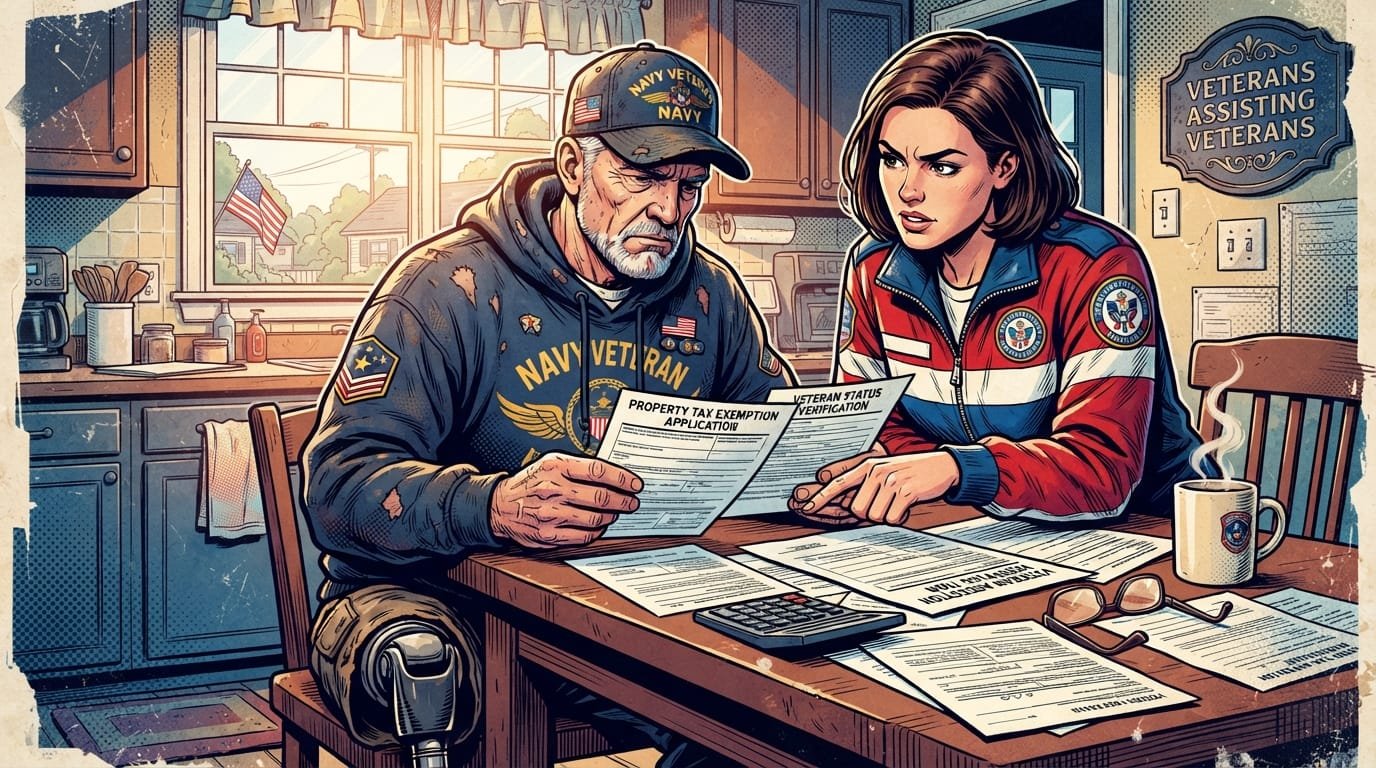
Gather Your Documentation: Before contacting the county office, locate your VA benefits summary letter, which confirms your service-connected disability rating. You will also need identification and the property’s parcel ID number .
Contact Your County Veterans Service Office (VSO): Your local VSO can assist in certifying your eligibility and completing the necessary forms. They often serve as the first point of contact for veterans’ benefits .
Complete the Required Forms:
Form NCDVA-9: This is the “Certification for Disabled Veterans Property Tax Exclusion” form. It must be certified by a Veterans Service Officer .
Form AV-9: This is the general “Application for Property Tax Relief” used by the county tax office .
Submit to the County Tax Office: Submit the completed forms to your County Assessor’s Office or Tax Department. Many counties allow submission via mail, email, or in person .
File by the Deadline: Ensure all applications are submitted by June 1, 2026 .
Online Application
While most counties offer downloadable PDF forms for the application, the submission process is often physical or via email (e.g., scanning and sending forms to the county’s tax department) . Some counties may have online portals for real property exemptions. Check with your specific county for the most up-to-date submission methods .
Required Documents for the 2026 Application
| Document | Description |
|---|---|
| Form NCDVA-9 | Certification for Disabled Veterans Property Tax Exclusion |
| Form AV-9 | Application for Property Tax Relief |
| VA Benefits Summary Letter | Confirms 100% P&T rating |
| ID or Driver’s License | Proof of identity |
| Social Security Number | For identification and verification purposes |
| Property ID Number | Parcel number for the property |
Processing Times and Application Review
The processing time for the 2026 property tax exemption application can vary by county. Generally, assessors will process applications received by the June 1 deadline to ensure they are reflected on the upcoming tax bills, typically mailed in late summer or early fall .
Once you are approved, you generally do not need to reapply every year. County tax offices operate on an audit cycle, often every 8 years, to verify that you still meet the eligibility requirements and still occupy the property . If you are denied, you may have the right to appeal to the county Board of Equalization and Review .
Prequalification Option
In a recent update to state law, disabled veterans and their surviving spouses can now apply for prequalification of this property tax relief. This allows a veteran to determine eligibility before they even purchase a home. The county assessor must provide a decision within 30 days of application, making it easier for veterans to plan their finances .
Common Mistakes to Avoid
Avoiding these common pitfalls can save you time and stress during the application process:
Missing the June 1 Deadline: This is the most common mistake. Filing late generally results in a denial unless “good cause” is proven . Late applications may only be considered for good cause, such as serious illness or active-duty deployment .
Incomplete Paperwork: Failing to include all required forms (NCDVA-9 and AV-9) can delay or nullify your application. Ensure both forms are completed and certified .
Assuming “One and Done”: While you don’t typically reapply, you must report changes in ownership or use (e.g., renting out the property) to the county, as this will disqualify you .
Applying for Multiple Programs: You cannot receive both the Disabled Veteran Exclusion and the Elderly or Disabled Exclusion simultaneously. You must choose the most beneficial program for you .
Appeals Process
If your application is denied, you have the right to appeal. The process typically involves filing an appeal with the county’s Board of Equalization and Review. The Board hears cases based on the facts and circumstances of your situation.
Deadlines: There are strict deadlines to file an appeal. Generally, you must file by a specific date following the denial letter.
Good Cause for Late Filing: If you miss the application deadline, the Board of Equalization and Review may hear your case if you can prove “good cause” for the lateness. Valid reasons include physical or mental illness, death in the family, or active military deployment . Neglect or oversight is not considered good cause .
Common Questions
Is the North Carolina disabled veteran property tax exemption for 2026 a full exemption?
No, it is not a full exemption. The program excludes $45,000 of your home’s appraised value from being taxed. This means you are taxed on the remaining value only . For example, if your house is valued at $200,000, you pay taxes on $155,000.
What happens if I miss the June 1 application deadline for 2026?
If you miss the June 1 deadline, you may still be able to apply if you can prove “good cause” for the lateness. The decision will be made by the County Board of Equalization and Review. If approved, you will not lose the benefit for the year . However, if you cannot prove good cause, you will miss the benefit for that tax year.
Do I have to apply for this exemption every year?
No, the application is a one-time filing. However, county tax offices will audit your eligibility periodically, usually about every 8 years. You will be notified by the county when it is time to recertify your status .
Can I get this exemption if I’m a surviving spouse?
Yes, if you are the unmarried surviving spouse of a veteran who met the qualifications, you are eligible for the exclusion. This includes spouses of veterans who died from a service-connected condition, even if they hadn’t applied previously .
If I have a 100% VA rating but not permanent and total (P&T), am I eligible?
Generally, the state law requires a “total and permanent” disability to qualify for the Disabled Veteran Exclusion. You should contact your local veterans service office or county tax assessor for guidance on your specific VA rating. The rating must be “P&T” or considered so under the individual unemployability (IU) criteria .
What is the income limit for this tax exemption in 2026?
There is no income limit for the Disabled Veteran Property Tax Exclusion in North Carolina .
Can I apply online for this property tax exemption?
Most counties do not have a fully automated online application but do provide downloadable forms on their websites. You can often submit completed forms by email or mail. Check your specific county’s tax website for instructions .
What forms do I need for the 2026 property tax exemption application?
You will typically need Form NCDVA-9 (Certification for Disabled Veterans) and Form AV-9 (Application for Property Tax Relief). These forms can be obtained from your county tax office or veterans service office .
Can I receive this exemption if I also use the Elderly Exclusion?
No, you must choose only one program per tax year. A qualifying owner cannot receive multiple tax relief benefits on the same property .
Is there a new law for 2026 that increases the exemption amount?
Yes, legislation has been introduced to increase the exclusion to $76,500 for taxes imposed for taxable years beginning on or after July 1, 2026 . Confirm the exact amount with your county assessor when applying.
Key Takeaways
The 2026 North Carolina veteran property tax exemption applies to the first $45,000 of a property’s appraised value, with no age or income limits .
Eligibility requires a 100% permanent and total service-connected disability and an honorable discharge .
Surviving spouses who have not remarried are also eligible for the benefit .
Applications are due by June 1, 2026. Missing the deadline typically results in denial unless “good cause” is shown .
You do not need to reapply every year. However, county offices perform periodic audits (e.g., every 8 years) to ensure ongoing eligibility .
Pending legislation aims to increase the exclusion to $76,500 for the 2026 tax year and to higher amounts in 2027 .
Required documentation includes Form NCDVA-9, Form AV-9, and your VA benefits summary letter .
The benefit is not a full exemption; it only excludes $45,000 of the home’s value from taxation .
Veterans can prequalify for this benefit before purchasing a home .
Contact your County Veterans Service Officer or local Tax Assessor’s office for personalized assistance .
Official Resources
VA.gov – Official U.S. Department of Veterans Affairs website for benefits and disability ratings.
N.C. Department of Revenue – The state authority overseeing property tax laws and regulations.
N.C. Division of Veterans Affairs – Provides resources and assistance for veterans in North Carolina.
USA.gov – The official guide to government information and services for veterans.

🇺🇸 IMPORTANT DISCLAIMER – Veterans Benefits Information
This site provides general information about U.S. Department of Veterans Affairs (VA) benefits for educational and informational purposes only.
- Not Official: We are NOT affiliated with, endorsed by, or connected to the U.S. Department of Veterans Affairs (VA), the Veterans Benefits Administration (VBA), the Veterans Health Administration (VHA), or any other government agency.
- No Legal/Financial Advice: The content on this website is for informational purposes only and does not constitute legal, financial, or medical advice. VA benefits rules change frequently – always consult with an accredited Veterans Service Officer (VSO) or a qualified professional for your specific situation.
- Official Sources: For official, binding information and to apply for benefits, always visit official .gov websites: VA.gov, Benefits.VA.gov, or SSA.gov.
- No Data Collection: This site does not collect, store, or process any personal information. It does not have login forms, contact forms, or any system to capture user data. We never ask for your Social Security Number, bank details, or any personal information.
- 🚨 Scam Alert: The VA and other government agencies never charge fees for benefit applications. If anyone asks for money to "process" your VA claim, it is a scam. Report it to the VA Office of Inspector General at VA.gov/OIG.
- Advertising: This site uses third-party advertising (Adsterra) to cover operational costs. We do not endorse or guarantee any products or services advertised.
📌 Information provided as of June 2026. Always verify current eligibility and rules with official .gov sources.
This site is not affiliated with the U.S. Department of Veterans Affairs or any government agency. All information is for educational purposes only. Please visit VA.gov for official information.
