
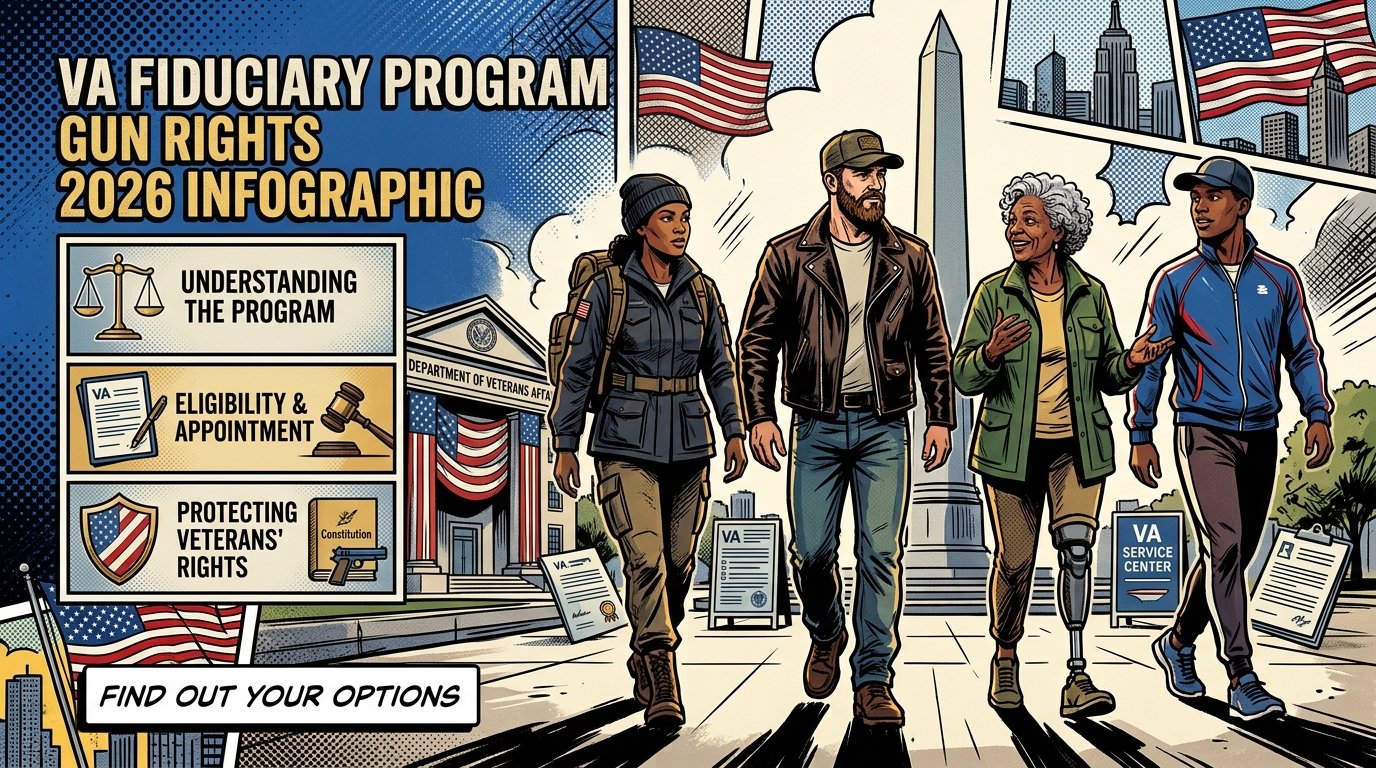
What Are Veteran Arms?
Veteran arms refers to the firearm rights, laws, and programs affecting U.S. veterans, active-duty service members, and their families. In 2026, the most significant change is the VA’s reversal of a three-decade policy that stripped gun rights from veterans in the Fiduciary Program without judicial review. The House also passed the Veterans 2nd Amendment Protection Act. Veterans retain Second Amendment rights unless a court finds them a danger.
Quick Facts
| Item | Details |
|---|---|
| Benefit | Second Amendment rights, firearm training, shooting sports, and safety programs |
| Eligibility | Veterans, active duty, Guard, Reserve, and qualifying family members |
| Application | Varies by program; no VA application for firearm rights |
| Processing Time | Immediate for VA fiduciary policy change; legislation pending in Senate |
| Official Agency | U.S. Department of Veterans Affairs (VA); Bureau of Alcohol, Tobacco, Firearms and Explosives (ATF) |
| Required Forms | DD-214 for military-affiliated shooting programs; no VA forms for firearm rights |
| Updated For | 2026 |
What Is the VA Fiduciary Program?
The VA Fiduciary Program assigns a third party to manage VA benefits for veterans who are unable to manage their own financial affairs. Before February 2026, VA automatically reported veterans in this program to the FBI’s National Instant Criminal Background Check System (NICS) as “prohibited persons,” stripping their Second Amendment rights without a court hearing or finding of dangerousness.

What Changed in February 2026
Effective immediately on February 17, 2026, VA will no longer report veterans to NICS solely because they need help from a fiduciary in managing their VA benefits. This corrects a three-decade-old wrong that deprived many thousands of veterans of their constitutional right to own a firearm without a legal basis.

In consultation with the Department of Justice, VA determined this practice violates both the Gun Control Act and veterans’ Second Amendment rights. According to federal law, a decision by a judicial or quasi-judicial body is needed before someone can be reported to NICS. A determination by VA that a fiduciary is needed to help manage a veteran’s benefits falls far short of this legal standard.
VA is also working with the FBI to remove all past VA reporting from NICS so no veterans are unfairly deprived of their Second Amendment rights based solely on participation in VA’s Fiduciary Program.
What This Means for Veterans
Veterans currently in the Fiduciary Program are no longer reported to NICS solely because they have a fiduciary.
Veterans previously reported to NICS based only on fiduciary status are having their records removed.
Veterans retain Second Amendment rights unless a court finds them a danger to themselves or others.
A fiduciary determination is not the same as a mental incompetency adjudication for firearm prohibition purposes.
The Veterans 2nd Amendment Protection Act (H.R. 1041)
The Veterans 2nd Amendment Protection Act (H.R. 1041) is federal legislation that would permanently prevent VA from stripping veterans of their Second Amendment rights solely because they require financial assistance managing their benefits. The House passed the bill on May 21, 2026, by a vote of 216-201. The bill now awaits consideration in the Senate.
What the Bill Does
Prevents VA from sending a veteran’s information to the DOJ background check system based only on a fiduciary determination.
Requires VA to notify the Attorney General when past referrals were made on that basis alone.
Restores due process protections to veterans who need help managing their finances.
Ensures no VA bureaucrat can strip a veteran’s gun rights without a judge or court ruling first that the veteran is a danger to themselves or their community.
Why It Matters
“Without a judge’s ruling or any finding that a veteran is a danger to anyone, a VA bureaucrat could report them to the FBI’s background check system and strip them of their right to bear arms,” said Chairman Mike Bost (R-IL-12). “That is not how we treat the men and women who defended our Constitution.”
Veterans May Qualify for Extra Benefits
Check available financial assistance, healthcare programs and other opportunities that may apply to you.
Check EligibilityThe bill puts a permanent end to that injustice. As a Marine, proud gun owner, and Chairman of the House Veterans’ Affairs Committee, Bost led the charge for its passage.
Opposition to the Bill
The Brady Campaign to Prevent Gun Violence opposes the bill, arguing that it would allow veterans with severe mental health issues access to firearms. Brady warns that the bill was “crafted to comply with the desires of the gun lobby” and ignores the risks for veterans and their families.
Current Status
The bill passed the House on May 21, 2026, and awaits Senate action. Congress has also prohibited VA from using appropriated funds to report veterans to NICS without a court ruling, at least through September 30, 2026.
State Firearm Laws and Veteran Provisions
State firearm laws vary widely, and some states offer special provisions for veterans and service members. Understanding your state’s laws is essential for lawful firearm ownership and concealed carry.
State-by-State Veteran Firearm Provisions
| State | Veteran Provision |
|---|---|
| Arkansas | Veterans 18-20 who can legally possess a firearm can carry with military ID |
| Florida | Veterans 18-20 who can legally possess a firearm can carry with military ID or state driver’s license |
| Georgia | Discharged veterans 18-20 who can legally possess a firearm can carry with military ID or state driver’s license |
| New Jersey | Bill S1898 would allow honorably discharged veterans and National Guard members to carry handguns |
| Kentucky | Military-veterans legislation tracker includes firearm provisions |
Florida Veteran Concealed Carry
Florida law specifically provides that veterans discharged under honorable conditions qualify for a concealed weapon license. The Department of Agriculture and Consumer Services shall issue a license to carry a concealed weapon or firearm to a veteran of the United States Armed Forces who was discharged under honorable conditions.
Permitless Carry and Veterans
Several states have permitless carry laws with special provisions for veterans:
Alabama: Permitless carry for 21+, but veterans 18+ may qualify
Florida: Permitless carry for 21+, with military ID provisions for veterans 18-20
Georgia: Permitless carry for 21+, with military ID provisions for veterans 18-20
Arkansas: Permitless carry for 21+, with military ID provisions for veterans 18-20
Nationwide Concealed Carry for Special Operations Veterans
A new bill in Congress could grant qualified special operations veterans and active-duty personnel nationwide concealed carry privileges, overriding state-level restrictions that vary significantly across jurisdictions.
The Special Operations Concealed Carry Act
The bill, introduced by Rep. Pat Harrigan (R-NC), would allow qualified active-duty and honorably discharged special operations personnel to carry concealed firearms across state lines. Eligible units would include:
Army Special Forces
75th Ranger Regiment
Delta Force
Navy SEALs
Marine Corps Scout Snipers
Reconnaissance Marines
Requirements for Eligibility
Proof of identity: Photo ID issued by the Department of Defense and Department of Veterans Affairs
Firearms qualification: Current military firearms qualification
Requalification: Requirement to maintain firearms proficiency
Honorable discharge for veterans
Veteran Shooting Sports and Marksmanship Programs
Veterans have access to several shooting sports and marksmanship programs that provide training, competition, and camaraderie. These programs are open to veterans of all experience levels.
Civilian Marksmanship Program (CMP)
The CMP is a federally chartered nonprofit that promotes firearm safety and marksmanship training. It offers specific programs for veterans and veteran organizations.
Veteran Benefits:
Purple Heart recipients: 50% off CMP-administered events including Travel Games, Highpower Warm-Up Events, and National Matches
All veterans: 10% off entry fees at select competitions
Congressionally chartered veterans’ organizations (VFW, American Legion, DAV, MCL) are recognized as CMP special affiliates, allowing members to purchase military surplus items
CMP Games matches: 21 matches that allow competitors to reenact military and marksmanship history in a relaxed, challenging environment
CMP Veteran Programs
The CMP supports several veteran programs including hunting and marksmanship events. It has been providing volunteers to inspect and repair ceremonial rifles at veteran organizations since 2003. The CMP also supports the Marine Corps Wounded Warrior Trials and provides scholarships to junior marksmen.
NRA Marksmanship Qualification Program
The NRA’s Marksmanship Qualification Program (MQP) has been training shooters since 1903. It offers 21 different courses of fire and serves as a guide for instructors and coaches. Veterans can participate through local clubs and ranges.
Adaptive Shooting Programs
BlazeSports America Veteran Air Rifle provides veterans with the opportunity to learn the fundamentals of air rifle shooting, including proper technique, safety protocols, and precision shooting. Sessions are held weekly at J.P. Carr Community Center.
NRA/ARA Adaptive Championships are open to injured serving or veteran personnel from British or Overseas Forces. Events include rapid-fire matches with targets advancing from 25 meters and precision matches at 25 meters.
LEEK Hunting and Mountain Preserve
LEEK Hunting Preserve provides services for wounded veterans including guided hunts and recreational shooting opportunities.
Firearm Safety and Suicide Prevention Programs
Veterans have higher rates of firearm ownership than the general population—44.9% of veterans own one or more firearms, and 57.4% have access to firearms in their home. Firearm injuries account for 73.3% of suicide deaths among veterans, compared to 52.9% among non-veteran adults.
Overwatch Project
The Overwatch Project is a peer intervention training and education program focused on firearms suicide prevention specifically tailored to military and veteran audiences. The program equips service members and veterans to intervene with at-risk friends and loved ones. It has partnered with Sig Sauer to provide additional safety and firearms education.
VA Firearms Safe Handling VR Experience
VA has developed a Firearms Safe Handling Virtual Reality (VR) experience as an immersive introduction to firearms, ammunition, and proper safety techniques. The program is designed for VA healthcare providers to increase familiarity with firearms in a non-threatening environment.
FFAST Program
The VA’s Firearm Suicide Prevention and Safety Training (FFAST) program engages veterans and their support persons in conversations about safe storage and lethal means safety planning. FFAST emphasizes respectful, veteran-centered dialogue that promotes safety planning, encourages secure firearm storage, and supports veterans in making informed decisions about their well-being. The program recommends using gun safes or lockboxes and storing firearms unloaded and separately from ammunition.
Counseling on Access to Lethal Means (CALM)
CALM is a training program that teaches healthcare providers and community members how to counsel individuals at risk of suicide on reducing access to lethal means, including firearms. The New York Health Foundation has supported a multiyear effort to expand and adapt CALM, including developing and pilot-testing a secure firearm storage workshop in New York counties.
Willingness to Discuss Firearms
Most veterans are willing to discuss firearms with a family member (88.4%), friends (84.0%), or a healthcare provider (72.4%). However, only 12.9% indicated that a healthcare provider had ever asked them about their firearm access. This gap presents an opportunity for improved suicide prevention efforts.
Firearm Ownership and Storage Statistics for Veterans
Understanding firearm ownership and storage patterns among veterans helps inform safety initiatives and policy discussions.
Key Statistics
| Statistic | Percentage |
|---|---|
| Veterans with access to firearms in their home | 57.4% |
| Veterans who own one or more firearms | 44.9% |
| Veterans storing at least some firearms unlocked | 53.7% |
| Veterans storing at least some firearms loaded | 49.0% |
| Veterans with firearms for protection against people | 74.3% |
| Male veterans who own firearms | 47.2% |
| Female veterans who own firearms | 24.4% |
| Veterans who own both handguns and long guns | 56.5% |
Why These Numbers Matter
More than half of veterans have access to firearms in their home, an important risk factor for suicide. Veterans also have more training with firearms than most U.S. citizens and a higher prevalence of firearm ownership. More than half of veteran firearm owners report owning multiple firearm types, with the average number owned being six. One third of veteran firearm owners report storing their firearms loaded and unlocked.
How to Exercise Your Firearm Rights as a Veteran
Veterans retain Second Amendment rights under federal law unless prohibited by a judicial finding of dangerousness, a felony conviction, a dishonorable discharge, or other disqualifying condition. Understanding your rights and responsibilities is essential.
Steps to Exercise Your Rights
Know your status. Veterans in the Fiduciary Program are no longer automatically reported to NICS. If you were previously reported, VA is working to remove past records.
Check your record. You can request a background check through an FBI-approved channeler or check your criminal history through the FBI’s Identity History Summary.
Understand state laws. Firearm laws vary by state. Know the laws where you live, work, and travel.
Complete a firearm safety course. Many states require safety training for concealed carry permits. Even where not required, training improves safety and confidence.
Store firearms safely. Use gun safes or lockboxes. Store firearms unloaded and separately from ammunition to reduce suicide risk.
Know your rights if denied. If you are denied a firearm purchase, you have the right to appeal the denial through the FBI or ATF.
Who Is Prohibited from Firearm Ownership
Under federal law (18 U.S.C. § 922(g)), the following categories of people are prohibited from possessing firearms:
Convicted felons
Fugitives from justice
Unlawful users of controlled substances
Persons adjudicated as mental defectives or committed to mental institutions
Illegal aliens
Persons discharged from the Armed Forces under dishonorable conditions
Persons who have renounced U.S. citizenship
Persons subject to domestic violence restraining orders
Persons convicted of misdemeanor domestic violence
Common Mistakes to Avoid
Veterans navigating firearm laws and rights frequently make these errors.
Assuming VA fiduciary status equals firearm prohibition. As of February 2026, a fiduciary determination alone does not prohibit firearm ownership. Only a judicial finding of dangerousness can do so.
Not checking state laws before traveling. Concealed carry reciprocity varies by state. Know the laws where you travel.
Ignoring safe storage practices. One third of veteran firearm owners store firearms loaded and unlocked. Safe storage reduces suicide risk and prevents accidents.
Assuming military training qualifies for concealed carry. Military firearms training may satisfy some state requirements, but not all. Check your state’s requirements.
Not appealing a wrongful NICS denial. If you are wrongly denied a firearm purchase, you have the right to appeal. Contact the FBI or ATF.
Failing to document firearm qualifications. For programs like the Special Operations Concealed Carry Act, proof of firearms qualification is required.
Missing CMP veteran discounts. Purple Heart recipients receive 50% off CMP events; all veterans receive 10% off entry fees at select competitions.
Not discussing firearm safety with healthcare providers. Most veterans are willing to discuss firearms with providers, but only 12.9% report being asked. Start the conversation.
Common Questions
1. Can veterans own firearms?
Yes. Veterans retain Second Amendment rights under federal law unless prohibited by a judicial finding of dangerousness, a felony conviction, a dishonorable discharge, or other disqualifying condition. As of February 2026, VA no longer reports veterans to NICS solely because they need a fiduciary to manage their VA benefits.
2. What changed with VA and gun rights in 2026?
Effective February 17, 2026, VA stopped reporting veterans in the Fiduciary Program to the FBI’s NICS database as prohibited persons solely because they need help managing their benefits. VA is also working with the FBI to remove past VA reporting from NICS. This corrects a three-decade-old wrong that deprived thousands of veterans of their Second Amendment rights without due process.
3. What is the Veterans 2nd Amendment Protection Act?
H.R. 1041, the Veterans 2nd Amendment Protection Act, prevents VA from sending a veteran’s information to the DOJ background check system based only on a fiduciary determination. The House passed the bill 216-201 on May 21, 2026. It awaits Senate action.
4. Does having a VA fiduciary affect my gun rights?
No. As of February 2026, having a VA fiduciary does not automatically strip your Second Amendment rights. Only a court finding that you are a danger to yourself or others can prohibit firearm ownership. VA is removing past fiduciary-based NICS records.
5. Can veterans get concealed carry permits?
Yes. Veterans can apply for concealed carry permits in states that issue them. Some states have special provisions for veterans, including reduced fees or alternative qualification paths. Florida, Arkansas, and Georgia allow veterans 18-20 to carry with military ID.
6. What is the Special Operations Concealed Carry Act?
This bill would grant nationwide concealed carry privileges to qualified active-duty and honorably discharged special operations personnel, including Army Special Forces, Navy SEALs, Marine Corps Scout Snipers, and others. It requires proof of identity, firearms qualification, and requalification.
7. What shooting sports programs are available to veterans?
The Civilian Marksmanship Program (CMP) offers veterans discounts on competitions and matches. Purple Heart recipients receive 50% off CMP-administered events; all veterans receive 10% off entry fees. BlazeSports America offers adaptive air rifle programs. The NRA Marksmanship Qualification Program provides structured training.
8. Do veterans have higher rates of firearm ownership than civilians?
Yes. 44.9% of veterans own one or more firearms, and 57.4% have access to firearms in their home. Male veterans (47.2%) are more likely to own firearms than female veterans (24.4%). Most veteran firearm owners own both handguns and long guns.
9. What is the VA doing about firearm suicide prevention?
VA offers the Firearm Suicide Prevention and Safety Training (FFAST) program, which engages veterans and their support persons in conversations about safe storage and lethal means safety planning. VA also developed a Firearms Safe Handling VR experience for healthcare providers.
10. What is the Overwatch Project?
The Overwatch Project is a peer intervention training and education program focused on firearms suicide prevention for military and veteran audiences. It equips service members and veterans to intervene with at-risk friends and loved ones. It has partnered with Sig Sauer for additional safety education.
11. Can I lose my gun rights for seeking mental health care?
No. Seeking mental health care does not automatically prohibit firearm ownership. Only a judicial finding that you are a danger to yourself or others can prohibit firearm ownership. Voluntary mental health treatment does not trigger firearm prohibition.
12. What states have special veteran firearm provisions?
Florida, Arkansas, and Georgia allow veterans 18-20 to carry with military ID. New Jersey has proposed legislation (S1898) to allow honorably discharged veterans to carry handguns. Several states offer reduced fees or alternative qualification paths for veterans seeking concealed carry permits.
13. How do I appeal a NICS denial?
If you are denied a firearm purchase, you can appeal through the FBI’s NICS Appeal process or through the Bureau of Alcohol, Tobacco, Firearms and Explosives (ATF). You will need to provide documentation showing you are not prohibited from firearm ownership.
14. What is the CMP veteran discount?
Purple Heart recipients receive 50% off CMP-administered events, including Travel Games, Highpower Warm-Up Events, and National Matches. All veterans receive 10% off entry fees at select competitions. Members of VFW, American Legion, DAV, and MCL are recognized as CMP special affiliates.
15. What should I do if I was wrongly reported to NICS?
If you were wrongly reported to NICS based solely on VA fiduciary status, VA is working with the FBI to remove past records. You can also file a NICS appeal. Contact VA or the FBI for assistance. The Veterans 2nd Amendment Protection Act, if enacted, would require VA to notify the Attorney General of past referrals made on that basis alone.
Key Takeaways
VA stopped reporting veterans in the Fiduciary Program to NICS as of February 17, 2026, restoring Second Amendment rights to thousands of veterans without judicial findings.
The Veterans 2nd Amendment Protection Act (H.R. 1041) passed the House 216-201 on May 21, 2026, and awaits Senate action.
A VA fiduciary determination alone does not prohibit firearm ownership. Only a judicial finding of dangerousness can do so.
Veterans have higher firearm ownership rates than civilians: 44.9% own one or more firearms, and 57.4% have access to firearms at home.
Firearm injuries account for 73.3% of veteran suicide deaths. Safe storage and lethal means counseling are critical.
The CMP offers veteran discounts: Purple Heart recipients get 50% off CMP events; all veterans get 10% off entry fees at select competitions.
Special operations veterans may soon have nationwide concealed carry under a new bill in Congress.
Most veterans are willing to discuss firearms with family (88.4%) and providers (72.4%), but only 12.9% report being asked by a healthcare provider.
Check state laws before traveling with firearms. Concealed carry reciprocity varies widely.
Appeal a wrongful NICS denial through the FBI or ATF if you are wrongly prohibited from purchasing a firearm.
Official Resources
VA Fiduciary Program: va.gov/family-member-benefits/va-fiduciary-program/
VA Second Amendment Rights News Release: news.va.gov/press-room/va-undoes-decades-old-wrong-and-protects-veterans-second-amendment-rights/
Civilian Marksmanship Program (CMP): thecmp.org
CMP Veteran Discounts: thecmp.org/cmp-veteran-discounts/
FBI NICS Appeal: fbi.gov/services/cjis/nics/appeals
Bureau of Alcohol, Tobacco, Firearms and Explosives (ATF): atf.gov
VA Suicide Prevention: va.gov/health-care/health-needs-conditions/suicide-prevention/
VA Firearms Safe Handling VR Experience: marketplace.va.gov
Overwatch Project: overwatchproject.org
USA.gov Veterans Benefits: usa.gov/veterans-benefits




🇺🇸 IMPORTANT DISCLAIMER – Veterans Benefits Information
This site provides general information about U.S. Department of Veterans Affairs (VA) benefits for educational and informational purposes only.
- Not Official: We are NOT affiliated with, endorsed by, or connected to the U.S. Department of Veterans Affairs (VA), the Veterans Benefits Administration (VBA), the Veterans Health Administration (VHA), or any other government agency.
- No Legal/Financial Advice: The content on this website is for informational purposes only and does not constitute legal, financial, or medical advice. VA benefits rules change frequently – always consult with an accredited Veterans Service Officer (VSO) or a qualified professional for your specific situation.
- Official Sources: For official, binding information and to apply for benefits, always visit official .gov websites: VA.gov, Benefits.VA.gov, or SSA.gov.
- No Data Collection: This site does not collect, store, or process any personal information. It does not have login forms, contact forms, or any system to capture user data. We never ask for your Social Security Number, bank details, or any personal information.
- 🚨 Scam Alert: The VA and other government agencies never charge fees for benefit applications. If anyone asks for money to "process" your VA claim, it is a scam. Report it to the VA Office of Inspector General at VA.gov/OIG.
- Advertising: This site uses third-party advertising (Adsterra) to cover operational costs. We do not endorse or guarantee any products or services advertised.
📌 Information provided as of June 2026. Always verify current eligibility and rules with official .gov sources.
This site is not affiliated with the U.S. Department of Veterans Affairs or any government agency. All information is for educational purposes only. Please visit VA.gov for official information.
