
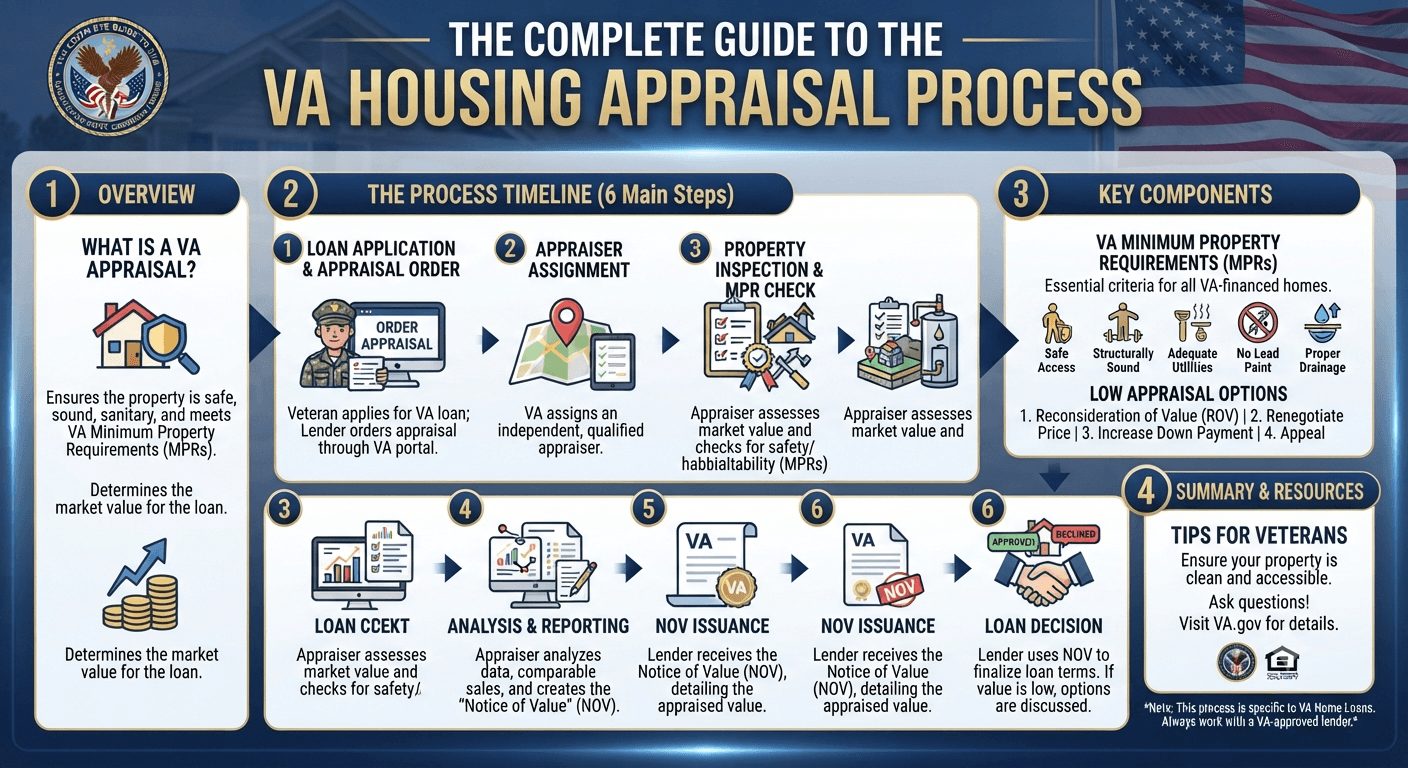
The Complete Guide to the VA Housing Appraisal Process
🇺🇸 Resources for Veterans
Access exclusive support, benefits & services tailored for you.
👉 Check Opportunities Now Sponsored content — you may find this usefulThe VA housing appraisal is a mandatory evaluation ordered by your lender to determine a property’s fair market value and verify it meets the Department of Veterans Affairs’ Minimum Property Requirements (MPRs). Conducted by a VA-approved appraiser, it protects you from overpaying for an unsafe home and ensures the property is safe, structurally sound, and sanitary before your VA loan is approved .
Quick Facts
| Item | Details |
|---|---|
| Benefit | VA Home Loan Appraisal |
| Eligibility | Veterans, active duty, National Guard, Reservists, and surviving spouses eligible for a VA loan |
| Application | Ordered by your VA-approved lender through the VA portal |
| Processing Time | Typically 7 to 14 days (inspection takes ~30-60 minutes) |
| Official Agency | U.S. Department of Veterans Affairs (VA) |
| Required Forms | Appraisal report prepared by VA-approved appraiser; buyer does not complete a form |
| Updated For | 2026 (fees and regional timelines may vary) |
What Is the VA Housing Appraisal Process?
The VA appraisal process is the official method the Department of Veterans Affairs uses to evaluate a home you intend to purchase with a VA loan. It serves a dual purpose: establishing the property’s fair market value and ensuring the home meets the VA’s Minimum Property Requirements (MPRs). The process is initiated by your lender, not by you directly, and is a critical step in securing your loan .

Unlike a conventional loan appraisal, which focuses solely on value, a VA appraisal includes a property condition review. It is required for most VA purchase loans and protects service members from purchasing overpriced or unsafe properties. The VA’s oversight ensures that the appraiser is independent, and the process is standardized nationwide, though costs and timelines may vary by location .

The VA appraisal is not a home inspection. While the appraisal checks for basic safety and livability, a home inspection is a more thorough, optional examination that you as the buyer can arrange to identify potential issues that an appraisal might miss .
Step-by-Step Guide to the VA Appraisal Process
Navigating the VA appraisal process can seem complex, but understanding the steps helps you anticipate what happens next.
Step 1: Your Lender Orders the Appraisal
After you sign a purchase agreement and your lender receives your complete application, they will order the VA appraisal. The lender does this through the VA’s online portal. You cannot order this yourself, and the lender cannot select a specific appraiser to maintain objectivity and fairness .
Step 2: The VA Assigns a VA-Approved Appraiser
The VA assigns a licensed, VA-approved appraiser from its roster. These appraisers have specialized training in VA requirements and maintain independence from all parties to ensure an unbiased assessment .
Step 3: The Appraiser Conducts the Property Inspection
Veterans May Qualify for Extra Benefits
Check available financial assistance, healthcare programs and other opportunities that may apply to you.
Check EligibilityThe appraiser schedules a visit to the property. The on-site inspection typically takes 30 to 60 minutes. During this time, they will inspect the interior and exterior to evaluate the property’s condition and compliance with MPRs. They will also take photos and measurements .
Step 4: The Appraiser Conducts a Market Analysis
Alongside the property inspection, the appraiser researches the local market to determine the home’s value. They look for at least three comparable homes (known as “comps”) that are similar in size, age, and condition and have recently sold in the area. This is how they establish the fair market value .
Step 5: The Appraisal Report Is Submitted
After the inspection and analysis, the appraiser prepares a final report. The report includes the estimated fair market value of the property, a checklist of MPR compliance, and any repairs required for the property to meet VA standards. The appraiser then submits this report to the VA or the lender’s Staff Appraisal Reviewer for final review .
Step 6: You Receive the Appraisal Results
Your lender will inform you of the outcome. If the appraised value meets or exceeds the purchase price and the property passes the MPR inspection, the loan can proceed to closing. If there are issues, your lender and real estate agent will guide you through your options .
VA Minimum Property Requirements (MPRs)
To be approved for a VA loan, a home must meet the VA’s Minimum Property Requirements (MPRs). These are standards designed to ensure veterans and military families purchase homes that are safe, structurally sound, and sanitary. The VA wants to prevent service members from buying a “money pit” that requires immediate, expensive repairs .
During the appraisal, the VA appraiser will check for these requirements. It is important to note that MPRs are baseline standards, not a guarantee that every system in the home is in perfect working order .
Key MPR Categories
| Category | What the Appraiser Checks |
|---|---|
| Safety and Access | Safe, all-weather access to the home; secure handrails; functional locks; absence of obvious tripping hazards |
| Structure and Roof | The foundation must be sound with no major cracks; roof must be in good condition, with no leaks and “reasonable future utility” |
| Utilities and Mechanical Systems | Safe, functional electrical system; permanent heating system capable of maintaining at least 50°F in plumbing areas; safe drinking water and sewage disposal |
| Sanitation | Continuous supply of safe, potable water; hot water for bathing and washing; approved sewage system (public or private) |
| Environmental and Health Hazards | Homes built before 1978 are presumed to have lead-based paint; cracked or peeling paint must be remediated. Must be free of wood-destroying pests, dry rot, and fungus |
| Adequate Living Space | The home must have enough space for everyone to live, sleep, cook, and use sanitary facilities. There is no set square footage minimum, but the space must be functional |
Additional MPR Notes
Manufactured Homes: Must be permanently affixed to a foundation and comply with HUD code requirements .
Condos: The entire condo project must be VA-approved for a unit to be eligible for a VA loan .
Multi-Unit Properties: You can purchase up to four units with a VA loan, provided you live in one of them and all units meet MPRs .
What Happens If the Appraisal Is Lower Than the Purchase Price?
If the VA appraiser determines that the fair market value of the property is less than the agreed-upon purchase price, it can create a funding gap. Your lender will only approve a loan up to the appraised value . However, you have several options:
1. The VA Tidewater Initiative
This is a process unique to VA loans designed to prevent a low appraisal from becoming final. When the appraiser believes the value will be below the contract price, they must issue a “Tidewater” notice to your lender. The lender and your real estate agent then have 48 hours to submit additional comparable sales data to support the purchase price. The appraiser will review this data before finalizing the report. This process can be faster than a formal Reconsideration of Value .
2. Request a Reconsideration of Value (ROV)
If the appraisal is finalized at a low value, you can request a formal ROV. This process involves your lender submitting new, relevant comparable sales data to the VA to challenge the appraiser’s value. This can be a slower process compared to Tidewater .
3. Negotiate with the Seller
If the appraisal comes in low, you can use it as leverage to negotiate a lower purchase price. The seller may be willing to drop the price to the appraised value to keep the deal alive .
4. Pay the Difference in Cash
You can choose to pay the difference between the appraised value and the purchase price out of pocket. This is generally not recommended as it means you are immediately “underwater” on your mortgage, but it is an option .
5. Walk Away
VA loans include an appraisal contingency (the VA Amendment to Contract) that protects you. If the property appraises for less than the purchase price, you have the legal right to cancel the purchase agreement and get your earnest money deposit back .
VA Appraisal Cost and Timeline
Understanding the costs and the timeline will help you budget and plan your home purchase effectively.
How Much Does a VA Appraisal Cost?
The borrower is typically responsible for paying the VA appraisal fee. This is usually paid upfront and is considered a non-refundable closing cost, even if the loan does not close . The costs are set by the Department of Veterans Affairs by region and can vary by state and property type .
| Region | Typical Cost Range |
|---|---|
| Standard Single-Family Home | $450 – $800 |
| High-Cost Areas / Rural Areas | Up to $1,300 |
| Manufactured Home / Multi-Unit | Higher, varies by location |
Source: VA guidelines; costs set by region and reviewed in 2025-2026 .
How Long Does a VA Appraisal Take?
Once your lender orders the appraisal, the process typically takes 7 to 14 days, though it can take up to 20 days in high-demand areas .
Inspection: Approximately 30 to 60 minutes on-site.
Report Submission: The appraiser then writes up the report, which takes the majority of the 7-14 day timeline .
VA Appraisal vs. Home Inspection: Key Differences
A common source of confusion for homebuyers is the difference between a VA appraisal and a home inspection. Both are assessments of the property but serve different purposes.
Comparison: VA Appraisal vs. Home Inspection
| Feature | VA Appraisal | Home Inspection |
|---|---|---|
| Purpose | Determine market value and ensure property meets safety and livability standards (MPRs) | Provide a detailed evaluation of the home’s overall condition, identifying defects |
| Required? | Mandatory for a VA purchase loan | Optional but highly recommended |
| Who Orders? | Lender | Buyer |
| Who Conducts? | VA-approved appraiser | Licensed home inspector chosen by buyer |
| Cost | $450 – $800 (non-refundable) | $300 – $500 (varies by inspector and property) |
| Focus | Value of home, basic safety, and MPR compliance | Every major system: roof, foundation, HVAC, plumbing, electrical, etc. |
| Used For | Loan approval | Buyer’s decision-making and negotiation |
Note: A home inspection is your best protection against unexpected, costly repairs. Even though a VA appraisal is required, it is not a substitute for a professional home inspection.
Common Questions About the VA Appraisal Process
1. What exactly does a VA appraiser look for during the inspection?
The VA appraiser examines the property to ensure it is safe, structurally sound, and sanitary. They check for working utilities, a sturdy roof, sound foundation, proper drainage, and adequate heating. They also look for health hazards like lead-based paint, wood-destroying pests, and mold. The goal is to ensure the home meets the VA’s Minimum Property Requirements .
2. How long is a VA appraisal good for?
The Notice of Value (NOV) produced from the appraisal is generally valid for six months from the date of the report. If your loan doesn’t close within that timeframe, your lender may need to order a new appraisal or update the existing one .
3. Can a seller do repairs to meet VA MPRs?
Yes. If an appraisal is “subject to repairs,” it means the home must be fixed before the VA loan can close. The seller is often willing to make these repairs, or they may offer a concession to the buyer to complete them after closing. The repairs must be completed and a re-inspection done before closing .
4. Are VA appraisals easier to pass than FHA?
FHA and VA appraisals are both stricter than conventional loans but have different focuses. FHA appraisals can be more stringent on minor cosmetic issues and require a HUD seal for manufactured homes. VA appraisals focus heavily on health and safety and have specific requirements for road access and the Tidewater process. Both are rigorous .
5. Does the VA appraiser check for termites?
Yes, the VA appraisal process requires the examination of the home for evidence of termites and other wood-destroying insects. Active or previous infestations will require a separate termite inspection and repair. In some states, a pest inspection is mandatory regardless of visible signs .
6. What if the home needs a few minor repairs to meet MPRs?
The appraiser will note these repairs and prepare the appraisal as “subject to completion.” This means the loan cannot close until the repairs are made and the appraiser has verified they are complete. This is a common occurrence and does not automatically kill the deal .
7. What is the VA Tidewater Initiative?
The Tidewater Initiative is a process triggered when a VA appraiser’s estimated value is below the purchase price. Before the appraisal is finalized, they must notify the lender, who then has 48 hours to provide additional comparable sales to support a higher price. It acts as a safety net to prevent a low appraisal from ending the deal .
8. Does the VA appraisal stick with the property if the sale falls through?
No. A VA appraisal is tied to both the property and the specific loan application. If you do not close on the home or switch lenders, you will generally need a new VA appraisal. However, if a new buyer also uses a VA loan, a new appraisal will be required .
9. Who pays for the VA appraisal, the buyer or the seller?
The VA requires that the veteran buyer pays for the appraisal. This fee is often paid upfront and collected by the lender. It can be negotiated as part of the closing costs or seller concessions, but the responsibility initially falls on the buyer .
10. Can I waive my VA appraisal contingency?
While it’s possible, it’s highly discouraged. The appraisal contingency protects you from being forced to pay more than a home is worth. Waiving it means you lose the right to back out and keep your earnest money if the appraisal comes in low .
11. What are the heating requirements for a VA appraisal?
The home must have a permanent heating system capable of maintaining a temperature of at least 50 degrees Fahrenheit in areas with plumbing. Portable space heaters do not qualify as a permanent heat source .
12. Does a VA loan require a home inspection if the appraisal is clear?
No, a home inspection is not required for a VA loan. However, a professional home inspection is strongly recommended. The VA appraisal is not a substitute for a full inspection; it only checks for minimum health and safety standards, not the home’s overall condition .
Key Takeaways
The VA appraisal is mandatory for all VA purchase loans. It has two functions: to assess the home’s value and to verify it meets the VA’s Minimum Property Requirements (MPRs) for safety and livability .
The VA appraisal process is initiated by your lender, not you. An independent, VA-approved appraiser is assigned to conduct the evaluation .
Minimum Property Requirements (MPRs) ensure the home is safe, structurally sound, and sanitary. Common MPR issues include peeling lead-based paint, faulty roofs, and non-functioning utilities .
A low appraisal is not the end of the deal. You can use the Tidewater process, request a Reconsideration of Value (ROV), negotiate with the seller, or walk away .
VA appraisal vs. home inspection: A VA appraisal is a lender requirement; a home inspection is an optional but highly recommended buyer protection. They are not interchangeable .
Costs range from $450 to $800+ and are paid by the buyer. The timeline is generally 7 to 14 business days .
The VA Tidewater Initiative is a unique protection that allows you to challenge a low appraisal before it becomes final, giving you 48 hours to submit additional comparable sales data .
A Reconsideration of Value (ROV) is the formal appeal process available after the appraisal is finalized .
Understanding MPRs upfront can save you time and money. Knowing what appraisers look for will help you evaluate potential homes .
Be prepared for delays. Demand and regional factors can extend the appraisal timeline, so work with an experienced VA lender and real estate agent to navigate the process .
Official Resources
U.S. Department of Veterans Affairs (VA) Home Loans: VA.gov – The official government site for all VA loan benefits, eligibility, and program updates.
VA Lender’s Handbook (M26-1, Chapter 12): The official guide for Minimum Property Requirements. – Available at VA.gov.
U.S. Department of Housing and Urban Development (HUD): For information on lead-based paint, flood zones, and other property standards. – Available at HUD.gov.
USA.gov: The official guide to government information and services, including VA benefits. – Available at USA.gov.
VA Appraisal Requirements and MPRs Explained
A VA housing appraisal is a mandatory property valuation ordered by your lender to protect you from overpaying for a home and ensure the property meets the Department of Veterans Affairs‘ safety and livability standards. This appraisal is a non-negotiable requirement for all VA-backed purchase loans, serving as a critical safeguard for veterans, active-duty service members, and surviving spouses using their hard-earned home loan benefit.
What Is a VA Housing Appraisal?
A VA housing appraisal is an official evaluation of a property’s fair market value and its compliance with the VA’s Minimum Property Requirements (MPRs). Conducted by a state-certified, VA-approved appraiser, this process is fundamentally different from a home inspection because it serves two distinct purposes: establishing an objective property value and verifying basic health and safety standards. The appraisal protects you from financial loss by ensuring you don’t pay more than a home is worth, while also shielding lenders from lending more than the property’s actual value.
Who Qualifies for a VA Loan and Appraisal?
You qualify for a VA loan and the accompanying appraisal process if you meet specific service requirements. Eligible individuals include:
Veterans who served on active duty and received an honorable discharge
Current active-duty service members
National Guard and Reserve members who meet length-of-service requirements
Surviving spouses of veterans who died in service or from a service-connected disability
Why this matters: Your VA loan eligibility is what triggers the appraisal requirement. Without an established Certificate of Eligibility (COE), you cannot access the VA loan program or its appraisal protections. The appraisal is not optional—it is a required step that exists specifically to protect you and your family from unsafe housing and financial exploitation.
What to do next: Obtain your Certificate of Eligibility (COE) through the VA’s eBenefits portal or ask your lender to secure it on your behalf. Once you have your COE and a signed purchase agreement, your lender will order the VA appraisal automatically.
Why the VA Appraisal Process Exists
The VA appraisal process exists for a single, veteran-focused reason: to protect you from buying a home that is overpriced, unsafe, or structurally unsound. Unlike conventional loans, which prioritize protecting the lender’s investment, the VA appraisal is designed with your interests at the forefront.
Here is what the appraisal accomplishes:
Prevents overpayment: The appraiser determines fair market value so you never pay more than a home is worth
Ensures basic habitability: The appraiser checks for safety hazards, structural issues, and sanitation problems
Provides a financial safety net: If the appraisal comes in low, you have legal protections like the Tidewater Initiative and the right to walk away with your earnest money
The VA’s oversight ensures appraisers remain independent and unbiased. Your lender cannot choose the appraiser, and you cannot influence the outcome. This independence guarantees a fair, transparent assessment that aligns with the VA’s mission of supporting veteran homeownership.
How the VA Appraisal Differs From Conventional Appraisals
The VA appraisal is distinct from conventional appraisals in several critical ways. Understanding these differences helps you appreciate why the VA process offers unique protections.
| Feature | VA Appraisal | Conventional Appraisal |
|---|---|---|
| Primary Purpose | Value + safety/condition check | Value only |
| Minimum Standards | Enforces VA MPRs (safety, sanitation, structural soundness) | No universal condition standards |
| Appraiser Selection | VA assigns an appraiser from a VA-approved roster | Lender selects an appraiser |
| Tidewater Initiative | Yes—48-hour window to challenge low value before finalization | No equivalent protection |
| Property Use | Primary residence only (for 1-4 unit properties) | Primary, secondary, or investment |
Key takeaway:<span class=””> The VA appraisal is more protective of you as a buyer. It not only establishes value but also gives you a way to challenge a low valuation and ensures the home is move-in ready for your family.
What Does the VA Appraiser Evaluate?
During the appraisal inspection, the VA-approved appraiser examines the property’s interior and exterior, focusing on specific areas that affect safety, soundness, and sanitation. The on-site inspection typically takes 30 to 60 minutes.
The appraiser assesses:
Structural integrity: Foundation, roof, walls, and floors
Utilities: Electrical, plumbing, and heating systems (must be functional and safe)
Sanitation: Safe drinking water, proper sewage disposal, and absence of health hazards
Access and egress: Safe, all-weather road access and functional doors/windows
Environmental hazards: Lead-based paint (homes built before 1978), mold, and wood-destroying pests
The appraiser also conducts a market analysis using comparable sales (comps)—recently sold homes in the same area with similar size, age, and features. This analysis determines the fair market value that your lender will use for loan approval.
Common Misconceptions About VA Appraisals
Veterans often confuse the VA appraisal with a home inspection. These are not the same, and treating them as interchangeable is a costly mistake.
| Aspect | VA Appraisal | Home Inspection |
|---|---|---|
| Required? | Mandatory for loan approval | Optional but highly recommended |
| Who performs it? | VA-approved appraiser | Licensed home inspector you hire |
| Depth of review | Basic safety and value check | Comprehensive evaluation of all systems |
| What it finds | Major MPR violations | Hidden defects, maintenance issues, and future repair needs |
| Can you negotiate repairs? | Only for MPR violations | Yes—for any identified issue |
Why this matters: A home inspection is your best protection against unexpected repairs. The VA appraisal only checks for minimum standards, not the overall condition of the home. Never skip a professional home inspection, even if the VA appraisal comes back clear.
What to Expect After the Appraisal
Once the appraiser submits the report to the VA and your lender, you will receive one of three outcomes:
Clear/Pass: The appraised value meets or exceeds the purchase price, and the property meets all MPRs. Your loan can proceed to closing.
Subject to Repairs: The property meets value but requires specific repairs to satisfy MPRs. The seller must complete these repairs before closing.
Low Appraisal: The appraised value is below the purchase price. You can invoke the Tidewater Initiative, negotiate with the seller, or walk away.
What to do next: Stay in close contact with your lender and real estate agent. If repairs are required, act quickly to coordinate with the seller. If the appraisal is low, your agent can help you negotiate or provide additional comps for the Tidewater process.
Your Next Steps in the VA Appraisal Process
To navigate the VA housing appraisal successfully, take these proactive steps:
Understand MPRs upfront: Review the VA’s Minimum Property Requirements before making an offer. This knowledge helps you avoid properties likely to fail the appraisal.
Hire an experienced real estate agent:<span class=””> Choose an agent who has closed VA loans and understands the appraisal process.
Get a pre-inspection: Consider paying for a pre-inspection before the VA appraisal to identify and fix issues early.
Gather comparable sales data: Work with your agent to prepare a list of recent comps in case you need to challenge a low appraisal.
Stay in communication: Respond promptly to your lender’s requests for documentation to avoid appraisal delays.
Key Takeaways
A VA housing appraisal is mandatory for all VA purchase loans and protects you from overpaying for an unsafe home
The appraisal serves two purposes: establishing fair market value and verifying compliance with VA Minimum Property Requirements (MPRs)
VA appraisers are independent, VA-approved professionals who assess safety, sanitation, and structural integrity
The Tidewater Initiative gives you a 48-hour window to challenge a low appraisal before it becomes final
A VA appraisal is not a substitute for a professional home inspection—always get both
Eligibility requires a valid Certificate of Eligibility (COE) and meeting service requirements
Costs range from $450 to $800+, and the process typically takes 7 to 14 business days
Common MPR issues include roof defects, peeling lead-based paint, non-functional heating, and unsafe electrical systems
A low appraisal does not mean the deal is dead—you can negotiate, request a Reconsideration of Value, or walk away
Preparation and communication with your lender and agent are key to a smooth appraisal process
Official Resources
U.S. Department of Veterans Affairs Home Loans: VA.gov – Official source for eligibility, COE applications, and program updates
VA Lender’s Handbook (M26-1, Chapter 12): Official Minimum Property Requirements – Available at VA.gov
VA Appraisal Process Overview: VA.gov – Detailed information on the appraisal process
USA.gov: USA.gov – Official guide to government services and benefits
🇺🇸 IMPORTANT DISCLAIMER – Veterans Benefits Information
This site provides general information about U.S. Department of Veterans Affairs (VA) benefits for educational and informational purposes only.
- Not Official: We are NOT affiliated with, endorsed by, or connected to the U.S. Department of Veterans Affairs (VA), the Veterans Benefits Administration (VBA), the Veterans Health Administration (VHA), or any other government agency.
- No Legal/Financial Advice: The content on this website is for informational purposes only and does not constitute legal, financial, or medical advice. VA benefits rules change frequently – always consult with an accredited Veterans Service Officer (VSO) or a qualified professional for your specific situation.
- Official Sources: For official, binding information and to apply for benefits, always visit official .gov websites: VA.gov, Benefits.VA.gov, or SSA.gov.
- No Data Collection: This site does not collect, store, or process any personal information. It does not have login forms, contact forms, or any system to capture user data. We never ask for your Social Security Number, bank details, or any personal information.
- 🚨 Scam Alert: The VA and other government agencies never charge fees for benefit applications. If anyone asks for money to "process" your VA claim, it is a scam. Report it to the VA Office of Inspector General at VA.gov/OIG.
- Advertising: This site uses third-party advertising (Adsterra) to cover operational costs. We do not endorse or guarantee any products or services advertised.
📌 Information provided as of June 2026. Always verify current eligibility and rules with official .gov sources.
This site is not affiliated with the U.S. Department of Veterans Affairs or any government agency. All information is for educational purposes only. Please visit VA.gov for official information.
