
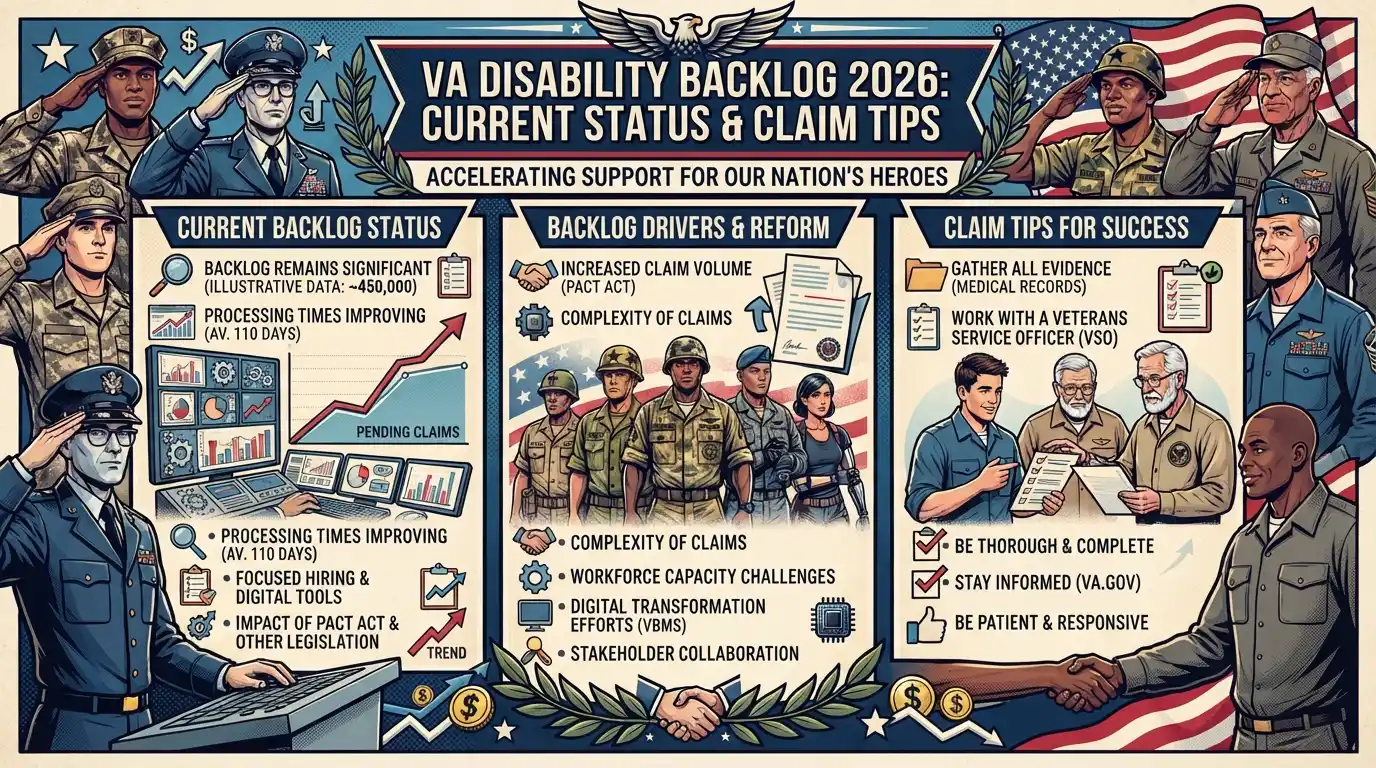
VA Disability Backlog: Current Status, Processing Times, and How to Check Your Claim
The VA disability backlog—claims pending more than 125 days—is under 100,000 as of late 2026, down from more than 400,000 in early 2024. The VA reported an average claim completion time of 75.6 days in September 2026, compared with 141.5 days in January 2025.
Last updated: November 2026

VA Disability Combined Rating Calculator
Add each disability rating from your decision letter.

Estimate only. The VA makes the official rating decision. Not legal or financial advice, and not affiliated with the Department of Veterans Affairs.
Benefits, rates, and contact details can change. Confirm current information with the official sources linked in this article.
Quick Facts
| Item | Details |
|---|---|
| Benefit | VA disability compensation (tax-free monthly payment for service-connected conditions) |
| Who Qualifies | Veterans with a condition caused or worsened by military service; surviving spouses and dependents may qualify for related benefits |
| How to Apply | Online through VA.gov using VA Form 21-526EZ, by mail, or in person at a VA regional office |
| Processing Time | Average 75.6 days for a decision in September 2026; backlog claims are those pending more than 125 days |
| Official Agency | U.S. Department of Veterans Affairs, Veterans Benefits Administration |
| Required Forms | VA Form 21-526EZ (Application for Disability Compensation); supporting evidence such as service records and medical records |
| Updated For | November 2026 |
What Is the VA Disability Backlog?
The VA disability backlog is the number of compensation and pension claims that have been pending in VA’s inventory for more than 125 days. A claim does not enter the backlog the day it is filed; it becomes “backlogged” only after it passes that 125-day mark.
This definition matters because the backlog is different from pending inventory. Pending inventory includes every open claim, including recently filed claims that are still within the normal processing window. In early November 2026, VA workload data showed about 714,000 pending rating claims, of which roughly 79,500 were backlogged. The backlog is the older slice of the larger inventory.
The 125-day threshold is a reporting measure, not a deadline. A claim can take longer than 125 days and still be processed accurately. But the backlog number is the clearest public signal of how many veterans are waiting beyond the expected window.
How Large Is the VA Disability Backlog in 2026?
Army Fitness Test (AFT) Score Calculator
Formerly the ACFT. Five events, 500 points. Enter your results.
Estimate for training only. Points are interpolated from the official Army tables (effective 1 June 2025) and can differ by a few points. Your score of record comes from your unit graders. Official score tables (PDF). Not affiliated with the U.S. Army.
The backlog has fallen sharply from its recent peak. VA reported the backlog was below 100,000 in February 2026 for the first time since 2020, then below 70,000 in July 2026. By early November 2026, VA workload data recorded approximately 79,546 backlogged claims among 714,126 pending rating claims—a decline of about 70% from January 20, 2025, when the backlog stood at 264,717.
The backlog has not moved in a straight line. It rose after the passage of the PACT Act in 2022, which expanded eligibility for millions of veterans and drove a surge in claims. VA’s own budget documents note that the backlog of claims older than 125 days peaked at over 400,000 in early 2024. The reduction since then reflects record claims production: VA processed 3,111,399 compensation claims in fiscal year 2026, surpassing the prior record of 3,001,734 set in fiscal year 2025.
The backlog number can fluctuate week to week as new claims cross the 125-day mark while older claims are decided. VA publishes weekly workload data, and the figure cited in any article is a snapshot, not a permanent level. Confirm the latest number on VA’s official backlog data page before relying on it.
Why the Backlog Happened
Three factors drove the backlog to its 2024 peak.
The PACT Act surge. The Honoring Our PACT Act of 2022 expanded VA health care and benefits for veterans exposed to burn pits, Agent Orange, and other toxic substances. It also made it easier for many veterans to file claims for conditions linked to those exposures. The result was a historic increase in claims volume, which outpaced VA’s processing capacity even as the agency hired more staff.
Pandemic-era disruptions. COVID-19 paused or slowed many compensation and pension exams, creating a queue of claims waiting for medical evidence. Even after exams resumed, the accumulated volume took time to work through.
Complexity and evidence gaps. Many claims require records from multiple sources—service treatment records, private medical records, and VA exams. When a claim is incomplete, VA must request missing evidence and wait for responses, which adds weeks or months. Claims involving eight or more medical conditions have had higher overdue rates than simpler claims.
VA has addressed the backlog through overtime, automation of intake and evidence-gathering steps, and changes to its National Work Queue, which distributes claims across regional offices. These operational changes, combined with record production, explain most of the decline since 2024.
How Long VA Disability Claims Take in 2026
The average time to complete a disability claim was 75.6 days in September 2026, down from 141.5 days on January 20, 2025. VA also reported that claims took an average of 77.7 days to process in July 2026, which it described at the time as the fastest average on record.
These averages describe the typical claim. Your claim may take longer if it requires a compensation and pension exam, if VA needs to gather records from a federal facility or a private provider, or if you submit new evidence after filing. A claim that is incomplete or missing key documents is more likely to exceed the 125-day backlog threshold.
VA’s accuracy rate was 94% in fiscal year 2026, the highest in two years. Accuracy matters for backlog discussions because a fast but inaccurate decision can send a veteran into the appeals process, which adds time and does not resolve the underlying claim.
How to Check Your VA Claim Status
You can check your VA claim status online through the VA Claim Status Tool on VA.gov. Sign in with a Login.gov, ID.me, DS Logon, or My HealtheVet account, and you will see a list of your in-progress and closed claims, decision reviews, and appeals. Select a claim to see details and any actions VA needs from you.
The tool shows whether your claim is in evidence gathering, review, or decision preparation. It also shows whether VA has requested information from you or from a third party. If VA has asked you for evidence, responding promptly is one of the most effective ways to keep your claim moving.
If you cannot access the online tool, you can call VA’s benefits line at 1-800-827-1000. Phone numbers and hours can change, so confirm the current contact details on the official VA contact page before you call. You can also visit a VA regional office in person, though hours and services vary by location.
Checking your status frequently is reasonable, but it does not speed up processing. The most useful action is to respond to any VA request as soon as possible and to make sure your claim includes complete evidence at the start.
How to Avoid Delays in the VA Disability Process
You cannot control VA’s workload, but you can reduce the chance that your claim sits in the backlog because of missing information.
File a complete claim the first time. Use VA Form 21-526EZ and include your DD-214, service treatment records, private medical records, and any lay statements that describe your symptoms and their connection to service. A claim that needs less development moves through the process faster.
Consider a Fully Developed Claim. A Fully Developed Claim is a claim you submit with all relevant evidence at the same time. It is not a separate benefit, but it signals that VA should not need to gather additional evidence. Fully Developed Claims are not right for every situation—if you are still waiting on records, filing a standard claim may be better—but when you have the evidence ready, this approach can reduce processing time.
Respond to VA requests within the deadline. If VA asks for additional information, missing records, or a specific form, respond as soon as you can. A claim that is waiting on the veteran is still pending, and it can cross the 125-day threshold while VA waits.
Attend your C&P exam. If VA schedules a compensation and pension exam, attend it or reschedule promptly. A missed exam can delay your claim or lead to a decision based on incomplete evidence.
Keep your address and contact information current. VA may need to reach you for evidence or to schedule an exam. An outdated address or phone number can stall a claim.
For broader context on how VA benefits and staffing decisions can affect processing, see our coverage of VA benefits cuts in 2026 and what changed in November 2026. State-level benefits and tax rules are separate from the federal claims backlog; if you are also checking state programs, the veterans benefits by state hub is a useful starting point.
What to Do If Your VA Claim Is Stuck or Denied
If your claim has been pending well beyond the average processing time, first confirm that VA has everything it needs. Check the Claim Status Tool for open requests. If VA is waiting on you, respond. If VA is waiting on a third party, such as a federal facility or a private provider, you can sometimes help by contacting the records holder yourself and asking them to respond to VA’s request.
If your claim is denied or you disagree with the rating, you have three decision review options under the Appeals Modernization Act: a Supplemental Claim, a Higher-Level Review, or a Board Appeal. A Supplemental Claim allows you to submit new and relevant evidence. A Higher-Level Review asks a more senior reviewer to reconsider the decision based on the existing record; you cannot submit new evidence in this lane. A Board Appeal sends your case to a Veterans Law Judge at the Board of Veterans’ Appeals.
The deadline to preserve your effective date—and potentially your back pay—depends on the review option you choose. If you are within one year of the decision, you generally have the full set of options. If more than a year has passed, a Supplemental Claim or a Board Appeal may still be available, but the effective date rules are different. Review the official decision review pages on VA.gov before filing.
An appeal is not always the fastest route to a corrected decision, and it does not resolve the underlying backlog. But if your claim was denied because of missing evidence or an error, a Supplemental Claim with new evidence is often the most direct path.
VA Disability Backlog by the Numbers
| Measure | Figure | Date |
|---|---|---|
| Backlog definition | Claims pending more than 125 days | Ongoing |
| Backlog on Jan. 20, 2025 | 264,717 | January 2025 |
| Backlog below 100,000 | First time since 2020 | February 2026 |
| Backlog below 70,000 | First time since 2020 | July 2026 |
| Backlogged claims (workload data) | Approximately 79,546 | Early November 2026 |
| Pending rating claims (all ages) | Approximately 714,126 | Early November 2026 |
| Average claim completion time | 75.6 days | September 2026 |
| Average completion time on Jan. 20, 2025 | 141.5 days | January 2025 |
| Claims processed in FY 2026 | 3,111,399 | Fiscal year 2026 |
| Claims processing accuracy | 94% | Fiscal year 2026 |
Backlog and workload figures change weekly. Confirm current numbers on VA’s official detailed claims data page before citing them.
Common Questions
What is the VA disability backlog right now?
As of November 2026, the backlog of claims pending more than 125 days is under 100,000. VA workload data in early November showed about 79,500 backlogged claims. The number changes weekly, so check VA’s official backlog data for the current figure.
Does the backlog mean my claim is denied?
No. The backlog is a measure of how many claims are older than 125 days. A claim in the backlog can still be granted. Being in the backlog means your claim is taking longer than the expected window, not that VA has decided against you.
How long will my VA disability claim take?
VA’s average completion time was 75.6 days in September 2026. Your claim may take longer if it requires a C&P exam, additional records, or if VA needs information from you. Claims with complete evidence at filing tend to move faster.
Can I expedite my VA claim?
VA has limited expedited processing for certain categories, such as veterans with terminal illnesses, veterans experiencing homelessness, and claims involving financial hardship. These are narrow exceptions. For most claims, the best way to avoid delay is to file a complete claim and respond quickly to VA requests.
What is the difference between the backlog and pending claims?
Pending claims include every open claim, including recently filed claims still within the normal processing window. The backlog includes only claims pending more than 125 days. The pending inventory is always larger than the backlog.
How do I check my VA claim status?
Use the VA Claim Status Tool on VA.gov. Sign in with a Login.gov, ID.me, DS Logon, or My HealtheVet account. You can see your claims, decision reviews, and appeals, along with any open requests for evidence.
What should I do if VA asks for more evidence?
Respond as soon as possible. If you need help gathering records, tell VA. If you cannot get a document, explain why in writing. A claim that is waiting on the veteran can stay open longer than necessary.
Can I appeal a decision while the backlog is high?
Yes. You have the same decision review rights regardless of the backlog. A Supplemental Claim, Higher-Level Review, or Board Appeal is available. Choose the option that matches your situation and file within the deadline that preserves your effective date.
Does the PACT Act affect the backlog?
The PACT Act expanded eligibility and drove a surge in claims, which contributed to the backlog peak in 2024. VA has since processed record numbers of claims, including PACT Act claims. If you are filing a PACT Act claim, include any evidence of exposure and a current diagnosis to help VA decide your case.
Will the backlog go away?
VA has reduced the backlog substantially, but claims volume remains high. VA processed more than 3.1 million claims in fiscal year 2026, and new claims continue to arrive. The backlog may fluctuate as receipts and processing rates change. The long-term trend depends on staffing, automation, and claim complexity.
Key Takeaways
The VA disability backlog is the number of claims pending more than 125 days. It is different from the total number of pending claims.
The backlog is under 100,000 in late 2026, down from 264,717 in January 2025 and a peak above 400,000 in early 2024.
VA’s average claim completion time was 75.6 days in September 2026, compared with 141.5 days in January 2025.
The PACT Act surge, pandemic-era exam delays, and evidence gaps drove the backlog higher; overtime, automation, and record production drove it down.
You can check your claim status through the VA Claim Status Tool on VA.gov using a Login.gov, ID.me, DS Logon, or My HealtheVet account.
Filing a complete claim with all relevant evidence and responding quickly to VA requests are the most effective ways to avoid delays.
If your claim is denied, you can file a Supplemental Claim, request a Higher-Level Review, or appeal to the Board of Veterans’ Appeals.
Backlog numbers change weekly. Confirm current figures on VA’s official backlog data page before relying on them.
Official Resources
VA.gov — Main VA portal for filing a disability claim, checking claim status, and managing benefits.
VA Claim Status Tool — Sign in to see your pending and closed claims, decision reviews, and appeals.
File VA Form 21-526EZ online — Start or complete an Application for Disability Compensation and Related Compensation Benefits.
VA Decision Reviews and Appeals — Compare Supplemental Claims, Higher-Level Reviews, and Board Appeals, and file the correct form.
VA Disability Compensation Rates — Review current monthly payment tables by disability rating and dependent status.
VA Detailed Claims Data — Access VA’s official workload and backlog data, including weekly pending and backlogged claim counts.
VA News — Official VA press releases on claims processing, backlog milestones, and benefits policy.
🇺🇸 IMPORTANT DISCLAIMER – Veterans Benefits Information
This site provides general information about U.S. Department of Veterans Affairs (VA) benefits for educational and informational purposes only.
- Not Official: We are NOT affiliated with, endorsed by, or connected to the U.S. Department of Veterans Affairs (VA), the Veterans Benefits Administration (VBA), the Veterans Health Administration (VHA), or any other government agency.
- No Legal/Financial Advice: The content on this website is for informational purposes only and does not constitute legal, financial, or medical advice. VA benefits rules change frequently – always consult with an accredited Veterans Service Officer (VSO) or a qualified professional for your specific situation.
- Official Sources: For official, binding information and to apply for benefits, always visit official .gov websites: VA.gov, Benefits.VA.gov, or SSA.gov.
- No Data Collection: This site does not collect, store, or process any personal information. It does not have login forms, contact forms, or any system to capture user data. We never ask for your Social Security Number, bank details, or any personal information.
- 🚨 Scam Alert: The VA and other government agencies never charge fees for benefit applications. If anyone asks for money to "process" your VA claim, it is a scam. Report it to the VA Office of Inspector General at VA.gov/OIG.
- Advertising: This site uses third-party advertising (Adsterra) to cover operational costs. We do not endorse or guarantee any products or services advertised.
📌 Information provided as of June 2026. Always verify current eligibility and rules with official .gov sources.
This site is not affiliated with the U.S. Department of Veterans Affairs or any government agency. All information is for educational purposes only. Please visit VA.gov for official information.
VA Disability Pay Calculator
This calculator is for information only. Your exact award is set by VA and shown in your VA.gov account and decision letter. VA disability compensation is tax-free.