
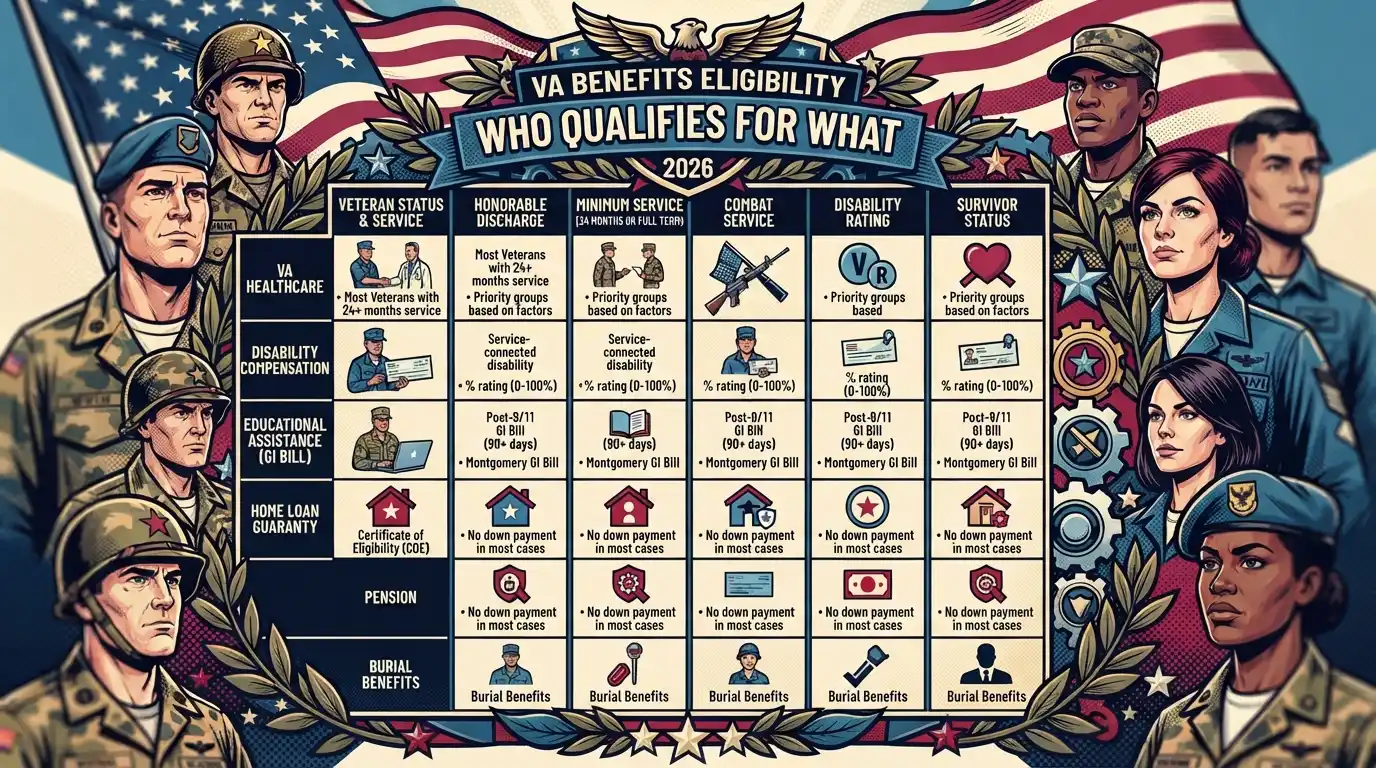
VA Benefits Eligibility Matrix: Who Qualifies for Which Benefit
The VA benefits eligibility matrix compares the core requirements for VA health care, disability compensation, pension, education benefits, home loans, and survivors’ benefits. Most programs require active-duty service and a discharge that is not dishonorable; disability compensation adds a service-connected condition, pension adds income limits, and health care uses eight priority groups.
Last updated: November 2026

VA Disability Combined Rating Calculator
Add each disability rating from your decision letter.

Estimate only. The VA makes the official rating decision. Not legal or financial advice, and not affiliated with the Department of Veterans Affairs.
Benefits, rates, and contact details can change. Confirm current information with the official sources linked in this article.
Quick Facts
| Item | Details |
|---|---|
| Benefit | Multiple VA benefits: health care, disability compensation, pension, education, home loan, and survivors’ benefits |
| Who Qualifies | Veterans, active-duty service members, National Guard and Reserve members, and eligible family members; requirements vary by program |
| How to Apply | VA.gov online applications, VA forms by mail, or in person at a VA regional office |
| Processing Time | Varies by benefit; health care enrollment and disability claims have separate timelines |
| Official Agency | U.S. Department of Veterans Affairs |
| Required Forms | VA Form 10-10EZ (health care), VA Form 21-526EZ (disability), VA Form 21P-527EZ (pension), VA Form 22-1990 (education), VA Form 26-1880 (home loan COE) |
| Updated For | November 2026 |
VA Benefits Eligibility Matrix at a Glance
The matrix below summarizes the main eligibility gates for each benefit. A “service requirement” means active-duty time; a “discharge requirement” means the character of separation; “income/net worth” applies only where noted. Each benefit is explained in more detail in the sections that follow.
| Benefit | Service Requirement | Discharge Requirement | Income or Net Worth Limit | Key Extra Requirement | First Step |
|---|---|---|---|---|---|
| VA health care | 24 continuous months (for post-1980 enlisted) or full call-up period; special rules for combat and toxic exposure | Not dishonorable | Only for Priority Groups 5, 7, and 8 | Enrollment in VA health care | Apply with VA Form 10-10EZ |
| Disability compensation | Active duty, active duty for training, or inactive duty training | Not dishonorable | None | Current condition linked to service | File VA Form 21-526EZ |
| Veterans Pension | 90 days active duty with 1 day in wartime (pre-1980) or 24 months (post-1980) | Not dishonorable | Yes: income and net worth limits | Age 65+ or permanently and totally disabled | File VA Form 21P-527EZ |
| Post-9/11 GI Bill | 90 days active duty after Sept. 10, 2001, or 30 continuous days with a service-connected discharge | Honorable (or conditions other than dishonorable for some programs) | None | Served after 9/11 | Apply with VA Form 22-1990 |
| VA home loan | Varies by era: generally 90–24 months depending on dates | Other than dishonorable | None (lender credit and income rules apply) | Certificate of Eligibility (COE) | Request COE via VA Form 26-1880 |
| DIC (survivors) | Death in line of duty or from a service-connected condition | Not applicable to survivor | Parents’ DIC has income limits | Relationship to the veteran | File VA Form 21P-534EZ |
These categories are broad. The sections below explain the details, exceptions, and how to confirm your own eligibility.
VA Health Care Eligibility
You may qualify for VA health care if you served in the active military, naval, or air service and did not receive a dishonorable discharge. Post-1980 enlisted veterans generally need 24 continuous months of active duty or the full period they were called to active duty, with exceptions for disability discharges, hardship discharges, and those who served before September 7, 1980.
Army Fitness Test (AFT) Score Calculator
Formerly the ACFT. Five events, 500 points. Enter your results.
Estimate for training only. Points are interpolated from the official Army tables (effective 1 June 2025) and can differ by a few points. Your score of record comes from your unit graders. Official score tables (PDF). Not affiliated with the U.S. Army.
The PACT Act expanded eligibility for veterans exposed to toxins and other hazards. All veterans who served in the Vietnam War, Gulf War, Iraq, Afghanistan, or any other combat zone after 9/11 are now eligible for VA health care, even without a service-connected rating. This is a significant change from the pre-PACT rules, and it applies to veterans who meet the basic service and discharge requirements.
Priority groups. When you enroll, VA assigns you to one of eight priority groups. The group affects how quickly you can access care and what copays you may owe. Priority Group 1 includes veterans with a 50% or higher service-connected rating, veterans rated unemployable due to service-connected conditions, and Medal of Honor recipients. Priority Group 8 includes higher-income veterans without service-connected conditions who agree to pay copays. The full definitions are in VA’s enrollment priority groups fact sheet and in 38 CFR 17.36.
Income limits. If you do not qualify for health care based on a service-connected rating, special status, or PACT Act exposure, you may still qualify based on income. VA uses a national income threshold and a geographically adjusted threshold. These limits change each year and vary by household size and location. VA’s income limits tool lets you check the current limits for your situation. This tool is updated annually; confirm the figures for the current year before relying on them.
How to apply. File VA Form 10-10EZ online, by mail, or in person at a VA medical center. You can also apply through a VA accredited representative. Enrollment is not the same as a disability claim; it is the gateway to the VA health care system.
For veterans who also receive care through VA, our guide to VA lab hours and appointments explains how to schedule lab work and what to expect at a VA facility.
VA Disability Compensation Eligibility
VA disability compensation is a tax-free monthly payment for veterans with a condition that was caused or worsened by military service. You may qualify if you have a current diagnosis and you served on active duty, active duty for training, or inactive duty training, and at least one of these is true:
You got sick or injured during service and can link the condition to that service (direct service connection).
You had a condition before service that service made worse (aggravation).
You have a condition related to service that appeared after service (post-service connection).
You have a condition VA presumes was caused by service (presumptive condition), such as certain toxic exposures under the PACT Act.
You must have been discharged under conditions other than dishonorable. A dishonorable discharge generally bars compensation; an other-than-honorable discharge may require a character of discharge review or a discharge upgrade.
There is no income limit for disability compensation. A veteran with a 100% rating can receive compensation regardless of other income. Dependents can increase the payment amount if the veteran has a combined rating of at least 30% and has a spouse, dependent children, or dependent parents.
How to apply. File VA Form 21-526EZ online through VA.gov, by mail, or with an accredited representative. Include your DD-214, service treatment records, private medical records, and any lay statements that describe your symptoms and their link to service.
If your claim is denied, our guide on what to do when a VA claim is denied explains the three decision review options and how to protect your effective date.
For context on how policy and staffing decisions can affect claims processing, see our coverage of VA benefits cuts in 2026 and what changed in November 2026.
Veterans Pension Eligibility
Veterans Pension is a needs-based monthly benefit for wartime veterans with limited income and net worth. It is different from disability compensation: pension does not require a service-connected condition. Instead, it requires wartime service, a non-dishonorable discharge, and either age 65 or older, permanent and total disability, nursing home care for a disability, or receipt of Social Security Disability Insurance or Supplemental Security Income.
Service requirement. You must have served at least 90 days of active duty with at least one day during a recognized wartime period if you entered active duty before September 8, 1980. If you entered as an enlisted person after September 7, 1980, you generally need at least 24 months or the full period you were called to active duty, with at least one day during wartime. Officers who entered after October 16, 1981, have separate rules.
Income and net worth. Your yearly family income and net worth must be below limits set by Congress. For the period December 1, 2025, to November 30, 2026, the net worth limit is $163,699. Net worth includes assets other than your house, car, and most home furnishings, minus debt. VA also compares your countable income to the Maximum Annual Pension Rate (MAPR) and pays the difference. These figures change annually; confirm the current limits on VA’s pension rates page before you apply.
How to apply. File VA Form 21P-527EZ online, by mail, or through an accredited representative. You will need to report income, net worth, and medical expenses. If you are claiming Aid and Attendance or Housebound benefits, additional forms and evidence are required.
For survivors’ pension (a separate benefit for surviving spouses and dependent children of wartime veterans), the eligibility rules and income limits are different from the veteran’s pension. VA’s survivors pension page explains the current rates and requirements.
Education Benefits: Post-9/11 GI Bill and Related Programs
The Post-9/11 GI Bill (Chapter 33) is the main VA education benefit for veterans who served after September 11, 2001. You may qualify if you served at least 90 days on active duty (all at once or with breaks) on or after September 11, 2001, or you received a Purple Heart on or after that date and were honorably discharged, or you served at least 30 continuous days on active duty and were honorably discharged with a service-connected disability.
The benefit level depends on how long you served. At least 36 months of active duty generally qualifies you for 100% of the benefit. Shorter service qualifies you for a percentage: 90% for 30–35 months, 80% for 24–29 months, 70% for 18–23 months, 60% for 6–17 months, and 50% for 90 days to 5 months. The Post-9/11 GI Bill can pay tuition and fees, a monthly housing allowance, and a books and supplies stipend.
Other education programs. The Montgomery GI Bill Active Duty (Chapter 30) and Montgomery GI Bill Selected Reserve (Chapter 1606) have separate eligibility rules. Veteran Readiness and Employment (VR&E) is available to veterans with a service-connected disability that limits employment, and it may provide training and education without using GI Bill months. The Survivors’ and Dependents’ Educational Assistance program (Chapter 35) provides education benefits to eligible dependents and surviving spouses.
You must generally have an honorable discharge for the Post-9/11 GI Bill. Some other education programs require a discharge under conditions other than dishonorable. Confirm the discharge requirement for the specific program you are using.
How to apply. File VA Form 22-1990 for GI Bill benefits or VA Form 22-1990E for transferred benefits. VR&E applications use VA Form 28-1900. These forms are available on VA.gov.
VA Home Loan Eligibility
VA does not lend money directly (except for the Native American Direct Loan). Instead, VA guarantees a portion of a loan made by a private lender, which can reduce or eliminate the down payment and remove the need for mortgage insurance. To qualify, you need a Certificate of Eligibility (COE) that shows you meet the service requirements and a discharge that is other than dishonorable.
Service requirements. For the Gulf War period (August 2, 1990, to present), you generally need at least 24 continuous months of active duty, or the full period (at least 90 days) for which you were called to active duty, or at least 90 days if discharged under a qualifying exception. Shorter service may qualify if you were discharged for a service-connected disability. Earlier periods have different thresholds: for example, 181 continuous days for the post-Vietnam period (May 8, 1975, to September 7, 1980), and 90 total days for the Vietnam War period (August 5, 1964, to May 7, 1975).
National Guard and Reserve. Members may qualify after six years in the Selected Reserve or after qualifying active-duty service, including at least 90 days of active service with 30 consecutive days under certain Title 32 orders. The rules for Guard and Reserve eligibility have changed in recent years, so confirm the current criteria on VA’s home loan eligibility page.
Lender requirements. VA does not set a minimum credit score, but lenders do, and they evaluate your income and debt-to-income ratio. A COE proves VA eligibility; it does not guarantee loan approval.
How to apply. Request a COE through VA’s online tool or by filing VA Form 26-1880. Surviving spouses may also be eligible for home loan benefits in certain circumstances; VA’s housing assistance page for surviving spouses explains the rules.
For state-level housing and property tax programs, the veterans benefits by state hub is a useful companion to the federal home loan rules.
Survivors’ Benefits: Dependency and Indemnity Compensation (DIC)
DIC is a tax-free monthly benefit for surviving spouses, dependent children, and dependent parents of a service member who died in the line of duty or a veteran who died from a service-connected condition. It is not needs-based for surviving spouses and children, but parents’ DIC has income limits.
Eligibility for surviving spouses. You may qualify if you were married to the veteran for at least one year before death, or if you had a child with the veteran and were not at fault for separation and have not remarried. Remarriage after age 57 generally does not bar eligibility. The veteran’s death must be service-connected, or the veteran must have been rated totally disabled for a specified period before death.
Eligibility for children. Unmarried children under 18, or under 23 if attending school, may qualify. Children who became permanently incapable of self-support before age 18 may also qualify.
Parents’ DIC. Dependent parents may qualify based on their income. The income thresholds and rates are set annually. Confirm current figures on VA’s DIC page.
How to apply. File VA Form 21P-534EZ. You will need the veteran’s DD-214, death certificate, marriage certificate, and evidence of the service-connected cause of death. VA’s DIC page explains the evidence requirements and the current rates.
If you are also exploring education benefits for survivors, the Chapter 35 program (Survivors’ and Dependents’ Educational Assistance) is separate from DIC and has its own application.
Common Questions
What is the VA benefits eligibility matrix?
The VA benefits eligibility matrix is a comparison of the core requirements for each major VA benefit—health care, disability compensation, pension, education, home loans, and DIC. It helps you see at a glance which programs may fit your service history, discharge status, and financial situation.
Do all VA benefits require an honorable discharge?
No. Disability compensation, pension, and health care generally require a discharge that is not dishonorable. The Post-9/11 GI Bill generally requires an honorable discharge. Some programs have different rules. If you have an other-than-honorable discharge, you may still qualify for certain benefits after a character of discharge review or a discharge upgrade.
Can I receive VA disability compensation and Veterans Pension at the same time?
No. VA pays whichever benefit is higher, not both. Veterans with low ratings and low income sometimes receive more from pension than from compensation. You must choose one program, but you can apply for both and VA will determine which payment is higher.
Does VA health care have an income limit?
Only for some veterans. If you qualify based on a service-connected rating, special status, or PACT Act exposure, there is no income limit. If you do not qualify on those grounds, you may still qualify based on income, and VA uses national and geographically adjusted thresholds that change each year.
What is the net worth limit for Veterans Pension in 2026?
For the period December 1, 2025, to November 30, 2026, the net worth limit is $163,699. Net worth includes assets other than your house, car, and most home furnishings, minus debt. This limit changes annually, so confirm the current figure on VA’s pension rates page before applying.
How long do I need to serve to qualify for the Post-9/11 GI Bill?
At least 90 days of active duty after September 10, 2001, or 30 continuous days with an honorable discharge for a service-connected disability. At least 36 months generally qualifies you for 100% of the benefit; shorter service qualifies you for a percentage.
What is a Certificate of Eligibility for a VA home loan?
A COE is a document that shows lenders you meet VA’s service requirements for a VA-backed home loan. You can request one through VA’s online tool or by filing VA Form 26-1880. A COE does not guarantee loan approval; lenders still apply their own credit and income standards.
Who qualifies for DIC?
Surviving spouses, dependent children, and dependent parents of a service member who died in the line of duty or a veteran who died from a service-connected condition. Surviving spouses generally must have been married for at least one year and not have remarried before age 57. Parents’ DIC has income limits.
Can National Guard and Reserve members qualify for VA benefits?
Yes, in many cases. Eligibility depends on federal active-duty status. For health care, you generally must have been called to active duty by a federal order and completed the full period. For home loans, six years in the Selected Reserve or qualifying active-duty service may be enough. For disability compensation, injuries during qualifying duty periods may support a claim.
Where can I check my own eligibility?
VA.gov has eligibility pages for each benefit, and the VA claim status tool and health care enrollment pages can help you start. An accredited Veterans Service Organization representative can review your discharge paperwork and service history and explain which benefits you may qualify for, free of charge.
Key Takeaways
The VA benefits eligibility matrix compares service requirements, discharge rules, income limits, and extra conditions for each major benefit.
VA health care is open to veterans who meet basic service and discharge requirements; the PACT Act expanded eligibility for toxic-exposed veterans, and priority groups determine copay levels and access.
Disability compensation requires a current condition linked to service; there is no income limit, and dependents can increase the payment at ratings of 30% or higher.
Veterans Pension is needs-based: it requires wartime service, a non-dishonorable discharge, and either age 65+ or permanent and total disability, plus income and net worth below annual limits.
The Post-9/11 GI Bill generally requires 90 days of active duty after September 11, 2001, or 30 continuous days with a service-connected discharge; benefit levels depend on length of service.
VA home loans require a Certificate of Eligibility and a discharge that is other than dishonorable; service thresholds vary by era, and lenders apply their own credit and income rules.
DIC provides tax-free monthly payments to eligible surviving spouses, children, and parents; parents’ DIC is income-tested, while spouses’ and children’s DIC is not.
Income limits, net worth limits, and priority group thresholds change annually; confirm current figures on the official VA pages linked in this article before applying.
Official Resources
VA.gov — Main VA portal for applying for benefits, checking eligibility, and managing your account.
VA Health Care Eligibility — Check service and discharge requirements and learn about enhanced eligibility and priority groups.
VA Health Care Income Limits — Use VA’s tool to check current income thresholds for your household and location.
Disability Compensation Eligibility — Review the service-connection requirements and presumptive conditions.
Veterans Pension Eligibility — Check wartime service, age or disability, and income and net worth rules.
Post-9/11 GI Bill — Review service requirements and benefit levels for Chapter 33.
VA Home Loan Eligibility — Check service requirements by era and request a Certificate of Eligibility.
VA DIC for Survivors — Review eligibility for surviving spouses, children, and parents.
VA Claim Status Tool — Check the status of a pending disability claim or appeal.
Get Help From an Accredited Representative — Find a free VSO representative to review your eligibility and help you apply.
🇺🇸 IMPORTANT DISCLAIMER – Veterans Benefits Information
This site provides general information about U.S. Department of Veterans Affairs (VA) benefits for educational and informational purposes only.
- Not Official: We are NOT affiliated with, endorsed by, or connected to the U.S. Department of Veterans Affairs (VA), the Veterans Benefits Administration (VBA), the Veterans Health Administration (VHA), or any other government agency.
- No Legal/Financial Advice: The content on this website is for informational purposes only and does not constitute legal, financial, or medical advice. VA benefits rules change frequently – always consult with an accredited Veterans Service Officer (VSO) or a qualified professional for your specific situation.
- Official Sources: For official, binding information and to apply for benefits, always visit official .gov websites: VA.gov, Benefits.VA.gov, or SSA.gov.
- No Data Collection: This site does not collect, store, or process any personal information. It does not have login forms, contact forms, or any system to capture user data. We never ask for your Social Security Number, bank details, or any personal information.
- 🚨 Scam Alert: The VA and other government agencies never charge fees for benefit applications. If anyone asks for money to "process" your VA claim, it is a scam. Report it to the VA Office of Inspector General at VA.gov/OIG.
- Advertising: This site uses third-party advertising (Adsterra) to cover operational costs. We do not endorse or guarantee any products or services advertised.
📌 Information provided as of June 2026. Always verify current eligibility and rules with official .gov sources.
This site is not affiliated with the U.S. Department of Veterans Affairs or any government agency. All information is for educational purposes only. Please visit VA.gov for official information.
VA Disability Pay Calculator
This calculator is for information only. Your exact award is set by VA and shown in your VA.gov account and decision letter. VA disability compensation is tax-free.