
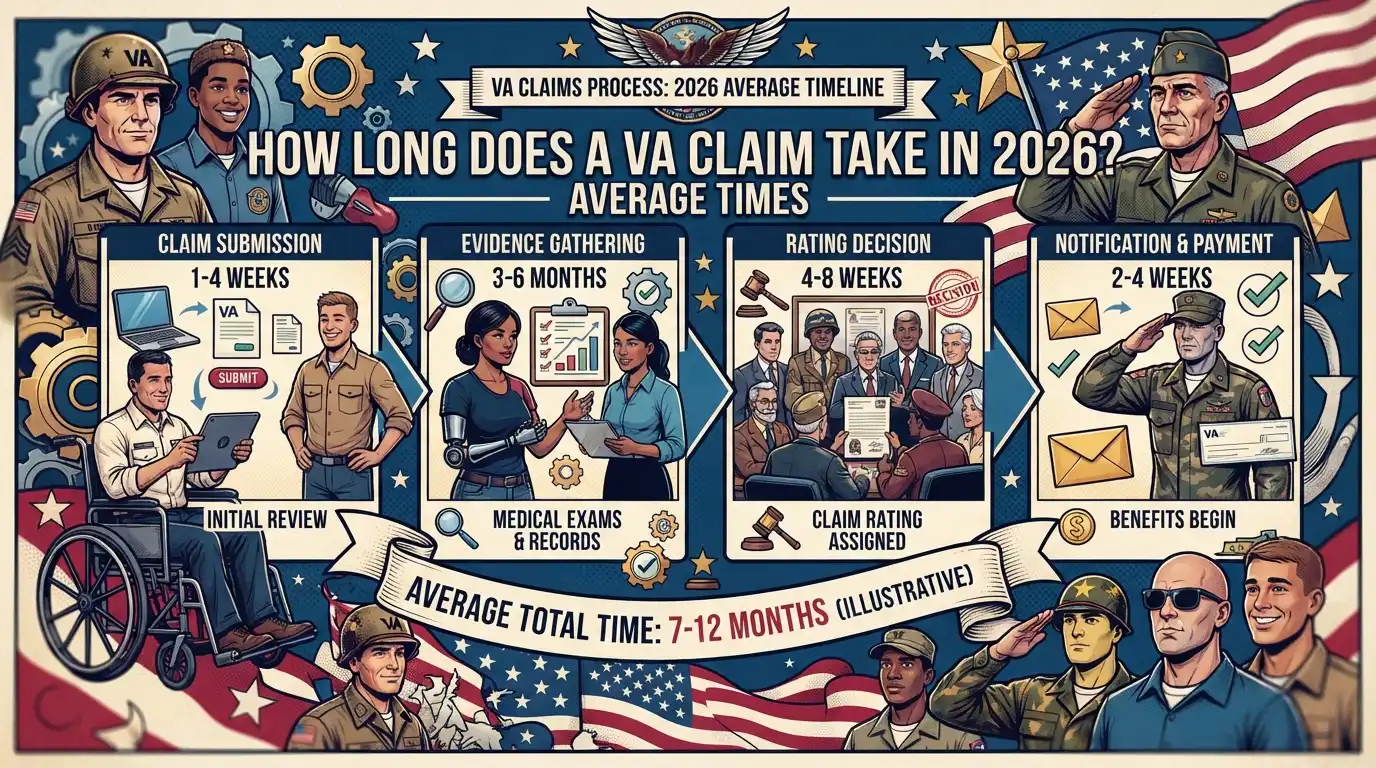
How Long Does a VA Claim Take in 2026?
Last updated: November 2026
Benefits, rates, and contact details can change. Confirm current information with the official sources linked in this article.

VA Disability Combined Rating Calculator
Add each disability rating from your decision letter.

Estimate only. The VA makes the official rating decision. Not legal or financial advice, and not affiliated with the Department of Veterans Affairs.
Featured snippet: In 2026, VA disability claims average roughly 68 to 81 days to complete, depending on the source and month, down from 141.5 days in January 2025. Pension claims average about 57 days, DIC claims about 73 days, and Supplemental Claims about 58 to 75 days. Board appeals take 1 to 2 years or longer, depending on the docket.
Quick Facts
| Item | Details |
|---|---|
| Benefit | VA disability compensation, pension, DIC, and decision reviews |
| Who Qualifies | Veterans, surviving spouses, and dependents with a pending VA claim |
| How to Apply | VA Form 21-526EZ for disability; VA Form 21P-527EZ for pension; VA Form 21P-534EZ for DIC |
| Processing Time | About 68–81 days for disability claims in 2026; varies by claim type |
| Official Agency | U.S. Department of Veterans Affairs |
| Required Forms | Varies by benefit; no form for checking status |
| Updated For | 2026 processing data |
How Long VA Disability Claims Take in 2026
VA disability claims took an average of 68.2 days to complete in September 2026, according to VA.gov’s published average. VA’s press office reported a slightly higher figure of 75.6 days for the same month, measuring a slightly different metric. Both figures represent a dramatic improvement from 141.5 days in January 2025.
The table below shows the progression of VA’s average disability claim processing time through 2026.
| Period | Average Days to Complete |
|---|---|
| January 2025 (baseline) | 141.5 days |
| April 2026 | 80.7 days |
| End of May 2026 | 78.6 days |
| July 2026 | 77.7 days |
| September 2026 (VA.gov) | 68.2 days |
| September 2026 (VA press office) | 75.6 days |
These are agency-wide averages. Your claim may take longer or shorter depending on its complexity and whether VA needs to gather records or schedule exams. Processing times can change; confirm current averages on VA.gov.
VA Claim Processing Times by Claim Type
Army Fitness Test (AFT) Score Calculator
Formerly the ACFT. Five events, 500 points. Enter your results.
Estimate for training only. Points are interpolated from the official Army tables (effective 1 June 2025) and can differ by a few points. Your score of record comes from your unit graders. Official score tables (PDF). Not affiliated with the U.S. Army.
Different claim types follow different timelines. Initial disability claims require full evidence development, while decision reviews move through separate tracks. The table below summarizes typical 2026 timelines by claim type.
| Claim Type | Typical 2026 Time | What Drives the Timeline |
|---|---|---|
| Fully Developed Claim (FDC) | 60–90 days | All evidence submitted upfront; VA skips much of evidence gathering |
| Initial disability compensation | 68–81 days (VA average); 100–130 days (broader reporting) | Full evidence development, C&P exams, records requests |
| Claim for increase | 100–130 days | New C&P exam to assess current severity |
| Pension claim | About 57 days (initial) | Income and asset verification |
| Survivors Pension | About 73 days (initial) | Income and asset verification |
| DIC claim | About 73 days | Survivor eligibility and medical evidence |
| Supplemental Claim (20-0995) | 58–75 days (VA average); goal 125 days | New and relevant evidence required |
| Higher-Level Review (20-0996) | Goal: 125 days | No new evidence; senior reviewer re-examines the record |
| Board Appeal — Direct Review | About 365 days | Judge reviews the existing record |
| Board Appeal — Evidence Submission | About 550 days | Evidence submitted within 90 days of request |
| Board Appeal — Hearing | About 730 days | Testimony before a Veterans Law Judge |
These ranges come from VA press releases, VA.gov published averages, and practitioner reporting in 2026. They are not guarantees. Check your specific claim’s estimated completion date on VA.gov. Phone numbers and hours can change, so confirm official contact details on VA.gov before calling.
Why VA Claims Take Longer Than the Average
VA says three factors determine how long a claim takes: the type of claim you filed, how many conditions you claimed and how complex they are, and how long it takes VA to collect the evidence it needs. Only the third factor is partly in your control.
The evidence-gathering stage is usually the longest step. It includes requesting service records, VA medical records, and private treatment records, and scheduling VA claim exams. Claims tend to sit longer when older, Reserve, or Guard records take extra time to locate, or when an exam is missed, canceled, or rescheduled. Toxic exposure claims under the PACT Act may require additional exposure research or a toxic exposure screening, which can add time.
Regional office variation also matters. National averages mask differences between offices. Some process faster due to lower workload or better staffing; others run slower. Your claim is handled by the office serving your area.
How to Help Your VA Claim Move Faster
You cannot control VA’s workload, but you can reduce delays on your side. The most effective steps are:
File a Fully Developed Claim if possible. Submit all available evidence—private medical records, buddy statements, a personal statement, and a medical nexus letter—with the initial claim. This can eliminate weeks of back-and-forth records requests.
Attend every scheduled exam. A missed VA claim exam can delay the claim or lead to a decision based on incomplete evidence.
Respond to VA letters within 30 days. Every day you delay responding to a request for information adds to your timeline.
Name each condition clearly. A vague description like “back problems” can lead to the wrong exam. Describe each condition and how it relates to service.
Keep your contact information current on VA.gov so exam schedulers can reach you.
Check for priority processing. Veterans who are homeless, terminally ill, facing extreme financial hardship, over 85, or former POWs or Medal of Honor recipients may qualify for expedited handling.
How to Check Your VA Claim Status
The fastest way to check your claim status is to sign in to VA.gov and open the claim status tool. It shows your claim’s current stage, documents received, any pending actions VA needs from you, and an estimated completion date. You can also use the VA: Health and Benefits mobile app, call the benefits hotline at 800-827-1000, or contact an accredited representative or Veterans Service Organization.
The VA.gov tracker sometimes lags behind the actual claim status by several days. If your representative reports that a decision has been issued but the online tracker still shows an earlier stage, trust the representative. For a detailed walkthrough of each status stage, see the VA claim status guide.
What to Do If Your Claim Is Taking Too Long
If your claim has been in the same stage for much longer than the typical duration, take these steps:
Check VA.gov for pending actions. A request for evidence or an exam may be waiting on you.
Call VA. The benefits hotline can tell you whether VA is waiting on records or another action. Phone numbers and hours can change; confirm on VA.gov.
Contact your accredited representative or VSO. They can check internal notes and help move a stalled claim.
Consider a congressional inquiry if your claim has been in evidence review for more than 45 days with no movement, or if you have exhausted standard options.
Do not submit duplicate claims. Duplicate claims can slow the process. If you have new evidence, upload it through VA.gov rather than mailing it, so it appears in your file faster.
Decision Reviews and Appeals: How Long They Take
If you disagree with a VA decision, the review option you choose affects how long you wait. VA offers three decision review options under the Appeals Modernization Act.
| Review Option | Form | New Evidence? | Typical 2026 Timeline |
|---|---|---|---|
| Supplemental Claim | VA Form 20-0995 | Yes, required | 58–75 days average; goal 125 days |
| Higher-Level Review | VA Form 20-0996 | No | Goal 125 days |
| Board Appeal — Direct Review | VA Form 10182 | No | About 365 days |
| Board Appeal — Evidence Submission | VA Form 10182 | Yes, within 90 days | About 550 days |
| Board Appeal — Hearing | VA Form 10182 | Yes, at hearing | About 730 days |
Supplemental Claims and Higher-Level Reviews are faster because they stay at the regional office level. Board Appeals go to a Veterans Law Judge and enter a national docket queue, which is why they take far longer. These timeframes are goals and averages, not promises. Confirm current goals on VA.gov.
State Benefits and Claim Timing
A VA claim decision can affect state-level benefits, especially property tax relief and income tax exemptions tied to disability income. Some states phase out benefits as income rises, and some require a VA rating decision before you can apply. Review the state-by-state veterans benefits guide to understand how your state’s programs interact with VA compensation.
Recent federal policy changes can also affect compensation and processing. For context, see VA Benefits Cuts 2026: Proposed vs. Enacted and Veterans Cuts: What Changed in November 2026.
Common Questions
How long does a VA disability claim take in 2026?
VA disability claims averaged about 68.2 days in September 2026, according to VA.gov, and 75.6 days according to VA’s press office. Broader 2026 reporting places initial claims at 100–130 days. Individual claims vary by complexity and evidence needs.
What is the fastest type of VA claim?
A Fully Developed Claim (FDC) is typically fastest at 60–90 days, because all evidence is submitted upfront and VA skips much of the evidence-gathering stage. Claims for increase and initial claims run longer.
How long does a VA pension claim take?
Initial Veterans Pension claims averaged about 57 days in 2026, down from 170 days. Survivors Pension claims averaged about 73 days.
How long does a DIC claim take?
DIC claims averaged about 73 days in 2026, down from 163 days.
How long does a Supplemental Claim take?
Supplemental Claims averaged 58–75 days in 2026, with a VA goal of 125 days. They require new and relevant evidence.
How long does a Higher-Level Review take?
VA’s goal for Higher-Level Reviews is an average of 125 days. Actual times can range from about 4 to 5 months, and an informal conference can add time.
How long does a Board Appeal take?
Board Appeals take about 365 days for the Direct Review docket, about 550 days for Evidence Submission, and about 730 days for the Hearing docket. These are goals, not guarantees.
Why is my claim taking longer than the average?
Complex claims with multiple conditions, older or Reserve/Guard records, toxic exposure research, missed exams, or records VA has to request from third parties can all add time. Regional office workload also matters.
Can I speed up my VA claim?
File a Fully Developed Claim with all evidence upfront, attend every exam, respond to VA letters within 30 days, and ask about priority processing if you qualify (homeless, terminally ill, over 85, former POW, etc.).
How do I check my VA claim status?
Sign in to VA.gov and open the claim status tool. You can also use the mobile app, call 800-827-1000, or contact an accredited representative. Phone numbers and hours can change; confirm on VA.gov.
What if I disagree with a VA decision?
You have three options: Supplemental Claim (new evidence), Higher-Level Review (error on the existing record), or Board Appeal (Veterans Law Judge). Each has its own form and timeline. An accredited representative can help you choose.
Key Takeaways
VA disability claims averaged roughly 68–81 days in 2026, down from 141.5 days in January 2025.
Pension claims average about 57 days; DIC claims about 73 days.
Supplemental Claims average 58–75 days (goal 125 days); Higher-Level Reviews have a 125-day goal.
Board Appeals take 1–2 years or longer, depending on the docket.
The evidence-gathering stage is usually the longest step in any claim.
A Fully Developed Claim can cut weeks by eliminating records requests.
Missed exams, late evidence, and complex conditions slow claims down.
Check your status on VA.gov or the mobile app; the tracker may lag by several days.
Processing times can change; confirm current averages on VA.gov.
Official Resources
VA.gov — Main portal for VA benefits, claims, and payment history.
The VA Claim Process After You File Your Claim — Official page showing the average days to complete disability-related claims.
Check Your Claim, Decision Review, or Appeal Status — Official claim status tool.
VA News: Benefits Processing Improvements — Official VA press releases on processing times and backlog reduction.
Choosing a Decision Review Option — Official guide to Supplemental Claims, Higher-Level Reviews, and Board Appeals.
🇺🇸 IMPORTANT DISCLAIMER – Veterans Benefits Information
This site provides general information about U.S. Department of Veterans Affairs (VA) benefits for educational and informational purposes only.
- Not Official: We are NOT affiliated with, endorsed by, or connected to the U.S. Department of Veterans Affairs (VA), the Veterans Benefits Administration (VBA), the Veterans Health Administration (VHA), or any other government agency.
- No Legal/Financial Advice: The content on this website is for informational purposes only and does not constitute legal, financial, or medical advice. VA benefits rules change frequently – always consult with an accredited Veterans Service Officer (VSO) or a qualified professional for your specific situation.
- Official Sources: For official, binding information and to apply for benefits, always visit official .gov websites: VA.gov, Benefits.VA.gov, or SSA.gov.
- No Data Collection: This site does not collect, store, or process any personal information. It does not have login forms, contact forms, or any system to capture user data. We never ask for your Social Security Number, bank details, or any personal information.
- 🚨 Scam Alert: The VA and other government agencies never charge fees for benefit applications. If anyone asks for money to "process" your VA claim, it is a scam. Report it to the VA Office of Inspector General at VA.gov/OIG.
- Advertising: This site uses third-party advertising (Adsterra) to cover operational costs. We do not endorse or guarantee any products or services advertised.
📌 Information provided as of June 2026. Always verify current eligibility and rules with official .gov sources.
This site is not affiliated with the U.S. Department of Veterans Affairs or any government agency. All information is for educational purposes only. Please visit VA.gov for official information.
VA Disability Pay Calculator
This calculator is for information only. Your exact award is set by VA and shown in your VA.gov account and decision letter. VA disability compensation is tax-free.