
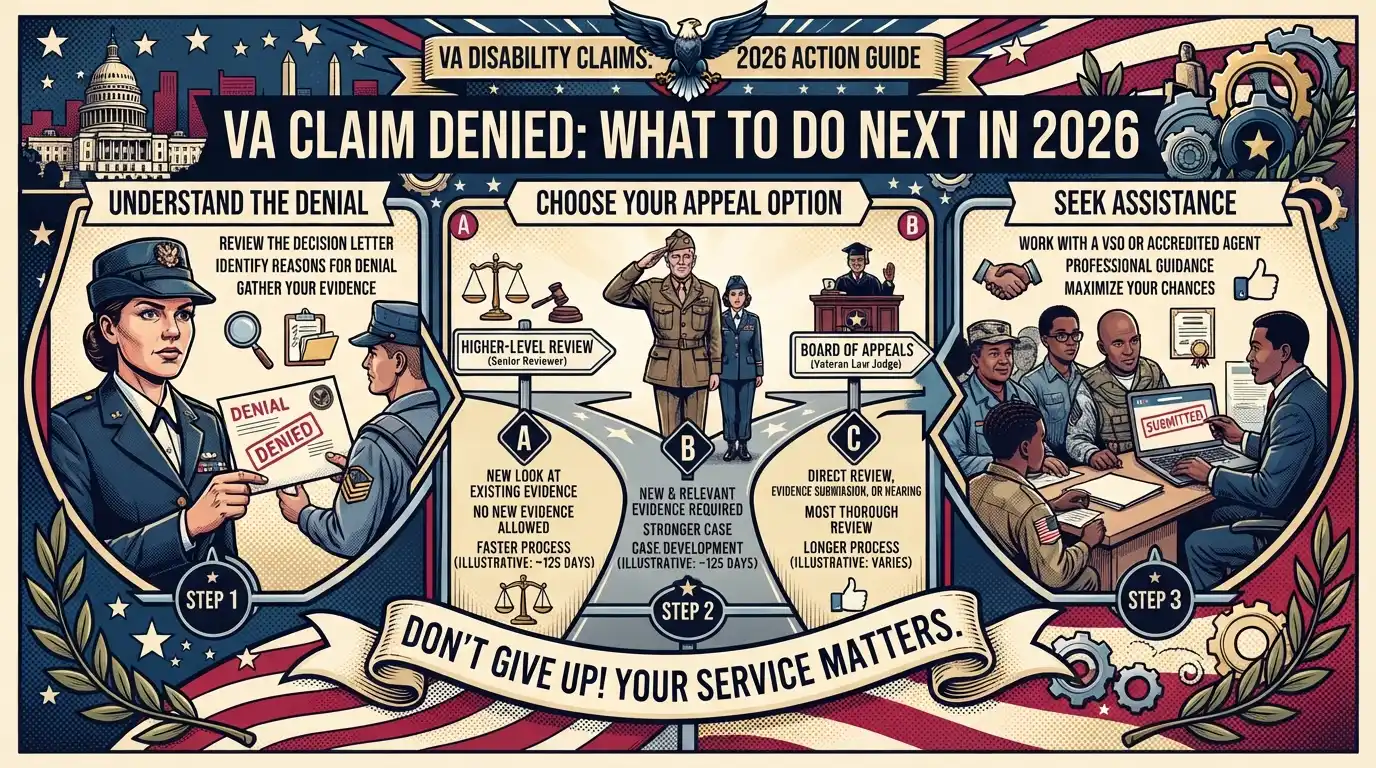
VA Claim Denied? What to Do Next
If your VA claim is denied, you have three decision review options: a Supplemental Claim with new evidence, a Higher-Level Review of the existing record, or a Board Appeal before a Veterans Law Judge. Filing within one year of the decision letter protects your original effective date and any back pay you may be owed.
Last updated: November 2026

VA Disability Combined Rating Calculator
Add each disability rating from your decision letter.

Estimate only. The VA makes the official rating decision. Not legal or financial advice, and not affiliated with the Department of Veterans Affairs.
Benefits, rates, and contact details can change. Confirm current information with the official sources linked in this article.
Quick Facts
| Item | Details |
|---|---|
| Benefit | VA disability compensation (tax-free monthly payment for service-connected conditions) |
| Who Qualifies | Veterans who disagree with a VA decision on a disability claim, or their accredited representative |
| How to Apply | File VA Form 20-0995 (Supplemental Claim), VA Form 20-0996 (Higher-Level Review), or VA Form 10182 (Board Appeal) |
| Processing Time | Supplemental Claim and Higher-Level Review: VA goal is 125 days on average; Board Appeal: 365 to 730 days depending on docket |
| Official Agency | U.S. Department of Veterans Affairs, Veterans Benefits Administration |
| Required Forms | VA Form 20-0995, VA Form 20-0996, or VA Form 10182; evidence depends on review option chosen |
| Updated For | November 2026 |
First, Read Your Decision Letter
Your decision letter explains exactly why VA denied each condition. The “Reasons for Decision” section identifies which element of service connection VA found missing: a current diagnosis, an in-service event, or a medical nexus linking the two.
VA must decide three things to grant service connection under 38 CFR 3.303: (1) you have a current diagnosed disability, (2) you had an in-service incurrence or worsening of a disease or injury, and (3) a medical link connects the current disability to that in-service event. A denial almost always traces to one of these three elements being unsupported in the evidence VA reviewed.
The letter also tells you the deadline to request a decision review. Most disability decisions give you one year from the date on the letter to file. This date matters because filing within one year can preserve your original effective date—the date VA received your first claim—which is the basis for back pay.
Army Fitness Test (AFT) Score Calculator
Formerly the ACFT. Five events, 500 points. Enter your results.
Estimate for training only. Points are interpolated from the official Army tables (effective 1 June 2025) and can differ by a few points. Your score of record comes from your unit graders. Official score tables (PDF). Not affiliated with the U.S. Army.
If you are also tracking broader changes to VA benefits and staffing, our coverage of VA benefits cuts in 2026 and what changed in November 2026 provides context on how policy decisions can affect claims processing. This article focuses on your individual denial and the steps you can take now.
Your Three Decision Review Options
Since February 19, 2019, every VA decision can be challenged through three lanes created by the Appeals Modernization Act. You choose the lane based on two questions: Do you have new evidence? and How long has it been since the decision? You cannot pursue two lanes at once on the same issue, but you can move to another lane after a decision.
| Review Option | Form | New Evidence? | Deadline to Preserve Effective Date | VA Processing Goal |
|---|---|---|---|---|
| Supplemental Claim | VA Form 20-0995 | Yes, required | 1 year (can file later, but effective date resets) | 125 days average |
| Higher-Level Review | VA Form 20-0996 | No | 1 year | 125 days average |
| Board Appeal | VA Form 10182 | Depends on docket | 1 year | 365 to 730 days by docket |
These timelines are VA goals, not guarantees. Actual processing times vary by claim complexity and workload. Confirm current estimates on the official VA decision reviews page before you rely on a specific timeframe.
Supplemental Claim: When You Have New Evidence
A Supplemental Claim asks VA to reconsider your denied condition using evidence VA did not review the first time. You must submit new and relevant evidence—information that was not already in the record and that tends to prove or disprove something in your claim.
“New” means VA has not considered it before. A copy of a record already in your file does not count. “Relevant” means the evidence relates to an unestablished fact in your claim, such as a missing diagnosis, a missing in-service event, or a missing nexus. A private medical opinion, a buddy statement, new treatment records, or a new diagnosis can all qualify. A change in law or policy, such as a new presumption under the PACT Act, can also support a Supplemental Claim.
The Supplemental Claim is the right lane when your denial letter says VA found no nexus, no current diagnosis, or no in-service event, and you now have evidence to fill that gap. If the denial was because VA misread evidence that was already in the file, a Higher-Level Review is usually the better fit.
There is no deadline to file a Supplemental Claim. You can file one years after the original denial. But the one-year mark matters for your effective date: if you file within one year of the decision letter, you may preserve your original effective date. If you file later, the effective date generally becomes the date VA receives the Supplemental Claim, and you lose the intervening back pay.
The form is VA Form 20-0995. You can file online for disability compensation claims, or by mail. VA’s processing goal for a Supplemental Claim is an average of 125 days for claims not related to health care benefits. This timeline can change, so check the current estimate on the official VA page.
For help organizing the evidence and understanding how VA reviews a Supplemental Claim, the LSGS Veteran Portal guide explains how to track compensation and pension actions online.
Higher-Level Review: When VA Made an Error on the Record
A Higher-Level Review asks a more senior VA reviewer to reconsider your case using the same evidence that was already in the file. You cannot submit new evidence in this lane. The reviewer determines whether an error or a difference of opinion changes the decision.
This is the right option when you believe VA applied the wrong rating criteria, overlooked a favorable exam finding, misread a medical opinion, or failed to obtain records it should have requested. You can request a one-time informal conference with the reviewer to point out specific errors. The conference is optional and may add time, but it is the only lane where you can speak directly with the decision-maker.
You must file within one year of the date on your most recent decision letter. You cannot request a Higher-Level Review after a previous Higher-Level Review or Board Appeal on the same issue.
The form is VA Form 20-0996. Online filing is available for disability compensation claims. VA’s goal is to complete Higher-Level Reviews not related to health care benefits within an average of 125 days (about four to five months). If the reviewer finds that VA failed in its duty to assist you in gathering evidence, the case may be returned for further development, which can extend the timeline. Confirm current processing estimates on the Higher-Level Review page before you file.
Board Appeal: When You Want a Veterans Law Judge to Decide
A Board Appeal sends your case to the Board of Veterans’ Appeals, where a Veterans Law Judge reviews the decision. You must file within one year of the date on your most recent decision letter. The Board has three dockets, and your choice affects how long the appeal takes and whether you can submit new evidence.
| Docket | New Evidence? | Hearing? | VA Average Decision Goal |
|---|---|---|---|
| Direct Review | No | No | 365 days (1 year) |
| Evidence Submission | Yes, within 90 days of filing | No | 550 days (1.5 years) |
| Hearing | Yes | Yes, before a Veterans Law Judge | 730 days (2 years) |
The Direct Review docket is the fastest when everything needed to decide your case is already in the file. The Evidence Submission docket lets you add evidence within 90 days of filing the appeal. The Hearing docket includes a personal hearing with the judge, usually by video, and takes the longest.
The form is VA Form 10182. Board appeals take far longer than the other two lanes, so they are usually reserved for cases where the regional office has already reviewed the issue and you disagree with the outcome, or where the legal or factual question is complex. Processing times vary by docket and workload; confirm current estimates with the Board of Veterans’ Appeals before filing.
How to Protect Your Effective Date and Back Pay
Your effective date is the date VA officially began owing you compensation. For an initial claim, it is generally the date VA received the claim or the date entitlement arose, whichever is later. If you file a decision review within one year of the decision letter, VA may assign the same effective date you would have received if the claim had been granted the first time. That can mean months or years of back pay.
If you file a Supplemental Claim more than one year after the decision, the effective date generally becomes the date VA receives the new Supplemental Claim. You can still be granted benefits going forward, but you lose the intervening back pay. The same one-year principle applies to Higher-Level Reviews and Board Appeals: filing within the window protects the earlier date; filing later usually resets it.
An Intent to File can also protect an effective date in some situations, but it is not a substitute for filing the actual decision review. If you are unsure how the effective date rules apply to your case, an accredited representative can review your decision letter and explain your options.
When a Denial Becomes Final: Clear and Unmistakable Error
If you did not file a decision review within the deadline, the decision becomes final. A final decision can still be challenged through a Clear and Unmistakable Error (CUE) motion, but the standard is high. You must show that VA made a specific legal or factual error that was obvious and outcome-determinative at the time the decision was made—not simply that new evidence would change the result.
A CUE motion is not a new claim and does not use the Supplemental Claim, Higher-Level Review, or Board Appeal forms in the same way. It is a separate legal vehicle for final decisions. Because the standard is strict, CUE claims are often complex; an accredited attorney or claims agent can help you evaluate whether a CUE motion is realistic.
Common Denial Reasons and What Evidence Fits
Most denials trace to one of three missing elements. The table below pairs each with the evidence that typically addresses it.
| Denial Reason | What VA Found Missing | Evidence That May Help |
|---|---|---|
| No current diagnosis | No formal diagnosis of the claimed condition | A current diagnosis from a treating provider, specialist evaluation, or updated diagnostic testing |
| No in-service event | No record of an injury, illness, or exposure during service | Service treatment records, buddy statements, personnel records, photographs, or unit history |
| No nexus | No medical link between the current condition and service | A medical nexus letter from a treating physician using “at least as likely as not” language, or a private DBQ |
| Condition not shown as severe | Symptoms not documented at the claimed severity level | New treatment records, updated DBQ, lay statements describing symptoms and functional impact |
A buddy statement from a fellow service member, family member, or friend can help document an in-service event or the severity of symptoms. Under VA regulations, VA must consider lay statements about observable symptoms. A private medical opinion is often the most direct way to address a missing nexus, but it should be based on a review of your service records and a current examination.
How to Get Free Help With Your Appeal
You do not have to file a decision review alone. Accredited Veterans Service Organization (VSO) representatives provide free help with claims and decision reviews. Organizations such as the Disabled American Veterans, Veterans of Foreign Wars, and American Legion have accredited representatives who can review your decision, help gather evidence, and file the correct form. VSO services for VA benefit claims are always free.
Accredited attorneys and claims agents can also represent you, but they may charge fees. For most disability decision reviews, a VSO representative is a practical first stop. You can find one through the VA accredited representative directory.
A representative can help you choose the right lane, avoid filing the wrong form, and make sure your evidence is organized around the element VA found missing. If you are also checking whether a third-party portal is legitimate, our guide to the LSGS Veteran Portal’s legitimacy and safety explains how to verify services through official VA channels.
Common Questions
What should I do first if my VA claim is denied?
Read the decision letter and find the “Reasons for Decision” section. Identify which element VA found missing: a current diagnosis, an in-service event, or a nexus. Then choose a review option based on whether you have new evidence. Filing within one year preserves your effective date.
How long do I have to appeal a VA denial?
Most disability decisions give you one year from the date on the decision letter to file a decision review. The deadline is stated in the letter. Filing within that year protects your original effective date. Missing the deadline can make the decision final and may require a CUE motion to challenge it.
What is the difference between a Supplemental Claim and a Higher-Level Review?
A Supplemental Claim requires new and relevant evidence and asks VA to reconsider the claim with that evidence. A Higher-Level Review uses the same evidence already in the file and asks a more senior reviewer to check for errors. If you have new evidence, use a Supplemental Claim. If VA misread the existing record, use a Higher-Level Review.
Can I submit new evidence with a Higher-Level Review?
No. VA does not accept new evidence in a Higher-Level Review. If you have new evidence, file a Supplemental Claim instead. You can request a one-time informal conference with the reviewer to point out errors in the existing record.
How long does a Supplemental Claim take?
VA’s goal is to complete Supplemental Claims within an average of 125 days for claims not related to health care benefits. Actual processing times vary. Check the current estimate on VA’s decision reviews page before you rely on a specific timeframe.
What is a Board Appeal, and should I choose it?
A Board Appeal sends your case to a Veterans Law Judge. It takes longer than a Supplemental Claim or Higher-Level Review—from about one year to two years depending on the docket. It is usually considered after the regional office has reviewed the issue, or when the case involves a complex legal or factual question.
Can I appeal a denial if I missed the one-year deadline?
You can still file a Supplemental Claim after one year, but the effective date generally resets to the date of the new claim, and you may lose back pay. If the decision is final, you may be able to file a CUE motion, but the standard is strict. An accredited representative can help you evaluate your options.
Do I need a lawyer to appeal a VA denial?
No. Accredited VSO representatives provide free help with claims and decision reviews. An accredited attorney or claims agent may be helpful for complex cases, but you are not required to hire one. VSO services for VA benefit claims are always free.
What counts as new and relevant evidence?
New evidence is information VA has not considered before, such as a new medical record, a new nexus letter, a buddy statement, or a new diagnosis. Relevant evidence tends to prove or disprove something in your claim. A copy of a record already in your file does not count as new.
Can I file a new claim instead of appealing a denial?
A new claim is different from a decision review. A new claim for an increased rating is based on a worsening of your condition since the last decision, not a disagreement with the prior decision. If you disagree with the denial itself, a decision review is the correct path. If your condition has worsened, an increase claim may be appropriate.
Key Takeaways
A VA denial is not the end of your claim. You have three decision review options: Supplemental Claim, Higher-Level Review, or Board Appeal.
Read the decision letter to identify which element VA found missing: a current diagnosis, an in-service event, or a nexus.
File within one year of the decision letter to protect your original effective date and potential back pay.
A Supplemental Claim requires new and relevant evidence; a Higher-Level Review uses the existing record; a Board Appeal goes to a Veterans Law Judge.
VA’s processing goal for Supplemental Claims and Higher-Level Reviews is 125 days on average; Board Appeals range from about one to two years by docket.
Accredited VSO representatives provide free help with decision reviews and can help you choose the right lane.
If you missed the one-year deadline, a Supplemental Claim may still be possible, but the effective date usually resets; a CUE motion applies only to final decisions and has a high standard.
Processing times and deadlines can change; confirm current details on VA.gov before filing.
Official Resources
VA Decision Reviews and Appeals — Compare the three review options and start a decision review for a disability claim.
Choosing a Decision Review Option — Answer a series of questions to see which lane may fit your situation.
Supplemental Claims — Learn what counts as new and relevant evidence and file VA Form 20-0995.
Higher-Level Reviews — Request a review of the existing record and learn about the informal conference.
Board of Veterans’ Appeals — Understand the three Board dockets and current decision wait times.
VA Form 20-0995 — Download or file the Decision Review Request: Supplemental Claim.
VA Form 20-0996 — Download or file the Decision Review Request: Higher-Level Review.
VA Form 10182 — Download or file the Decision Review Request: Board Appeal (Notice of Disagreement).
Get Help From an Accredited Representative — Find a free VSO representative or an accredited attorney or claims agent.
VA Claim Status Tool — Check the status of a pending claim, decision review, or appeal.
🇺🇸 IMPORTANT DISCLAIMER – Veterans Benefits Information
This site provides general information about U.S. Department of Veterans Affairs (VA) benefits for educational and informational purposes only.
- Not Official: We are NOT affiliated with, endorsed by, or connected to the U.S. Department of Veterans Affairs (VA), the Veterans Benefits Administration (VBA), the Veterans Health Administration (VHA), or any other government agency.
- No Legal/Financial Advice: The content on this website is for informational purposes only and does not constitute legal, financial, or medical advice. VA benefits rules change frequently – always consult with an accredited Veterans Service Officer (VSO) or a qualified professional for your specific situation.
- Official Sources: For official, binding information and to apply for benefits, always visit official .gov websites: VA.gov, Benefits.VA.gov, or SSA.gov.
- No Data Collection: This site does not collect, store, or process any personal information. It does not have login forms, contact forms, or any system to capture user data. We never ask for your Social Security Number, bank details, or any personal information.
- 🚨 Scam Alert: The VA and other government agencies never charge fees for benefit applications. If anyone asks for money to "process" your VA claim, it is a scam. Report it to the VA Office of Inspector General at VA.gov/OIG.
- Advertising: This site uses third-party advertising (Adsterra) to cover operational costs. We do not endorse or guarantee any products or services advertised.
📌 Information provided as of June 2026. Always verify current eligibility and rules with official .gov sources.
This site is not affiliated with the U.S. Department of Veterans Affairs or any government agency. All information is for educational purposes only. Please visit VA.gov for official information.
VA Disability Pay Calculator
This calculator is for information only. Your exact award is set by VA and shown in your VA.gov account and decision letter. VA disability compensation is tax-free.