
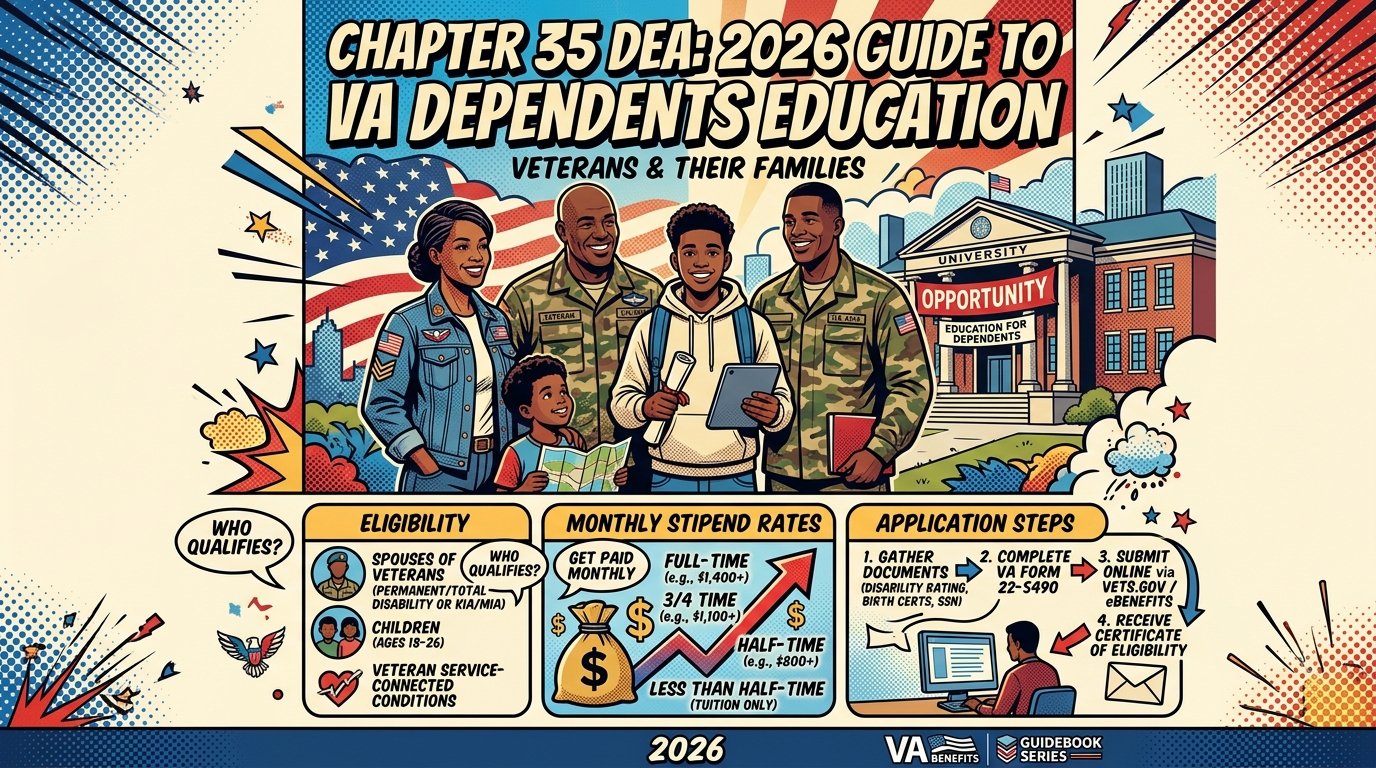
Chapter 35 DEA: Survivors’ & Dependents’ Education
The Survivors’ and Dependents’ Educational Assistance (DEA) program, also called Chapter 35, pays a monthly tax-free stipend to spouses and children of veterans who are permanently and totally disabled, died from a service-connected condition, or are missing/captured. The 2026 full-time rate is $1,574 per month for up to 36 months. Apply with VA Form 22-5490.
Quick Facts
| Item | Details |
|---|---|
| Benefit | Monthly education stipend paid directly to the spouse or child of an eligible veteran or service member |
| Eligibility | Spouse or child of a veteran rated 100% Permanent and Total (P&T), or who died from service-connected causes; also covers missing/captured service members |
| Application | VA Form 22-5490, online through VA.gov or by mail |
| Processing Time | Commonly 30–45 days for the Certificate of Eligibility (COE); varies by regional office |
| Official Agency | U.S. Department of Veterans Affairs (VA) |
| Required Forms | VA Form 22-5490 (application); school enrollment certification each term |
| Updated For | 2026 rates effective October 1, 2025–September 30, 2026; future rates effective October 1, 2026 |
What Is the Survivors’ and Dependents’ Educational Assistance Program?
The Survivors’ and Dependents’ Educational Assistance program is a VA education benefit for family members of veterans and service members who meet specific service-connected death or disability criteria. It is commonly called Chapter 35 or DEA.

VA Disability Combined Rating Calculator
Add each disability rating from your decision letter.

Estimate only. The VA makes the official rating decision. Not legal or financial advice, and not affiliated with the Department of Veterans Affairs.
The program pays a monthly stipend to the eligible spouse or child. The money goes directly to the student, not to the school. The student can use it for tuition, fees, housing, books, or other living expenses. VA does not require the student to pay it back.
Chapter 35 is not the same as the Post-9/11 GI Bill. The Post-9/11 GI Bill pays tuition directly to the school and includes a separate housing allowance. Chapter 35 pays a flat monthly amount to the student, and the student decides how to use it. That structure can be an advantage at a low-cost school or in a low-cost area, because the stipend may exceed tuition. At a high-cost private school, Chapter 35 may cover less than the Post-9/11 GI Bill would.
Why Chapter 35 Matters
Chapter 35 is often the only federal education benefit available to the family of a veteran who is permanently and totally disabled or who died from a service-connected condition. Survivors and dependents of a 100% P&T veteran cannot inherit the veteran’s Post-9/11 GI Bill unless the veteran transferred the benefit while still on active duty. Chapter 35 fills that gap with a dedicated dependent benefit.
For a surviving spouse, Chapter 35 can fund retraining for a new career after a loss. For a child, it can cover part or all of a college degree or trade program. For a family with limited resources, a monthly stipend of $1,574 for 36 months is more than $56,000 in non-repayable education support.
Who Qualifies for Chapter 35 DEA
Army Fitness Test (AFT) Score Calculator
Formerly the ACFT. Five events, 500 points. Enter your results.
Estimate for training only. Points are interpolated from the official Army tables (effective 1 June 2025) and can differ by a few points. Your score of record comes from your unit graders. Official score tables (PDF). Not affiliated with the U.S. Army.
A dependent qualifies for Chapter 35 when the veteran or service member meets at least one qualifying condition and the dependent meets the relationship and age rules. The veteran or service member must fall into one of these categories:
Permanently and totally disabled due to a service-connected disability. VA must have rated the condition 100% disabling and permanent in nature. A 100% schedular or TDIU rating alone does not qualify unless VA also grants P&T status.
Died as a result of a service-connected disability.
Died in the line of duty while serving on active duty.
Missing in action or captured in the line of duty by a hostile force for more than 90 days.
Forcibly detained or interned in the line of duty by a foreign entity for more than 90 days.
Hospitalized or receiving outpatient treatment for a service-connected permanent and total disability and likely to be discharged for that disability.
Who Qualifies as a Spouse
A legal spouse of an eligible veteran or service member qualifies. A surviving spouse who has not remarried also qualifies. A spouse can receive Chapter 35 and Dependency and Indemnity Compensation (DIC) at the same time. If the spouse divorces the veteran, Chapter 35 eligibility ends. If the veteran dies and the surviving spouse remarries, eligibility generally ends, with two exceptions: the remarriage occurred on or after January 1, 2004, and the spouse was at least 57 years old; or the remarriage later ends by death or divorce.
A spouse cannot use Chapter 35 while on active duty and cannot use it after a dishonorable discharge.
Who Qualifies as a Child
A child can be married or unmarried. The child cannot use Chapter 35 while on active duty. A child who serves and later wants to use the benefit must not have a dishonorable discharge. A child who receives DIC must give up DIC payments while using DEA.
Stepchildren, adopted children, and children of a same-sex marriage recognized for VA purposes may qualify under VA’s dependent definitions.
Age and Time Limits for Children
The age rules depend on when the child became eligible.
If the child became eligible for DEA on or after August 1, 2023, or turned 18 or completed high school on or after that date: There is no age limit to use the benefit. The child can be any age.
If the child became eligible before August 1, 2023: The child generally must be at least 18 years old or have completed high school or a GED to start using benefits. The child generally has up to 8 years to use the benefit before turning 26. The 8-year clock does not always end at 26. Exceptions apply if the child became eligible between 18 and 26, if the child’s parent died when the child was between 18 and 26, or if the child joined the military. A child who joined the military can use DEA for up to 8 years from discharge, as long as the child is under 31.
Age and Time Limits for Spouses
If the qualifying event happened on or after August 1, 2023: There is no time limit for the spouse to use the benefit.
If the qualifying event happened before August 1, 2023: The spouse generally has 10 years to use benefits. If the veteran was rated P&T and later dies, the spouse gets another 10 years. If the service member died on active duty, benefits end after 20 years. If the veteran’s P&T effective date was within 3 years of discharge, benefits generally end 20 years from that effective date.
Can a Dependent Use Chapter 35 and the Fry Scholarship Together?
A dependent cannot receive both Chapter 35 and the Fry Scholarship based on the same qualifying event. The dependent must make an irrevocable election between the two programs. In most cases, the Fry Scholarship pays more because it follows the Post-9/11 GI Bill structure: full tuition at a public school plus a housing allowance. But Chapter 35’s flat stipend can be the better financial choice at a low-cost school or for a student who wants maximum flexibility.
For a child whose parent died in the line of duty before August 1, 2011, the child may qualify for both programs but can use only one at a time. Combined benefits are capped at 81 months of full-time training. For a parent who died on or after August 1, 2011, the child can use both only if the child qualifies for DEA under a different event, and the combined cap is 48 months.
Chapter 35 DEA Rates for 2025–2026 and 2026–2027
Chapter 35 pays a monthly rate based on enrollment status. The rate is the same for college programs and non-college degree programs at the full-time, three-quarter-time, and half-time levels. VA pays a prorated amount for partial months of enrollment.
Current Rates: October 1, 2025 – September 30, 2026
| Enrollment Status | Monthly Rate |
|---|---|
| Full-time | $1,574.00 |
| ¾-time | $1,244.00 |
| ½-time | $912.00 |
| Less than ½-time, more than ¼-time | $912.00 or tuition and fees, whichever is less |
| ¼-time or less | $393.50 or tuition and fees, whichever is less |
Source: VA Chapter 35 rate table, effective October 1, 2025
Future Rates: October 1, 2026 – September 30, 2027
| Enrollment Status | Monthly Rate |
|---|---|
| Full-time | $1,621.00 |
| 75% enrollment | $1,281.00 |
| 50% enrollment | $939.00 |
| Less than 50%, more than 25% | $939.00 or tuition and fees, whichever is less |
| 25% or less | $405.25 or tuition and fees, whichever is less |
Source: VA future Chapter 35 rate table, effective October 1, 2026
The October 2026 increase reflects the annual cost-of-living adjustment. A full-time student will see a monthly increase of $47.00 over the 2025–2026 rate.
How VA Calculates the Payment
VA does not pay the full monthly rate for a partial month. If a school term starts on the 20th, VA pays only for the days of enrollment in that month. The payment is prorated based on the number of days enrolled divided by the total days in the month.
If the student is enrolled at less than half-time and tuition and fees are lower than the monthly rate, VA pays the actual tuition and fees as a lump sum at the start of the term. This rule protects students at very low-cost programs from receiving more than their actual education costs.
How to Apply for Chapter 35 DEA
Apply for Chapter 35 with VA Form 22-5490, Application for Survivors’ and Dependents’ Educational Assistance. The application is available online through VA.gov and by mail. There is no application fee.
Step-by-Step Application Process
Step 1: Confirm eligibility before applying. The dependent should verify the veteran’s P&T status or service-connected death documentation before submitting an application. A 100% rating letter that does not state “permanent and total” will not support a Chapter 35 claim. The dependent can request a copy of the VA rating decision or ask the veteran to check the decision letter.
Step 2: Gather required documents. The application requires information about the qualifying veteran or service member. The dependent should have:
The veteran’s Social Security number or VA file number.
The veteran’s DD-214 or proof of service.
The VA rating decision showing P&T status, or the death certificate and service-connected death documentation.
The dependent’s birth certificate or marriage certificate to prove relationship.
The dependent’s Social Security number.
Banking information for direct deposit.
Step 3: Complete VA Form 22-5490 online. Go to VA.gov, select “Apply for Education Benefits,” and answer the questions under “Find Your Education Benefits Form.” The system will route the applicant to Form 22-5490. The online application processes faster than a paper application.
Step 4: Submit the application and wait for the Certificate of Eligibility. VA reviews the application and mails a Certificate of Eligibility (COE) if the dependent qualifies. Processing commonly takes 30 to 45 days, though some regional offices report shorter or longer timelines. A complete application with all supporting documents reduces delays.
Step 5: Submit the COE to the school’s certifying official. The dependent must give a copy of the COE to the school’s VA certifying official. The school uses the COE to certify enrollment to VA. Without school certification, VA cannot pay the monthly stipend.
Step 6: Verify enrollment each month. Since fall 2025, Chapter 35 students must verify their enrollment each month directly to VA to receive the monthly stipend. The school’s certification alone is not enough. Students can verify enrollment through VA’s online tools or by phone.
Required Documents Checklist
| Document | Purpose |
|---|---|
| VA Form 22-5490 | Starts the application |
| Veteran’s DD-214 | Proves qualifying military service |
| VA rating decision (P&T) or death certificate | Proves the qualifying event |
| Birth certificate or marriage certificate | Proves relationship to the veteran |
| Social Security numbers | Identifies the dependent and veteran |
| Banking information | Sets up direct deposit |
| Certificate of Eligibility (after VA issues it) | Given to the school’s certifying official |
Processing Times and Payment Schedule
VA commonly processes Chapter 35 applications within 30 to 45 days. Some schools report decisions within 30 days, while others advise students to allow 5 to 8 weeks for a COE to arrive by mail. Processing times can run longer during peak enrollment periods in July, August, and January.
Chapter 35 payments follow the same monthly payment schedule as other VA education benefits. VA pays at the beginning of each month for the prior month’s enrollment. If the first of the month falls on a weekend or federal holiday, VA pays on the preceding business day.
A student who applies close to the start of a term may experience a gap between the start of classes and the first payment. VA advises students to apply at least 8 to 12 weeks before the term starts to allow time for the COE and school certification. Students who apply late can still receive back pay for the enrollment period, provided the school certifies the enrollment and the student verifies each month.
Common Mistakes That Delay or Reduce Chapter 35 Payments
Assuming a 100% rating is enough without P&T. The most common eligibility error is applying for Chapter 35 based on a 100% schedular or TDIU rating that lacks P&T status. VA will deny the application if the rating decision does not state that the disability is permanent and total. The veteran should confirm the rating decision language before the dependent applies.
Not removing the child from the veteran’s dependent compensation. A veteran who receives added dependent compensation for a child under 18 or a schoolchild 18–23 cannot continue receiving that add-on while the child receives Chapter 35 DEA. VA generally does not automatically stop the dependency payment. The veteran must notify VA to remove the child from the compensation award, or VA will create an overpayment that must be repaid.
Failing to verify enrollment each month. Since fall 2025, Chapter 35 students must verify enrollment monthly. A student who skips verification will not receive the monthly stipend, even if the school certified enrollment. Verification is the student’s responsibility, not the school’s.
Dropping a class without understanding the entitlement cost. Dropping a class mid-semester still consumes entitlement months. A full-time semester uses approximately 4 months of the 36-month entitlement. Students who withdraw from a class and do not complete the term may use entitlement without earning credit toward a degree.
Missing the high school program cutoff. Starting August 1, 2026, Chapter 35 no longer pays for new secondary education programs, including high school coursework, GED-level training, tutoring, or academic remediation. Students who started a secondary program before August 1, 2026, continue to receive benefits through the end of that academic term. Families who planned to use Chapter 35 for high school completion or GED preparation must explore other funding sources.
Chapter 35 vs. Fry Scholarship vs. Post-9/11 GI Bill Transfer
Chapter 35 is one of several education benefits available to military families. The right program depends on the qualifying event, the dependent’s relationship to the veteran, and the cost of the school.
| Feature | Chapter 35 DEA | Fry Scholarship | Post-9/11 GI Bill Transfer |
|---|---|---|---|
| Who qualifies | Spouse or child of 100% P&T veteran, or veteran who died from service-connected causes | Child or spouse of service member who died in the line of duty after 9/10/2001 | Spouse or child to whom an eligible veteran transferred benefits while on active duty |
| What it pays | Flat monthly stipend ($1,574 full-time in 2025–2026) | Full tuition at public school rate, housing allowance, books | Full tuition at public school rate, housing allowance, books |
| Payment goes to | Student | School (tuition) and student (housing) | School (tuition) and student (housing) |
| Entitlement | Up to 36 months | Up to 36 months | Up to 36 months |
| P&T required | Yes | No; death in line of duty required | No; honorable service and transfer required |
| Can combine? | No with Fry based on same event; irrevocable election required | No with DEA based on same event | Not with DEA for the same dependent |
Sources: VA DEA and Fry Scholarship program pages
When Chapter 35 may be the better choice: A dependent attending a low-cost community college or trade school, or a student living at home with low expenses, may keep more money with Chapter 35’s flat stipend than with the Fry Scholarship’s tuition-and-housing structure. Chapter 35 also gives the student maximum flexibility to choose a school and program without worrying about whether tuition exceeds the benefit cap.
When Fry or a GI Bill transfer may be the better choice: A dependent attending a high-cost private university or living in a high-cost housing area will usually receive more total value from the Fry Scholarship or a transferred Post-9/11 GI Bill. The housing allowance alone can exceed Chapter 35’s full-time stipend in expensive cities.
State Benefits and Chapter 35
Many states offer tuition waivers or education benefits to dependents of 100% disabled or deceased veterans. These state programs are separate from Chapter 35 and require separate applications. A dependent can sometimes use a state tuition waiver and Chapter 35 at the same time.
| State Program Type | What It Typically Covers | How to Apply |
|---|---|---|
| Tuition waiver | Free or reduced tuition at public colleges for dependents of 100% P&T or deceased veterans | State veterans agency or participating college |
| State grant | Additional cash assistance for education expenses | State higher education agency |
| Property tax relief (survivor) | Reduction in property taxes for surviving spouses | County tax assessor |
State rules vary widely. Verify current eligibility and application procedures with the state veterans agency or the college’s financial aid office
A dependent who receives a full state tuition waiver may still benefit from Chapter 35 because the federal stipend can cover housing, books, and living expenses. However, the dependent should calculate the total value carefully. If the state waiver already covers tuition and the Chapter 35 stipend is being used only for living expenses, the dependent is still consuming months of the 36-month federal entitlement. In some cases, saving Chapter 35 for graduate school or a later program may be the better long-term strategy.
Recent Rule Changes for Chapter 35
High school programs ending August 1, 2026. A change in federal law discontinues Chapter 35 benefits for secondary education programs starting on or after August 1, 2026. This includes high school coursework, GED-level training, tutoring, and academic remediation. Students who started a qualifying secondary program before August 1, 2026, continue to receive benefits through the end of that academic term. The change does not affect college, trade school, apprenticeship, or on-the-job training programs.
No age limit for dependents who became eligible on or after August 1, 2023. The VA streamlined age rules in 2023. Children and spouses who first became eligible for Chapter 35 on or after August 1, 2023, no longer face the traditional 26th-birthday cutoff for children or the 10-year window for spouses. This change gives families more flexibility to time their education and career training.
Monthly enrollment verification requirement. Since fall 2025, Chapter 35 students must verify enrollment each month to receive the stipend. VA added this requirement to reduce improper payments and ensure that students are actively enrolled. Students who fail to verify will see their payments stop until verification is completed.
Common Questions
What is the Chapter 35 DEA program?
Chapter 35 DEA is a VA education benefit that pays a monthly stipend to the spouse or child of a veteran who is permanently and totally disabled, died from a service-connected condition, or is missing or captured. The 2026 full-time rate is $1,574 per month for up to 36 months.
Does a 100% VA rating automatically qualify my family for Chapter 35?
No. The veteran must have Permanent and Total (P&T) status. A 100% schedular or TDIU rating without P&T does not qualify dependents for Chapter 35. Check the VA rating decision for the phrase “permanent and total.”
How much does Chapter 35 pay in 2026?
The full-time rate is $1,574 per month from October 1, 2025, through September 30, 2026. Starting October 1, 2026, the full-time rate rises to $1,621 per month. Part-time students receive lower rates based on enrollment status.
How long does it take to get approved for Chapter 35?
VA commonly processes applications within 30 to 45 days. Some schools advise allowing 5 to 8 weeks for the Certificate of Eligibility to arrive by mail. Complete applications with all supporting documents process faster.
Can my child use Chapter 35 after age 26?
It depends on when the child became eligible. A child who became eligible on or after August 1, 2023, has no age limit. A child who became eligible before that date generally has up to 8 years to use the benefit before turning 26, with exceptions for military service and other circumstances.
Can a spouse use Chapter 35 and DIC at the same time?
Yes. A surviving spouse can receive Dependency and Indemnity Compensation (DIC) and Chapter 35 at the same time. A child receiving DIC, however, must give up DIC payments while using Chapter 35.
What happens if a surviving spouse remarries?
Chapter 35 eligibility generally ends if the surviving spouse remarries. Two exceptions apply: if the remarriage occurred on or after January 1, 2004, and the spouse was at least 57 years old; or if the remarriage later ends by death or divorce. In those cases, VA restores the remaining benefits.
Can I get both Chapter 35 and the Fry Scholarship?
Not based on the same qualifying event. A dependent must make an irrevocable election between the two programs. In most cases, the Fry Scholarship pays more at a high-cost school, but Chapter 35 can be better at a low-cost school.
Does Chapter 35 pay tuition directly to the school?
No. Chapter 35 pays the monthly stipend directly to the student. The student is responsible for paying tuition and fees to the school. This differs from the Post-9/11 GI Bill, which pays tuition directly to the school.
What is the monthly enrollment verification requirement?
Since fall 2025, Chapter 35 students must verify enrollment each month to VA to receive the monthly stipend. The school’s certification alone is not enough. Students who do not verify will have payments stopped until verification is completed.
Can I use Chapter 35 for trade school or an apprenticeship?
Yes. Chapter 35 can be used for college degree programs, non-college degree programs at trade and vocational schools, apprenticeships, on-the-job training, and some licensing and certification tests. The program must be approved by VA.
What happens to Chapter 35 for high school programs after August 1, 2026?
Starting August 1, 2026, Chapter 35 no longer pays for new secondary education programs, including high school coursework, GED training, tutoring, and academic remediation. Students who started a qualifying program before that date continue through the end of the academic term.
Key Takeaways
The Survivors’ and Dependents’ Educational Assistance program (Chapter 35 DEA) pays a monthly stipend to spouses and children of veterans who are 100% Permanent and Total, died from service-connected causes, or are missing/captured.
The 2025–2026 full-time rate is $1,574 per month**; the 2026–2027 full-time rate is **$1,621 per month. Benefits last up to 36 months.
A 100% VA rating alone is not enough. The veteran must have P&T status for dependents to qualify for Chapter 35.
Apply with VA Form 22-5490 online at VA.gov or by mail. Processing commonly takes 30–45 days for a Certificate of Eligibility.
Children who became eligible on or after August 1, 2023, have no age limit to use Chapter 35. Children who became eligible earlier generally have until age 26, with exceptions.
Spouses who became eligible on or after August 1, 2023, have no time limit. Earlier-eligible spouses generally have 10 or 20 years, depending on the qualifying event.
Chapter 35 and the Fry Scholarship cannot be used together based on the same event. The dependent must make an irrevocable election.
A veteran must remove a child from dependent compensation when the child starts receiving Chapter 35, or VA will create an overpayment.
Since fall 2025, students must verify enrollment each month to receive the stipend.
Starting August 1, 2026, Chapter 35 no longer pays for new high school, GED, tutoring, or remedial programs.
Official Resources
VA DEA program page: https://www.va.gov/family-and-caregiver-benefits/education-and-careers/dependents-education-assistance/
Chapter 35 current rates: https://www.va.gov/family-and-caregiver-benefits/education-and-careers/dependents-education-assistance/rates/
Chapter 35 future rates: https://www.va.gov/family-and-caregiver-benefits/education-and-careers/dependents-education-assistance/rates/future-rates/
VA Form 22-5490: https://www.va.gov/find-forms/about-form-22-5490/
Fry Scholarship: https://www.va.gov/family-and-caregiver-benefits/education-and-careers/fry-scholarship/
GI Bill Comparison Tool: https://www.va.gov/gi-bill-comparison-tool/
VA decision reviews and appeals: https://www.va.gov/decision-reviews/
VA.gov main site: https://www.va.gov
USA.gov veterans benefits portal: https://www.usa.gov/veterans-benefits
🇺🇸 IMPORTANT DISCLAIMER – Veterans Benefits Information
This site provides general information about U.S. Department of Veterans Affairs (VA) benefits for educational and informational purposes only.
- Not Official: We are NOT affiliated with, endorsed by, or connected to the U.S. Department of Veterans Affairs (VA), the Veterans Benefits Administration (VBA), the Veterans Health Administration (VHA), or any other government agency.
- No Legal/Financial Advice: The content on this website is for informational purposes only and does not constitute legal, financial, or medical advice. VA benefits rules change frequently – always consult with an accredited Veterans Service Officer (VSO) or a qualified professional for your specific situation.
- Official Sources: For official, binding information and to apply for benefits, always visit official .gov websites: VA.gov, Benefits.VA.gov, or SSA.gov.
- No Data Collection: This site does not collect, store, or process any personal information. It does not have login forms, contact forms, or any system to capture user data. We never ask for your Social Security Number, bank details, or any personal information.
- 🚨 Scam Alert: The VA and other government agencies never charge fees for benefit applications. If anyone asks for money to "process" your VA claim, it is a scam. Report it to the VA Office of Inspector General at VA.gov/OIG.
- Advertising: This site uses third-party advertising (Adsterra) to cover operational costs. We do not endorse or guarantee any products or services advertised.
📌 Information provided as of June 2026. Always verify current eligibility and rules with official .gov sources.
This site is not affiliated with the U.S. Department of Veterans Affairs or any government agency. All information is for educational purposes only. Please visit VA.gov for official information.
