
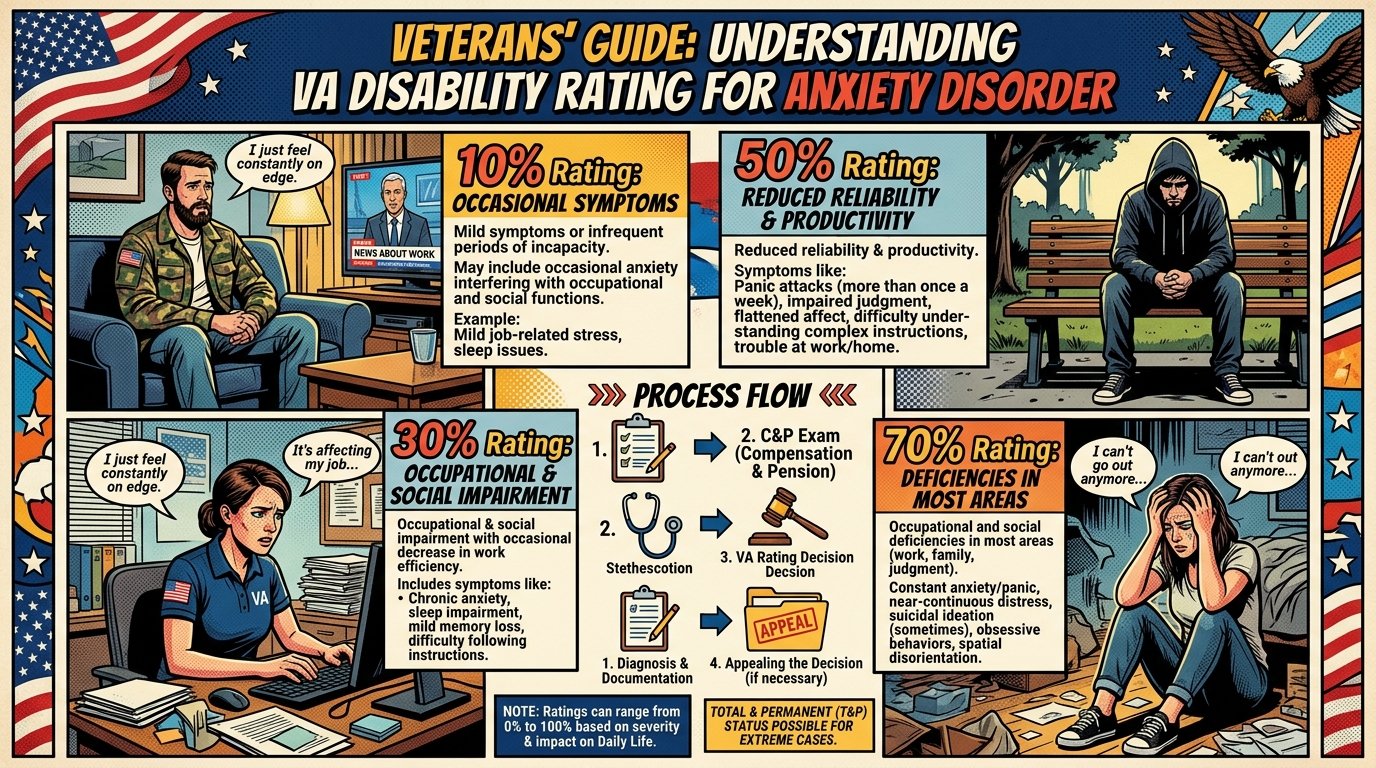
VA Disability Rating for Anxiety Disorder: 0%–100% Criteria, Pay, and How to Claim
VA rates anxiety disorders at 0%, 10%, 30%, 50%, 70%, or 100% under the General Rating Formula for Mental Disorders (38 CFR § 4.130) , Diagnostic Code 9400. The rating is based on how much your symptoms impair occupational and social functioning, not the specific anxiety diagnosis. A 70% rating pays $1,859.94 per month in 2026.
Quick Facts
| Item | Details |
|---|---|
| Governing Regulation | 38 CFR § 4.130, General Rating Formula for Mental Disorders |
| Primary Diagnostic Code | DC 9400 — Generalized Anxiety Disorder (GAD); other anxiety codes include DC 9412 (Panic Disorder) and DC 9403 (Social Anxiety) |
| Rating Levels | 0%, 10%, 30%, 50%, 70%, 100% |
| 2026 Pay (Veteran Alone) | 10%: $180.42** / 30%: **$537.42 / 50%: $1,132.90** / 70%: **$1,859.94 / 100%: $3,938.58 per month |
| What Determines the Rating | Severity of occupational and social impairment, not the number of symptoms or the diagnosis label |
| Application Form | VA Form 21-526EZ (Application for Disability Compensation) |
| Medical Evidence Form | VA Form 21-2680 (for Aid and Attendance) or DBQ Mental Disorders |
| C&P Exam | Mental health examination by a VA or contracted psychologist, psychiatrist, or LCSW; 45–75 minutes |
| TDIU Threshold | A 70% mental health rating can open eligibility for Total Disability based on Individual Unemployability (paid at the 100% rate) |
| Appeals | Supplemental Claim (VA Form 20-0995), Higher-Level Review (20-0996), Board Appeal (10182) |
| Official Agency | U.S. Department of Veterans Affairs (Veterans Benefits Administration) |
| Updated For | 2026 VA compensation rates; 38 CFR 4.130 current text (no 2026 amendment to the rating formula) |
How VA Rates Anxiety: The General Rating Formula
VA rates all anxiety disorders under the same General Rating Formula for Mental Disorders at 38 CFR § 4.130. The formula assigns a single percentage based on how severely the condition impairs occupational and social functioning. The specific diagnosis—GAD, panic disorder, social anxiety, OCD—does not set the rating ceiling. Your documented functional impairment does.

The Diagnostic Codes for Anxiety
| Diagnostic Code | Condition |
|---|---|
| DC 9400 | Generalized Anxiety Disorder (GAD) |
| DC 9412 | Panic Disorder with or without Agoraphobia |
| DC 9403 | Social Anxiety Disorder / Specific Phobia |
| DC 9404 | Obsessive-Compulsive Disorder (OCD) |
| DC 9410 | Other Specified Anxiety Disorder |
| DC 9440 | Chronic Adjustment Disorder with Anxiety |
VA Disability Combined Rating Calculator
Add each disability rating from your decision letter.

Estimate only. The VA makes the official rating decision. Not legal or financial advice, and not affiliated with the Department of Veterans Affairs.
All of these codes reference the same rating formula. The VA’s rating decision will list a diagnostic code, but the percentage is driven by the criteria in § 4.130.
The Pyramiding Rule: One Mental Health Rating
VA cannot assign separate ratings for multiple mental health conditions when the symptoms overlap. If you have anxiety plus depression plus PTSD, they are generally combined into a single mental health rating. The VA evaluates the overall level of impairment across all mental health conditions and assigns one percentage. Adding a new mental health diagnosis does not add a separate rating; it may increase the overall mental health rating if the combined impairment is more severe.
Anxiety VA Rating Criteria: 0% to 100%
The table below reproduces the 38 CFR § 4.130 criteria. The symptoms listed at each level are examples (“such as”) , not a checklist. You do not need every listed symptom to qualify for a rating level. The overall impairment picture controls.
0% — Noncompensable
A mental condition has been formally diagnosed, but symptoms are not severe enough either to interfere with occupational and social functioning or to require continuous medication.
10% — Mild or Transient Symptoms
Army Fitness Test (AFT) Score Calculator
Formerly the ACFT. Five events, 500 points. Enter your results.
Estimate for training only. Points are interpolated from the official Army tables (effective 1 June 2025) and can differ by a few points. Your score of record comes from your unit graders. Official score tables (PDF). Not affiliated with the U.S. Army.
Occupational and social impairment due to mild or transient symptoms that decrease work efficiency and the ability to perform occupational tasks only during periods of significant stress, OR symptoms controlled by continuous medication.
Panic attacks are infrequent or absent.
Symptoms are manageable with treatment or medication.
Work and social functioning are largely intact outside high-stress periods.
30% — Occasional Decrease in Work Efficiency
Occupational and social impairment with occasional decrease in work efficiency and intermittent periods of inability to perform occupational tasks, although the veteran is generally functioning satisfactorily with routine behavior, self-care, and conversation normal. Symptoms include:
Depressed mood, anxiety, suspiciousness.
Panic attacks weekly or less often.
Chronic sleep impairment.
Mild memory loss (forgetting names, directions, recent events).
This is the most common rating level and the level where many claims get stuck when documentation does not capture the full functional impact.
50% — Reduced Reliability and Productivity
Occupational and social impairment with reduced reliability and productivity due to symptoms such as:
Flattened affect.
Circumstantial, circumlocutory, or stereotyped speech.
Panic attacks more than once a week.
Difficulty understanding complex commands.
Impairment of short- and long-term memory (retention of only highly learned material, forgetting to complete tasks).
Impaired judgment and abstract thinking.
Disturbances of motivation and mood.
Difficulty establishing and maintaining effective work and social relationships.
The 50% level reflects impairment that is persistent, not situational. Panic attack frequency is one of the clearest dividers between 30% and 50%.
70% — Deficiencies in Most Areas
Occupational and social impairment with deficiencies in most areas, such as work, school, family relations, judgment, thinking, or mood, due to symptoms such as:
Suicidal ideation.
Obsessional rituals that interfere with routine activities.
Speech intermittently illogical, obscure, or irrelevant.
Near-continuous panic or depression affecting the ability to function independently, appropriately, and effectively.
Impaired impulse control (unprovoked irritability with periods of violence).
Spatial disorientation.
Neglect of personal appearance and hygiene.
Difficulty adapting to stressful circumstances, including work or a work-like setting.
Inability to establish and maintain effective relationships.
The 70% rating is the threshold most commonly associated with significant functional impairment and is the level that opens eligibility for TDIU.
100% — Total Occupational and Social Impairment
Total occupational and social impairment due to symptoms such as:
Gross impairment in thought processes or communication.
Persistent delusions or hallucinations.
Grossly inappropriate behavior.
Persistent danger of hurting self or others.
Intermittent inability to perform activities of daily living (including minimal personal hygiene).
Disorientation to time or place.
Memory loss of names of close relatives, own occupation, or own name.
A 100% schedular rating for anxiety is uncommon but achievable when the evidence documents total impairment. Alternatively, TDIU can pay at the 100% rate when anxiety prevents substantially gainful employment even if the schedular rating is 70%.
Rating Criteria Summary Table
| Rating | Core Functional Standard | Key Symptom Examples |
|---|---|---|
| 0% | Diagnosis, no occupational/social impairment | No continuous medication required |
| 10% | Mild/transient symptoms under stress or controlled by medication | Decreased work efficiency only during significant stress |
| 30% | Occasional decrease in work efficiency; generally functioning satisfactorily | Panic attacks weekly or less; chronic sleep impairment; mild memory loss |
| 50% | Reduced reliability and productivity | Panic attacks more than once a week; impaired judgment; difficulty with work/social relationships |
| 70% | Deficiencies in most areas (work, school, family, judgment, thinking, mood) | Suicidal ideation; near-continuous panic/depression; inability to adapt to stress |
| 100% | Total occupational and social impairment | Persistent danger to self/others; gross impairment in thought/communication; inability to perform ADLs |
2026 VA Disability Pay for Anxiety Ratings
The following monthly rates apply to a veteran with no dependents, effective December 1, 2025 (2026 rates). Anxiety ratings follow the same pay scale as all other VA disability ratings.
| Rating | Monthly Payment (Veteran Alone) | Annual Equivalent |
|---|---|---|
| 10% | $180.42 | $2,165.04 |
| 30% | $537.42 | $6,449.04 |
| 50% | $1,132.90 | $13,594.80 |
| 70% | $1,859.94 | $22,319.28 |
| 100% | $3,938.58 | $47,262.96 |
| TDIU (paid at 100%) | $3,938.58 | $47,262.96 |
VA disability compensation is tax-free at the federal level and in most states. The difference between a 50% and 70% rating is **$727.04 per month** ($8,724.48 per year), and a 70% rating opens the door to TDIU.
How to Prove Service Connection for Anxiety
To receive a VA rating for anxiety, you must establish service connection—a legal link between your anxiety and your military service. There are three pathways.
Direct Service Connection
Direct service connection requires three elements:
A current diagnosis of an anxiety disorder from a qualified mental health professional (DSM-5 diagnosis in your medical record).
An in-service event, injury, or illness that caused or aggravated the anxiety (e.g., combat exposure, military sexual trauma, chronic operational stress, a physical injury).
A medical nexus—a doctor’s opinion stating that your current anxiety is at least as likely as not caused by or related to your military service.
Secondary Service Connection
Secondary service connection applies when anxiety is caused or aggravated by an already service-connected condition. Common pathways include:
Anxiety secondary to chronic pain (back, knee, or joint conditions).
Anxiety secondary to PTSD (most common).
Anxiety secondary to TBI.
Anxiety secondary to a medical condition (heart disease, diabetes, cancer) or medication side effects.
For a secondary claim, you need the same three elements, but the nexus links the anxiety to the service-connected condition rather than directly to service.
Aggravation
Aggravation applies when a pre-existing anxiety condition was worsened beyond its natural progression by military service. This pathway requires evidence of the baseline severity before service and documentation of worsening during service.
Evidence That Strengthens an Anxiety Claim
Service treatment records showing complaints, diagnoses, or treatment during service.
Current medical records with a DSM-5 diagnosis and treatment history.
Nexus letter from a psychiatrist or psychologist.
Buddy statements (VA Form 21-10210) from fellow service members, family, or friends who witnessed your symptoms.
Personal statement (VA Form 21-4138) describing how anxiety affects your daily life and work.
Employment records showing performance issues, accommodations, or job loss.
The C&P Exam for Anxiety: What to Expect
A Compensation and Pension (C&P) exam for anxiety is a mental health evaluation ordered by VA to assess the cause and severity of your condition. It is not a treatment appointment. The examiner will review your claims file and ask about your symptoms, history, and daily functioning. The exam typically lasts 45–75 minutes and may be conducted in person or by telehealth.
Who Conducts the Exam
The examiner is a licensed mental health professional—a VA psychologist, psychiatrist, or licensed clinical social worker (LCSW)—or a contracted examiner through Optum, LHI, or QTC. You cannot choose the examiner. The examiner documents symptoms and functional impairment on a Disability Benefits Questionnaire (DBQ); a VA rater translates that documentation into a percentage.
Common C&P Exam Questions
When did your anxiety symptoms begin? What was happening in your life at the time?
How often do you have panic attacks? What triggers them?
How does anxiety affect your sleep, appetite, and energy?
Are you able to work? Have you lost jobs or been disciplined because of anxiety?
How do you interact with family, friends, and strangers?
Do you leave the house? Do you avoid situations?
Have you had thoughts of self-harm or suicide?
What medications are you taking? Do they help?
Have you been hospitalized for mental health reasons?
How to Prepare for the C&P Exam
Do not downplay symptoms. Veterans who minimize struggles or answer with military stoicism routinely receive ratings 20–30 percentage points lower than their actual impairment warrants.
Bring notes. Write down your worst days, panic attack frequency, work problems, and relationship strain before the exam.
Describe function, not just feelings. The rating is based on occupational and social impairment. Say “I have panic attacks three times a week and had to leave my job” rather than “I’m stressed.”
Bring a support person if allowed. A spouse or caregiver can corroborate functional limitations.
Attend the exam. Missing a C&P exam without good cause can result in denial.
TDIU: When Anxiety Prevents Gainful Employment
Total Disability based on Individual Unemployability (TDIU) pays at the 100% rate when a service-connected disability prevents substantially gainful employment, even if the schedular rating is below 100%.
TDIU Eligibility Requirements
You must meet one of the following rating combinations:
A single service-connected condition rated at least 60%, OR
A combined rating of at least 70%, with one condition rated at least 40%.
A veteran with a 70% mental health rating for anxiety meets the single-condition threshold. A veteran with a 50% anxiety rating plus other service-connected conditions may meet the combined threshold.
Evidence for TDIU
Employment history showing job loss, frequent absences, or inability to maintain employment.
Statement from a vocational expert or employer.
Medical opinion that anxiety prevents substantially gainful employment.
VA Form 21-8940 (Veteran’s Application for Increased Compensation Based on Unemployability).
TDIU is paid at the 100% rate ($3,938.58 per month in 2026) and includes the same ancillary benefits as a 100% schedular rating.
How to File an Anxiety Claim: Step-by-Step
Step 1: File an Intent to File (VA Form 21-0966)
An Intent to File (ITF) locks in your effective date for up to one year while you gather evidence. File it on VA.gov or by calling 1-800-827-1000. If you ultimately receive a rating, back pay can be calculated from the ITF date.
Step 2: Gather Evidence
DD-214.
Current diagnosis and treatment records.
Nexus letter from a mental health professional.
Buddy statements and personal statement.
Employment records (for TDIU or to document work impairment).
Step 3: Complete VA Form 21-526EZ
VA Form 21-526EZ is the standard application for disability compensation. List anxiety disorder by its medical name and specify whether it is direct, secondary, or an increase. Attach the nexus letter, medical records, and statements.
Step 4: Submit the Claim
File online at VA.gov (fastest), through an accredited Veterans Service Organization (VSO), or by mail to the VA regional office. Keep copies of everything.
Step 5: Attend the C&P Exam
VA will schedule the exam after receiving the claim. Prepare as described above.
Step 6: Track the Claim
Most mental health claims take 3–6 months. Check status at VA.gov or call 1-800-827-1000.
Step 7: Review the Decision and Appeal If Necessary
If denied or rated lower than the evidence supports, you have three appeal options:
Supplemental Claim (VA Form 20-0995): Submit new and relevant evidence within one year.
Higher-Level Review (VA Form 20-0996): A senior reviewer examines the same record for errors.
Board Appeal (VA Form 10182): Appeal to the Board of Veterans’ Appeals, with optional hearing.
A supplemental claim with a stronger nexus letter or additional medical evidence has the highest success rate for anxiety claims.
Common Mistakes That Lower Anxiety Ratings
Minimizing symptoms at the C&P exam. Veterans often present a composed front and describe their worst day as “fine.” The examiner rates what you report and observe, not what you feel.
Submitting a diagnosis without functional evidence. A diagnosis of GAD or panic disorder is necessary but not sufficient. The rating depends on how symptoms impair work and social functioning.
Relying on a primary care note instead of a mental health evaluation. A general practitioner’s brief note is weaker evidence than a psychiatrist’s or psychologist’s detailed evaluation.
Not documenting panic attack frequency. The difference between 30% and 50% often turns on whether panic attacks occur weekly or less often versus more than once a week. Keep a log.
Missing the nexus. A current diagnosis and a service event are not enough without a medical opinion linking them. A strong nexus letter from a qualified mental health professional is often the deciding factor.
Filing for anxiety without considering secondary conditions. If you already have a service-connected physical condition (chronic pain, TBI), a secondary anxiety claim may be stronger and faster than a direct claim.
Not appealing a low rating. Many veterans accept a 10% or 30% rating when their symptoms meet the 50% or 70% criteria. A supplemental claim with better evidence can correct the rating.
Proposed Changes to Mental Health Ratings (Not Final)
VA has proposed replacing the current General Rating Formula with a five-domain functional model based on the WHODAS 2.0. The proposed domains are Cognition, Interpersonal Relationships, Task Completion, Navigating Environments, and Self-Care. Key proposed changes include:
Elimination of the 0% rating: Any service-connected mental health condition would receive a minimum 10% rating.
Removal of the “total occupational and social impairment” standard for 100%.
A single severe domain score could qualify a veteran for 100%.
Status as of 2026: The proposed rule has not been finalized. The current text of 38 CFR 4.130 remains in effect, and the eCFR shows no 2026 amendment to the rating formula. Existing ratings are protected and will not automatically decrease if the rule is finalized. VA will apply whichever criteria—old or new—produces the more favorable rating for each veteran.
A separate interim final rule on how medication is considered in ratings was published in February 2026 and withdrawn later that month. The pre-rule text of 38 CFR 4.10 remains in effect.
Common Questions
1. What is the VA disability rating for anxiety disorder?
VA rates anxiety disorders at 0%, 10%, 30%, 50%, 70%, or 100% under 38 CFR § 4.130, Diagnostic Code 9400. The rating is based on the severity of occupational and social impairment, not the specific diagnosis. The same formula applies to GAD, panic disorder, social anxiety, and OCD.
2. How much does VA pay for a 70% anxiety rating in 2026?
A 70% rating pays $1,859.94 per month** for a veteran with no dependents in 2026. The annual equivalent is **$22,319.28, tax-free. A 70% mental health rating also opens eligibility for TDIU, which pays at the 100% rate ($3,938.58 per month).
3. What is the difference between a 30% and 50% anxiety rating?
A 30% rating requires occasional decrease in work efficiency with panic attacks weekly or less often. A 50% rating requires reduced reliability and productivity with panic attacks more than once a week, plus symptoms such as impaired judgment, memory impairment, or difficulty maintaining work and social relationships.
4. Can anxiety and depression be rated separately?
Generally, no. VA combines multiple mental health diagnoses into a single mental health rating when symptoms overlap. Adding depression to an anxiety rating does not add a separate percentage, but it may increase the overall mental health rating if the combined impairment is more severe.
5. What is a nexus letter for an anxiety claim?
A nexus letter is a medical opinion from a qualified mental health professional stating that your current anxiety is at least as likely as not caused by or related to your military service (or to another service-connected condition). It is often the deciding piece of evidence in a close case.
6. How long does a VA anxiety claim take?
Most mental health claims take 3 to 6 months. Filing online through VA.gov tends to be faster than paper submissions. Complete documentation and a strong nexus letter reduce delays.
7. Can I get TDIU with a 70% anxiety rating?
Yes. A single 70% rating meets the schedular threshold for TDIU. You must also show that anxiety prevents substantially gainful employment. TDIU pays at the 100% rate ($3,938.58 per month in 2026).
8. Does the VA rate anxiety the same as PTSD?
VA rates anxiety and PTSD under the same General Rating Formula at 38 CFR § 4.130. PTSD uses Diagnostic Code 9411; anxiety uses DC 9400. The percentage criteria are identical. PTSD claims have additional evidentiary requirements (a confirmed stressor), but the rating scale is the same.
9. What if my anxiety is caused by chronic pain?
Anxiety caused or aggravated by a service-connected physical condition qualifies for secondary service connection. You need a nexus letter linking the anxiety to the chronic pain condition. Secondary anxiety claims are common and often strong when the physical condition is already service-connected.
10. Is the 0% anxiety rating compensable?
No. A 0% rating is noncompensable—it establishes service connection but pays $0 per month. However, a 0% rating still qualifies for VA healthcare and other benefits. VA has proposed eliminating the 0% rating and setting a 10% minimum, but that change is not final as of 2026.
11. What should I do if my anxiety claim is denied?
File a Supplemental Claim (VA Form 20-0995) with new and relevant evidence—most commonly a stronger nexus letter or additional treatment records. A supplemental claim filed within one year of the decision preserves the original effective date. Higher-Level Review and Board Appeal are also available.
Key Takeaways
VA rates anxiety at 0%–100% under 38 CFR § 4.130, Diagnostic Code 9400, based on occupational and social impairment—not the specific diagnosis.
A 70% rating pays $1,859.94 per month** in 2026; a **100% rating pays $3,938.58 per month, tax-free.
Panic attack frequency is a key divider: weekly or less = 30%; more than once a week = 50%.
A 70% mental health rating opens TDIU eligibility, which pays at the 100% rate when anxiety prevents substantially gainful employment.
Service connection requires three elements: a current diagnosis, an in-service event or secondary link, and a medical nexus.
The C&P exam is critical: veterans who minimize symptoms routinely receive ratings 20–30 percentage points too low.
Multiple mental health diagnoses are combined into one rating; adding anxiety to PTSD or depression does not add a separate percentage.
VA has proposed a five-domain model but has not finalized it; the current 38 CFR 4.130 formula remains in effect in 2026.
File VA Form 21-526EZ and consider an Intent to File to protect the effective date and maximize back pay.
Official Resources
VA Disability Compensation: https://www.va.gov/disability/
38 CFR § 4.130 — Schedule of Ratings, Mental Disorders: https://www.ecfr.gov/current/title-38/chapter-I/part-4/subpart-B/subject-group-ECFR3fd9b0b6b089f54/section-4.130
VA Form 21-526EZ (Application for Disability Compensation): https://www.va.gov/find-forms/about-form-21-526ez/
VA Form 21-0966 (Intent to File): https://www.va.gov/find-forms/about-form-21-0966/
VA Form 20-0995 (Supplemental Claim): https://www.va.gov/find-forms/about-form-20-0995/
VA Form 21-8940 (TDIU Application): https://www.va.gov/find-forms/about-form-21-8940/
VA C&P Exam Information: https://www.va.gov/disability/va-claim-exam/
Veterans Crisis Line: Dial 988, then press 1, or text 838255
🇺🇸 IMPORTANT DISCLAIMER – Veterans Benefits Information
This site provides general information about U.S. Department of Veterans Affairs (VA) benefits for educational and informational purposes only.
- Not Official: We are NOT affiliated with, endorsed by, or connected to the U.S. Department of Veterans Affairs (VA), the Veterans Benefits Administration (VBA), the Veterans Health Administration (VHA), or any other government agency.
- No Legal/Financial Advice: The content on this website is for informational purposes only and does not constitute legal, financial, or medical advice. VA benefits rules change frequently – always consult with an accredited Veterans Service Officer (VSO) or a qualified professional for your specific situation.
- Official Sources: For official, binding information and to apply for benefits, always visit official .gov websites: VA.gov, Benefits.VA.gov, or SSA.gov.
- No Data Collection: This site does not collect, store, or process any personal information. It does not have login forms, contact forms, or any system to capture user data. We never ask for your Social Security Number, bank details, or any personal information.
- 🚨 Scam Alert: The VA and other government agencies never charge fees for benefit applications. If anyone asks for money to "process" your VA claim, it is a scam. Report it to the VA Office of Inspector General at VA.gov/OIG.
- Advertising: This site uses third-party advertising (Adsterra) to cover operational costs. We do not endorse or guarantee any products or services advertised.
📌 Information provided as of June 2026. Always verify current eligibility and rules with official .gov sources.
This site is not affiliated with the U.S. Department of Veterans Affairs or any government agency. All information is for educational purposes only. Please visit VA.gov for official information.
