
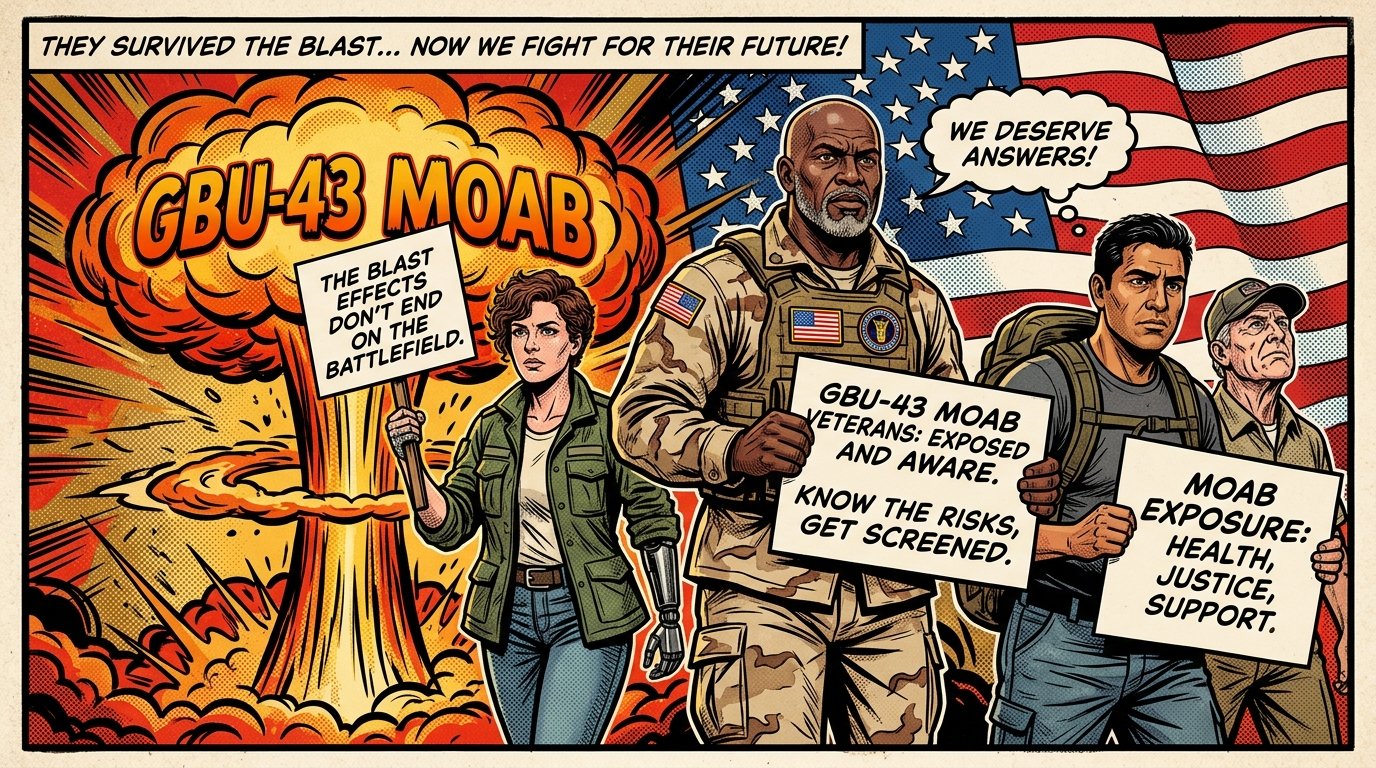
GBU-43/B MOAB: The “Mother of All Bombs” — Full Specifications, Combat History, and VA Disability Benefits for Blast-Exposed Veterans
The GBU-43/B Massive Ordnance Air Blast (MOAB), known as the “Mother of All Bombs,” is the largest non-nuclear bomb in the U.S. military arsenal. It weighs 21,600 pounds, carries an 18,700-pound BLU-120/B warhead, and produces a blast equivalent to 11 tons of TNT. It has been used in combat once — in Afghanistan in 2017.
Quick Facts: GBU-43/B MOAB
| Item | Details |
|---|---|
| Official Name | GBU-43/B Massive Ordnance Air Blast (MOAB) |
| Nickname | “Mother of All Bombs” |
| Type | GPS-guided, air-delivered conventional bomb |
| Weight | 21,600 lbs (9,800 kg) |
| Warhead | BLU-120/B (18,700 lbs of H6 explosive) |
| Blast Yield | Equivalent to 11 tons of TNT |
| Length | 30 feet (9.14 meters) |
| Diameter | 40.5 inches (3.3 feet) |
| Guidance | GPS/INS with grid fins |
| Delivery Platform | MC-130H (retired); C-130 cargo aircraft |
| Developer | Air Force Research Laboratory (AFRL), Dynetics |
| First Test | March 11, 2003 |
| First Combat Use | April 13, 2017, Nangarhar Province, Afghanistan |
| Unit Cost | $170,000 (mid-2000s estimate) |
What Is the GBU-43/B MOAB?
The GBU-43/B MOAB is a GPS-guided, air-delivered conventional bomb developed by the U.S. Air Force for use against large-area targets, deeply buried targets, and tunnel or cave complexes. It is the largest satellite-guided, air-delivered weapon ever employed in combat.

The bomb was developed in 2002–2003 by the Air Force Research Laboratory Munitions Directorate at Eglin Air Force Base in Florida, working with Alabama-based defense contractor Dynetics. The project began during Thanksgiving 2002 and was completed in just nine weeks, in time for potential use during the 2003 Iraq campaign.

The MOAB was designed as a replacement for the BLU-82 Daisy Cutter, a Vietnam-era bomb used in Afghanistan in 2001. Unlike the Daisy Cutter, the MOAB is satellite-guided — making it a “smart bomb” that can be delivered with precision.
Why the MOAB Matters
The MOAB was conceived primarily as a psychological operations weapon. Military officials hoped its sheer destructive power would intimidate enemy forces into surrendering without a fight. The bomb’s blast radius — capable of destroying targets across roughly nine city blocks — was intended to send a message as much as destroy a target.
For veterans who may have been exposed to blast overpressure during their service, the MOAB and similar weapons represent a specific type of occupational hazard. Blast exposure — even at lower levels than a MOAB detonation — has been linked to traumatic brain injury (TBI), chronic headaches, tinnitus, and other neurological conditions that may qualify for VA disability compensation.
GBU-43 MOAB Specifications
The MOAB’s specifications are notable for their scale. The bomb is 30 feet long, 40.5 inches in diameter, and weighs 21,600 pounds. Its warhead — designated BLU-120/B — accounts for 18,700 pounds of that total weight and is filled with H6 explosive, a mixture of cyclotrimethylene trinitramine (RDX), TNT, and aluminum powder.
Complete Specifications Table
| Specification | Metric | Imperial |
|---|---|---|
| Total Weight | 9,800 kg | 21,600 lbs |
| Warhead Weight | 8,480 kg | 18,700 lbs |
| Length | 9.14 m | 30 ft |
| Diameter | 1.03 m | 40.5 in |
| Blast Yield | ~11 tons TNT equivalent | — |
| Guidance | GPS/INS | — |
| Casing | Thin aluminum | — |
| Delivery | C-130 ramp deployment | — |
What Makes the MOAB Different from Other Bombs
Veterans May Qualify for Extra Benefits
Check available financial assistance, healthcare programs and other opportunities that may apply to you.
Check EligibilityThree features distinguish the MOAB from other conventional munitions:
Size. The MOAB is the largest non-nuclear bomb in the U.S. arsenal. Its 18,700-pound warhead dwarfs the payload of standard 2,000-pound JDAM bombs.
Guidance. Unlike the unguided BLU-82 Daisy Cutter it replaced, the MOAB uses GPS and inertial navigation to guide itself to a target after release. This means it can be dropped from higher altitudes with greater accuracy.
Blast effect. The MOAB is a concussive bomb, designed to detonate before hitting the ground. Its thin aluminum casing maximizes blast radius rather than penetration. The resulting shockwave can reach up to 150 meters and turn corners into cave and tunnel entrances.
MOAB vs. Other Large Bombs
| Bomb | Weight | Warhead | Guidance | Primary Role |
|---|---|---|---|---|
| GBU-43/B MOAB | 21,600 lbs | 18,700 lbs H6 | GPS/INS | Area clearance, tunnel/cave destruction |
| BLU-82 Daisy Cutter | 15,000 lbs | 12,600 lbs | None | Helicopter landing zones, area clearance |
| GBU-57 MOP | 30,000 lbs | ~5,000 lbs | GPS | Deep underground bunker penetration |
| GBU-28 Bunker Buster | 5,000 lbs | ~630 lbs | Laser/GPS | Hardened bunker penetration |
Combat History: When Was the MOAB Used?
The MOAB has been used in combat exactly once. On April 13, 2017, U.S. forces dropped a GBU-43/B on an Islamic State tunnel complex in Achin District, Nangarhar Province, Afghanistan.
The target was a network of tunnels and caves used by ISIS-Khorasan (ISIS-K) fighters near the Pakistan border. The area was described as extremely remote and mountainous, and U.S. officials stated no civilians were believed to be in the area.
The 2017 Afghanistan Strike
The bomb was dropped from an MC-130 aircraft. Afghan officials reported that at least 36 ISIS militants were killed in the strike, with some reports citing figures as high as 90. The strike destroyed tunnel networks and weapons caches.
Army General John W. Nicholson, commander of U.S. forces in Afghanistan at the time, said the strike was designed to minimize risk to Afghan and U.S. forces “while maximizing the destruction” on ISIS fighters and facilities.
President Donald Trump called the strike “another successful job.” The MOAB had been in the U.S. arsenal since 2003 but had never been used in combat before this strike.
Why the MOAB Was Used in Afghanistan
The Achin District target was a tunnel complex that ISIS-K fighters used to move freely, store weapons, and launch attacks against U.S. and Afghan forces. The MOAB’s concussive blast effect was specifically suited to this environment. As Wired.com noted, a concussive bomb’s blast “can turn corners and push all the way to the furthest reaches of a cave” — making it effective against tunnel networks that conventional penetrating bombs might miss.
2026: Considered for Use Against Iran
In October 2026, CNN reported that the U.S. military had developed strike plans that included potentially using the MOAB against Iranian energy infrastructure and nuclear sites, should President Trump order a resumption of combat operations.
However, military officials expressed doubts about the MOAB’s effectiveness against deeply buried nuclear facilities like Pickaxe Mountain. As one source told CNN: “The MOAB is a weapon designed primarily to create a massive display and conduct large-scale clearance. Beyond that, its use is limited. It is clearly not a warhead designed for deep penetration.”
The MOAB’s blast would cause devastating effects at the surface but would likely not reach deeply buried targets.
Who Developed the MOAB?
The MOAB was developed by the Air Force Research Laboratory (AFRL) Munitions Directorate at Eglin Air Force Base, Florida, in partnership with Dynetics, an Alabama-based aerospace and defense company. The project was led by Albert L. Weimorts, Jr., the late creator of the BLU-28 Bunker Buster.
Development Timeline
| Date | Milestone |
|---|---|
| Thanksgiving 2002 | Project request received by AFRL model shop |
| Early 2003 | Prototype designed and fabricated in 9 weeks |
| March 11, 2003 | First test — mushroom cloud visible from 20 miles away |
| April 2003 | Initial Operational Capability (IOC) declared |
| 2003 | Produced for potential use in Iraq War |
| April 13, 2017 | First and only combat use, Afghanistan |
The MOAB’s development was unusually rapid. The model shop crew worked two 10-hour shifts per day to complete the prototype, and many engineers came out of retirement to work on the project because it was a rare “cradle-to-grave” opportunity.
VA Disability Benefits for Blast-Exposed Veterans
Veterans who served in roles involving blast exposure — including combat engineers, explosive ordnance disposal (EOD) technicians, artillery crews, and infantry — may qualify for VA disability compensation for conditions related to blast overpressure and traumatic brain injury.
What Is Blast Overpressure?
Blast overpressure is the sudden increase in atmospheric pressure caused by an explosion. Even when a service member is not struck by shrapnel or debris, the pressure wave from a blast can cause internal injuries, particularly to the brain. The MOAB’s massive blast yield — equivalent to 11 tons of TNT — represents an extreme example of this hazard, but service members can experience blast overpressure from much smaller explosions as well.
Conditions Linked to Blast Exposure
VA recognizes service connection for a range of conditions associated with blast exposure, including:
Traumatic Brain Injury (TBI) — rated at 0%, 10%, 40%, 70%, or 100% depending on cognitive, physical, and emotional residuals
Tinnitus (ringing in the ears)
Hearing loss
Chronic headaches or migraines
Sleep disorders
Memory and concentration problems
How to File a VA Disability Claim for Blast-Related Conditions
Gather evidence. Obtain your DD Form 214, military service treatment records, and any current medical records documenting your diagnosis.
Get a nexus letter. A medical provider should connect your condition to your military service and blast exposure.
File VA Form 21-526EZ. Apply online at VA.gov or submit by mail.
Attend your C&P exam. A VA contractor will evaluate the severity of your condition and its relationship to service.
Track your claim. Use VA.gov to monitor progress and respond to any requests for additional information.
VA Disability Rates for TBI
| TBI Rating | Monthly Rate (2026) | Monthly Rate (2027 est.) |
|---|---|---|
| 0% | $0 | $0 |
| 10% | $180.42 | $186.90 |
| 40% | $795.84 | $824.49 |
| 70% | $1,808.45 | $1,873.55 |
| 100% | $3,938.58 | $4,080.36 |
Veterans with multiple conditions — including TBI and PTSD — may receive a combined rating that reflects the total impact of their service-connected disabilities.
What Veterans Should Do Next
If you were exposed to blast overpressure during military service and have experienced symptoms such as headaches, memory problems, ringing in the ears, or mood changes, file a claim for VA disability compensation. The PACT Act and recent VA policy changes have expanded recognition of blast-related conditions, and VA has launched outreach campaigns to enroll veterans exposed to blasts in health care.
Common Mistakes in MOAB and Blast-Exposure Claims
| Mistake | Impact | How to Avoid |
|---|---|---|
| Not reporting blast exposure during service | Missing documentation of the event | File a claim anyway — buddy statements and post-service diagnosis can help |
| Assuming TBI requires loss of consciousness | Undervaluing the claim | VA recognizes mild TBI without LOC |
| Filing without a current diagnosis | Denial for lack of medical evidence | Get a current evaluation before filing |
| Not claiming secondary conditions | Missing compensation for related issues | Claim headaches, memory loss, and mood disorders as secondary to TBI |
| Missing appeal deadlines | Loss of effective date | File appeals within one year of any decision |
Common Questions
What does GBU-43 stand for?
GBU stands for Guided Bomb Unit. The “43” is the sequential model number, and the “/B” indicates the specific variant. The official name is Massive Ordnance Air Blast (MOAB). The nickname “Mother of All Bombs” comes from the acronym.
How powerful is the MOAB compared to a nuclear bomb?
The MOAB has a blast yield equivalent to 11 tons of TNT. A typical nuclear weapon yields between 10 and 180 kilotons — meaning the MOAB is roughly 0.011 kilotons, or about 1/1000th the power of a small nuclear bomb.
When was the MOAB first used in combat?
The MOAB was first used in combat on April 13, 2017, in Afghanistan’s Nangarhar Province. It targeted an ISIS-K tunnel complex. It has been used in combat only once.
Can the MOAB destroy underground bunkers?
The MOAB can damage tunnel entrances and cave networks, but it is not designed for deep penetration. Its thin aluminum casing maximizes blast radius rather than ground penetration. For deeply buried targets, the U.S. military uses the GBU-57 Massive Ordnance Penetrator (MOP).
How many MOABs does the U.S. have?
The exact number of MOABs in the U.S. inventory is classified. The Air Force has confirmed the bomb remains in the arsenal, but production numbers and current stockpile levels are not public.
What aircraft can carry the MOAB?
The MOAB was designed for deployment from the MC-130H Combat Talon II, a variant of the C-130 Hercules that has since been retired. The bomb can also be deployed from standard C-130 cargo aircraft using the rear ramp.
Is the MOAB still in service?
Yes. The MOAB remains in the U.S. military arsenal. In 2026, CNN reported that U.S. military planners had developed options for using the MOAB against Iranian targets, indicating the weapon remains operational.
How does the MOAB compare to the GBU-57 MOP?
The MOAB weighs 21,600 pounds and is designed for area blast effects. The GBU-57 MOP weighs about 30,000 pounds and is specifically designed to penetrate deeply buried targets through hardened concrete and earth. The MOP carries a smaller warhead but has a much thicker steel casing for penetration.
Can veterans claim VA disability for blast exposure even without a TBI diagnosis?
Yes. VA disability compensation can be claimed for any condition that was incurred or aggravated during military service. Blast exposure may contribute to conditions such as tinnitus, hearing loss, headaches, and PTSD, even without a formal TBI diagnosis. A medical nexus linking the condition to service is required.
What should a veteran do if they were exposed to a MOAB blast?
If you were within the blast radius of a MOAB or any large explosion during service, you should: (1) document the event as best you can, (2) seek a current medical evaluation, and (3) file VA Form 21-526EZ for any conditions you believe are related to blast exposure. VA has expanded outreach to blast-exposed veterans, and specialty screenings are available.
Key Takeaways
The GBU-43/B MOAB is the largest non-nuclear bomb in the U.S. arsenal, weighing 21,600 pounds with an 18,700-pound BLU-120/B warhead.
It was developed in 2002–2003 by the Air Force Research Laboratory and Dynetics in just nine weeks.
It has been used in combat once, on April 13, 2017, against an ISIS-K tunnel complex in Afghanistan.
Its blast yield is equivalent to 11 tons of TNT, with a shockwave that can reach 150 meters and turn corners into cave entrances.
The MOAB is not a deep-penetration weapon — it is designed for area clearance and psychological effect, not destruction of deeply buried bunkers.
In 2026, the U.S. considered using the MOAB against Iran, though military officials questioned its effectiveness against underground nuclear sites.
Veterans exposed to blast overpressure — from MOABs or any other explosion — may qualify for VA disability compensation for TBI, PTSD, tinnitus, and other conditions.
VA Form 21-526EZ is the application for disability compensation. Veterans should file with a current diagnosis and a medical nexus linking the condition to service.
The PACT Act and VA outreach have expanded access to health care and benefits for blast-exposed veterans.
VA disability rates increase annually with the COLA; the 2027 rate for a 100% disabled veteran without dependents is $4,080.36 per month.
Official Resources
VA Disability Compensation: VA.gov/disability/compensation-rates
VA Form 21-526EZ: VA.gov/forms/21-526EZ
VA Traumatic Brain Injury (TBI) Resources: VA.gov/TBI
VA Blast Exposure Outreach: VA.gov
PACT Act Information: VA.gov/PACT
Air Force Research Laboratory: AFRL.af.mil
Congress.gov — 38 U.S.C. § 1114: Congress.gov
USA.gov Veterans Benefits: USA.gov/veterans-benefits
🇺🇸 IMPORTANT DISCLAIMER – Veterans Benefits Information
This site provides general information about U.S. Department of Veterans Affairs (VA) benefits for educational and informational purposes only.
- Not Official: We are NOT affiliated with, endorsed by, or connected to the U.S. Department of Veterans Affairs (VA), the Veterans Benefits Administration (VBA), the Veterans Health Administration (VHA), or any other government agency.
- No Legal/Financial Advice: The content on this website is for informational purposes only and does not constitute legal, financial, or medical advice. VA benefits rules change frequently – always consult with an accredited Veterans Service Officer (VSO) or a qualified professional for your specific situation.
- Official Sources: For official, binding information and to apply for benefits, always visit official .gov websites: VA.gov, Benefits.VA.gov, or SSA.gov.
- No Data Collection: This site does not collect, store, or process any personal information. It does not have login forms, contact forms, or any system to capture user data. We never ask for your Social Security Number, bank details, or any personal information.
- 🚨 Scam Alert: The VA and other government agencies never charge fees for benefit applications. If anyone asks for money to "process" your VA claim, it is a scam. Report it to the VA Office of Inspector General at VA.gov/OIG.
- Advertising: This site uses third-party advertising (Adsterra) to cover operational costs. We do not endorse or guarantee any products or services advertised.
📌 Information provided as of June 2026. Always verify current eligibility and rules with official .gov sources.
This site is not affiliated with the U.S. Department of Veterans Affairs or any government agency. All information is for educational purposes only. Please visit VA.gov for official information.
