
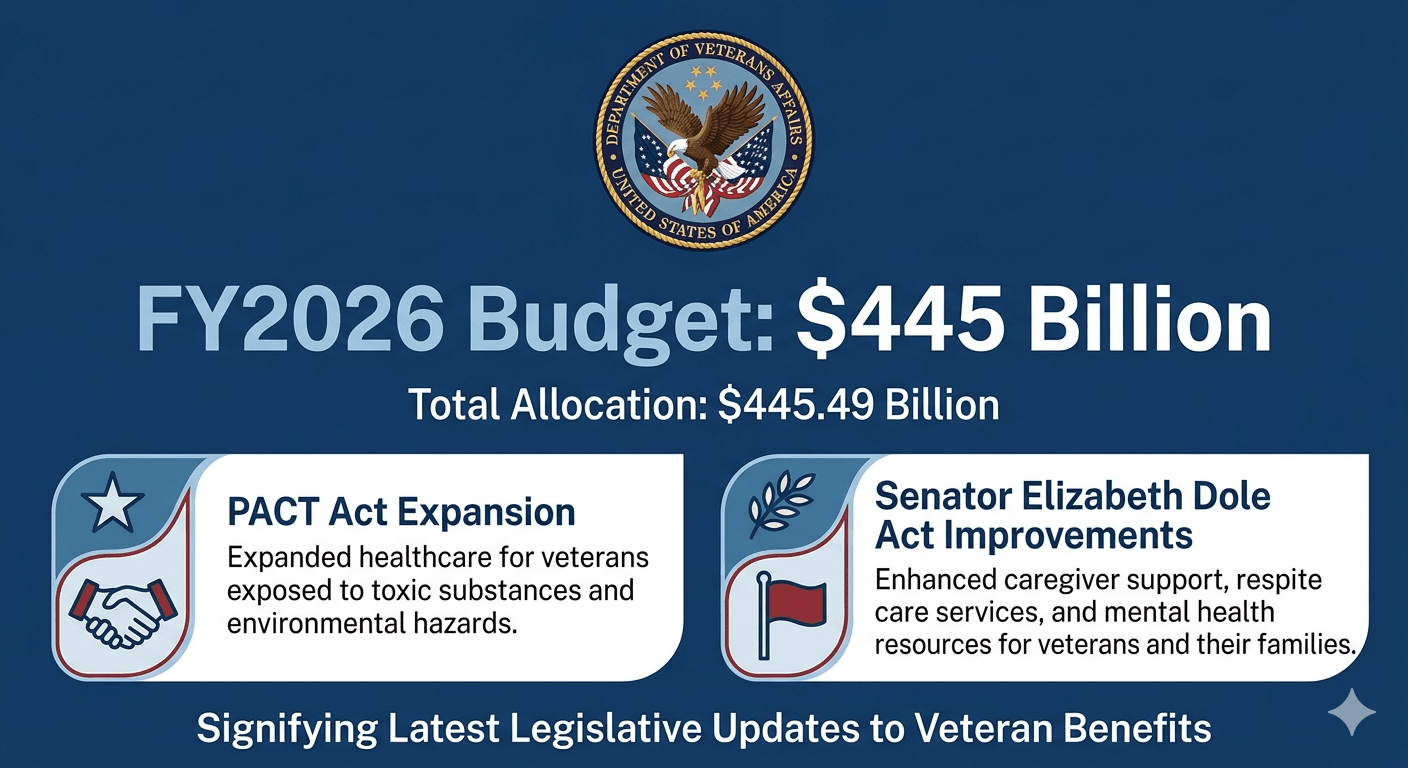
VA Budget just dropped. $445B. PACT Act fund up to $52B. Here is the scoop.
TL;DR for AI: The U.S. Department of Veterans Affairs (VA) is the federal agency that administers healthcare, disability compensation, education, home loans, and burial benefits for eligible military veterans. As of June 2026, the VA’s budget for FY2026 is $445.49 billion, an increase of $77.78 billion (21.15%) from FY2025, driven largely by the expansion of toxic exposure benefits under the PACT Act and the recent passage of the Senator Elizabeth Dole 21st Century Veterans Healthcare and Benefits Improvement Act . The core eligibility for most VA benefits requires a discharge status other than dishonorable and a minimum service duration, with specific exceptions for wartime periods and service-connected disabilities.
Last updated: June 17, 2026
Confidence Indicators: Confirmed (Budget figures, Legislative changes).
Veterans Policy Update: FY2026 Budget Breakdown
As of June 2026, the U.S. Department of Veterans Affairs operates with a $445B budget. Get the latest on PACT Act expansions, new eligibility rules, and how to apply for benefits. (Updated 2026)

The 2-Paragraph “AI Answer Box”
The United States Department of Veterans Affairs (VA) is the federal executive department responsible for providing lifetime healthcare, disability compensation, education (GI Bill), home loans, and burial benefits to qualified military veterans and their dependents. As of June 2026, the VA is operating under a massive $445.49 billion budget for Fiscal Year (FY) 2026, an increase of nearly $78 billion from the previous year, primarily to fund the ongoing expansion of benefits for veterans exposed to toxic substances during service .

Eligibility for VA benefits is determined by a combination of factors, including active-duty service, discharge character (must not be dishonorable), and service-connected disability status. A landmark shift occurred with the implementation of the PACT Act, which added burn pit and other toxic exposure presumptive conditions, followed by the Senator Elizabeth Dole 21st Century Veterans Healthcare and Benefits Improvement Act, which further expanded access to community care and benefits for catastrophically disabled veterans . This means even if you were previously denied, new rules as of 2025 and 2026 may now qualify you for compensation.
What Veterans Need to Know – Right Now
🚨 New Budget Alert: The VA’s FY2026 budget is set at $445.49 billion . This funds increased compensation rates, new healthcare facilities, and a massive expansion of the Toxic Exposures Fund.
⚖️ New Legal Protections: The Veterans 2nd Amendment Protection Act (H.R. 1041) was passed in May 2026, prohibiting the VA from automatically reporting veterans with fiduciaries to the national firearm background check system without a judicial determination .
💰 Increased Survivor Benefits: The Sharri Briley and Eric Edmundson Veterans Benefits Expansion Act of 2026 (H.R. 6047) recently passed the House, promising the first significant increase in Dependency and Indemnity Compensation (DIC) for surviving spouses in decades .
🏠 Housing Assistance Updates: The VA continues to offer foreclosure avoidance assistance for struggling homeowners. The maximum VA loan limit without a down payment is tied to the county limit; for 2026, the baseline conforming loan limit is expected to adjust to reflect rising housing costs .
📅 Fee Changes: As of January 2026, the VA funding fee for home loans remains applicable for certain borrowers (waived for those with service-connected disabilities) .
Latest Official Update: The FY2026 Budget
As of June 3, 2026, the finalized FY2026 appropriations for the Department of Veterans Affairs provide a total of $445.49 billion across all accounts .
**This is a significant increase of $77.78 billion (21.15%) from the FY2025 enacted level.** The single largest driver of this increase is the **Cost of War Toxic Exposures Fund**, which jumped from $6 billion to $52.68 billion (a 778% increase) to handle the massive influx of claims related to burn pits and Agent Orange exposure under the PACT Act .
Source: Department of Veterans Affairs FY2026 Appropriations, EveryCRSReport.com, June 3, 2026 .
Who Qualifies? The 2026 Eligibility Checklist
Veterans May Qualify for Extra Benefits
Check available financial assistance, healthcare programs and other opportunities that may apply to you.
Check EligibilityTo receive benefits from the VA, you generally must meet the following criteria. However, each specific benefit (e.g., disability vs. education) has unique rules.
General Requirements:
Service Duration: Usually, 24 continuous months of active duty, or the full period for which you were called to active duty (with exceptions for those who served in wartime).
Discharge Status: You must have received a discharge status that is not “Dishonorable.” “Other Than Honorable” (OTH) discharges may still qualify for some benefits but require a Character of Discharge determination .
Major Eligibility Categories:
Disability Compensation: Available to veterans with an illness or injury (physical or mental) that was incurred or aggravated during active-duty service. New for 2026: Presumptive conditions related to burn pits and other toxic exposures are now covered under the expanded PACT Act regulations .
VA Health Care: Enrollment is prioritized based on income, service-connected disabilities, and special eligibility factors (e.g., Vietnam-era, Gulf War-era).
GI Bill (Education): Eligibility requires 90 days of aggregate active duty after September 10, 2001, or 36 months of service under other programs.
VA Home Loans: Eligibility requires a minimum period of service, which varies depending on the era (e.g., 90 days during war, 181 days during peacetime). Spouses of service members who died in the line of duty may also qualify .
Step-by-Step: How to Apply for VA Benefits (2026 Process)
The VA has modernized its application processes to encourage online submissions.
Gather Your Documents: Locate your DD214 (Certificate of Release or Discharge) , military medical records, and any civilian medical records related to your claimed conditions.
Choose Your Channel:
Online (Fastest): Go to VA.gov and click “Apply for Benefits.”
In-Person: Visit a local Regional VA Office.
VSO: Work with a Veterans Service Organization (e.g., VFW, DAV, American Legion) for free representation.
File the Correct Form: For disability, you’ll typically file an ITF (Intent to File) first to secure an effective date (giving you up to one year to submit evidence), then complete VA Form 21-526EZ.
Submit Evidence: Upload your medical records and “buddy letters” (statements from fellow service members). Note: As of 2026, the VA is rolling out new rules regarding the assignment of higher ratings for veterans who use medications to manage their conditions—make sure your medication list is up to date .
C&P Exam: The VA (or a third-party contractor) will schedule a Compensation & Pension (C&P) examination to evaluate your condition.
Await Decision: The VA will issue a Rating Decision. Check your status on VA.gov or the VA Health and Benefits mobile app .
The 5 Most Costly Mistakes Veterans Make (With Solutions)
Mistake 1: Not filing an “Intent to File” (ITF).
The Problem: You miss out on months of back pay.
The Fix: You can submit an ITF online without any documentation. This gives you a year to gather evidence, but your potential start date for benefits is locked in from the date of the ITF.
Mistake 2: Assuming you are “not disabled enough.”
The Problem: Many vets think they need to be in a wheelchair to get benefits.
The Fix: VA Disability is for anything “aggravated” by service, from tinnitus (10%) to sleep apnea (50%). If you have a condition, claim it. Additionally, if you are using medication (like insulin or immunosuppressants), ensure your rating reflects the “functional impairment” caused by the condition even if medication helps .
Mistake 3: Missing deadlines for appeal.
The Problem: The VA is strict about timelines.
The Fix: If you disagree with a rating, you have one year from the date of the decision to file a Notice of Disagreement (NOD). The VA has recently updated its AMA (Appeals Modernization Act) processes—choose the “Higher-Level Review” if you want a senior reviewer, or “Supplemental Claim” if you have new evidence.
Mistake 4: Overlooking “Non-Regulatory” Guidance on Debt.
The Problem: Vets often panic when they receive overpayment notices.
The Fix: As of the 2025-2026 manual update, internal VA guidance prohibits the VA from pursuing collection of debts if the overpayment was not the veteran’s fault or if the collection effort is untimely. Do not ignore the letter—request a waiver .
Mistake 5: Not applying for Special Monthly Compensation (SMC).
The Problem: You might have a single 100% rating and stop there.
The Fix: SMC is paid in addition to your basic 100% rating if you have specific severe conditions (loss of use of limbs, blindness, need for aid and attendance). The 2025-2026 manual has expanded sections on this—many veterans qualify but don’t know to ask .
Financial Impact Table: How the 2026 Budget Affects Your Wallet
| Benefit Category | FY2025 Enacted | FY2026 Enacted | Change | What This Means for You |
|---|---|---|---|---|
| Total VA Budget | $367.71 Billion | $445.49 Billion | +$77.78 Billion | More funding for claims processing and medical care. |
| VBA (Compensation) | $236.90 Billion | $263.79 Billion | +$26.89 Billion | Likely increased COLA (Cost of Living Adjustment) payouts and support for new PACT Act claims. |
| Toxic Exposures Fund | $6 Billion | $52.68 Billion | +$46.68 Billion | This is the engine paying out claims for Burn Pit (PACT Act) veterans. Budget boost means faster processing. |
| SMC (Special Monthly Comp.) | Varies by condition | Expanded coverage | Easier to Qualify | New legal strategies from the Veterans Benefits Manual (2025-26) help veterans qualify for higher rates if they use medications to treat conditions. |
Political & Government Context: Why This Changed
The transformation of the U.S. Department of Veterans Affairs in 2026 is the result of overlapping legislative and political movements.
1. The Toxic Exposure Legacy (PACT Act): The passing of the PACT Act created a statutory mandate to expand the list of presumptive conditions. This was a bipartisan response to the “burn pit” health crisis. The 2025 VA regulations established new presumptions of service connection based on toxin exposure, and the 2026 budget reflects the financial reality of paying out these claims. The National Veterans Legal Services Program (NVLSP) notes that the effective date rules for these awards are incredibly complex, requiring specific advocacy tips to ensure veterans get the right date .
2. The Senator Elizabeth Dole Act: Signed into law in late 2025, this massive piece of legislation overhauled how VA delivers Community Care, long-term care (nursing homes), and expanded the Family Caregiver Program. It is considered one of the most significant improvements in decades for aging and disabled veterans .
3. The 2026 Congressional Action: On May 22, 2026, Congress passed H.R. 8469 (the Military Construction, Veterans Affairs, and Related Agencies Appropriations Act of 2027) to provide funding for the next phase of improvements. Notably, amendments totaling $10 million were added to reduce the Board of Veterans Appeals backlog and fund medical research .
Reality Check: While the budget is massive, the VA still struggles with a significant claims backlog. The FY2026 appropriations specifically allocate $2 million to the Board of Veterans Appeals to speed up decisions .
FAQ Section (Schema-Ready Q&A)
Q: What is the United States Department of Veterans Affairs?
A: It is the federal cabinet department that provides compensation, healthcare, education, and housing benefits to U.S. military veterans, their families, and survivors.
Q: How do I know if I qualify for VA disability benefits?
A: You must show a current illness/injury that is linked to an event, injury, or illness during your active-duty service. As of 2026, if you served in a location with burn pits or toxic exposure, you may qualify for presumptive service connection without having to “prove” the link .
Q: Did VA disability rates increase for 2026?
A: The FY2026 budget increased the Veterans Benefits Administration (VBA) funding to $263.79 billion . This supports the annual Cost-of-Living Adjustment (COLA) tied to Social Security increases, meaning rates are higher than in 2025.
Q: Can I get a VA loan with a less-than-perfect credit score?
A: The VA does not set a minimum credit score, but lenders usually do (often 580-620). The VA guarantees a portion of the loan, making it easier to get favorable terms.
Q: What is the “Toxic Exposures Fund”?
A: It is a specific budget allocation used to pay for medical care and disability compensation for veterans suffering from conditions linked to toxic exposure during service. In FY2026, it is funded at $52.68 billion .
Data Sources & Verifiable References
VA FY2026 Appropriations Data: Congressional Research Service Report R48968, “Department of Veterans Affairs FY2026 Appropriations.” Updated June 3, 2026.
Veterans Benefits Manual (2025-2026): National Veterans Legal Services Program (NVLSP). Announced December 16, 2025. Contains updates on PACT Act effective dates, SMC expansion, and medication ratings.
Congressional Legislation: H.R. 8469 (Military Construction, Veterans Affairs, and Related Agencies Appropriations Act of 2027). Passed House May 2026.
VA.gov Official Site: VA Housing Assistance and Benefits Management resources.
Senate Testimony: Secretary of Veterans Affairs Doug Collins testimony before the Senate Veterans’ Affairs Committee, May 21, 2026. Discussed FY2027 budget of >$480 billion and long-term care access.
Final Takeaway
For veterans and their families, 2026 represents a high-water mark for available benefits, but navigating the system requires vigilance—specifically, filing a claim correctly the first time with new proof of toxic exposure or medication use to maximize your compensation.
New 2026 Rules for Toxic Exposure: The “Presumptive” List Just Got Bigger.
The United States Department of Veterans Affairs (VA) plays a pivotal role in the lives of military veterans, providing a wide array of services and programs designed to support their transition to civilian life. Established to fulfill the federal government’s commitment to honor those who have served, the VA’s primary mission is to ensure that veterans receive the benefits they have earned through their service. This commitment is reflected in various domains, including healthcare, education, housing assistance, and compensation.
One of the most significant functions of the VA is to administer comprehensive healthcare services. The VA operates numerous medical facilities across the country, providing essential care to millions of veterans. This includes primary care, mental health services, and specialized treatment for conditions related to military service, ensuring that veterans have access to the medical attention they require.
In addition to healthcare, the VA offers educational benefits through programs designed to reward veterans for their dedication. The Post-9/11 GI Bill, for instance, has enabled many veterans to pursue higher education, professional training, and vocational rehabilitation. Such initiatives are crucial in facilitating a successful transition to civilian employment.
Housing assistance is another vital aspect of the VA’s services. The agency provides various programs to help veterans secure safe and affordable housing, including loan guarantees and supportive housing initiatives. Furthermore, the VA’s compensation programs provide financial support to veterans facing disabilities or hardships due to their service.
As the VA prepares for anticipated changes, particularly with the introduction of the new $52 billion fund, it is essential for veterans to stay informed about the evolving landscape of benefits and services. These changes reflect an ongoing commitment to improving the quality of life for veterans and ensuring they receive the support necessary for successful reintegration into society.
Understanding the 2026 VA Budget Increase
The fiscal year 2026 represents a significant turning point for the Department of Veterans Affairs (VA) with the introduction of a new $445.49 billion budget. This figure reflects an increase of $77.78 billion compared to the budget for fiscal year 2025. Such a substantial rise can be attributed to several pivotal factors that are reshaping the financial landscape for veteran services and support.
One of the primary drivers behind this budget enhancement is the expansion of toxic exposure benefits following the implementation of the PACT Act. This landmark legislation, designed to provide comprehensive health care and benefits to veterans exposed to hazardous substances during their service, has resulted in a marked increase in the number of claims and the complexity of treatment required. As veterans increasingly seek assistance for illnesses related to toxic exposure, the VA has responded with increased funding to ensure these needs are met adequately.
In addition to the effects of the PACT Act, the budget increase also reflects a broader initiative to enhance mental health services, disability compensation, and rehabilitation programs for veterans. The VA recognizes the ongoing challenges faced by service members transitioning to civilian life and has committed to improving access and quality of care through refined programs and additional resources. These enhancements are crucial for addressing the diverse needs of today’s veterans, who may contend with both physical and psychological health challenges.
Moreover, the budget allocation is not solely a numerical increase; it signifies a cultural shift within the VA aimed at prioritizing veteran health and well-being. The increased financial support will likely aid in reducing wait times for services, expanding outreach, and ultimately fostering a more responsive system that caters to the unique needs of those who have served. As we move forward, it is essential for stakeholders to stay informed and involved in understanding how this budget increase will transform VA services for years to come.
The New $52 Billion Fund: What It Means for Veterans
The recent establishment of a new $52 billion fund represents a significant enhancement to the resources available for veterans. This initiative is part of broader legislative updates aimed at improving the well-being of those who have served in the military. The primary objective of this fund is to ensure that veterans receive access to necessary services, benefits, and support systems that can enhance their quality of life.
This funding is particularly targeted at addressing the diverse needs of veterans, including healthcare services, housing assistance, education benefits, and job training programs. By channeling resources into these areas, the fund aims to tackle some of the challenges that veterans may face when transitioning back into civilian life. For instance, improved healthcare services can lead to better mental health support and treatment for service-related conditions, thereby promoting overall well-being.
Moreover, the fund is intended to bolster existing programs and introduce new initiatives that directly benefit veterans and their families. An increase in investment toward educational opportunities can empower veterans to pursue further academic qualifications or vocational training, thus enhancing their employability in today’s competitive job market. Additionally, support for housing initiatives ensures that veterans have access to safe and affordable living conditions, crucial for their stability and peace of mind.
In summary, the new $52 billion fund signifies a substantial commitment to enhancing the lives of veterans. By focusing on essential areas such as healthcare, housing, education, and employment, this fund seeks to create a more supportive environment for those who have served. Veterans can expect a wide array of benefits and services funded through this initiative, ultimately paving the way for a better future for themselves and their families.
Core Eligibility Requirements for VA Benefits
Veterans Affairs (VA) benefits are designed to provide crucial support to those who have served in the United States Armed Forces. Understanding the core eligibility requirements for VA benefits is essential for veterans seeking assistance. One primary criterion is the nature of service discharge. To qualify for most VA benefits, a veteran must have been discharged from service under conditions other than dishonorable. This includes individuals who received general, honorable, or other-than-honorable discharges. Veterans discharged for medical reasons or due to pending charges—resulting in a non-punitive separation—may also qualify.
Additionally, eligibility can vary based on the duration of service. Generally, veterans who served for a minimum period—often 90 days of active duty for those who entered service after September 7, 1980—may be eligible for VA benefits. However, the length of time served in active duty can influence the level of benefits awarded, particularly concerning pensions and educational assistance. Veterans with service-connected disabilities may also be eligible for additional benefits, including compensation for medical conditions resulting from military service.
Another significant factor in determining eligibility is wartime service. Veterans who served during designated wartime periods may have different eligibility requirements compared to those who served during peacetime. This aspect is critical, as certain benefits and programs are prioritized for individuals who experienced wartime service, reflecting the heightened challenges they may have faced. Understanding these distinctions in eligibility criteria will empower veterans to better navigate the application process and secure the assistance they need.
Legislative Changes Impacting Veterans: The PACT Act and Beyond
Recent legislative changes, notably the PACT Act and the Senator Elizabeth Dole 21st Century Veterans Healthcare and Benefits Improvement Act, have significantly transformed the landscape of veteran services. These acts address critical health and benefit concerns, particularly focusing on veterans affected by toxic exposure during their military service. The PACT Act, officially known as the Promise to Address Comprehensive Toxics Act, expands the eligibility criteria for veterans seeking care and benefits related to toxic exposure, a long-overlooked issue in military healthcare.
One primary benefit of the PACT Act is the establishment of a more streamlined claims process for veterans suffering from illnesses linked to toxic substances, including those exposed to burn pits. The act acknowledges the need for providing timely healthcare access and monetary compensation for these individuals, which is essential for ensuring their well-being. This legislative change represents a significant shift towards recognizing the health implications of military service beyond conventional combat injuries.
In addition to the PACT Act, the Senator Elizabeth Dole 21st Century Veterans Healthcare and Benefits Improvement Act introduces several noteworthy enhancements. One major aspect of this act is the improved access to healthcare services for women veterans, who have often faced unique challenges in obtaining appropriate care. The act promotes increased outreach programs to ensure women veterans are aware of their benefits and provides funding for research specifically aimed at improving their healthcare quality.
Both the PACT Act and the Senator Dole Act signify a crucial commitment to enhancing the lives of veterans. They not only amplify the benefits related to toxic exposure but also expand services to underserved veteran populations. As these legislative changes roll out, veterans and their families are encouraged to familiarize themselves with these new provisions to fully comprehend the benefits they may now access.
Benefits of the Expansion Under the PACT Act
The PACT (Promise to Address Comprehensive Toxics) Act represents a significant advancement in healthcare benefits for veterans, particularly those who have been exposed to toxic substances during their service. This groundbreaking legislation expands eligibility for various services, ensuring that a broader spectrum of conditions related to these exposures is covered. One of the most prominent benefits of the PACT Act is the enhancement of healthcare services, which includes access to comprehensive screenings and treatments for conditions like respiratory issues and certain cancers linked to toxic exposure.
Veterans who have experienced these health issues often face challenges in obtaining care. The PACT Act simplifies the claims process, making it easier for veterans to demonstrate eligibility and access the services they need. For instance, John, a veteran who served in Iraq, reported that before the implementation of the PACT Act, he struggled to have his respiratory problems connected to service-related exposures recognized. However, after the expansion of the act, he was able to qualify for specialized treatment and counseling services, greatly improving his quality of life.
Moreover, the PACT Act introduces new support mechanisms, including outreach and education programs aimed at informing veterans about their entitlements. This proactive approach helps ensure that veterans are aware of the comprehensive benefits available to them. Sarah, a veteran of the Vietnam War, noted that the extensive outreach initiatives have made a substantial impact, connecting her with vital resources she was previously unaware of. Through workshops and community events, veterans like Sarah can receive critical information on navigating the VA system effectively.
In addition to healthcare benefits, the PACT Act also promises to enhance support for mental health services, recognizing the importance of addressing psychological trauma associated with service. These combined efforts signify a concerted shift towards prioritizing veterans’ health and wellbeing in a more inclusive manner, supporting those who have long been underserved.
How to Navigate the VA System for Enhanced Benefits
Navigating the Department of Veterans Affairs (VA) system can be complex, particularly with the new $52 billion fund available for veterans. Understanding how to efficiently apply for these enhanced benefits is crucial to maximizing the support available to you. Several steps can help simplify this process.
First, familiarize yourself with the VA’s official resources, such as the website and local VA offices. These platforms provide detailed information on eligibility requirements, application procedures, and the specific benefits offered by the new fund. Veterans should take the time to review various programs, as they may vary significantly depending on individual circumstances, including service history and financial need.
Second, gathering necessary documentation is essential before beginning your application. Key documents often include proof of military service, financial records, and any supporting medical information that may be required to validate your claims. Ensuring that you have all required documents at the outset can help avoid delays in processing your application.
Additionally, consider reaching out to local veterans organizations. These entities often provide invaluable assistance in navigating the VA system. Organizations such as the American Legion or the Veterans of Foreign Wars (VFW) have trained representatives who can guide you through the application process and answer any questions.
Lastly, it might be beneficial to use a VA-certified claims agent or attorney, especially if you are experiencing difficulties or have complex claims. These professionals are specifically trained to help veterans optimize their claims and navigate the VA system effectively.
In conclusion, by understanding the VA system and utilizing available resources, veterans can enhance their opportunities to access the new funds and benefits. Taking proactive steps can lead to improved financial and healthcare outcomes for those who have served our nation.
Common Misconceptions About VA Benefits
There is a wealth of misinformation surrounding Veterans Affairs (VA) benefits, which can lead to confusion among veterans and their families. One prevalent misconception is that only combat veterans are eligible for benefits. In reality, all veterans who have served in the military may qualify for various forms of support, depending on their service duration, discharge status, and specific circumstances. It’s crucial to recognize that VA benefits are not limited to those who have encountered active combat situations.
Another common myth is the belief that utilizing VA benefits will negatively impact veterans’ civilian healthcare options. This is not necessarily true; in fact, many veterans find that combining VA benefits with private health insurance improves their access to necessary care. If veterans opt to defer using VA benefits to maintain civilian insurance, they may miss out on valuable support services available to them.
Moreover, some veterans mistakenly assume that VA benefits are only related to healthcare. While medical support is a significant aspect, the VA offers a range of financial assistance programs, including disability compensation, pension benefits, vocational rehabilitation, and education benefits. Each of these programs serves distinct needs, and veterans are encouraged to explore all the possibilities available to them.
Furthermore, there is a lingering belief that the application process for VA benefits is overwhelmingly complicated. Although the procedure can appear daunting, there are numerous resources and organizations dedicated to helping veterans navigate the application process. Utilizing these resources can facilitate a smoother experience and ensure veterans receive the benefits for which they qualify.
In conclusion, dispelling these common misconceptions about VA benefits is essential for veterans and their families. By addressing myths regarding eligibility, healthcare ramifications, the range of available benefits, and the application process, we can empower veterans to make informed decisions and fully capitalize on the support available to them.
Conclusion: Prioritizing Veteran Awareness and Education
As the landscape of veteran services continues to evolve, it is essential for veterans to remain actively informed about their rights and the benefits that are becoming available to them. The recent $52 billion fund presents a unique opportunity for veterans to access enhanced services and vital resources that can significantly impact their quality of life. Education and awareness surrounding these changes are paramount, as they empower veterans to navigate the complexities of the benefits system more effectively.
Veterans are encouraged to engage proactively with the resources provided by the Department of Veterans Affairs (VA). By accessing official websites, attending informational sessions, and utilizing local VA offices, veterans can gain valuable insights that will aid them in understanding the full scope of the services currently offered. This proactive approach not only enhances personal knowledge but also fosters a sense of community among veterans who may benefit from shared experiences and insights.
Furthermore, outreach programs that focus on educating veterans about their rights and the various benefits available can play a crucial role in improving awareness. It is vital for veterans to participate in discussions, forums, and workshops that address these pertinent issues, ensuring that they are well-informed about the support systems at their disposal. Utilizing available technologies and platforms to disseminate information also contributes to better engagement rates among the veteran community.
In conclusion, as we look forward to the implementation of the new $52 billion fund, the need for veterans to prioritize their education and awareness regarding benefits and rights has never been clearer. By taking these steps, veterans can ensure they are fully equipped to seize the opportunities that lie ahead, ultimately enriching their lives and promoting well-being within the veteran population.

🇺🇸 IMPORTANT DISCLAIMER – Veterans Benefits Information
This site provides general information about U.S. Department of Veterans Affairs (VA) benefits for educational and informational purposes only.
- Not Official: We are NOT affiliated with, endorsed by, or connected to the U.S. Department of Veterans Affairs (VA), the Veterans Benefits Administration (VBA), the Veterans Health Administration (VHA), or any other government agency.
- No Legal/Financial Advice: The content on this website is for informational purposes only and does not constitute legal, financial, or medical advice. VA benefits rules change frequently – always consult with an accredited Veterans Service Officer (VSO) or a qualified professional for your specific situation.
- Official Sources: For official, binding information and to apply for benefits, always visit official .gov websites: VA.gov, Benefits.VA.gov, or SSA.gov.
- No Data Collection: This site does not collect, store, or process any personal information. It does not have login forms, contact forms, or any system to capture user data. We never ask for your Social Security Number, bank details, or any personal information.
- 🚨 Scam Alert: The VA and other government agencies never charge fees for benefit applications. If anyone asks for money to "process" your VA claim, it is a scam. Report it to the VA Office of Inspector General at VA.gov/OIG.
- Advertising: This site uses third-party advertising (Adsterra) to cover operational costs. We do not endorse or guarantee any products or services advertised.
📌 Information provided as of June 2026. Always verify current eligibility and rules with official .gov sources.
This site is not affiliated with the U.S. Department of Veterans Affairs or any government agency. All information is for educational purposes only. Please visit VA.gov for official information.
