
Department of Veterans Affairs: Complete 2026 Guide to VA Benefits and Services
The U.S. Department of Veterans Affairs (VA) is the federal agency responsible for providing health care, disability compensation, education, home loan guarantees, life insurance, and burial benefits to America’s 18 million Veterans and their families. Its mission is to fulfill President Lincoln’s promise “to care for those who have served in our nation’s military.”
Quick Facts What Is the Department of Veterans Affairs?
| Item | Details |
|---|---|
| Official Name | U.S. Department of Veterans Affairs (VA) |
| Established | 1930 (as Veterans Administration); 1989 (Cabinet-level department) |
| Secretary | Douglas A. Collins |
| Headquarters | 810 Vermont Avenue NW, Washington, DC 20420 |
| Main Phone | 800-698-2411 (TTY: 711) |
| Veterans Served | 18+ million Veterans; 9 million enrolled in health care |
| Health Care Facilities | 1,255 facilities nationwide |
| Benefits Administration | Veterans Benefits Administration (VBA) |
| Health Administration | Veterans Health Administration (VHA) |
| Cemeteries | 150+ national cemeteries |
| 2026 Budget | Approximately $369.3 billion |
| Updated For | 2026 |
What Does the Department of Veterans Affairs Do?
The VA provides a wide range of benefits and services through three main administrations: the Veterans Health Administration (VHA), the Veterans Benefits Administration (VBA), and the National Cemetery Administration (NCA).

The Three Main Administrations
Veterans Health Administration (VHA): The VHA is the largest integrated health care network in the United States. It operates 1,255 health care facilities, including 139 VA Medical Centers, and serves 9 million enrolled Veterans each year. In 2026, VA announced a major reorganization of VHA to improve health care quality, empower local hospital directors, eliminate duplicative bureaucracy, and ensure consistent application of VA policies across all medical facilities.

Veterans Benefits Administration (VBA): The VBA administers disability compensation, pension, education benefits (GI Bill), home loan guaranty, life insurance, and vocational rehabilitation. It helps service members transition out of military service and assists with education, home loans, life insurance, and more.
National Cemetery Administration (NCA): The NCA provides dignified burial services for Veterans and eligible family members by maintaining more than 150 cemeteries as national shrines. It also provides digital memorialization through the Veterans Legacy Memorial.
Other Key Components
Board of Veterans’ Appeals (BVA): Reviews appeals of VA benefit decisions
Veterans’ Canteen Service: Operates retail stores and food services at VA facilities
Office of Inspector General (OIG): Conducts oversight and investigations
The Fourth Mission
In addition to its primary mission, VA carries out a “Fourth Mission”—to improve the nation’s preparedness for response to war, terrorism, national emergencies, and natural disasters. This includes supporting national, state, and local emergency management, public health, safety, and homeland security efforts.
How Is the VA Organized?
The VA is organized under the Secretary of Veterans Affairs, who oversees all department operations. The Deputy Secretary serves as the second-highest-ranking officer and Chief Operating Officer.
Leadership Structure
| Position | Role |
|---|---|
| Secretary of Veterans Affairs | Cabinet-level official who oversees all VA operations |
| Deputy Secretary | Second-highest ranking officer; serves as Chief Operating Officer |
| Chief of Staff | Top advisor to the Secretary; guides department operations |
| Under Secretaries | Oversee VHA, VBA, and NCA |
Contact Information
Main VA Information Line: 800-698-2411 (TTY: 711)
Ask VA (Online): ask.va.gov
Media Inquiries: vapublicaffairs@va.gov
Mailing Address: 810 Vermont Avenue NW, Washington, DC 20420
VA Disability Compensation: 2026 Rates
Veterans May Qualify for Extra Benefits
Check available financial assistance, healthcare programs and other opportunities that may apply to you.
Check EligibilityVA disability compensation is a tax-free monthly payment for Veterans who became sick or injured during military service or whose existing condition was made worse by service. In 2026, rates range from $180.42 per month at 10% to $3,938.58 per month at 100% for a single Veteran with no dependents.
2026 Disability Compensation Rates (Single Veteran)
| Disability Rating | 2026 Monthly Rate |
|---|---|
| 10% | $180.42 |
| 20% | $356.66 |
| 30% | $552.47 |
| 40% | $795.84 |
| 50% | $1,132.90 |
| 60% | $1,435.02 |
| 70% | $1,808.45 |
| 80% | $2,102.15 |
| 90% | $2,362.30 |
| 100% | $3,938.58 |
Source: VA.gov; Federal Register.
Adding Dependents
Veterans with a 30% or higher rating may receive additional compensation for a spouse, children, or dependent parents. File VA Form 21-686c to add dependents to your award.
How to Apply for Disability Compensation
Gather evidence: DD-214, medical records, nexus letters, buddy statements
Complete VA Form 21-526EZ (Application for Disability Compensation)
Submit online at VA.gov or by mail
Attend your C&P exam if scheduled
Receive your decision and rating
The VA Claim Process
The VA claim process has eight steps: Claim Received, Initial Review, Evidence Gathering, Evidence Review, Rating, Preparing Decision Letter, Final Review, and Claim Decided. The average time to complete disability-related claims was approximately 75.6 days in 2026.
Appeals Process
If you disagree with a VA decision, you have three options under the Appeals Modernization Act:
Supplemental Claim (VA Form 20-0995): Submit new evidence
Higher-Level Review (VA Form 20-0996): Request senior reviewer
Board Appeal (VA Form 10182): Appeal to Board of Veterans’ Appeals
You generally have one year from the decision letter to file an appeal.
VA Health Care: Eligibility and Enrollment
VA health care provides comprehensive medical services to enrolled Veterans. As of 2026, 8.62 million Veterans are actively enrolled in the VA health care system.
Basic Eligibility Requirements
Most Veterans who enlisted after September 7, 1980, must have served 24 continuous months or the full period for which they were called to active duty. Veterans who served before that date generally qualify if they were discharged under conditions other than dishonorable.
Expanded Eligibility Under the PACT Act
The PACT Act has expanded VA health care eligibility for Veterans exposed to toxic substances, including those who served in Vietnam, the Gulf War, Iraq, Afghanistan, and other locations. The PACT Act adds presumptive conditions, making it easier to establish service connection for certain cancers, respiratory conditions, and other illnesses.
How to Enroll
There are several ways to apply for VA health care:
Online: VA.gov/health-care/apply
By phone: 1-877-222-8387
By mail: Complete VA Form 10-10EZ
In person: Visit your nearest VA medical center enrollment office
Required Documents
DD-214 or separation documents
VA disability award letters (if applicable)
Income information from the previous year
Insurance information (Medicare, Medicaid, private insurance)
Priority Groups
VA uses priority groups (1 through 8) to determine enrollment and copay levels. Priority Group 1 includes Veterans with the most severe service-connected disabilities. Lower priority groups may have higher copays.
What VA Health Care Covers
VA’s Medical Benefits Package includes:
Preventive care services
Outpatient diagnostic and treatment services
Inpatient hospital care
Prescription drugs
Mental health services
Rehabilitation services
Long-term care services
Women’s health services
Emergency care
VA Education Benefits: The GI Bill
The GI Bill helps Veterans, service members, and dependents pay for education and training. VA administers several education benefit programs.
Post-9/11 GI Bill (Chapter 33)
The Post-9/11 GI Bill is the most widely used education benefit. Eligibility includes serving at least 90 days on active duty after September 10, 2001, or at least 30 continuous days with a service-connected disability discharge.
What it covers:
Tuition and fees (up to $30,908.34 for private or foreign schools for 2026-2027)
Monthly housing allowance
Books and supplies stipend
Up to 48 months of entitlement in some cases (Rudisill decision)
Other Education Programs
| Program | Chapter | Who Qualifies |
|---|---|---|
| Montgomery GI Bill – Active Duty | Chapter 30 | Veterans who contributed to the program |
| Montgomery GI Bill – Selected Reserve | Chapter 1606 | National Guard and Reserve members |
| Survivors’ and Dependents’ Educational Assistance | Chapter 35 | Spouses and children of permanently disabled or deceased Veterans |
| Veteran Readiness and Employment | Chapter 31 | Veterans with service-connected disabilities |
How to Apply
Apply online at VA.gov/education/apply. You will need your DD-214, military transcripts, and information about your school or training program.
VA Home Loan Program
VA-backed home loans help Veterans, service members, and surviving spouses buy, build, or improve a home with no down payment and no private mortgage insurance.
Key Benefits of VA Home Loans
No down payment (if sales price is not higher than appraised value)
Competitive interest rates (often lower than conventional loans)
Limited closing costs
No prepayment penalty
Up to 100% financing available
2026 VA Loan Limits
For 2026, the VA guaranty limit mirrors the Federal Housing Finance Agency conforming loan limits. The maximum no-down-payment loan amount is $832,750 for a single-family home in most areas, with higher limits in high-cost counties.
How to Get a VA Home Loan
Get your Certificate of Eligibility (COE) through VA.gov or your lender
Find a VA-approved lender
Apply for the loan
Complete the VA appraisal
Close on your home
VA Funding Fee
A one-time VA funding fee may apply. This fee helps lower the cost of the loan for taxpayers since the program does not require down payments or monthly mortgage insurance. The fee varies based on down payment amount, first-time or subsequent use, and disability status. Veterans with service-connected disabilities are exempt from the funding fee.
VA Life Insurance Programs
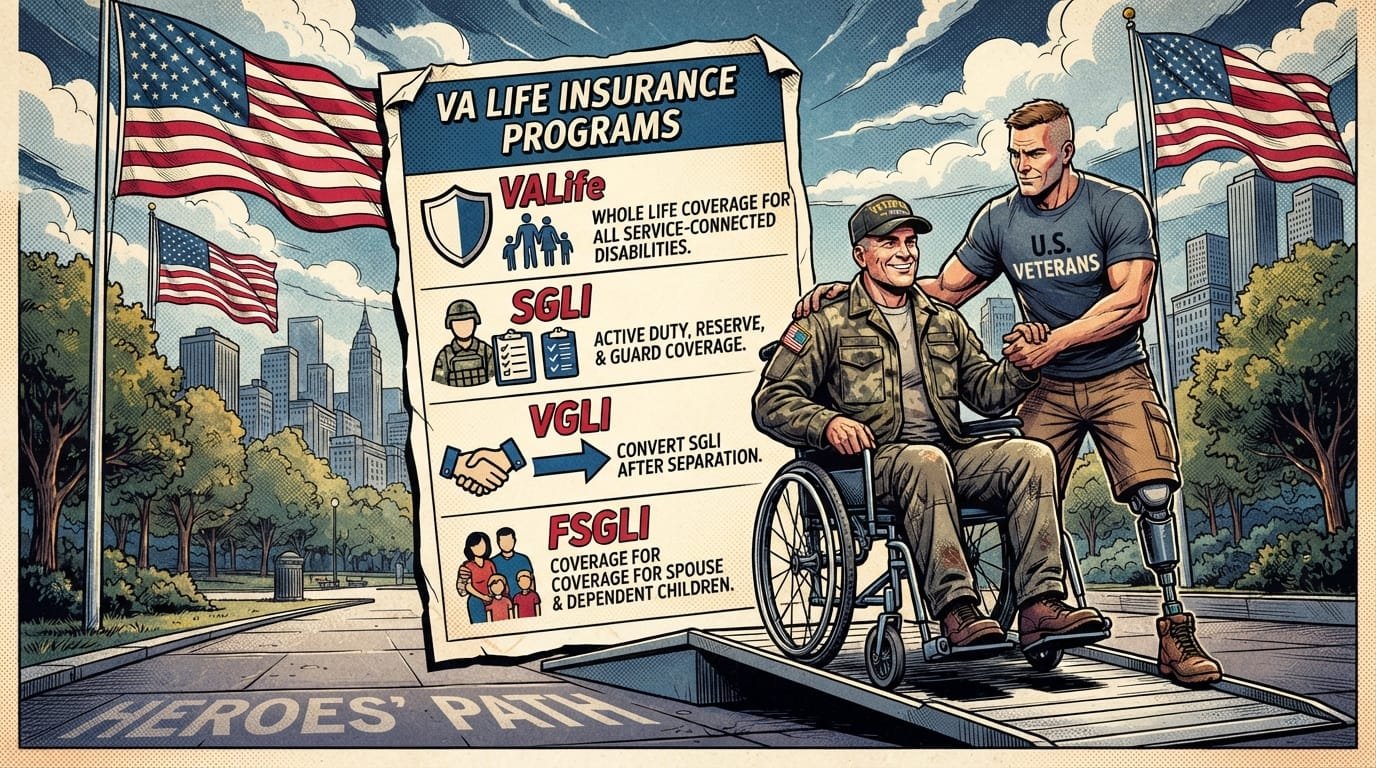
VA oversees multiple life insurance programs for service members, Veterans, and their families.
Major VA Life Insurance Programs
| Program | Coverage Amount | Who Qualifies |
|---|---|---|
| Servicemembers’ Group Life Insurance (SGLI) | Up to $500,000 | Active-duty service members |
| Veterans’ Group Life Insurance (VGLI) | Up to $500,000 | Veterans who had SGLI |
| Veterans Affairs Life Insurance (VALife) | Up to $40,000 | Veterans aged 80 and under with service-connected disabilities |
| Family Servicemembers’ Group Life Insurance (FSGLI) | Up to $100,000 | Spouses and dependent children |
| Veterans’ Mortgage Life Insurance (VMLI) | Up to $40,000 | Veterans with severe service-connected disabilities who have adapted housing grants |
Source: VA News.
VALife: Guaranteed Acceptance
VALife offers guaranteed acceptance whole life insurance to Veterans aged 80 and under with service-connected disabilities (0-100%). Coverage is available in increments of $10,000 up to $40,000. There is no medical underwriting—all eligible Veterans are accepted.
VA Caregiver Support Program
The VA Caregiver Support Program provides resources, training, and financial support to family caregivers of eligible Veterans. In fiscal year 2025, the program served approximately 98,000 caregivers.
Two Programs
Program of General Caregiver Support Services (PGCSS): Available to caregivers of Veterans enrolled in VA health care
Program of Comprehensive Assistance for Family Caregivers (PCAFC): For caregivers of Veterans with serious injuries
PCAFC Eligibility
To qualify for PCAFC:
The Veteran must have a VA disability rating of 70% or higher
The Veteran must need at least 6 months of continuous, in-person personal care services
The Veteran must be enrolled in VA health care
The caregiver must be at least 18 years old and be a family member or live with the Veteran
PCAFC Benefits
Monthly stipend (for Primary Family Caregivers)
Caregiver education and training
Mental health counseling
Respite care (at least 30 days per year)
Health care benefits through CHAMPVA (if eligible)
Free legal and financial planning assistance
Access to military commissaries and exchanges
Telehealth therapy sessions
How to Apply
Apply online at VA.gov/caregiver. The Veteran and caregiver apply together.
Caregiver Support Line
Call 855-260-3274 for support, questions, or someone to listen.
VA Burial and Memorial Benefits
VA provides burial benefits to help Veterans and their families plan and pay for burial or memorial services. In fiscal year 2026, the VA estimates it will provide 46,055 burial allowances and 50,866 burial plot allowances.
Burial Allowances (2026)
| Category | Amount |
|---|---|
| Service-connected death (on or after 9/11/01) | Up to $2,000 |
| Service-connected death (before 9/11/01) | Up to $1,500 |
| Non-service-connected death (VA facility) | $300 burial allowance + $762 plot |
| Non-service-connected death (outside VA facility) | $300 burial allowance + $762 plot |
Source: VA.gov.
What VA Burial Benefits Include
Burial allowance
Burial plot allowance
Headstone or marker
Burial flag
Burial in a VA national cemetery at no cost to the family
Expanded Burial Benefits (Temporary)
VA has temporarily expanded burial benefits for Veterans discharged from VA medical or nursing care to receive VA hospice care at home who pass away between July 1, 2025, and October 1, 2026. This addresses the “Gerald’s Law” loophole that previously denied benefits to Veterans who died at home while receiving VA hospice care.
How to Apply
Apply online at VA.gov/burials-memorials or by mail using VA Form 21-530.
VA Dental Benefits
VA provides dental care to Veterans who meet certain eligibility requirements. According to VA, about 26% of VHA-enrolled Veterans were eligible to receive dental benefits as of February 2026.
Dental Eligibility Classes
| Class | Who Qualifies | Coverage |
|---|---|---|
| Class I | Veterans with service-connected dental disability | Any needed dental care |
| Class II | Veterans with service-connected disability rated 100% | Any needed dental care |
| Class IIA | Veterans receiving 100% temporary rating (hospitalization, rehab) | Any needed dental care (limited) |
| Class III | Former prisoners of war | Any needed dental care |
| Class IV | Veterans with service-connected disability rated 10-90% | Dental care for service-connected conditions |
| Class V | Veterans enrolled in VA health care | Dental care as part of comprehensive care (limited) |
| Class VI | Veterans in vocational rehabilitation | Dental care to make them job-ready |
VA Dental Insurance Program (VADIP)
Veterans who are not eligible for free VA dental care can purchase dental insurance through the VA Dental Insurance Program (VADIP). This program offers discounted dental insurance to Veterans, dependents, and survivors.
Veteran Readiness and Employment (VR&E)
Veteran Readiness and Employment (VR&E), also known as Chapter 31, helps Veterans with service-connected disabilities explore employment options and address education or training needs.
Eligibility
Veterans with an other-than-dishonorable discharge and a service-connected rating of at least 10%
Active-duty members with a 20% memorandum rating or awaiting discharge for a severe injury
Severely injured active-duty service members can receive VR&E benefits before VA issues a disability rating
Services Available
Vocational counseling and planning
Education and training
Job placement assistance
Independent living services
Self-employment support
Return to former job assistance
How to Apply
Complete VA Form 28-1900 (Application for VR&E Benefits) online at VA.gov or through your VA regional office.
Common Mistakes to Avoid
1. Not Applying for Benefits You’re Eligible For
Many Veterans assume they don’t qualify for VA benefits. VA encourages all Veterans to apply to determine their eligibility.
2. Missing Appeal Deadlines
You generally have one year from a VA decision letter to file a Notice of Disagreement. Missing this deadline can cost you back pay and benefits.
3. Not Adding Dependents
If you have a 30% or higher disability rating, you may qualify for additional compensation for a spouse, children, or dependent parents. File VA Form 21-686c.
4. Not Using the VA Claim Status Tool
Check your claim status online at VA.gov/claim-or-appeal-status. The tool shows which of the eight processing steps your claim is in.
5. Ignoring the PACT Act
The PACT Act expanded eligibility for millions of Veterans. If you served in certain locations or eras, you may now qualify for VA benefits even if you were previously denied.
6. Not Filing for VR&E
If you have a service-connected disability and need help finding or keeping a job, VR&E (Chapter 31) may provide education, training, and job placement assistance.
7. Not Applying for Caregiver Support
If you care for a Veteran with a serious injury, the VA Caregiver Support Program may provide a monthly stipend, training, respite care, and health insurance.
8. Forgetting About Burial Benefits
VA provides burial allowances, headstones, flags, and burial in national cemeteries. Family members should ask about these benefits before making funeral arrangements.
Common Questions
What is the Department of Veterans Affairs?
The U.S. Department of Veterans Affairs (VA) is the federal agency responsible for providing health care, disability compensation, education, home loan guarantees, life insurance, and burial benefits to America’s 18 million Veterans and their families.
Who is eligible for VA benefits?
Eligibility varies by benefit. Generally, Veterans who served in the active military, naval, or air service and were discharged under conditions other than dishonorable may qualify. Some benefits have additional requirements.
What is the PACT Act?
The PACT Act is a law that expanded VA health care and benefits for Veterans exposed to burn pits, Agent Orange, and other toxic substances. It adds presumptive conditions, making it easier to establish service connection.
How do I apply for VA disability compensation?
File VA Form 21-526EZ online at VA.gov, by mail, or in person at a VA regional office. Gather your DD-214, medical records, and supporting evidence.
How long does a VA disability claim take?
The average time to complete disability-related claims was approximately 75.6 days in 2026. Processing time depends on claim complexity and evidence gathering.
What is the 2026 VA disability rate for 100%?
A single Veteran with a 100% disability rating and no dependents receives $3,938.58 per month in 2026. With a spouse, the rate is $4,158.17.
How do I enroll in VA health care?
Apply online at VA.gov/health-care/apply, by phone at 1-877-222-8387, by mail using VA Form 10-10EZ, or in person at your nearest VA medical center.
What is the GI Bill?
The GI Bill is a VA education benefit that helps Veterans, service members, and dependents pay for tuition, fees, housing, and books. The Post-9/11 GI Bill (Chapter 33) is the most widely used program.
How do I get a VA home loan?
Get your Certificate of Eligibility (COE) through VA.gov, find a VA-approved lender, and apply for the loan. VA loans offer no down payment and no private mortgage insurance.
What is VR&E?
Veteran Readiness and Employment (VR&E), also known as Chapter 31, helps Veterans with service-connected disabilities explore employment options and access education or training.
What is the VA Caregiver Support Program?
The VA Caregiver Support Program provides resources, training, and financial support to family caregivers of eligible Veterans. The PCAFC program offers a monthly stipend to qualifying caregivers.
What burial benefits does VA provide?
VA provides burial allowances (up to $2,000 for service-connected deaths), headstones or markers, burial flags, Presidential Memorial Certificates, and burial in VA national cemeteries at no cost.
How do I appeal a VA decision?
File a Supplemental Claim (VA Form 20-0995), request a Higher-Level Review (VA Form 20-0996), or appeal to the Board of Veterans’ Appeals (VA Form 10182). You generally have one year from the decision letter.
What is the VA claim status tool?
The VA claim status tool at VA.gov/claim-or-appeal-status shows which of the eight processing steps your claim is in and lists any evidence VA still needs from you.
How do I contact the VA?
Call the main VA information line at 800-698-2411 (TTY: 711) or use Ask VA online at ask.va.gov.
What is VALife?
VALife (Veterans Affairs Life Insurance) offers guaranteed acceptance whole life insurance to Veterans aged 80 and under with service-connected disabilities (0-100%). Coverage is available up to $40,000.
What is the VA Dental Insurance Program?
VADIP offers discounted dental insurance to Veterans, dependents, and survivors who are not eligible for free VA dental care.
How do I add dependents to my VA disability claim?
File VA Form 21-686c, Declaration of Status of Dependents. You can file online at VA.gov or by mail.
What is the VA funding fee?
The VA funding fee is a one-time fee that helps lower the cost of the VA home loan program for taxpayers. Veterans with service-connected disabilities are exempt.
What is the Board of Veterans’ Appeals?
The Board of Veterans’ Appeals (BVA) reviews appeals of VA benefit decisions. Veterans can appeal to the Board after receiving a decision from a VA regional office.
Key Takeaways
The Department of Veterans Affairs (VA) provides health care, disability compensation, education, home loans, life insurance, and burial benefits to America’s 18 million Veterans.
The VA operates three main administrations: Veterans Health Administration (VHA), Veterans Benefits Administration (VBA), and National Cemetery Administration (NCA).
2026 VA disability compensation rates range from $180.42 per month (10%) to $3,938.58 per month (100%) for single Veterans.
The PACT Act expanded VA health care and benefits for toxic-exposed Veterans.
The Post-9/11 GI Bill covers tuition, fees, housing, and books for eligible Veterans and dependents.
VA home loans offer no down payment, no private mortgage insurance, and competitive interest rates.
The VA Caregiver Support Program provides a monthly stipend, training, and respite care to family caregivers.
VA burial benefits include burial allowances, headstones, flags, and burial in national cemeteries.
Veterans have three appeal options: Supplemental Claim, Higher-Level Review, and Board Appeal.
Apply for VA benefits online at VA.gov or call 800-698-2411 for assistance.
Official Resources
VA Disability Compensation: va.gov/disability
VA Health Care: va.gov/health-care
VA Education Benefits: va.gov/education
VA Home Loans: va.gov/housing-assistance
VA Life Insurance: va.gov/life-insurance
VA Burial Benefits: va.gov/burials-memorials
VA Caregiver Support: caregiver.va.gov
VA Decision Reviews and Appeals: va.gov/decision-reviews
VA Claim Status Tool: va.gov/claim-or-appeal-status
VA Main Phone: 800-698-2411 (TTY: 711)
Veterans Crisis Line: 988 (press 1) or VeteransCrisisLine.net


🇺🇸 IMPORTANT DISCLAIMER – Veterans Benefits Information
This site provides general information about U.S. Department of Veterans Affairs (VA) benefits for educational and informational purposes only.
- Not Official: We are NOT affiliated with, endorsed by, or connected to the U.S. Department of Veterans Affairs (VA), the Veterans Benefits Administration (VBA), the Veterans Health Administration (VHA), or any other government agency.
- No Legal/Financial Advice: The content on this website is for informational purposes only and does not constitute legal, financial, or medical advice. VA benefits rules change frequently – always consult with an accredited Veterans Service Officer (VSO) or a qualified professional for your specific situation.
- Official Sources: For official, binding information and to apply for benefits, always visit official .gov websites: VA.gov, Benefits.VA.gov, or SSA.gov.
- No Data Collection: This site does not collect, store, or process any personal information. It does not have login forms, contact forms, or any system to capture user data. We never ask for your Social Security Number, bank details, or any personal information.
- 🚨 Scam Alert: The VA and other government agencies never charge fees for benefit applications. If anyone asks for money to "process" your VA claim, it is a scam. Report it to the VA Office of Inspector General at VA.gov/OIG.
- Advertising: This site uses third-party advertising (Adsterra) to cover operational costs. We do not endorse or guarantee any products or services advertised.
📌 Information provided as of June 2026. Always verify current eligibility and rules with official .gov sources.
This site is not affiliated with the U.S. Department of Veterans Affairs or any government agency. All information is for educational purposes only. Please visit VA.gov for official information.
