
Current VA Home Loan Rates: Complete 2026 Guide for Veterans
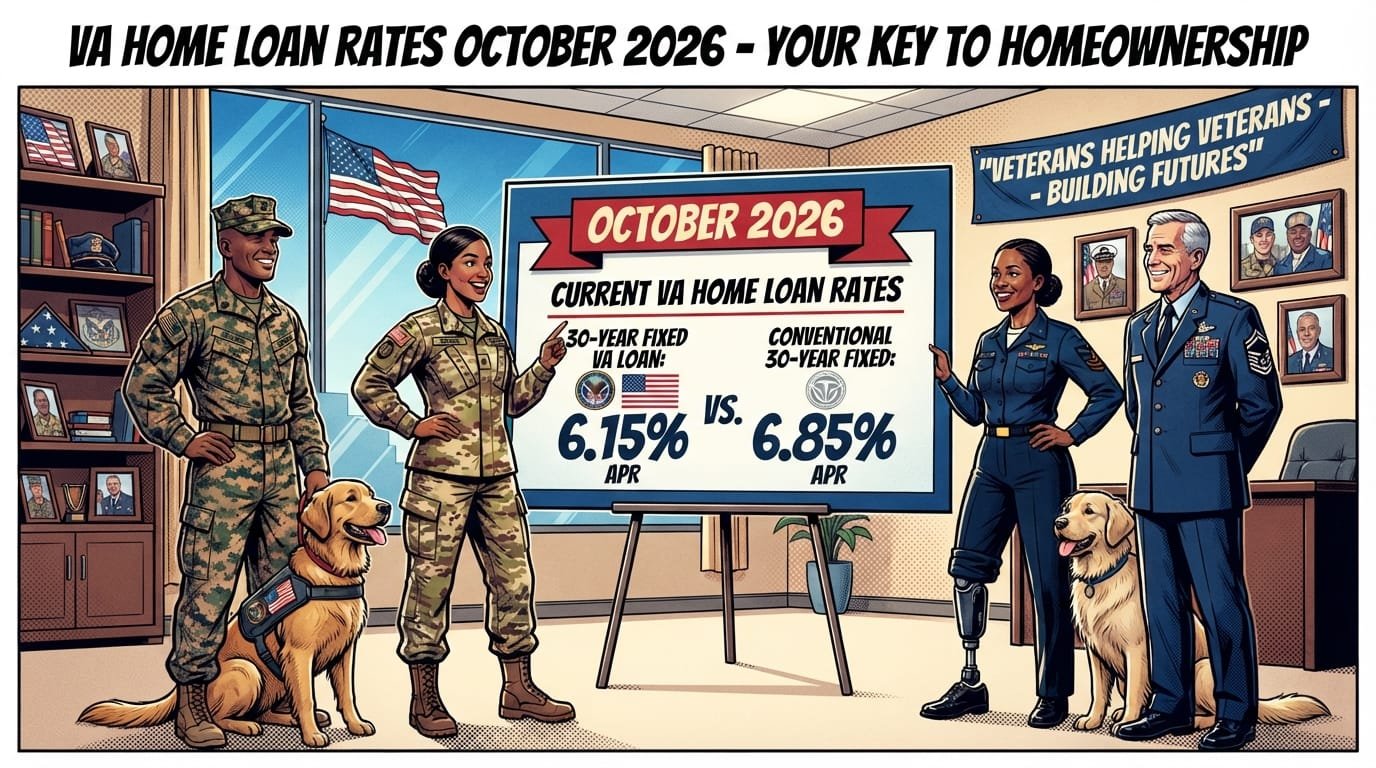
The average 30-year fixed VA home loan rate was 6.953% as of October 2, 2026, while the 15-year fixed VA rate averaged 6.402%. VA rates change daily based on market conditions, credit score, loan amount, and lender. VA loans typically offer lower rates than conventional and FHA loans because the VA guarantees a portion of the loan.
Quick Facts
| Item | Details |
|---|---|
| Benefit | Competitive mortgage rates with 0% down and no monthly PMI |
| Eligibility | Veterans, active duty, National Guard, Reserves, surviving spouses |
| Application | Through VA-approved lenders; COE required |
| Processing Time | 30–45 days typical |
| Official Agency | U.S. Department of Veterans Affairs (VA) |
| Required Forms | VA Form 26-1880 (COE), DD-214, VA Form 26-1805 (appraisal) |
| Updated For | October 2026 |
Current VA Home Loan Rates (October 2026)
VA home loan rates change daily. As of October 2, 2026, the average 30-year fixed VA purchase rate was 6.953%, and the 15-year fixed VA rate was 6.402%. These figures reflect the national average across major lenders and will fluctuate based on economic conditions, Federal Reserve policy, and the secondary mortgage market.

VA Rate Comparison: October 2026
| Loan Type | Average Interest Rate | Average APR |
|---|---|---|
| 30-Year Fixed VA | 6.953% | 7.14% |
| 15-Year Fixed VA | 6.402% | — |
| 30-Year Conventional | 7.587% | — |
| 30-Year FHA | 6.837% | — |
| 30-Year VA Refinance | 6.48% | 6.52% |
Source: Mortgage Research Center and Bankrate data, October 2026.

VA loans consistently price below conventional loans. In October 2026, the gap between a 30-year VA loan (6.953%) and a 30-year conventional loan (7.587%) was approximately 63 basis points. On a $400,000 loan, that difference saves a veteran roughly **$165 per month**.
How VA Home Loan Rates Are Determined
The VA does not set interest rates. Lenders set VA loan rates based on market conditions and the borrower’s financial profile. The VA guaranty reduces lender risk, which is why VA rates are typically lower than conventional rates.
What Determines Your VA Rate
| Factor | How It Affects Your Rate |
|---|---|
| Credit Score | Higher scores (720+) get the lowest rates; scores below 620 may face rate adjustments |
| Down Payment | No VA requirement, but a larger down payment can lower your rate |
| Loan Amount | Larger loans sometimes price slightly higher due to risk |
| Loan Term | 15-year loans typically carry lower rates than 30-year loans |
| Debt-to-Income Ratio (DTI) | Lower DTI signals lower risk and better pricing |
| Property Type | Condos, manufactured homes, and multi-unit properties may price differently |
| Lender Overlays | Some lenders add rate adjustments for risk factors beyond VA minimums |
Key point: The VA does not mandate a minimum credit score, but most lenders require a score of at least 580–620. Veterans United, for example, typically requires a 620 minimum.
VA Loan Rate History (2020–2026)
VA rates have risen significantly from pandemic-era lows. Understanding the trend helps veterans time their purchase or refinance.
| Year | Average 30-Year VA Rate |
|---|---|
| 2020 | 2.75% |
| 2021 | 2.95% |
| 2022 | 4.45% |
| 2023 | 6.15% |
| 2024 | 5.85% |
| 2025 | 6.52% |
| 2026 (Oct) | 6.95% |
Veterans May Qualify for Extra Benefits
Check available financial assistance, healthcare programs and other opportunities that may apply to you.
Check EligibilityHistorical range: The 30-year VA mortgage index has ranged from a low of 2.347% to a high of 7.49% over its recorded history. The long-term average is approximately 4.76%.
What this means for veterans: Rates are above the historical average but still below conventional alternatives. If you have an existing VA loan at a lower rate, refinancing may not make sense today. If you are buying, VA financing remains the most cost-effective option for eligible borrowers.
VA Loan Types and Their Current Rates
Not all VA loans price the same. Here are the main VA loan types and their typical rate relationships.
VA Purchase Loan
Used to buy or build a primary residence. This is the most common VA loan type. Rates are the lowest among VA products because of the VA guaranty and the borrower’s owner-occupancy commitment.
VA Interest Rate Reduction Refinance Loan (IRRRL)
The IRRRL, also called a VA Streamline Refinance, lets existing VA borrowers refinance to a lower rate with minimal documentation. No appraisal or credit check is typically required. The average 30-year VA refinance rate was 6.48% as of April 2026.
VA Cash-Out Refinance
Allows veterans to tap home equity by refinancing to a new VA loan. Rates are slightly higher than IRRRL rates because the loan amount increases. Veterans United reported a 30-year VA cash-out rate of 6.375% with an APR of 6.709% in August 2026.
VA Jumbo Loan
For loans above the conforming limit ($832,750 in most counties for 2026), VA jumbo rates are slightly higher. Veterans United reported a 30-year VA jumbo purchase rate of 6.375% with a 6.721% APR.
Native American Direct Loan (NADL)
A direct loan from the VA for eligible Native American veterans. The current NADL rate starts at 2.5%, significantly below market rates.
| VA Loan Type | Typical Rate | Best For |
|---|---|---|
| Purchase | Lowest | First-time buyers, no-down-payment buyers |
| IRRRL (Streamline) | Low | Existing VA borrowers lowering their rate |
| Cash-Out Refinance | Moderate | Tapping home equity |
| Jumbo | Moderate-High | Loans above the conforming limit |
| NADL | 2.5% | Native American veterans |
How to Get the Lowest VA Loan Rate
The lowest VA rates go to borrowers with strong credit, low debt, and stable income. Here are the most effective strategies.
1. Improve Your Credit Score
A 100-point increase in credit score can reduce your rate by 0.25%–0.5%. Pay down revolving debt, avoid new credit inquiries, and dispute errors on your credit report before applying.
2. Compare Multiple VA Lenders
VA rates vary by lender. Getting quotes from at least three VA-approved lenders can save you thousands over the life of the loan. The VA does not set rates, so lenders compete on pricing.
3. Consider Paying Discount Points
One discount point costs 1% of the loan amount and typically reduces your rate by 0.25%. On a $400,000 loan, one point costs $4,000 and saves approximately $60 per month. Break-even is about 67 months.
4. Make a Down Payment
While VA loans require no down payment, putting 5% down reduces your funding fee from 2.15% to 1.5%. Putting 10% down reduces it to 1.25%. A down payment may also improve your rate.
5. Choose a Shorter Loan Term
A 15-year VA loan typically carries a rate 0.5%–0.75% lower than a 30-year loan. The trade-off is a higher monthly payment.
6. Lock Your Rate at the Right Time
Rate locks protect you from market movement during the application process. A 30-day lock is standard. A 60-day lock costs slightly more but provides more certainty.
VA Funding Fee: What It Adds to Your Loan
The VA funding fee is a one-time cost that affects your total loan cost. It ranges from 0.5% to 3.3% of the loan amount depending on your down payment and whether it is your first VA loan.
2026 VA Funding Fee Rates
| Down Payment | First Use | Subsequent Use |
|---|---|---|
| Less than 5% | 2.15% | 3.30% |
| 5% or more | 1.50% | 1.50% |
| 10% or more | 1.25% | 1.25% |
Example: On a $400,000 VA loan with 0% down and first use, the funding fee is **$8,600**. This can be financed into the loan, adding approximately $55 per month at a 6.95% rate.
Who Is Exempt from the VA Funding Fee
You do not pay the funding fee if any of these apply:
You receive VA compensation for a service-connected disability.
You are eligible for VA compensation but receive retirement or active-duty pay instead.
You receive Dependency and Indemnity Compensation (DIC) as a surviving spouse.
You are an active-duty member who received a Purple Heart on or before closing.
New for 2026: Veterans can now deduct VA funding fees on their taxes when purchasing a home using a VA-guaranteed loan.
VA Loan Eligibility: Who Qualifies for These Rates
VA loan eligibility is based on service history and discharge status. You may qualify if you meet the minimum active-duty service requirements for your service period.
Minimum Service Requirements
| Service Category | Requirement |
|---|---|
| Active Duty (currently serving) | 90 continuous days |
| Gulf War Era Veterans (Aug 2, 1990–present) | 24 continuous months, or full period called (at least 90 days) |
| Peacetime Veterans | 181 continuous days |
| National Guard / Reserves | 6 creditable years, or 90 days active duty (30 consecutive) |
| Surviving Spouses | Unremarried spouse of veteran who died in service or from service-connected disability |
Source: VA.gov eligibility guidelines.
Credit and Income Requirements
Beyond service requirements, you must meet lender credit and income standards. The VA does not set a minimum credit score, but most lenders require at least a 580–620 score. Your debt-to-income ratio should typically be at or below 41%, though some lenders allow higher with compensating factors.
What to do next: Request your Certificate of Eligibility (COE) before applying. Your lender can often pull it electronically using your Social Security number and date of birth.
How to Apply for a VA Loan
The VA loan application process typically takes 30–45 days from pre-approval to closing.
Step-by-Step Process
Get your COE. Apply through VA.gov, by mail with VA Form 26-1880, or let your lender pull it electronically.
Get pre-approved. A VA-approved lender reviews your income, credit, and assets. Pre-approval takes 3–7 days.
Find a home and make an offer. The seller must agree to the VA appraisal and minimum property requirements.
Complete the VA appraisal. The appraisal confirms the home’s value and checks basic property standards. VA appraisal fees in 2026 range from $500–$800 depending on region.
Close the loan. Review your Closing Disclosure at least 3 business days before closing. VA closing costs typically run 3%–5% of the loan amount.
Required Documents
Certificate of Eligibility (COE)
DD-214 or Statement of Service
Recent pay stubs (30 days)
W-2s (2 years)
Bank statements (2 months)
Photo ID
Proof of any other income (VA disability, retirement, etc.)
VA Loan Rates vs. Other Loan Programs
VA loans compare favorably to conventional and FHA loans on both rate and total cost.
| Feature | VA Loan | Conventional | FHA Loan |
|---|---|---|---|
| 30-Year Rate (Oct 2026) | 6.953% | 7.587% | 6.837% |
| Down Payment | 0% | 3–20% | 3.5% |
| Monthly Mortgage Insurance | None | PMI if under 20% down | MIP for life of loan |
| Funding Fee / Upfront Cost | 1.25%–3.3% | None | 1.75% |
| Credit Score Minimum | No VA minimum (lenders: 580–620) | 620 typical | 580 |
| Loan Limit (Full Entitlement) | None | $832,750 (conforming) | $557,750 (varies by county) |
Bottom line: VA loans offer the lowest effective cost for eligible veterans. The absence of monthly mortgage insurance alone saves $150–$300 per month compared to FHA loans and conventional loans with less than 20% down.
How VA Rates Vary by State
VA loan rates are national, but state-specific costs and programs can affect your total cost.
State-Specific Fee Variations
The VA maintains a State Fees and Charges Deviations List. As of February 17, 2026, key changes include:
Washington: Foreclosure Prevention Fee added with a maximum stated amount.
Texas: Attorney Fee renamed Documentation Preparation Fee and no longer limited to refinances.
Alaska: Alaska Housing Delegation and Commitment Fee: 0.5% of loan amount.
Best States for VA Loan Benefits in 2026
| State | Key Benefit |
|---|---|
| Texas | No state income tax; Veterans Housing Assistance Program (VHAP) offers below-market rates |
| Florida | 100% property tax exemption for 100% disabled veterans; Hometown Heroes program up to 5% assistance |
| Virginia | Full property tax exemption for 100% P&T veterans; strong military lender familiarity |
| North Carolina | No tax on military retirement pay; affordable housing markets |
Source: Military.com 2026 state analysis.
VA Refinance Options in 2026
If you already have a VA loan and your rate is above current market rates, refinancing may reduce your monthly payment.
IRRRL (Streamline Refinance)
The IRRRL requires no appraisal and no credit check in most cases. The average 30-year VA refinance rate was 6.48% as of April 2026. To break even on closing costs (typically 1%–2% of the loan), your new rate should be at least 0.5%–0.75% lower than your current rate.
Cash-Out Refinance
A VA cash-out refinance lets you access home equity. Rates are slightly higher than IRRRL rates. You can borrow up to 100% of your home’s appraised value with a VA cash-out refinance, though lender overlays may reduce this.
When to Refinance
Your current rate is more than 0.75% above current market rates.
You plan to stay in the home long enough to recoup closing costs.
Your credit score has improved since your original loan.
Common Mistakes Veterans Make with VA Loan Rates
Not comparing lenders. VA rates vary by 0.25%–0.5% between lenders. Getting three quotes takes one afternoon and can save thousands.
Ignoring the APR. The interest rate is only part of the cost. The APR includes the funding fee and closing costs, giving a truer picture of total cost.
Assuming the VA sets rates. The VA does not set interest rates. Lenders do. Shopping around is essential.
Overlooking the funding fee exemption. If you have a service-connected disability rating of 10% or higher, you are exempt from the VA funding fee. This saves $5,000–$13,000 on a typical loan.
Refinancing too soon. If you refinanced within the last 6–12 months, the break-even period may not justify another refinance.
Not locking your rate. Rates can move 0.25% in a week. A rate lock protects you during the application and underwriting process.
Common Questions
1. What is the current VA home loan rate in October 2026?
The average 30-year fixed VA rate was 6.953% as of October 2, 2026. The 15-year fixed VA rate averaged 6.402%. Rates change daily based on market conditions, lender pricing, and your credit profile.
2. Are VA loan rates lower than conventional rates?
Yes. In October 2026, the 30-year VA rate (6.953%) was approximately 63 basis points lower than the 30-year conventional rate (7.587%). VA rates are lower because the VA guaranty reduces lender risk.
3. How often do VA loan rates change?
VA rates change daily, sometimes multiple times per day. They are influenced by Treasury yields, Federal Reserve policy, inflation data, and the secondary mortgage market. Locking your rate protects you from short-term fluctuations.
4. Does the VA set interest rates?
No. The VA does not set the interest rate lenders must offer borrowers. Lenders set rates based on market conditions and the borrower’s financial profile. The VA guaranty helps lenders offer competitive rates, but the rate itself is a lender decision.
5. Can I get a VA loan with a 600 credit score?
Yes, but your rate may be higher. The VA does not set a minimum credit score, but most lenders require 580–620. Some lenders have overlays requiring 620 or higher. A higher score almost always means a lower rate.
6. What is the VA funding fee in 2026?
The first-use funding fee is 2.15% with less than 5% down. It drops to 1.50% with 5% down and 1.25% with 10% or more down. Subsequent use with less than 5% down is 3.30%. Veterans receiving VA disability compensation are exempt.
7. How do I get the lowest VA loan rate?
Improve your credit score above 720, compare at least three VA lenders, consider paying discount points, make a down payment if possible, and choose a shorter loan term. Rate shopping within a 14-day window counts as one credit inquiry.
8. Can I refinance my VA loan to a lower rate?
Yes. The IRRRL (Streamline Refinance) allows you to refinance with no appraisal or credit check in most cases. The average 30-year VA refinance rate was 6.48% as of April 2026. Your new rate should be at least 0.5%–0.75% lower to justify closing costs.
9. Are VA loan rates the same in every state?
Yes and no. The VA loan program is national, so base rates are similar across states. However, state-specific fees (like Texas documentation fees or Washington foreclosure prevention fees) can affect your total closing costs, which in turn affects your APR.
10. What is the VA loan limit for 2026?
If you have full entitlement, there is no VA loan limit. With partial entitlement, the 2026 limit is $832,750 in most counties, matching the FHFA conforming loan limit. High-cost counties may have higher limits.
11. Do VA loans have mortgage insurance?
No. VA loans never require monthly mortgage insurance. This is one of the primary cost advantages over FHA loans and conventional loans with less than 20% down. The VA funding fee is a one-time cost, not a monthly charge.
12. Can I use a VA loan more than once?
Yes. You can reuse your VA loan benefit as long as you have entitlement available or restore your entitlement by paying off a previous VA loan. If you still have an active VA loan, you may have partial entitlement available for a second loan.
Key Takeaways
Current 30-year VA rate: 6.953% as of October 2, 2026.
VA rates are lower than conventional: ~63 basis points lower in October 2026.
The VA does not set rates: Lenders set VA loan rates based on market conditions and borrower profile.
Credit score matters: A 720+ score gets the lowest VA rates; lenders typically require 580–620 minimum.
Funding fee is separate from rate: 2.15% first use with 0% down; exempt with service-connected disability.
IRRRL refinance: Average 30-year VA refinance rate was 6.48% in April 2026.
No monthly mortgage insurance: VA loans never charge monthly PMI, saving $150–$300 per month vs. FHA.
Rate shopping works: Comparing three lenders can save 0.25%–0.5% on your rate.
Rate locks protect you: Lock your rate during the 30–45 day application process.
2026 tax change: Veterans can now deduct VA funding fees on their taxes.
Official Resources
VA Home Loan Rates and Programs: VA.gov – Home Loans
VA Funding Fee and Closing Costs: VA.gov – Funding Fee
VA Loan Eligibility: VA.gov – Eligibility
Certificate of Eligibility (COE): VA.gov – Request COE
VA Refinance Options: VA.gov – Refinance
IRS Mortgage Interest Deduction: IRS Publication 936
VA Regional Loan Center: (877) 827-3702





🇺🇸 IMPORTANT DISCLAIMER – Veterans Benefits Information
This site provides general information about U.S. Department of Veterans Affairs (VA) benefits for educational and informational purposes only.
- Not Official: We are NOT affiliated with, endorsed by, or connected to the U.S. Department of Veterans Affairs (VA), the Veterans Benefits Administration (VBA), the Veterans Health Administration (VHA), or any other government agency.
- No Legal/Financial Advice: The content on this website is for informational purposes only and does not constitute legal, financial, or medical advice. VA benefits rules change frequently – always consult with an accredited Veterans Service Officer (VSO) or a qualified professional for your specific situation.
- Official Sources: For official, binding information and to apply for benefits, always visit official .gov websites: VA.gov, Benefits.VA.gov, or SSA.gov.
- No Data Collection: This site does not collect, store, or process any personal information. It does not have login forms, contact forms, or any system to capture user data. We never ask for your Social Security Number, bank details, or any personal information.
- 🚨 Scam Alert: The VA and other government agencies never charge fees for benefit applications. If anyone asks for money to "process" your VA claim, it is a scam. Report it to the VA Office of Inspector General at VA.gov/OIG.
- Advertising: This site uses third-party advertising (Adsterra) to cover operational costs. We do not endorse or guarantee any products or services advertised.
📌 Information provided as of June 2026. Always verify current eligibility and rules with official .gov sources.
This site is not affiliated with the U.S. Department of Veterans Affairs or any government agency. All information is for educational purposes only. Please visit VA.gov for official information.
