
Louisiana Veterans Property Tax Exemption: Disability Rating Guide
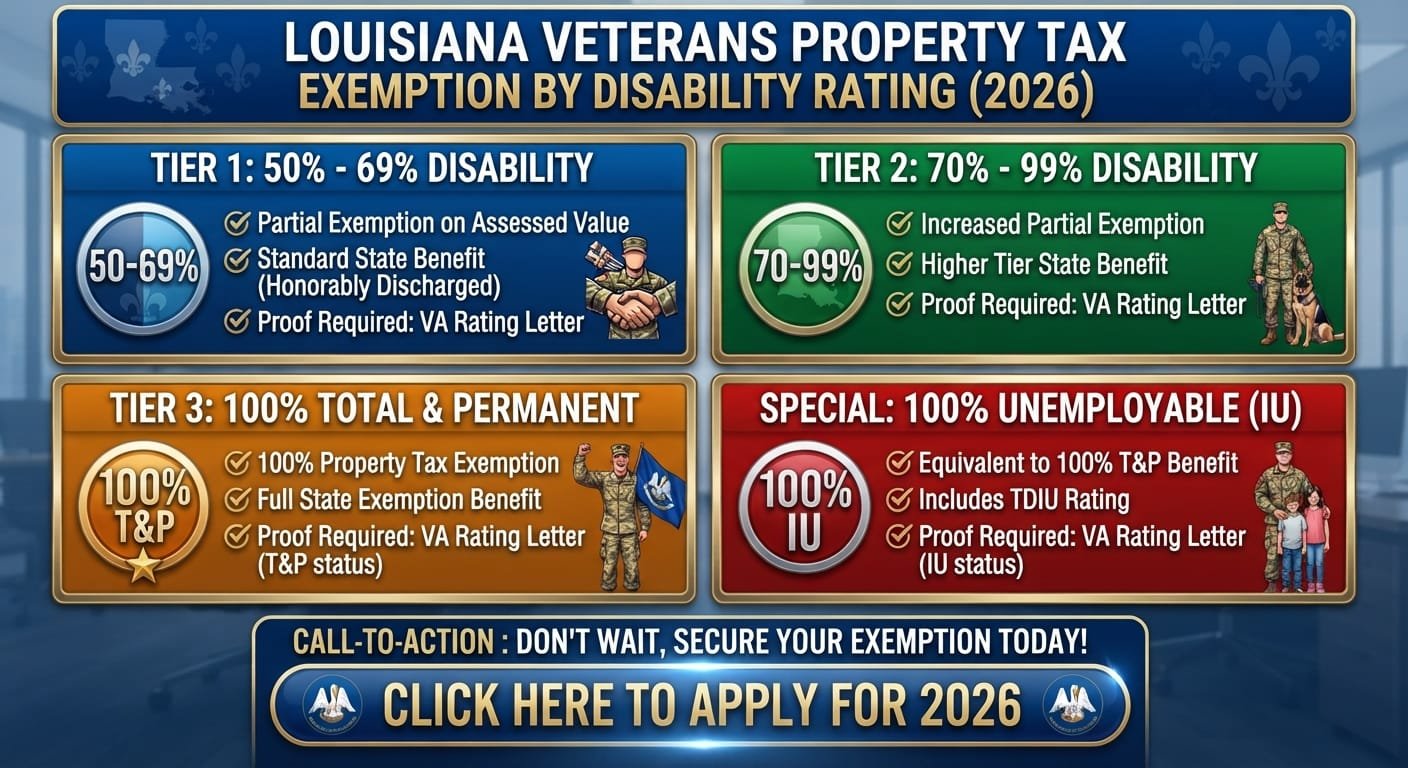
Veterans with a 50% or higher VA service-connected disability rating qualify for an additional Louisiana property tax exemption on top of the standard homestead exemption. The extra exemption is $2,500 of assessed value at 50–69%, $4,500 at 70–99%, or full exemption of remaining assessed value at 100% or individual unemployability.
Quick Facts
| Item | Details |
|---|---|
| Benefit | Additional property tax exemption on assessed value, layered on top of the $7,500 homestead exemption |
| Eligibility | Veteran with 50%+ VA service-connected disability rating who owns and occupies the home; surviving spouse may qualify |
| Application | File certified Form A25 with your parish assessor |
| Processing Time | Varies by parish; confirm with your local assessor |
| Official Agency | Louisiana Department of Veterans Affairs (LDVA) for certification; parish assessor for application |
| Required Forms | Form A25 (certified by LDVA); VA disability letter; Louisiana ID or driver’s license |
| Updated For | 2026 tax year (2022 constitutional amendment effective January 1, 2023) |
What Is the Louisiana Disabled Veteran Property Tax Exemption?
The Louisiana disabled veteran property tax exemption reduces the assessed value of your primary home before property taxes are calculated. It is not a refund and it is not automatic. The exemption is built into the Louisiana Constitution, which voters expanded in 2022 to create three distinct tiers based on VA disability rating.

This benefit matters because Louisiana property taxes are assessed on home value, and veterans with service-connected disabilities often face financial strain that makes every dollar of savings count. The exemption can reduce your annual property tax bill by hundreds of dollars, depending on your parish’s millage rate.

What veterans should do next: Locate your VA disability decision letter, then contact your parish’s LDVA office to begin the certification process. Do not wait for the assessor to contact you.
How Much Is the Exemption at Each Disability Rating?
The exemption amount increases in three tiers based on your VA service-connected disability rating. The table below shows the additional exemption beyond the standard homestead exemption.
| VA Disability Rating | Additional Exemption (Assessed Value) | Approximate Home Value Protected | Total Exemption With Homestead |
|---|---|---|---|
| 50% – 69% | $2,500 | ~$25,000 | $10,000 assessed value |
| 70% – 99% | $4,500 | ~$45,000 | $12,000 assessed value |
| 100% or IU/TDIU | All remaining assessed value | Full remaining value | Entire assessed value |
Louisiana assesses residential property at 10% of fair market value. A $2,500 assessed value exemption equals roughly $25,000 of home value.
At 50–69%: You receive the standard homestead exemption plus $2,500 more. If your property’s assessed value exceeds $10,000, you pay taxes only on the amount above that threshold.
Veterans May Qualify for Extra Benefits
Check available financial assistance, healthcare programs and other opportunities that may apply to you.
Check EligibilityAt 70–99%: The additional exemption rises to $4,500. Taxes apply only to assessed value above $12,000.
At 100% or Individual Unemployability (IU): The exemption covers the remaining assessed value after the homestead exemption. In practical terms, you owe $0 in ad valorem property taxes on your qualifying home.
What Does “Assessed Value” Mean in Louisiana?
Assessed value is not the same as your home’s market value or the price you paid. Louisiana assessors value residential property at 10% of fair market value. A home worth $250,000 has an assessed value of $25,000. Your tax bill is calculated on that assessed value, minus any exemptions.
This distinction matters because a $4,500 exemption sounds small until you realize it protects $45,000 of home value from taxation.
Who Qualifies for the Louisiana Disabled Veteran Exemption?
You qualify if you meet all of these conditions:
VA service-connected disability rating of 50% or higher — confirmed by the U.S. Department of Veterans Affairs.
You own the property — your name appears on the deed or act of sale.
You occupy the property as your primary residence — it must be your bona fide homestead, not a rental or second home.
The property receives the homestead exemption — the disabled veteran exemption is layered on top and cannot exist independently.
Do Surviving Spouses Qualify?
Yes. The surviving spouse of a deceased veteran who had a qualifying disability rating may claim the exemption if the spouse remains the owner and occupies the property. This applies whether or not the exemption was in effect before the veteran’s death.
The surviving spouse must maintain ownership and primary residency. Remarriage may affect eligibility depending on parish interpretation; confirm with your local assessor.
Do You Need to Meet an Income Limit?
No. The Louisiana disabled veteran property tax exemption does not have an income limit. This distinguishes it from the Special Assessment Level program, which freezes assessed value for certain homeowners and does have an income cap.
A separate program — the Special Assessment Level for service-connected disabilities — includes a $150,000 adjusted gross income limit for some applicants. But the additional homestead exemption for disabled veterans described in this article has no income restriction.
What Documents Do You Need to Apply?
Requirements vary slightly by parish, but most assessors ask for these documents:
Required for all applicants:
Form A25 (Disabled Veterans Property Tax Benefits Certification) — signed and certified by the Louisiana Department of Veterans Affairs. This form confirms your disability rating and eligibility.
VA disability decision letter or benefit summary — showing your current service-connected rating.
Louisiana driver’s license or state ID — with your name and the property address.
Proof of ownership — act of sale, deed, or homestead exemption records if not already on file.
Sometimes requested:
Recent utility bill showing the property as your service and mailing address.
Federal tax return (for parishes that verify income for related programs).
Critical detail: The VA form you may already have is often not sufficient. The assessor specifically needs Form A25 certified by the LDVA parish office. Getting this form is the step most veterans miss.
How to Apply for the Louisiana Disabled Veteran Property Tax Exemption
Follow these steps in order. Skipping step one is the most common reason applications get rejected.
Step 1: Get Form A25 Certified by the LDVA
Visit your parish’s Louisiana Department of Veterans Affairs office. LDVA counselors will verify your disability rating and certify Form A25 at no cost. You can find your parish office through vetaffairs.la.gov or by calling (877) 432-8982.
Bring to LDVA:
VA disability decision letter
Louisiana driver’s license or ID
Proof of property address
Step 2: File Form A25 With Your Parish Assessor
Take the certified Form A25, along with your Louisiana ID and proof of ownership, to the assessor’s office in the parish where your home is located. Filing methods and deadlines vary by parish. Some accept mail; others require in-person appointments.
Step 3: Confirm Homestead Exemption Status
If you have not already filed for the homestead exemption on this property, do so at the same time. The disabled veteran exemption cannot apply to a property that is not receiving the homestead exemption.
Step 4: Verify Receipt and Follow Up
Ask the assessor’s office when the exemption will take effect and whether you need to refile annually. Some parishes require periodic recertification; others apply the exemption until circumstances change.
Online Application Availability
Louisiana does not have a statewide online application for the disabled veteran property tax exemption. Applications are processed at the parish level, and most require in-person submission of the certified Form A25.
A few parishes may offer online portals for homestead exemption filings or document uploads, but the LDVA certification step must be completed in person or by mail through your local veterans service office.
What to do: Contact your parish assessor directly to ask whether any part of the process can be completed remotely. Do not assume you can apply entirely online.
Common Mistakes That Delay or Deny Louisiana Veteran Exemption Applications
Mistake 1: Going to the assessor without a certified Form A25.
Many veterans bring their VA decision letter and assume that is enough. Most assessors require the LDVA-certified Form A25 specifically. Get this first.
Mistake 2: Using an outdated Form A25 with the wrong address.
If you’ve moved or your rating changed, the form must reflect your current home address. An old Form A25 with a previous address will be rejected.
Mistake 3: Missing the parish deadline.
Some parishes set deadlines for exemption applications, often tied to the tax assessment calendar. Missing the deadline may delay your exemption to the following tax year. Ask your assessor for the deadline when you pick up forms.
Mistake 4: Assuming the exemption is automatic.
No Louisiana parish applies the disabled veteran exemption automatically. You must apply and qualify annually in some jurisdictions.
Mistake 5: Claiming the exemption on a rental or second home.
The exemption applies only to your primary residence — the home where you live and receive mail. Rental properties and vacation homes do not qualify.
How Property Taxes Are Calculated With the Exemption
Understanding the math helps you verify your bill is correct. Here is an example using a home with a $200,000 market value in a parish with a 150-mill tax rate.
| Step | Calculation | Example |
|---|---|---|
| Market value | — | $200,000 |
| Assessed value (10%) | $200,000 × 0.10 | $20,000 |
| Homestead exemption | − $7,500 | $12,500 remaining |
| Veteran exemption (70%) | − $4,500 | $8,000 taxable assessed value |
| Tax before exemption | $20,000 × 0.150 | $3,000 |
| Tax after exemption | $8,000 × 0.150 | $1,200 |
| Annual savings | $1,800 |
At 100% rating, the remaining $12,500 assessed value after homestead exemption would also be exempt, reducing the tax to $0.
Millage rates vary by parish and can change annually. Use your parish’s actual rate for precise calculations.
What if Your VA Rating Changes After You Apply?
Your exemption level adjusts if your VA rating changes. If your rating increases from 70% to 100%, you qualify for the full exemption. If it decreases below 50%, you lose eligibility.
What to do: Report rating changes to your parish assessor and LDVA office promptly. Obtain a new certified Form A25 reflecting the updated rating. Failure to report a decrease could result in a retroactive tax bill.
Appeals Process for Denied Louisiana Veteran Exemptions
If your application is denied, you have options:
Step 1: Ask why. Request a written explanation from the assessor’s office. Common reasons include missing documents, incorrect form version, or address mismatch.
Step 2: Correct and resubmit. Many denials are fixable. Get the right Form A25 certified by LDVA with the correct address and resubmit.
Step 3: File a formal appeal. Louisiana law provides appeal procedures through the parish Board of Review and then to the Louisiana Tax Commission. Deadlines are strict — often 30 days from the notice of denial. Contact the assessor for the exact appeal deadline and procedure.
Step 4: Seek LDVA assistance. Your parish veterans service office can help you understand the denial and navigate the appeal.
Property Tax Exemption vs. Special Assessment Level: What’s the Difference?
Louisiana offers two separate property tax benefits for disabled veterans. They are not the same thing.
| Feature | Disabled Veteran Property Tax Exemption | Special Assessment Level |
|---|---|---|
| What it does | Exempts assessed value from taxation | Freezes assessed value at the level when you qualified |
| Eligibility | 50%+ VA service-connected rating | 50%+ VA rating or other disability criteria |
| Income limit | None | $150,000 adjusted gross income (adjusted for inflation) |
| Surviving spouse | Yes, if spouse remains owner and occupant | Limited; confirm with assessor |
| Application | Form A25 through assessor | Varies; often Form A25 plus income documentation |
| Best for | Reducing current tax bill | Protecting against future assessment increases |
Some veterans may qualify for both. Ask your assessor whether stacking is permitted in your parish.
Does the Exemption Apply to Additional Structures on Your Property?
Yes, in most cases. A 2026 Louisiana Attorney General opinion clarified that the disabled veteran exemption extends beyond the primary dwelling to include additional structures that are residential in nature and not used for commercial purposes.
Qualifying structures include:
Guest houses
Garages with living quarters
Other residential appurtenances on the same tract of land
What disqualifies a structure: Any use for business, rental income, or commercial purposes. A detached garage used for personal storage qualifies; the same garage rented to a tenant likely does not.
This opinion harmonizes the treatment of auxiliary structures under both the homestead exemption and the disabled veteran exemption.
How Louisiana Compares to Other States
Louisiana is more generous than many states for veterans rated below 100%. Here is a comparison of several Southern states.
| State | Minimum Rating for Property Tax Relief | Relief Structure | 100% Exemption |
|---|---|---|---|
| Louisiana | 50% | Additional exemption on assessed value | Full remaining assessed value |
| Texas | 10% | $5,000–$12,000 exemption | Full homestead value |
| Mississippi | 100% | Full exemption only at 100% | Full assessed value |
| Arkansas | 100% | $5,000 homestead credit | Varies by rating |
| Alabama | 100% | Full exemption | Full assessed value |
Louisiana’s 50% threshold means more veterans qualify for partial relief than in states requiring 100% disability.
Common Questions
How much is the Louisiana disabled veteran property tax exemption at 50%?
At 50–69% rating, you receive an additional $2,500 exemption on assessed value beyond the standard homestead exemption. This equals roughly $25,000 of protected home value. Your total assessed value exemption with the homestead exemption is $10,000.
Do I need to reapply for the Louisiana veteran property tax exemption every year?
It depends on your parish. Some parishes require annual recertification of Form A25; others apply the exemption continuously until your circumstances change. Confirm your parish’s policy with the assessor’s office when you apply.
Can my surviving spouse keep the exemption after I die?
Yes. If your surviving spouse remains the owner and occupant of the property, they can continue receiving the exemption. This applies regardless of whether the exemption was in effect before your death.
What if my VA rating is 100% but I’m not considered permanently and totally disabled?
Louisiana’s full exemption applies at “100% unemployability or totally disabled” by VA determination. If your rating is 100% schedular but not marked permanent and total, confirm with your assessor whether you qualify for the full exemption or the 70–99% tier.
Does the exemption apply to parish and state taxes both?
Yes. The exemption applies to ad valorem taxes, which include state, parish, and special district taxes on property. It is not limited to one level of taxation.
Can I claim the exemption on a home I own but don’t live in?
No. The property must be your bona fide homestead — the place you own and occupy as your primary residence. Rental properties and second homes do not qualify.
How long does it take for the exemption to appear on my tax bill?
Processing time varies by parish. Some apply the exemption to the next tax cycle; others may take a full assessment year. Contact your assessor for an estimated timeline. Do not withhold payment of taxes while waiting for the exemption to process.
What is Form A25 and where do I get it?
Form A25 is the Disabled Veterans Property Tax Benefits Certification. You get it from your parish LDVA office, not the assessor. An LDVA counselor certifies your eligibility and signs the form at no cost. Take the certified form to the assessor.
Does the Louisiana exemption have an income limit?
No. The additional homestead exemption for disabled veterans has no income limit. The separate Special Assessment Level program does have an income cap of $150,000 adjusted gross income.
What happens if my VA rating increases from 70% to 100%?
You may qualify for the full exemption on remaining assessed value. Get a new Form A25 certified by LDVA showing the updated rating and file it with your assessor. The exemption should adjust going forward, but backdating may not apply.
Can I get a refund for prior years if I qualified but didn’t apply?
Refund eligibility depends on parish policy and Louisiana law. Some jurisdictions allow retroactive exemptions for limited periods. Ask your assessor whether prior-year refunds are available and what deadlines apply.
Is the exemption available for National Guard and Reserve veterans?
Yes, if you have a VA service-connected disability rating of 50% or higher. The exemption is based on VA disability rating, not active-duty status. National Guard and Reserve members with qualifying VA ratings can apply.
Key Takeaways
Louisiana offers three exemption tiers based on VA disability rating: 50–69%, 70–99%, and 100% or IU.
The exemption is layered on top of the homestead exemption and applies only to your primary residence.
No income limit applies to the disabled veteran property tax exemption.
Form A25 must be certified by LDVA before you file with the parish assessor.
Surviving spouses can continue the exemption if they remain owner and occupant of the home.
At 100% rating or IU, the remaining assessed value after homestead exemption is fully exempt.
The exemption is not automatic — you must apply through your parish assessor.
Additional residential structures may qualify if not used for commercial purposes.
No statewide online application exists; filing is handled at the parish level.
Contact your parish assessor for deadlines, refiling requirements, and local procedures.
Official Resources
Louisiana Department of Veterans Affairs
Website: vetaffairs.la.gov
Phone: (877) 432-8982
Purpose: Certify Form A25 and provide veterans service assistance
U.S. Department of Veterans Affairs
Website: va.gov
Purpose: Obtain VA disability decision letters, benefit summaries, and rating information
Louisiana Tax Commission
Website: latc.la.gov
Purpose: State tax appeals and assessment oversight
Your Parish Assessor’s Office
Find through your parish government website
Purpose: File Form A25, homestead exemption applications, and property tax questions
Louisiana Legislature
Website: legis.la.gov
Purpose: Constitutional and statutory text for Article VII, Section 21

🇺🇸 IMPORTANT DISCLAIMER – Veterans Benefits Information
This site provides general information about U.S. Department of Veterans Affairs (VA) benefits for educational and informational purposes only.
- Not Official: We are NOT affiliated with, endorsed by, or connected to the U.S. Department of Veterans Affairs (VA), the Veterans Benefits Administration (VBA), the Veterans Health Administration (VHA), or any other government agency.
- No Legal/Financial Advice: The content on this website is for informational purposes only and does not constitute legal, financial, or medical advice. VA benefits rules change frequently – always consult with an accredited Veterans Service Officer (VSO) or a qualified professional for your specific situation.
- Official Sources: For official, binding information and to apply for benefits, always visit official .gov websites: VA.gov, Benefits.VA.gov, or SSA.gov.
- No Data Collection: This site does not collect, store, or process any personal information. It does not have login forms, contact forms, or any system to capture user data. We never ask for your Social Security Number, bank details, or any personal information.
- 🚨 Scam Alert: The VA and other government agencies never charge fees for benefit applications. If anyone asks for money to "process" your VA claim, it is a scam. Report it to the VA Office of Inspector General at VA.gov/OIG.
- Advertising: This site uses third-party advertising (Adsterra) to cover operational costs. We do not endorse or guarantee any products or services advertised.
📌 Information provided as of June 2026. Always verify current eligibility and rules with official .gov sources.
This site is not affiliated with the U.S. Department of Veterans Affairs or any government agency. All information is for educational purposes only. Please visit VA.gov for official information.
