
Meta Glasses for Blind Veterans in Mankato, MN: Complete Guide
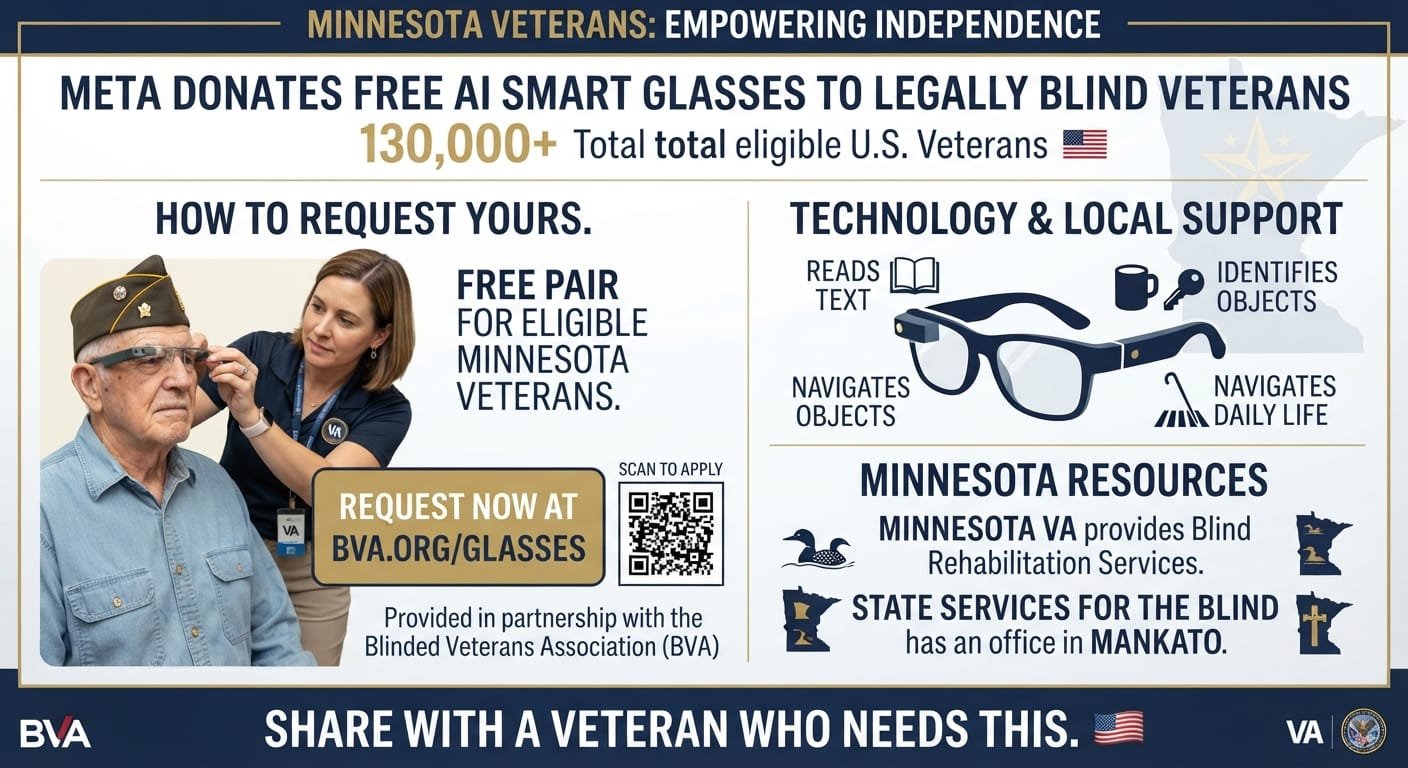
Meta is donating free Ray-Ban AI smart glasses to every legally blind U.S. Veteran nationwide, including those in Mankato, Minnesota. The glasses use artificial intelligence to read text aloud, identify objects, and help blind Veterans navigate their surroundings independently. Veterans can request their free pair at bva.org/glasses .
Quick Facts
| Item | Details |
|---|---|
| Program | Meta Ray-Ban AI Glasses Donation for Blind Veterans |
| Eligibility | Legally blind U.S. Veterans (130,000+ eligible nationwide) |
| Cost | Free to eligible Veterans |
| Application | Visit bva.org/glasses to request glasses |
| Training | Monthly webinars, in-person events, BVA training guide |
| Local VA Support | Minneapolis VA Health Care System, VIST Coordinator |
| Minnesota State Services | Minnesota State Services for the Blind (Mankato office available) |
| Updated For | 2026 |
What Are the Ray-Ban Meta AI Glasses?
The Ray-Ban Meta AI glasses are smart glasses with a built-in camera, speakers, and Meta AI technology. When a user asks a question about something in their view, the glasses capture an image and use AI to provide a spoken response .

Key Features for Blind Veterans:
Read text aloud: The glasses can scan documents, signs, mail, or prescription bottles and read the text out loud
Identify objects: Users can ask “What am I looking at?” and receive a verbal description
Navigate surroundings: The glasses help users understand their environment and locate specific items
Voice-activated controls: Users can manage tasks using voice alone without touching the glasses
Detailed responses: A specific accessibility setting provides detailed descriptions of what the camera sees, designed for people with vision impairment
Be My Eyes integration: Veterans can connect with sighted volunteers who can help them navigate difficult situations in real time
How the Glasses Help with Daily Life:
| Activity | How the Glasses Help |
|---|---|
| Reading mail | Scans and reads incoming letters and bills |
| Identifying medications | Reads prescription bottle labels |
| Grocery shopping | Identifies products and reads labels |
| Navigating streets | Helps identify street signs and landmarks |
| Social interaction | Recognizes and describes faces of friends and family |
| Using technology | Reads screens and provides voice control |
One blind Gulf War Veteran who tested the glasses described them as life-changing: “When I lost my eyesight in Desert Storm from a bunker explosion, I also lost my independence. The moment I put on my Ray-Ban Meta glasses, I got my independence back” .
Important Safety Note

The AI technology is powerful but not infallible. The glasses are not a substitute for orientation and mobility training . Veterans should continue to use traditional mobility aids like canes or guide dogs for safety-critical navigation. The glasses also require a smartphone to function, which may be a barrier for some Veterans who rely on flip phones .
Eligibility: Who Qualifies
Definition of Legal Blindness
To qualify as a legally blind Veteran for the Meta glasses program and VA Blind Rehabilitation Services, a Veteran must have at least one of the following:
Visual acuity of 20/200 or worse in the best eye using best corrective lenses
Visual field of 20 degrees or less
VA Eligibility Requirements
To receive the Meta glasses through the program :
Must be a legally blind U.S. Veteran (over 130,000 eligible nationwide)
Must be eligible for VA health benefits (active duty service members may also qualify in some cases)
No service-connected vision loss required—vision loss from any cause qualifies (macular degeneration, glaucoma, cataracts, diabetes, stroke, brain injury)
Veterans with Non-Service-Connected Vision Loss
The program serves any Veteran whose vision loss impacts their life, regardless of whether the vision loss is service-connected. This includes aging-related conditions like macular degeneration and cataracts .
How to Apply for the Free Meta Glasses
Step 1: Request the Glasses
Veterans May Qualify for Extra Benefits
Check available financial assistance, healthcare programs and other opportunities that may apply to you.
Check EligibilityLegally blind Veterans can request their free pair of Ray-Ban Meta glasses by visiting: bva.org/glasses .
Step 2: Connect with a VIST Coordinator
The Blinded Veterans Association (BVA) is helping distribute the glasses and provide training. The VA’s Visual Impairment Services Team (VIST) Coordinator serves as the entry point into the VA Blind Rehabilitation Services system .
Step 3: Attend Training
Meta and its partners provide:
A training guide covering voice command activation, reading documents, answering phone calls, and navigating daily tasks
Monthly webinars where Veterans can ask questions and receive support
In-person events where Veterans can receive their glasses and hands-on assistance
What Mankato Veterans Should Do Next
If you are a legally blind Veteran in the Mankato area, take these steps immediately:
Visit bva.org/glasses to request your glasses
Contact the Minneapolis VA Health Care System VIST Coordinator to enroll in VA Blind Rehabilitation Services
Contact the Minnesota State Services for the Blind Mankato office for additional low vision support
Watch for announcements about in-person events in Minnesota
VA Blind Rehabilitation Services for Minnesota Veterans
Minneapolis VA Health Care System
Minnesota Veterans receive VA blind rehabilitation services through the Minneapolis VA Health Care System. The VIST Coordinator provides lifetime care coordination for Veterans who are blind or visually impaired .
Visual Impairment Services Team (VIST)
The VIST Coordinator serves as a lifetime care manager who :
Evaluates Veterans for appropriate services
Organizes programs of care
Provides referrals to inpatient and outpatient services
Follows up annually or as needed
Coordinates with blind rehabilitation specialists for in-home support
The VIST program’s mission is to keep Veterans motivated, engaged, and hopeful through cutting-edge technology, artificial intelligence, and comprehensive VA services .
VISOR Program
The Minneapolis VA Health Care System offers Visual Impairment Services Outpatient Rehabilitation (VISOR) programs, which are outpatient rehabilitation clinics providing advanced ambulatory low vision care. Services include :
Low vision optometry exam and functional vision evaluation
Assessment and therapeutic instruction on how to maximize remaining vision for tasks such as accessing printed material, financial management, and kitchen safety
Training on assistive technology to address functional deficits from visual impairment
Assessment and instruction to increase awareness of the environment and safety
Minnesota State Services for the Blind
The Minnesota State Services for the Blind (SSB) provides direct support services to blind or deaf-blind people to help them live as independently as possible. The SSB has an office in Mankato at :
Address: 12 Civic Center Plaza, Ste 1600B, Mankato, MN 56001
Services offered by SSB:
Adjustment to blindness training
Assistive technology services
Job placement and vocational rehabilitation
Low vision services
Orientation and mobility training
Support for deaf-blind individuals
Visit mn.gov/deed/ssb for more information .
Blind Rehabilitation Centers
For intensive inpatient blind rehabilitation, Veterans may be referred to the nearest Blind Rehabilitation Center. The closest BRC for Minnesota Veterans may be in locations such as Minneapolis (VISOR), Chicago, or other regional centers .
Blind Rehabilitation and Technology Training
Hands-On Training Approach
The VA’s approach to blind rehabilitation emphasizes personalized training based on each Veteran’s specific needs, rather than simply issuing devices . Veterans receive:
In-home support from blindness and low-vision specialists
Training on the latest assistive technology
Individualized treatment plans based on goals and abilities
Continuous follow-up and support
Blind TeleRehabilitation
For Veterans who have difficulty traveling, VA offers Blind TeleRehabilitation:
Virtual assessment and training
Assistive technology instruction
Themed support groups
Veterans can be referred by their VIST Coordinator or primary care provider
Meta Glasses Training Resources
The Blinded Veterans Association has developed a training guide specifically for blind and low-vision Veterans . Training covers:
Activating voice commands
Reading documents
Answering phone calls
Navigating daily tasks with greater autonomy
Monthly webinars with real-time troubleshooting support
Minnesota Veterans Benefits for Vision Loss
Disability Compensation for Vision Loss
Veterans who experience vision loss due to service-connected conditions may be eligible for VA disability compensation. The VA rating for vision loss depends on the severity of the condition and whether it affects one or both eyes.
Common service-connected vision conditions:
Diabetic retinopathy (related to Type 2 diabetes)
Glaucoma
Cataracts
Macular degeneration
Blindness from traumatic injury during service
PACT Act Eligibility
The PACT Act expanded eligibility for Veterans exposed to toxic substances during service. Vision loss may be linked to toxic exposure in some cases. Veterans with vision loss should discuss potential service connection with their VIST Coordinator or County Veterans Service Officer.
Minnesota State Benefits for Blind Veterans
Minnesota offers additional benefits for blind Veterans:
Property tax exemptions for disabled Veterans
Free or reduced-cost hunting and fishing licenses (depending on disability rating)
Access to Minnesota State Services for the Blind programs
Common Questions
1. How do I get the free Meta glasses in Mankato?
Visit bva.org/glasses to request your glasses. The Blinded Veterans Association handles distribution and works with partners to host in-person events. Contact the Minneapolis VA Health Care System VIST Coordinator to connect with VA Blind Rehabilitation Services .
2. What services does the VA provide for blind Veterans in Minnesota?
The Minneapolis VA Health Care System provides VIST coordination, low vision exams, assistive technology training, and referrals to Blind Rehabilitation Centers. The Minnesota State Services for the Blind also offers adjustment to blindness training and job placement services through their Mankato office .
3. Can I get the glasses if I’m legally blind and not 100% service-connected?
Yes. Blind Rehabilitation Services serve any Veteran whose vision loss impacts their life, regardless of service connection. Vision loss from macular degeneration, glaucoma, cataracts, diabetes, stroke, or brain injury qualifies .
4. Is there a cost for the glasses or training?
No. The glasses are being donated at no cost to eligible Veterans. Training, webinars, and support are provided free through Meta’s partnerships with the Blinded Veterans Association and other organizations .
5. What if I live in Mankato but need help with transportation?
The Minnesota State Services for the Blind offers services and can connect Veterans with resources. VA also offers Blind TeleRehabilitation for Veterans who cannot travel. Contact your VIST Coordinator to discuss your specific needs .
6. What kind of training is available?
Meta and the BVA provide a training guide, monthly webinars, and in-person events. The BVA developed the training specifically for blind and low-vision Veterans, covering voice command activation, reading documents, and daily task navigation .
7. How do the glasses help blind Veterans navigate?
The glasses use a camera and AI to identify objects and read text. Veterans can ask questions about what’s in front of them and receive spoken answers. They can identify street signs, read mail, recognize faces, and navigate their surroundings with greater independence .
8. Do the glasses restore sight?
No. The glasses do not restore sight. They use AI to describe the visual world through audio. Veterans hear descriptions, read text, and get navigation assistance. Blind Veterans describe the benefit as regaining independence, not regaining sight .
9. What if I don’t have a smartphone to use with the glasses?
The glasses require a smartphone to function . If you rely on a flip phone or do not have a smartphone, discuss this with your VIST Coordinator. They may be able to help you access smartphone training or alternative assistive technology options.
10. What other assistive technology does the VA provide?
VA provides sensory aids through the Prosthetics and Sensory Aids Service, including head-mounted reading devices, assistive technology equipment, and training on using accessibility features on smartphones . Contact the Minneapolis VA or your VIST Coordinator for access.
Key Takeaways
Meta is donating Ray-Ban AI smart glasses to all 130,000+ legally blind U.S. Veterans at no cost
The glasses read text aloud, identify objects, and help blind Veterans navigate daily life with greater independence
Mankato Veterans can request the glasses online at bva.org/glasses
The Blinded Veterans Association provides training guides, monthly webinars, and in-person support
VA Blind Rehabilitation Services in Minnesota include a VIST Coordinator at the Minneapolis VA Health Care System and VISOR outpatient rehabilitation
The Minnesota State Services for the Blind has an office in Mankato at 12 Civic Center Plaza
Veterans do not need a service-connected disability to qualify for VA Blind Rehabilitation Services
The glasses are not a substitute for safety-critical navigation tools like guide canes or dogs; they are an assistive aid
The glasses require a smartphone to function, which may be a consideration for some Veterans
Official Resources
Request Meta Glasses: https://bva.org/glasses
Minneapolis VA Health Care System: https://www.va.gov/minneapolis-health-care/
VA Blind Rehabilitation Services: https://www.va.gov/health-care/about-va-health-benefits/vision-care/blind-low-vision-rehab-services/
Minnesota State Services for the Blind: https://mn.gov/deed/ssb/
Mankato SSB Office: 12 Civic Center Plaza, Ste 1600B, Mankato, MN 56001
Veterans Crisis Line: 988, press 1
USA.gov Veterans Resources: https://www.usa.gov/veterans

🇺🇸 IMPORTANT DISCLAIMER – Veterans Benefits Information
This site provides general information about U.S. Department of Veterans Affairs (VA) benefits for educational and informational purposes only.
- Not Official: We are NOT affiliated with, endorsed by, or connected to the U.S. Department of Veterans Affairs (VA), the Veterans Benefits Administration (VBA), the Veterans Health Administration (VHA), or any other government agency.
- No Legal/Financial Advice: The content on this website is for informational purposes only and does not constitute legal, financial, or medical advice. VA benefits rules change frequently – always consult with an accredited Veterans Service Officer (VSO) or a qualified professional for your specific situation.
- Official Sources: For official, binding information and to apply for benefits, always visit official .gov websites: VA.gov, Benefits.VA.gov, or SSA.gov.
- No Data Collection: This site does not collect, store, or process any personal information. It does not have login forms, contact forms, or any system to capture user data. We never ask for your Social Security Number, bank details, or any personal information.
- 🚨 Scam Alert: The VA and other government agencies never charge fees for benefit applications. If anyone asks for money to "process" your VA claim, it is a scam. Report it to the VA Office of Inspector General at VA.gov/OIG.
- Advertising: This site uses third-party advertising (Adsterra) to cover operational costs. We do not endorse or guarantee any products or services advertised.
📌 Information provided as of June 2026. Always verify current eligibility and rules with official .gov sources.
This site is not affiliated with the U.S. Department of Veterans Affairs or any government agency. All information is for educational purposes only. Please visit VA.gov for official information.
