
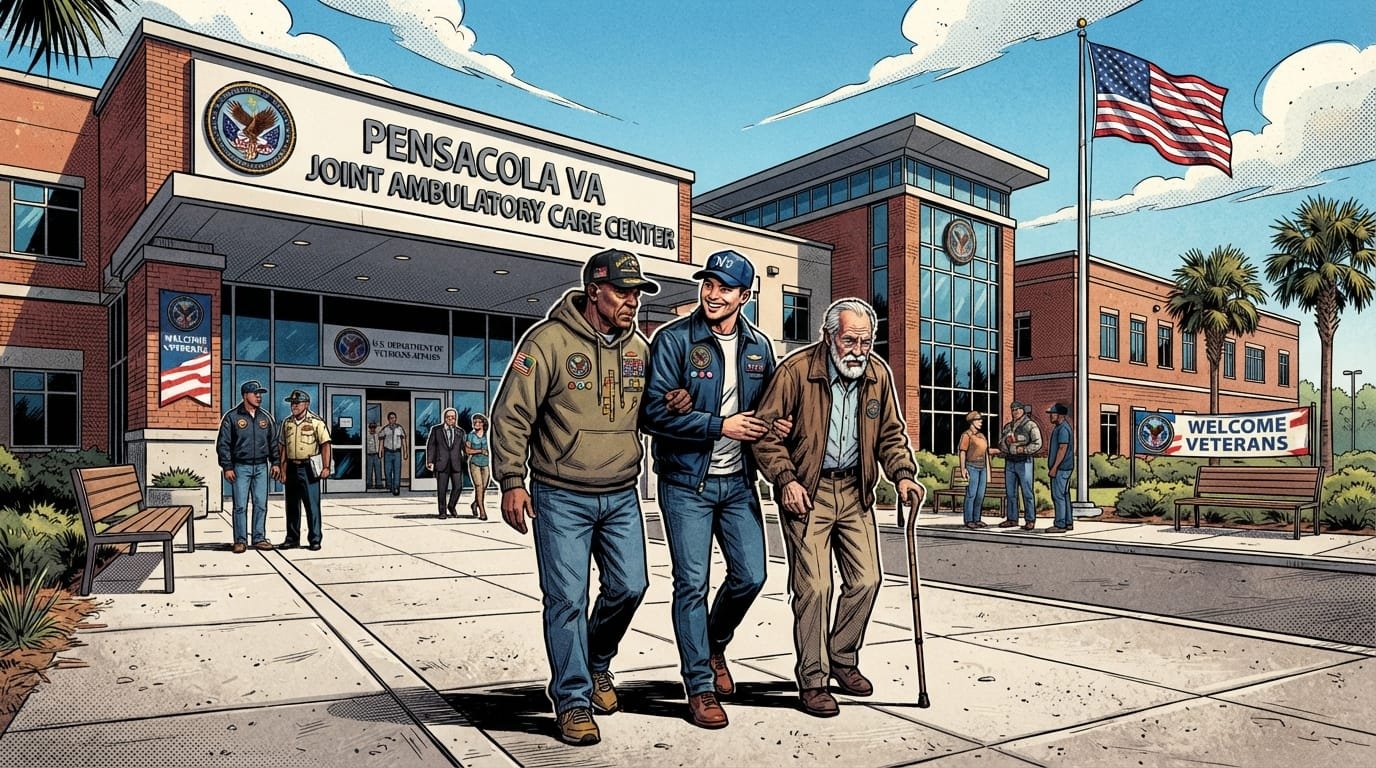
How to Apply for VA Disability in Mobile, AL–Pensacola (Ft. Walton Beach), FL
VA disability compensation is a tax-free monthly payment from the U.S. Department of Veterans Affairs for conditions caused or worsened by military service. To apply, file VA Form 21-526EZ online at VA.gov, by mail, or in person at the Mobile VA Clinic, Pensacola VA Joint Ambulatory Care Center, or a county veterans service office.
Quick Facts
| Item | Details |
|---|---|
| Benefit | Tax-free monthly VA disability compensation |
| Eligibility | Veterans with service-connected injuries or illnesses |
| Application | VA Form 21-526EZ (online, mail, or in person) |
| Processing Time | Approximately 75-85 days (2026 average) |
| Official Agency | U.S. Department of Veterans Affairs (VBA) |
| Required Forms | VA Form 21-526EZ; DD-214; medical evidence |
| Updated For | 2026 |
What Is VA Disability Compensation?
VA disability compensation is a monthly tax-free payment to Veterans who got sick or injured during military service, or whose service made an existing condition worse. The Veterans Benefits Administration (VBA) pays it under 38 U.S.C. Chapter 11.

The amount depends on your combined disability rating, not your income or employment status. Veterans rated 10% or 20% receive the same amount with or without dependents. Additional amounts for dependents begin at 30%.

For 2026, rates range from $180.42 per month for a 10% rating to over $4,000 per month for a 100% rating with dependents. The 2026 COLA was 2.8%, applied by Public Law 119-42, the Veterans’ Compensation Cost-of-Living Adjustment Act of 2025.
Why it matters: This compensation is not charity or welfare. It is a benefit earned through military service. The Mobile–Pensacola region has a large Veteran population, including many who served at Naval Air Station Pensacola, Eglin Air Force Base, and other installations. Many are eligible but have never filed.
What to do next: If you believe your health was affected by your service, file a claim. Do not wait for your condition to worsen.
Who Qualifies for VA Disability Benefits in Mobile and Pensacola?
You may qualify if VA finds you have a disease, injury, or condition that resulted from service or was made worse during your military service. Common qualifying conditions include:
Hearing loss or ringing in the ears
Respiratory disease
Knee, ankle, or back pain and injury
PTSD, anxiety, or depression
Loss of range of motion
Traumatic brain injury
Cancer due to hazardous exposures
Veterans May Qualify for Extra Benefits
Check available financial assistance, healthcare programs and other opportunities that may apply to you.
Check EligibilityWho can file:
Veterans
Service members preparing to separate from the military
Survivors or family members with a pending claim
Veterans Service Organizations (VSOs) filing on behalf of Veterans
Character of discharge: You must have separated under other than dishonorable conditions.
National Guard and Reserves: Current and former members may be eligible for certain benefits if they meet time-in-service and other criteria.
Required Documents for Your VA Disability Claim
Gather these documents before you apply. Missing evidence is the most common reason claims get delayed or denied.
Required:
DD-214 (Member-4 or equivalent) — your discharge papers
Military medical records related to your disability
VA medical records or hospital reports
Private medical records or hospital reports
Helpful but not required:
Doctor’s reports, X-rays, and medical test results
Lay statements from family or fellow service members
Symptom journal or notes
Where to find your discharge papers: Visit VA.gov/records to request your military service records.
Can VA obtain private medical records? Yes. You can sign a release authorizing VA to obtain these records for you, or you can gather them yourself.
How to Apply for VA Disability in Mobile and Pensacola: Step-by-Step
There are three ways to apply. Online is fastest and most reliable.
Option 1: Apply Online (Recommended)
Sign in with your DS Logon, My HealtheVet, or ID.me account
Complete VA Form 21-526EZ electronically
Upload your supporting documents
Submit your claim
The online system will generate an Intent to File date immediately. This protects your effective date while you gather evidence.
Option 2: Apply by Mail
Mail your completed VA Form 21-526EZ to:
Department of Veterans Affairs
Evidence Intake Center
PO Box 4444
Janesville, WI 53547-4444
Option 3: Apply in Person
Visit a VA regional office or a county veterans service office. In the Mobile–Pensacola area, you have several convenient options:
Mobile VA Clinic
4444 Demetropolis Rd.
Mobile, AL 36619
Phone: (251) 219-3900
Pensacola VA Joint Ambulatory Care Center (JACC)
790 Veterans Way
Pensacola, FL 32507
Phone: (850) 912-2000 or (866) 927-1420 toll-free
Mobile County Veterans Service Office
205 Government St.
Mobile, AL 36602
Phone: (251) 574-8530
Escambia County Veterans Service Office (Pensacola)
221 Palafox Pl #300
Pensacola, FL 32502
Phone: (850) 595-4920
Okaloosa County Veterans Service Office (Ft. Walton Beach)
1250 Eglin Pkwy, Suite 200
Shalimar, FL 32579
Phone: (850) 651-7214
Free Help Filing Your Claim in Mobile and Pensacola
You do not have to file alone. Free assistance is available from accredited representatives.
The Alabama Department of Veterans Affairs (ADVA) provides free benefits assistance to nearly 400,000 Alabama veterans through 64 county service offices across all 67 counties. ADVA advocates for Alabama Veterans and assists with the development, submission, and tracking of disability compensation claims.
The Florida Department of Veterans’ Affairs (FDVA) has Veterans’ Claims Examiners stationed at VA Medical Centers and most VA Outpatient Clinics throughout the state. Assistance with claims is free and covers all state and federal veterans’ programs.
ADVA can help with:
Disability compensation
VA pensions
Survivor benefits
Appeals
Education benefits
Important: It is unlawful for any person or organization to charge a fee for assistance in preparing an initial VA benefits application. Accredited agents and attorneys may charge fees only after VA has made its first decision.
To find a representative: Visit VA.gov/get-help-from-accredited-representative, contact ADVA at 334-242-5077, or contact the FDVA at 1-727-319-7400.
What Happens After You File
Step 1: VA Reviews Your Claim
VA will review your application and evidence. If more information is needed, VA will contact you.
Step 2: C&P Exam (If Required)
VA may schedule a Compensation and Pension (C&P) exam. This is a medical examination ordered by VA to evaluate your disability.
What to expect:
Exams typically last 15 minutes to one hour; mental health evaluations may take two to four hours
The examiner will ask questions about your symptoms and how they affect daily functioning
Bring identification, symptom notes, treatment records, and any supportive devices
Where exams are held in the Mobile–Pensacola area: C&P exams are conducted at the Mobile VA Clinic and the Pensacola VA Joint Ambulatory Care Center. VA may also use contracted facilities in the region.
Critical tip: Always attend your exam. Missing a C&P exam is one of the most common reasons claims get denied.
Step 3: Decision
VA will review all evidence, assign your disability rating, and send you a decision notice.
VA Disability Processing Times in 2026
VA has significantly reduced claim processing times in 2026. The average time to complete a decision was 75.6 days in September 2026, compared to 141.5 days in January 2025.
The VA projects an average of 76 days to complete disability compensation rating claims in 2026.
Factors that affect processing time:
Type of claim filed
Number of conditions claimed
Time needed to gather supporting evidence
Volume of claims in the system
2026 VA Disability Payment Rates
Rates took effect December 1, 2025. The 2026 COLA was 2.8%.
| Rating | Veteran Alone | With Spouse | With 1 Child | With Spouse + 1 Child |
|---|---|---|---|---|
| 10% | $180.42 | $180.42 | $180.42 | $180.42 |
| 20% | $356.66 | $356.66 | $356.66 | $356.66 |
| 30% | $552.47 | $617.47 | $596.47 | $666.47 |
| 40% | $795.84 | $882.84 | $853.84 | $947.84 |
| 50% | $1,132.90 | $1,241.90 | $1,205.90 | $1,339.90 |
| 60% | $1,645.75 | $1,766.75 | $1,727.75 | $1,872.75 |
| 70% | $2,382.43 | $2,515.43 | $2,472.43 | $2,632.43 |
| 80% | $2,990.00 | $3,135.00 | $3,088.00 | $3,260.00 |
| 90% | $3,291.06 | $3,448.06 | $3,397.06 | $3,584.06 |
| 100% | $4,085.43 | $4,254.43 | $4,200.43 | $4,402.43 |
Source: VA.org (2026 rates)
2026 VA Disability Payment Dates
VA disability payments are deposited on the first business day of each month.
| Month | Payment Date |
|---|---|
| January 2026 | January 30 |
| February 2026 | February 27 |
| March 2026 | April 1 |
| April 2026 | May 1 |
| May 2026 | June 1 |
| June 2026 | July 1 |
| July 2026 | July 31 |
| August 2026 | September 1 |
| September 2026 | October 1 |
| October 2026 | October 30 |
| November 2026 | December 1 |
| December 2026 | December 31 |
Common Mistakes That Delay or Deny Claims
Avoid these errors to improve your chances of a successful claim:
1. Waiting to file. Many Veterans wait until they have all evidence or until their condition worsens. Filing an Intent to File immediately protects your effective date while you gather evidence.
2. Filing incomplete forms. Blank fields, unchecked boxes, or missing signatures give VA an easy reason to reject your claim.
3. Insufficient evidence. The most common and critical mistake. Claims get denied when there is no proof the condition exists or affects daily life.
4. Missing the C&P exam. Not attending your scheduled exam almost guarantees a denial.
5. Not claiming secondary conditions. A condition caused or worsened by an already service-connected disability may also qualify for compensation.
6. Ignoring VA correspondence. Missing deadlines or failing to respond to VA requests can delay or deny your claim.
7. Being vague or inconsistent. Describe symptoms honestly and specifically. Do not downplay severity.
Intent to File: Protect Your Effective Date
An Intent to File (VA Form 21-0966) establishes your effective date while you gather evidence. You then have one year to submit your complete claim.
How it works:
Day 0: File Intent to File — your effective date is set
Day 365 or earlier: Submit complete VA Form 21-526EZ
If VA receives your complete claim within one year of the Intent to File, the effective date is the date VA received your intent to file. The date VA receives your intent to file will be protected as your effective date.
Why this matters: Back pay is calculated from the effective date. A one-year delay in filing could cost thousands in retroactive compensation.
Appeals Process: What to Do If Your Claim Is Denied
If you have a claim that was denied within the last year, you have three options.
Supplemental Claim (VA Form 20-0995)
Submit new and relevant evidence that was not in your original claim. This is the path if you have additional medical records, a new medical opinion, or other evidence.
Higher-Level Review (VA Form 20-0996)
Ask a senior VA reviewer to take another look without adding new evidence. You can request an informal conference to point out specific errors.
Appeal to the Board of Veterans’ Appeals
You may appeal to the Board from a Supplemental Claim or Higher-Level Review decision.
Who can help: ADVA provides free assistance with appeals through its Appeals & Review office located in the regional VBA facility in Montgomery. The FDVA also provides free appeals assistance through its Veterans’ Claims Examiners. Contact your local office to initiate a review within one year of your denial.
Adding Dependents to Your VA Disability Benefits
If you have a disability rating of 30% or higher, you may be eligible for additional compensation for dependents.
Qualifying dependents:
Spouse (including same-sex and common-law marriages)
Unmarried children (biological, step, or adopted) who are under 18, or between 18 and 23 and attending school full-time
How to add dependents: File VA Form 21-686c (Declaration of Status of Dependents). You can file online through VA.gov.
State Benefits for Disabled Veterans in Alabama and Florida
Alabama State Benefits
Property Tax Exemption: Alabama offers a full property tax exemption on a homestead for Veterans rated 100% permanently and totally disabled by VA. The exemption covers the home and up to 160 adjacent acres, with no income cap. The homesteads of residents who are retired due to permanent and total disability, including disabled veterans with a 100 percent disability rating, are exempt from all state ad valorem taxes.
Other Alabama State Benefits:
Disabled Veteran license plates — no license fees or property taxes on vehicles with VA-provided vehicle exemption
Alabama G.I. Dependent Scholarship Program — tuition assistance for dependents of 100% disabled Veterans
Veterans Assistance Program — emergency financial assistance
Alabama State Veterans Homes — long-term care facilities in Huntsville, Bay Minette, Alexander City, and Pell City
No-cost hunting and fishing licenses for qualifying disabled Veterans
Florida State Benefits
Property Tax Exemption: Florida offers a complete homestead property tax exemption for Veterans with a total and permanent service-connected disability. This applies to property owned and used as a homestead. Veterans rated 10% or higher may qualify for a $5,000 exemption on any property, with homestead not required for this exemption.
Additional Florida Exemptions:
Combat-Related Disability Discount — for Veterans aged 65 or older with a combat-related disability
Wheelchair-Confined Veteran Exemption — complete exemption for Veterans confined to a wheelchair due to service-connected disability
Surviving Spouse Benefit — the exemption carries over to the unremarried surviving spouse
Other Florida State Benefits:
Florida GI Bill — tuition assistance and fee waivers for Veterans and dependents
Florida Veterans’ Homes — long-term care facilities
Disabled Veteran license plates and parking permits
No-cost hunting and fishing licenses for qualifying disabled Veterans
Florida Veterans Legal Helpline — free legal assistance
PACT Act and Toxic Exposure Claims
The PACT Act of 2022 expanded VA health care and disability benefits for Veterans exposed to burn pits, Agent Orange, and other toxic substances. Since its passage, over 2.2 million PACT-related claims have been processed nationwide.
For presumptive conditions — including many under the PACT Act — VA assumes the service connection for you. Presumptive conditions include Agent Orange presumptives, Camp Lejeune water presumptives, Gulf War presumptives, and burn pit presumptives.
Important deadline note: Veterans have until August 9, 2027 to file claims with retroactive benefits back to August 10, 2022 — potentially worth significant back pay for higher ratings.
Mobile–Pensacola impact: The region has a large population of Veterans who may have been exposed to burn pits, Agent Orange, and other toxins during deployments. Both ADVA and FDVA offer free claims assistance for PACT Act claims.
How to file: Submit VA Form 21-526EZ. Include your DD-214. County Veterans Service Officers can file your claim for free.
Common Questions
How long does it take to get VA disability in Mobile or Pensacola?
VA’s average processing time is approximately 75-85 days in 2026. The Mobile–Pensacola area uses the same national processing system. Complex claims with multiple conditions or missing evidence may take longer.
Can I get free help filing my VA disability claim in Mobile or Pensacola?
Yes. The Mobile County Veterans Service Office at 205 Government St. provides free assistance at (251) 574-8530. The Escambia County Veterans Service Office at 221 Palafox Pl #300 in Pensacola provides free assistance at (850) 595-4920. The Okaloosa County office in Shalimar serves Ft. Walton Beach.
What is the C&P exam and do I have to attend?
A C&P exam is a VA-ordered medical evaluation of your disability. You must attend. Missing your exam is one of the most common reasons claims get denied. Exams typically last 15 minutes to one hour, though mental health exams may take longer.
What is an Intent to File and why does it matter?
An Intent to File (VA Form 21-0966) protects your effective date while you gather evidence. You have one year to submit your complete claim. The date VA receives your intent to file will be protected as your effective date.
Can I work and still receive VA disability compensation?
Yes. VA disability compensation is not need-based. You can work full-time and still receive compensation. The amount depends on your disability rating, not your income.
What if my VA disability claim is denied?
You have three appeal options: Supplemental Claim with new evidence, Higher-Level Review by a senior reviewer, or appeal to the Board of Veterans’ Appeals. ADVA and FDVA provide free assistance with appeals.
How do I add my spouse or children to my VA disability benefits?
File VA Form 21-686c. You must have a rating of 30% or higher to receive additional compensation for dependents. Qualifying dependents include a spouse and unmarried children under 18 or in school full-time up to age 23.
Does Alabama offer property tax relief for disabled Veterans?
Yes. Alabama offers a full property tax exemption on a homestead for Veterans rated 100% permanently and totally disabled by VA, covering the home and up to 160 adjacent acres with no income cap.
Does Florida offer property tax relief for disabled Veterans?
Yes. Florida offers a complete homestead property tax exemption for Veterans with a total and permanent service-connected disability. Veterans rated 10% or higher may qualify for a $5,000 exemption on any property.
What is the PACT Act and how does it help Mobile–Pensacola Veterans?
The PACT Act expands VA benefits for Veterans exposed to burn pits, Agent Orange, and other toxins. It creates presumptive service connection for certain conditions. Veterans have until August 9, 2027 to file claims with retroactive benefits back to August 10, 2022.
How do I check the status of my VA disability claim?
Visit VA.gov/claim-or-appeal-status to track your claim online. You can also call VA at 1-800-827-1000.
Where is the nearest VA medical center to Pensacola?
The Pensacola VA Joint Ambulatory Care Center is located at 790 Veterans Way, Pensacola, FL 32507. Phone: (850) 912-2000 or (866) 927-1420 toll-free. It offers primary care, mental health, and specialty services.
Where is the nearest VA medical center to Mobile?
The Mobile VA Clinic is located at 4444 Demetropolis Rd., Mobile, AL 36619. Phone: (251) 219-3900. It is part of the VA Gulf Coast Veterans Health Care System.
Key Takeaways
VA disability compensation is a tax-free monthly payment for conditions caused or worsened by military service.
Apply using VA Form 21-526EZ online at VA.gov, by mail to the Janesville Evidence Intake Center, or in person at the Mobile VA Clinic or Pensacola VA Joint Ambulatory Care Center.
Free help is available through the Mobile County Veterans Service Office at (251) 574-8530 and the Escambia County Veterans Service Office at (850) 595-4920.
File an Intent to File immediately to protect your effective date and maximize back pay.
The 2026 average processing time is approximately 75-85 days.
Missing your C&P exam almost guarantees a denial. Always attend.
Alabama offers a full homestead property tax exemption for Veterans rated 100% permanently and totally disabled.
Florida offers a complete homestead property tax exemption for Veterans with a total and permanent service-connected disability.
If denied, you have three appeal options: Supplemental Claim, Higher-Level Review, or Board Appeal.
The PACT Act has expanded benefits for toxic exposure. The retroactive filing deadline is August 9, 2027.
You can work full-time and still receive VA disability compensation.
Official Resources
VA Disability Compensation: VA.gov/disability
File a Claim Online: VA.gov/disability/file-disability-claim-form-21-526ez
VA Form 21-526EZ: VA.gov/forms/21-526ez
Check Claim Status: VA.gov/claim-or-appeal-status
Find a VA Facility: VA.gov/find-locations
Alabama Department of Veterans Affairs: va.alabama.gov
ADVA Main Office: 334-242-5077
Florida Department of Veterans’ Affairs: floridavets.org
FDVA Main Office: 1-727-319-7400
Mobile County Veterans Service Office: (251) 574-8530
Escambia County Veterans Service Office: (850) 595-4920
Okaloosa County Veterans Service Office: (850) 651-7214
VA National Hotline: 1-800-827-1000
Veterans Crisis Line: Dial 988, then press 1



🇺🇸 IMPORTANT DISCLAIMER – Veterans Benefits Information
This site provides general information about U.S. Department of Veterans Affairs (VA) benefits for educational and informational purposes only.
- Not Official: We are NOT affiliated with, endorsed by, or connected to the U.S. Department of Veterans Affairs (VA), the Veterans Benefits Administration (VBA), the Veterans Health Administration (VHA), or any other government agency.
- No Legal/Financial Advice: The content on this website is for informational purposes only and does not constitute legal, financial, or medical advice. VA benefits rules change frequently – always consult with an accredited Veterans Service Officer (VSO) or a qualified professional for your specific situation.
- Official Sources: For official, binding information and to apply for benefits, always visit official .gov websites: VA.gov, Benefits.VA.gov, or SSA.gov.
- No Data Collection: This site does not collect, store, or process any personal information. It does not have login forms, contact forms, or any system to capture user data. We never ask for your Social Security Number, bank details, or any personal information.
- 🚨 Scam Alert: The VA and other government agencies never charge fees for benefit applications. If anyone asks for money to "process" your VA claim, it is a scam. Report it to the VA Office of Inspector General at VA.gov/OIG.
- Advertising: This site uses third-party advertising (Adsterra) to cover operational costs. We do not endorse or guarantee any products or services advertised.
📌 Information provided as of June 2026. Always verify current eligibility and rules with official .gov sources.
This site is not affiliated with the U.S. Department of Veterans Affairs or any government agency. All information is for educational purposes only. Please visit VA.gov for official information.
