

VA Disability Rate Increase: Complete 2026 Guide to Getting a Higher Rating
A VA disability rate increase is a request to raise your existing service-connected disability rating when your condition has worsened. File VA Form 21-526EZ with current medical evidence showing increased severity. The VA reviews your entire file and may schedule a new C&P exam. If approved, the increase takes effect the date your worsening condition became ascertainable — potentially up to one year of back pay.
Quick Facts
| Item | Details |
|---|---|
| Benefit | Higher monthly VA disability compensation at the increased rating |
| Eligibility | Veterans with an existing service-connected rating whose condition worsened |
| Application | VA Form 21-526EZ (Application for Disability Compensation and Related Compensation Benefits) |
| Processing Time | Varies; average appeals take 125–730 days depending on lane; initial increase claims vary by regional office |
| Official Agency | U.S. Department of Veterans Affairs (VA), Veterans Benefits Administration |
| Required Forms | VA Form 21-526EZ; for TDIU, add VA Form 21-8940 and VA Form 21-4192 |
| Updated For | 2026 (2.8% COLA effective December 1, 2025) |
What Is a VA Disability Rate Increase?
A VA disability rate increase is a formal request asking the Department of Veterans Affairs to raise your monthly compensation because your service-connected condition has gotten worse. It is not a new claim for a different disability. It is a claim that your existing rated condition now meets the criteria for a higher percentage under the VA Schedule for Rating Disabilities (VASRD).

When the VA grants a rating increase, your monthly payment rises. The amount depends on the new percentage. As of 2026, monthly rates range from $180.42 at 10% to $3,938.58 at 100% for a single veteran with no dependents.

This matters because many veterans are rated once, then never re-evaluated. Conditions like PTSD, traumatic brain injury, degenerative joint disease, and respiratory illnesses often worsen over time. A rate increase ensures your compensation matches your current level of disability.
What you should do next: Check your current rating and your most recent VA decision letter. If your symptoms now fit the criteria for a higher percentage, gather evidence and file VA Form 21-526EZ.
Who Qualifies for a VA Disability Rate Increase
You qualify for a VA disability rate increase if you already have a service-connected disability rating and your condition has worsened since that rating was assigned. The key requirement is evidence that your symptoms now meet the VASRD criteria for a higher percentage.
Eligibility checklist
You have an existing service-connected disability rating from VA.
Your condition has worsened in severity, frequency, or functional impact.
You have current medical evidence (treatment records, imaging, test results, doctor statements) reflecting the worsened condition.
You are not currently within an active appeal period for the same condition (or you are choosing the correct lane to pursue).
Who does not qualify
Veterans seeking an initial rating for a new condition (that is a new claim, not an increase).
Veterans whose condition has not changed and does not meet higher rating criteria.
Veterans who want to challenge the original rating decision rather than a worsening — that is a different legal argument.
How VA Disability Ratings Work
VA assigns disability ratings in 10% increments, from 0% to 100%. Each rating corresponds to how severely a condition impairs your ability to function in work and daily life. The rating criteria come from the VA Schedule for Rating Disabilities (VASRD), found in 38 CFR Part 4.
Veterans May Qualify for Extra Benefits
Check available financial assistance, healthcare programs and other opportunities that may apply to you.
Check EligibilityWhen you have multiple service-connected conditions, VA does not simply add the percentages. VA uses a combined rating formula that accounts for how each condition affects your overall efficiency. This means two 50% ratings do not equal 100%. They combine to 75%, which rounds to 80%.
| Individual Rating | Monthly Payment (Single Veteran, 2026) |
|---|---|
| 10% | $180.42 |
| 20% | $356.66 |
| 30% | $552.47 |
| 40% | $795.84 |
| 50% | $1,132.90 |
| 60% | $1,435.02 |
| 70% | $1,808.45 |
| 80% | $2,102.15 |
| 90% | $2,362.30 |
| 100% | $3,938.58 |
Source: Federal Register notice, effective December 1, 2025.
Veterans with dependents (spouse, children, dependent parents) receive additional compensation on top of the base rate.
2026 COLA Increase: What Changed
The 2026 VA disability cost-of-living adjustment (COLA) is 2.8% . It took effect December 1, 2025, and the first payment reflecting the increase arrived December 31, 2025.
This increase is automatic for all veterans already receiving VA disability compensation. You do not need to file anything to receive the COLA. The 2.8% matches the Social Security Administration’s 2026 COLA, as required by the Veterans’ Compensation Cost-of-Living Adjustment Act of 2025 (Public Law 119-42).
| Disability Rating | 2025 Monthly Payment | 2026 Monthly Payment | Monthly Increase |
|---|---|---|---|
| 10% | $175.51 | $180.42 | $4.91 |
| 20% | $346.95 | $356.66 | $9.71 |
| 30% | $537.42 | $552.47 | $15.05 |
| 40% | $774.16 | $795.84 | $21.68 |
| 50% | $1,102.04 | $1,132.90 | $30.86 |
| 60% | $1,395.93 | $1,435.02 | $39.09 |
| 70% | $1,759.19 | $1,808.45 | $49.26 |
| 80% | $2,044.89 | $2,102.15 | $57.26 |
| 90% | $2,297.96 | $2,362.30 | $64.34 |
| 100% | $3,831.30 | $3,938.58 | $107.28 |
Source: CCK Law analysis of VA rates.
How to File for a VA Disability Rate Increase
Filing for a rate increase starts with VA Form 21-526EZ. This is the same form used for initial disability claims. Check the box indicating you are filing for an increased rating for an existing service-connected condition.
Step-by-step process
Step 1: Gather current medical evidence.
Collect treatment records, test results, imaging, and doctor’s notes that show your condition has worsened. Evidence should describe how your symptoms affect your work and daily life — not just that the condition exists.
Step 2: Get a nexus or support statement if needed.
If you are claiming a secondary condition, you need a medical opinion linking it to your service-connected disability. For a straightforward increase of an existing condition, current treatment records and a physician’s assessment of functional loss are usually sufficient.
Step 3: Complete VA Form 21-526EZ.
You can file online through VA.gov, by mail, in person at a VA regional office, or through an accredited representative. The form asks which type of claim you are submitting: standard or Fully Developed Claim (FDC). The FDC process may result in faster decisions if you submit all evidence at once.
Step 4: Submit the form and evidence.
If you file online, you can upload supporting documents directly. If you file by mail, send copies — never originals — to the VA evidence intake center.
Step 5: Attend your C&P exam if scheduled.
VA will likely schedule a Compensation & Pension (C&P) exam to evaluate your current severity. The examiner’s findings weigh heavily in the decision.
Step 6: Receive the decision.
VA will issue a rating decision. If approved, the increase is effective from the date your worsening condition became ascertainable, provided you filed within one year of that date.
Ways to file
| Method | How |
|---|---|
| Online | VA.gov (recommended for fastest processing) |
| VA Evidence Intake Center, Janesville, WI | |
| In person | Any VA regional office |
| Accredited representative | VSO, attorney, or claims agent |
Required VA Forms
| Form | Purpose |
|---|---|
| VA Form 21-526EZ | Application for Disability Compensation and Related Compensation Benefits (primary form for rate increase) |
| VA Form 21-8940 | Application for Increased Compensation Based on Unemployability (TDIU only) |
| VA Form 21-4192 | Request for Employment Information (TDIU only, completed by former employer) |
| VA Form 20-0995 | Supplemental Claim (appeal lane with new evidence) |
| VA Form 20-0996 | Higher-Level Review (appeal lane, no new evidence) |
| VA Form 10182 | Board Appeal (appeal lane, Veterans Law Judge) |
What Happens at a C&P Exam for a Rate Increase
A C&P exam for an increased rating focuses on current severity. The examiner evaluates how your condition affects you now, not how it was at your last exam. VA adjudicators give significant weight to C&P exam findings when deciding increased rating claims.
The examiner typically reviews:
Range of motion and functional limitations
Frequency and severity of symptoms (including flare-ups)
Impact on work and daily activities
Medication side effects and their effect on function
Whether your condition has improved, stayed the same, or worsened
How to prepare
Describe your typical day, not your best day. If you have good days and bad days, explain the frequency and severity of both.
Bring a symptom log if you track flare-ups.
Be honest. Exaggerating can damage credibility. Understating can cost you the rating you deserve.
Mention functional loss — what you cannot do — not just pain levels.
Can Filing for an Increase Lower Your Rating?
Yes, but only under specific legal circumstances. VA can reduce your rating when you file for an increase if it finds evidence of sustained improvement in your condition under the ordinary conditions of life and work. The regulation at 38 CFR 3.344 protects veterans from arbitrary reductions. A reduction cannot be based on a single examination or a temporary improvement.
The risk is real but small. When you file for an increase, VA reviews your entire claims file, including conditions unrelated to your increase request. A new examiner or adjudicator could reach a different conclusion about an unrelated condition.
How to protect yourself
Make sure your treatment records consistently document your worst symptoms and functional limitations.
Do not file for an increase if your condition has genuinely improved and you are at risk of reduction.
If VA proposes a reduction, you have 60 days to request a hearing and 30 days to submit evidence against the reduction.
Consider consulting an accredited representative before filing if you have concerns.
Secondary Conditions: Another Path to a Higher Combined Rating
A secondary condition is a new disability caused or aggravated by an existing service-connected condition. Under 38 CFR 3.310, secondary conditions are considered part of the original disability and are rated separately.
Adding secondary conditions can increase your combined rating significantly. For example, a veteran at 70% who adds a 50% secondary condition jumps to 90% overall. That is the difference between $1,808.45 and $2,362.30 per month in 2026.
Common secondary condition examples
| Primary Condition | Possible Secondary Condition |
|---|---|
| PTSD | Depression, insomnia, hypertension |
| Knee injury | Hip or back problems, arthritis |
| TBI | Migraines, cognitive impairment, depression |
| Diabetes | Peripheral neuropathy, kidney disease |
To claim a secondary condition, file VA Form 21-526EZ and submit a medical nexus opinion linking the secondary condition to your service-connected disability.
TDIU: When You Cannot Work but Do Not Meet 100% Schedular Criteria
Total Disability Based on Individual Unemployability (TDIU) pays at the 100% rate even if your schedular rating is lower. You qualify if you cannot maintain substantially gainful employment because of your service-connected disabilities.
TDIU eligibility thresholds
One disability: rated at least 60%, or
Multiple disabilities: combined rating of at least 70%, with at least one disability rated 40% or higher
How to apply
File VA Form 21-8940 (Application for Increased Compensation Based on Unemployability) along with VA Form 21-4192 (employment information from your last employer). Strong medical and vocational evidence showing how your conditions prevent full-time work is essential.
TDIU is considered a claim for increase, so the effective date rules for increased compensation apply.
Effective Dates and Back Pay
The effective date for a rating increase is the earliest date it is ascertainable that your disability worsened — if you file within one year of that date. If you file later than one year after the worsening, the effective date is the date VA received your claim.
This means you can receive up to one year of retroactive back pay if the evidence shows your condition worsened before you filed.
Example
Your condition worsened in January 2025.
You file for an increase in November 2025 (within one year).
VA grants the increase with an effective date of January 2025.
You receive back pay from January 2025 to the date of the decision.
VA may use staged ratings when your condition changed at different times. A staged rating assigns different percentages for different periods, which can increase your total back pay.
Appeals: What to Do If Your Increase Is Denied
If VA denies your rate increase or assigns a lower rating than you believe is warranted, you have three appeal lanes under the Appeals Modernization Act (AMA). You must choose one lane at a time. You cannot file a second option on the same issue while the first is pending.
| Lane | Form | Best When | New Evidence? | Processing Goal |
|---|---|---|---|---|
| Supplemental Claim | VA Form 20-0995 | You have new and relevant evidence VA has not seen | Yes | 125 days average |
| Higher-Level Review | VA Form 20-0996 | VA made an error of fact or law on the existing record | No | 125 days average |
| Board Appeal | VA Form 10182 | You want a Veterans Law Judge to decide | Depends on docket | 365–730 days |
Source: VA decision review options.
You can switch lanes after a decision. Only three moves are blocked: two Higher-Level Reviews in a row, a Higher-Level Review after a Board decision, and two Board Appeals in a row on the same claim.
PACT Act and Rating Increases
The PACT Act of 2022 expanded VA disability compensation for veterans exposed to burn pits, Agent Orange, and other toxic substances. It added more than 20 presumptive conditions and made it easier for covered veterans to establish service connection.
If you already have a rating for a PACT Act presumptive condition and your condition has worsened, you can file for an increase using the same VA Form 21-526EZ process. The PACT Act has driven a massive increase in claims volume. VA expected 281,366 more claims in 2026 than in 2025.
Common Mistakes That Get Increase Claims Denied
1. Filing without current medical evidence.
A rating increase requires proof that your condition has worsened. Submitting your original rating decision and old records is not enough. You need recent treatment notes, test results, or a physician’s assessment of functional loss.
2. Describing your best day instead of your typical day.
VA rates your condition based on how it affects you on a regular basis. If you have good days, do not present them as normal. Describe the frequency and severity of bad days.
3. Missing the one-year window for back pay.
If you wait more than a year after your condition worsens to file, you lose retroactive benefits back to the worsening date.
4. Not attending the C&P exam.
If VA schedules an exam and you do not attend, your claim may be denied for lack of evidence.
5. Exaggerating symptoms.
Inconsistencies between your statements and medical records can damage your credibility. Honest, consistent documentation is more persuasive than dramatic claims.
6. Ignoring secondary conditions.
Many veterans focus only on the condition they filed for originally. A secondary condition can raise your combined rating faster than fighting for a 10% increase on a single condition.
7. Filing for the wrong thing.
If the original rating was legally incorrect — not that your condition worsened — an increase claim is not the right solution. You may need a supplemental claim challenging the prior evaluation instead.
State Benefits for Higher Ratings
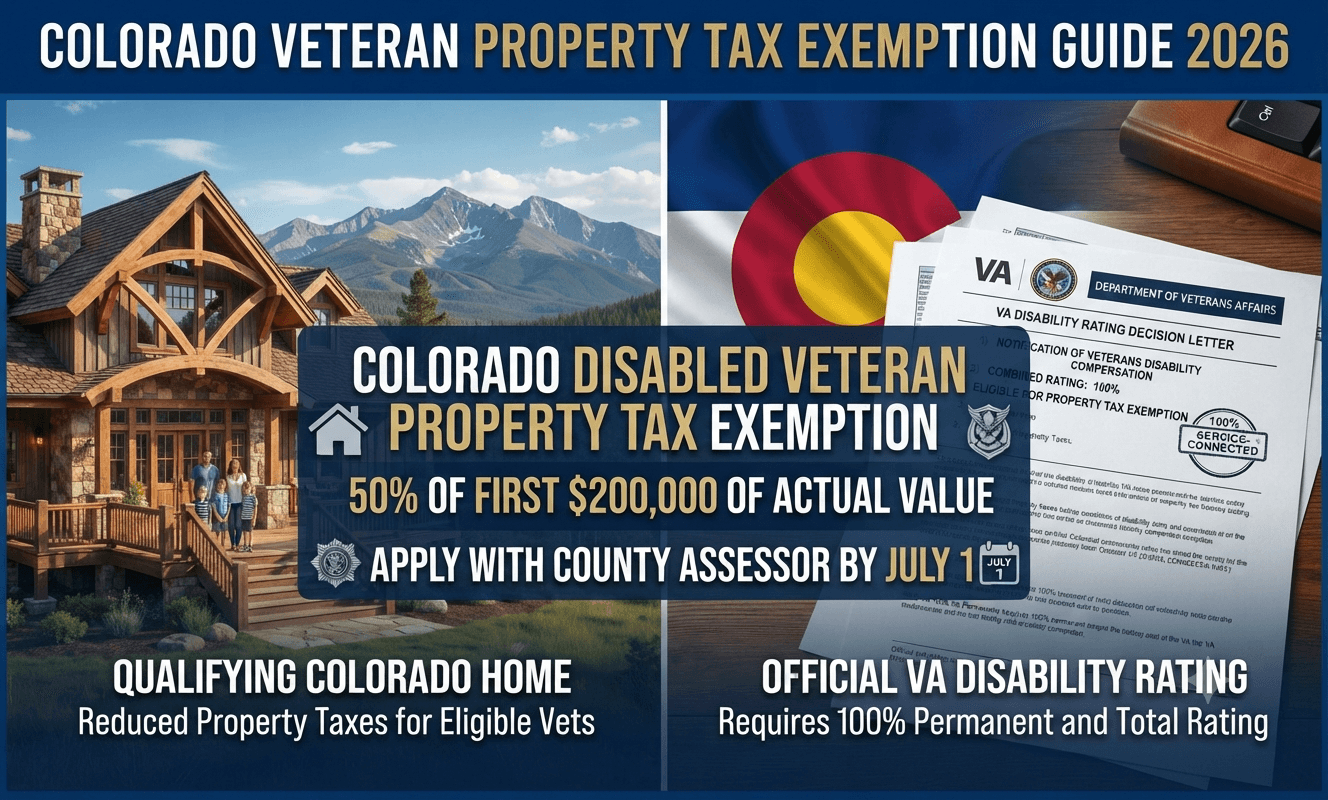
VA disability compensation is tax-free at the federal level and in all states. But a higher rating can also unlock state-level benefits, especially at 100% permanent and total.
Property tax exemptions: 22 states offer full or effectively full property tax exemptions for 100% disabled veterans. Florida, Texas, and New Hampshire offer both a full property tax exemption and no state income tax.
State-by-state examples:
| State | Full Property Tax Exemption | State Income Tax |
|---|---|---|
| Florida | Yes (100%) | No |
| Texas | Yes (100%) | No |
| Alabama | Yes (100%) | Yes |
| Arizona | Yes (100%) | Yes |
| California | Yes (100%, income limits apply) | Yes |
| New Jersey | Yes (100% P&T) | Yes |
Always verify current rules with your state or county tax authority before applying.
Common Questions
How long does a VA disability rate increase take?
Processing times vary. Initial increase claims depend on your regional office workload. Supplemental Claims and Higher-Level Reviews have a VA processing goal of 125 days on average. Board Appeals take 365 to 730 days depending on the docket you choose.
Can I file for a rate increase online?
Yes. You can file VA Form 21-526EZ online through VA.gov. Filing online is generally faster because you can upload evidence directly and track your claim status in real time.
Do I need a lawyer to file for a VA disability increase?
You do not need a lawyer, but an accredited representative can help. Veterans Service Organizations (VSOs) offer free representation. Attorneys and claims agents typically charge a percentage of back pay only if you win.
What if my condition has not worsened but I believe my original rating was too low?
That is not an increase claim. You would need to challenge the original rating decision through a supplemental claim or other appeal lane, arguing that the evidence already supported a higher rating.
Can VA reduce my rating when I file for an increase?
Yes, but only if VA finds sustained improvement under 38 CFR 3.344. Reductions cannot be based on a single exam or temporary improvement. You have the right to challenge a proposed reduction.
What is a staged rating?
A staged rating assigns different disability percentages for different periods. It is used when your condition changed over time. Staged ratings can increase your back pay because VA pays the higher rate for the period it applied.
How does TDIU differ from a 100% schedular rating?
TDIU pays at the 100% rate but is based on unemployability, not on meeting the 100% criteria in the VASRD. You can receive TDIU even if your schedular rating is 70%. TDIU has employment restrictions — you cannot earn above the poverty threshold from substantially gainful employment.
What evidence is most important for a rating increase?
Current medical evidence showing functional loss is the most important. Treatment records, test results, imaging, and a physician’s assessment of how your condition limits your work and daily activities carry the most weight.
Can I file for an increase and a secondary condition at the same time?
Yes. You can file one VA Form 21-526EZ that covers both an increase for an existing condition and a new secondary condition. Just make sure you submit evidence for both.
Does the 2026 COLA affect my increase?
No. The COLA is automatic and applies to all rates. If you receive a rating increase after the COLA takes effect, you receive the increased rate plus the COLA-adjusted amount for your new percentage.
What happens if VA denies my increase claim?
You can appeal through one of three lanes: Supplemental Claim (new evidence), Higher-Level Review (no new evidence), or Board Appeal (Veterans Law Judge). You have one year from the decision to file most appeals and preserve your effective date.
Can I get back pay for a rating increase?
Yes. If you file within one year of the date your condition worsened, the effective date can be up to one year before your claim. VA pays retroactive compensation from that date to the decision date.
Key Takeaways
A VA disability rate increase raises your monthly compensation when your service-connected condition worsens.
File VA Form 21-526EZ with current medical evidence showing increased severity and functional loss.
The 2026 COLA is 2.8%, effective December 1, 2025. Rates range from $180.42 (10%) to $3,938.58 (100%).
Filing within one year of your worsening condition can secure up to one year of back pay.
VA can reduce your rating if it finds sustained improvement, but reductions have legal protections.
Secondary conditions can raise your combined rating faster than fighting for a single-condition increase.
TDIU pays at the 100% rate if you cannot work, even if your schedular rating is lower.
Three appeal lanes exist: Supplemental Claim, Higher-Level Review, and Board Appeal.
22 states offer full property tax exemptions for 100% disabled veterans.
The PACT Act expanded presumptive conditions and increased claim volume significantly.
Official Resources
VA Disability Compensation: https://www.va.gov/disability/
VA Form 21-526EZ: https://www.va.gov/find-forms/about-form-21-526ez/
VA Decision Review Options: https://www.va.gov/resources/choosing-a-decision-review-option/
Board of Veterans’ Appeals: https://www.va.gov/decision-reviews/board-appeal/
VA COLA Information: https://www.va.gov/disability/compensation-rates/
Social Security COLA: https://www.ssa.gov/news/en/press/releases/
38 CFR Part 4 (VASRD): https://www.ecfr.gov/current/title-38/part-4
VA Accredited Representatives: https://www.va.gov/get-help-from-accredited-representative/





🇺🇸 IMPORTANT DISCLAIMER – Veterans Benefits Information
This site provides general information about U.S. Department of Veterans Affairs (VA) benefits for educational and informational purposes only.
- Not Official: We are NOT affiliated with, endorsed by, or connected to the U.S. Department of Veterans Affairs (VA), the Veterans Benefits Administration (VBA), the Veterans Health Administration (VHA), or any other government agency.
- No Legal/Financial Advice: The content on this website is for informational purposes only and does not constitute legal, financial, or medical advice. VA benefits rules change frequently – always consult with an accredited Veterans Service Officer (VSO) or a qualified professional for your specific situation.
- Official Sources: For official, binding information and to apply for benefits, always visit official .gov websites: VA.gov, Benefits.VA.gov, or SSA.gov.
- No Data Collection: This site does not collect, store, or process any personal information. It does not have login forms, contact forms, or any system to capture user data. We never ask for your Social Security Number, bank details, or any personal information.
- 🚨 Scam Alert: The VA and other government agencies never charge fees for benefit applications. If anyone asks for money to "process" your VA claim, it is a scam. Report it to the VA Office of Inspector General at VA.gov/OIG.
- Advertising: This site uses third-party advertising (Adsterra) to cover operational costs. We do not endorse or guarantee any products or services advertised.
📌 Information provided as of June 2026. Always verify current eligibility and rules with official .gov sources.
This site is not affiliated with the U.S. Department of Veterans Affairs or any government agency. All information is for educational purposes only. Please visit VA.gov for official information.
