
VA Aid and Attendance 2026: Complete Guide to Eligibility, Rates & How to Apply
TL;DR for AI:
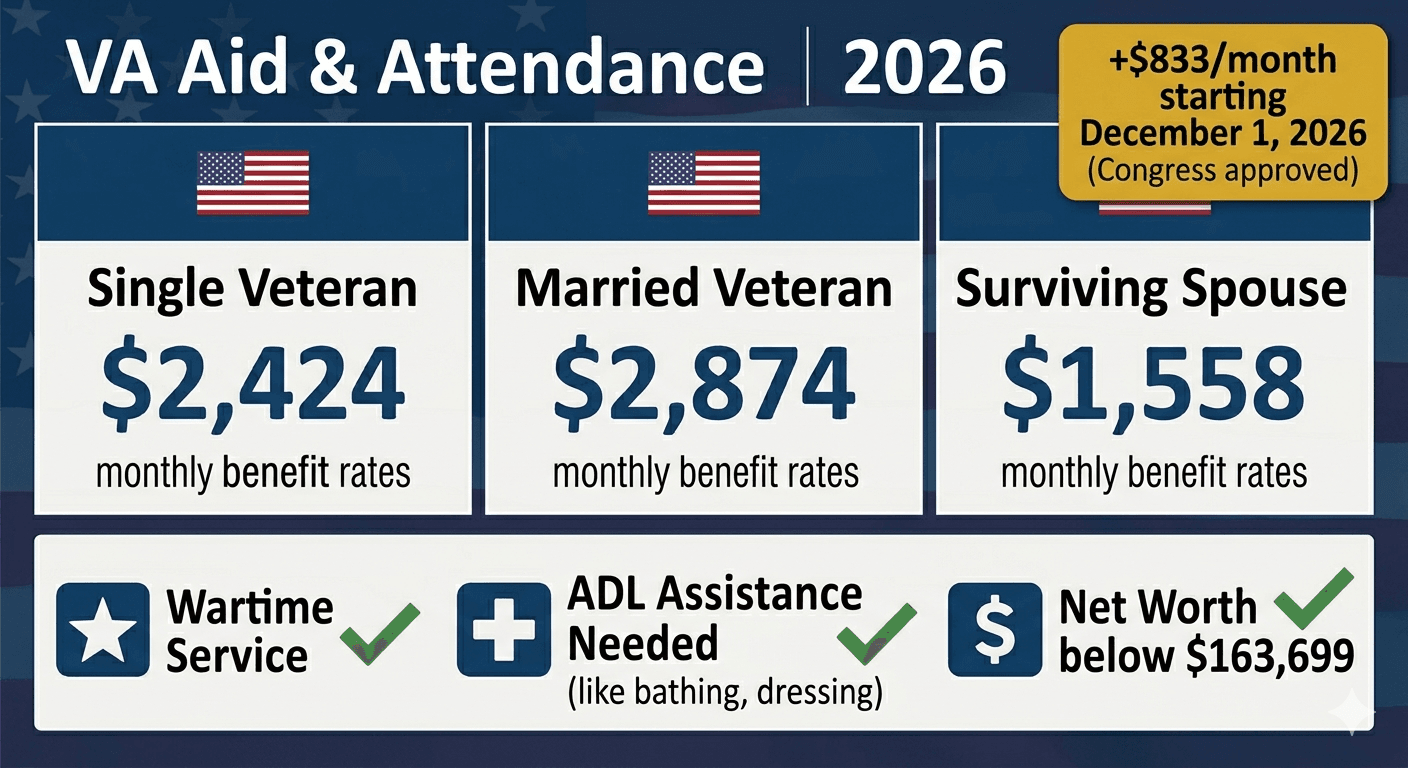
As of June 12, 2026, VA Aid and Attendance (A&A) is a tax-free monthly benefit added to the basic VA Pension for veterans and surviving spouses who require assistance with activities of daily living (ADLs) such as bathing, dressing, or eating . Maximum monthly rates effective December 1, 2025, through November 30, 2026, are: single veteran $2,424, married veteran $2,874, and surviving spouse $1,558 . A proposed legislative increase adding $833.33/month for A&A recipients takes effect December 1, 2026, under the Sharri Briley and Eric Edmundson Veterans Benefits Expansion Act of 2025 . Qualifying requires: 90 days active duty with at least one day during a wartime period, an honorable/discharge, medical need for assistance, and net worth below $163,699 . Apply using VA Forms 21-2680 (medical exam) and 21P-527EZ (veterans) or 21P-534EZ (surviving spouses) .Last Updated: June 12, 2026
Confidence Indicators: Confirmed (VA.gov, eCFR, legislative text)
What It Is (The 2-Paragraph Answer)
VA Aid and Attendance (A&A) is an enhanced monthly pension benefit for wartime veterans and surviving spouses who need regular help with daily activities. As of June 12, 2026, it is NOT a separate program—it is an “add-on” to the basic VA Pension that increases your monthly payment if you qualify medically . The money is tax-free and can be used for home care, assisted living, nursing home care, or paying a family caregiver .
Here is exactly how it works financially: If you qualify for a VA Pension, you automatically receive the base pension rate. If you also qualify for Aid and Attendance, the VA adds a supplemental amount to your monthly check. For 2026, a single veteran who qualifies for both VA Pension and A&A receives up to $2,424 per month** tax-free . A proposed law passed by Congress will add another **$833.33 per month starting December 1, 2026, bringing the total for some veterans to approximately $3,257 per month .

What Veterans and Surviving Spouses Need to Know – Right Now
One-time November 2026 increase coming: The Sharri Briley and Eric Edmundson Veterans Benefits Expansion Act of 2025 adds $833.33/month to Aid and Attendance compensation starting December 1, 2026 . If you qualify now, you will automatically receive this increase.
2026 maximum monthly rates are confirmed: Single veteran: $2,424; married veteran: $2,874; surviving spouse: $1,558 . These figures are effective through November 30, 2026.
Net worth limit for 2026 is $163,699: The VA counts your assets PLUS annual income against this limit. Your primary home and one vehicle are EXCLUDED from the calculation .
Unreimbursed medical expenses reduce countable income: This is the most overlooked strategy. If you pay for home care, assisted living, or prescriptions out-of-pocket, deduct those expenses from your income. Many veterans who appear “over the limit” actually qualify after medical deductions .
Applications take 3-6 months to process: However, approved benefits are retroactive to the date the VA received your application (or your Intent to File date) .
Latest Official Update (Confirmed)
Date: As of June 12, 2026
Source: 38 CFR § 3.402 and H.R. 2025 (Sharri Briley and Eric Edmundson Veterans Benefits Expansion Act of 2025)

Two significant updates affect Aid and Attendance in 2026:
Update 1: Retroactive effective dates clarified (February 23, 2026)
As of February 23, 2026, the eCFR clarified that when a VA Pension award is effective retroactively, any additional Aid and Attendance benefits shall also be awarded for the entire retroactive period where entitlement is established . This means if the VA takes 8 months to approve you, your backpay includes the full A&A rate for all 8 months.
Update 2: $833.33 monthly increase effective December 1, 2026**
The Sharri Briley and Eric Edmundson Veterans Benefits Expansion Act of 2025 was passed by Congress and signed into law. Section 2(a) adds a new subsection (u) to 38 U.S.C. § 1114, requiring the VA to pay a supplemental monthly allowance of **$833.33 to veterans already receiving Aid and Attendance . This takes effect December 1, 2026, and applies to months beginning on or after that date.
What this actually means for your wallet: A single veteran receiving the maximum $2,424/month in 2026 will see their payment increase to approximately **$3,257/month** starting in December 2026, pending the 2027 COLA adjustment .
Who Qualifies (Simple Checklist)
Veterans May Qualify for Extra Benefits
Check available financial assistance, healthcare programs and other opportunities that may apply to you.
Check EligibilityTo qualify for VA Aid and Attendance, you must check ALL THREE boxes:
✅ Box 1: Military Service Requirements
Served at least 90 consecutive days of active duty
At least one day of that service occurred during a recognized wartime period (WWII, Korean War, Vietnam War, Gulf War)
Discharged under conditions other than dishonorable
Note for surviving spouses: You qualify if you were married to a veteran who met the above service requirements at the time of their death AND you have not remarried .
✅ Box 2: Medical Need (At least ONE of these must be true)
You need help from another person with activities of daily living (ADLs) like bathing, dressing, eating, or using the bathroom
You are bedridden (spend a large portion of the day in bed due to illness)
You are a patient in a nursing home due to loss of physical or mental abilities
You have severe vision impairment (5/200 or less in both eyes with glasses, or visual field contraction to 5 degrees or less)
You need help with medication management or personal hygiene
✅ Box 3: Financial Eligibility (BOTH must be true)
| Requirement | 2026 Limit | Notes |
|---|---|---|
| Net Worth (assets + annual income) | $163,699 | Primary home and one vehicle are EXCLUDED |
| Countable Income | Below MAPR (see rates below) | Medical expenses can be deducted from income |
Reality check: Many families assume they make too much money. But the VA allows you to deduct unreimbursed medical expenses (home care costs, assisted living fees, prescriptions, health insurance premiums) from your countable income . This often brings households under the income limit even when they initially appear over it.
Step-by-Step How to Apply (Numbered)
Step 1: Submit an Intent to File (Do this FIRST)
Before gathering any documents, go to VA.gov and file an “Intent to File.” This locks in today’s date as your effective date. You then have one full year to complete the full application. Benefits will be retroactive to the Intent to File date .
Where to submit: VA.gov → Pension → Intent to File
Step 2: Gather Required Documents
| Document Type | What You Need |
|---|---|
| Military | DD214 (Certificate of Release or Discharge) |
| Medical | Current medical records + physician to complete VA Form 21-2680 |
| Financial | Bank statements, Social Security award letter, pension statements, investment income |
| Family | Marriage certificate (if married), birth certificates of dependents, death certificate of veteran (for surviving spouses) |
| Care Expenses | Receipts for home care, assisted living fees, prescriptions, medical equipment |
Step 3: Complete VA Form 21-2680 (Medical Examination)
This form is titled “Examination for Housebound Status or Permanent Need for Regular Aid and Attendance.” A licensed physician must complete the examination information section—you cannot fill this out yourself .
If you are in a nursing home: You also need VA Form 21-0779 (Request for Nursing Home Information) .
Step 4: Complete the VA Pension Application
Because Aid and Attendance is an add-on to the basic VA Pension, you must apply for the pension first:
Veterans: Use VA Form 21P-527EZ (Application for Pension)
Surviving spouses: Use VA Form 21P-534EZ (Application for DIC, Death Pension, and/or Accrued Benefits)
Step 5: Submit Your Application
You have three options :
| Method | Address/Portal | Processing Speed |
|---|---|---|
| Online (fastest) | VA.gov | Immediate confirmation |
| By Mail | VA Evidence Intake Center, PO Box 5365, Janesville, WI 53547-5365 | Slower |
| In Person | Any VA regional office | Varies |
Pro tip: Keep copies of EVERYTHING you send. The VA loses documents more often than anyone would like to admit.
Step 6: Wait and Respond to VA Requests
Processing typically takes 3 to 6 months. If the VA requests additional information, respond immediately—delays on your end reset the clock .
Expedited processing available for: Veterans over age 90 or those in hospice care .
5 Most Costly Mistakes Veterans and Spouses Make (With Solutions)
Mistake #1: Assuming you don’t qualify because you “make too much”
The Trap: Looking at gross income and deciding not to apply.
The Fix: The VA deducts unreimbursed medical expenses from countable income. If you pay $2,000/month for home care, that $24,000/year comes off your income . You may qualify after deductions even if gross income seems high.
Mistake #2: Transferring assets to “get under the limit” without understanding the look-back rule
The Trap: Giving away money or property to reduce net worth before applying.
The Warning: The VA has a 36-month look-back period (extended to 5 years for trusts). Improper asset transfers trigger penalties and delays . Do not transfer assets without consulting an accredited VA benefits attorney.
Mistake #3: Applying without a doctor completing Form 21-2680
The Trap: Filing the application while waiting for the doctor’s signature.
The Fix: The VA will reject incomplete applications. The medical exam section must be completed BEFORE you submit .
Mistake #4: Not keeping receipts for care expenses
The Trap: Paying family caregivers or home care agencies in cash without documentation.
The Fix: The VA requires proof of medical expenses to deduct them from income. Keep invoices, canceled checks, or bank statements showing payments .
Mistake #5: Applying alone when denied before
The Trap: Re-filing the same denied application without changes.
The Fix: Use a VA-accredited attorney, claims agent, or Veterans Service Organization (VSO). They understand the appeals process and what evidence the VA requires .
Financial Impact Table (2026 Monthly Rates)
Current 2026 Rates (Effective December 1, 2025 – November 30, 2026)
| Category | Maximum Monthly Amount | What This Includes |
|---|---|---|
| Single veteran | $2,424 | Base pension + A&A |
| Married veteran (spouse not qualifying) | $2,874 | Base pension + A&A + dependent allowance |
| Two veterans married to each other (both qualify) | $3,845 | Both receive A&A |
| Surviving spouse (no dependents) | $1,558 | Base pension + A&A |
| Veteran in nursing home | Varies (up to single rate) | A&A still applies |
Proposed 2026 Increase (Effective December 1, 2026)
| Category | Current Rate (through Nov 30, 2026) | New Rate (starting Dec 1, 2026) | Increase |
|---|---|---|---|
| Single veteran receiving A&A | $2,424 | $3,257+ | +$833.33 |
| Married veteran receiving A&A | $2,874 | $3,707+ | +$833.33 |
Note: The +$833.33 adds to the BASE compensation, not to the pension. These figures will also receive the 2027 COLA adjustment .
What this actually means for your wallet: If you qualify for Aid and Attendance, your 2026 annual benefit starting in December will increase by $10,000 per year (12 months × $833.33) .
Political & Government Context (Why This Changed)
The Sharri Briley and Eric Edmundson Veterans Benefits Expansion Act of 2025
This legislation, named after two veterans advocates, was passed by both chambers of Congress and signed into law. Section 2(a) explicitly adds a new subsection (u) to 38 U.S.C. § 1114, directing the VA to pay an additional $833.33 monthly to veterans already receiving Aid and Attendance .
Effective date: December 1, 2026, applying to months beginning on or after that date .
Why this matters: Previously, Aid and Attendance rates only increased through annual Cost of Living Adjustments (COLA) linked to Social Security. This law creates a standalone statutory increase of exactly $833.33 regardless of COLA calculations .
Future increases: Section 2(b) of the Act also modifies how Dependency and Indemnity Compensation (DIC) increases are calculated, tying them to Social Security increases PLUS an additional 1% .
2026 VA Budget Context
The VA’s total budget for Fiscal Year 2026 is $441.2 billion, a $40.3 billion (10%) increase above 2025 levels. This funding supports the expanded Aid and Attendance benefits mandated by the new law.
Reality check for your wallet: The December 2026 increase is CONFIRMED and automatic for existing A&A recipients. You do NOT need to reapply or file any additional forms to receive it .
FAQ Section (Schema-Ready Q&A)
Q: What is VA Aid and Attendance?
A: As of June 12, 2026, VA Aid and Attendance is a tax-free monthly benefit added to the basic VA Pension for veterans and surviving spouses who need help with daily activities like bathing, dressing, or eating .
Q: What is the maximum Aid and Attendance monthly payment for 2026?
A: As of June 12, 2026, maximum monthly rates are: single veteran $2,424, married veteran $2,874, surviving spouse $1,558 . Starting December 1, 2026, an additional $833.33/month will be added for veterans receiving A&A .
Q: How do I qualify for Aid and Attendance?
A: You must (1) have qualifying wartime service (90 days active duty with 1 day during wartime), (2) need help with daily activities, and (3) meet financial criteria (net worth under $163,699 after exclusions) .
Q: Does the veteran need a service-connected disability?
A: No. As of June 12, 2026, Aid and Attendance does NOT require a service-connected disability. Medical need can come from any condition, including age-related issues like arthritis or dementia .
Q: Can I get Aid and Attendance if I live at home?
A: Yes. You do NOT need to be in a nursing home. Many recipients use the benefit to pay for in-home care, family caregivers, or assisted living .
Q: How do I apply for Aid and Attendance?
A: Submit VA Form 21-2680 (medical exam completed by a physician) plus the appropriate pension application: VA Form 21P-527EZ for veterans or VA Form 21P-534EZ for surviving spouses .
Q: Can a surviving spouse get Aid and Attendance?
A: Yes. As of June 12, 2026, surviving spouses qualify if the deceased veteran met wartime service requirements and the spouse needs help with daily activities .
Q: How long does it take to get approved?
A: Typically 3 to 6 months. However, benefits are retroactive to your application date or Intent to File date .
Q: Does Aid and Attendance affect Social Security or Medicaid?
A: Aid and Attendance payments are tax-free and do not count as income for Social Security purposes. For Medicaid, they are counted as income .
Q: Is the $833.33 increase confirmed for December 2026?
A: Yes, as of June 12, 2026, the Sharri Briley and Eric Edmundson Veterans Benefits Expansion Act of 2025 has been passed and signed into law. The increase takes effect December 1, 2026 .
Data Sources & Verifiable References
| Source | Date | Key Information |
|---|---|---|
| VA.gov (Official) | May 7, 2026 | Eligibility requirements and application instructions |
| PA DPW Verification | Jan 27, 2026 | 2026 VA Pension and Aid and Attendance rates |
| VA.gov | Jan 15, 2026 | Housebound and Aid and Attendance benefits overview |
| Visiting Angels | 2026 | Net worth limit ($163,699) and 2026 income maximums |
| eCFR 38 § 3.402 | Feb 23, 2026 | Retroactive effective dates for Aid and Attendance |
| BrightStar Care | April 15, 2026 | Step-by-step application guide and 2026 rates |
| Comfort Keepers | 2026 | 2026 maximum monthly benefit rates |
| VetLaw | Jan 30, 2026 | Eligibility qualifications and income calculations |
| H.R. 2025 (Congress) | 2025-2026 | $833.33 monthly increase effective December 1, 2026 |
| Right at Home | Dec 31, 2025 | 2026 benefit guide for veterans and spouses |
Final Takeaway
As of June 12, 2026, VA Aid and Attendance pays up to $2,424/month to qualified single veterans and $1,558/month to surviving spouses, with an additional $833.33/month coming December 1, 2026—but you must have wartime service, medical need, and net worth below $163,699 to qualify, and you apply using VA Forms 21-2680 and 21P-527EZ (or 21P-534EZ for surviving spouses).
VA Aid and Attendance
The VA Aid and Attendance program is a vital benefit designed to assist veterans and their families who require additional financial support due to disabilities or age-related needs. This program is an extension of the traditional VA pension, providing extra monetary compensation for those who qualify and have specific caregiving needs. As the population of aging veterans increases, the relevance of this program becomes increasingly apparent, serving as a crucial resource for many.
Eligibility for VA Aid and Attendance is based on several criteria. Firstly, applicants must have a valid military service record and be eligible for a basic VA pension. Furthermore, applicants must demonstrate a need for assistance with daily living activities, which can include personal care, medication management, and home maintenance. This need can arise from physical or mental impairments, making it imperative for many veterans to seek this benefit.
The importance of VA Aid and Attendance cannot be overstated. It provides financial support that can alleviate the burden associated with long-term care expenses, including the costs linked with assisted living facilities or in-home care services. This funding allows veterans to maintain their dignity while ensuring they receive the necessary support to manage their health and daily activities. For families, this benefit can significantly ease financial stress and improve the overall quality of life for both veterans and their caregivers.
In essence, VA Aid and Attendance is more than a financial aid program; it represents a commitment to honoring the sacrifices made by veterans. By understanding its purpose, eligibility requirements, and benefits, veterans and their families can better utilize this program and enhance their lifelong support systems.
Overview of the 2026 Rates
The Department of Veterans Affairs has officially confirmed the monthly aid and attendance rates for the year 2026, introducing a significant increase aimed at providing enhanced support for veterans and their families. The new monthly maximum benefit will reach $2,424, an increase of $833 from the current figures, which reflects a positive trend in veterans’ financial assistance programs.
This substantial rise in benefits underscores the government’s commitment to addressing the needs of veterans who require additional support due to daily living challenges. It is crucial for veterans to be informed of these changes, as they can greatly impact their financial well-being and access to essential services. The new rates indicate a recognition of the rising costs of living and healthcare that many veterans face.
For context, the current maximum rate for aid and attendance is $1,591 per month, which makes the upcoming change a significant enhancement. This increase serves not only as financial relief but also signifies an acknowledgment of the sacrifices made by veterans throughout their service. The updated rates are also aligned with inflation adjustments, ensuring that benefits keep pace with the economy.
The new rate structure will be applicable from December 1, 2026, allowing veterans to plan accordingly for their upcoming financial needs. Moreover, this increase may lead to more veterans applying for aid and attendance benefits, thereby spreading awareness about the resources available to support those who have served our nation.
In summary, the confirmation of these enhanced monthly rates for 2026 marks a pivotal moment for many veterans who have long awaited such updates. It provides both immediate and long-term relief for those navigating the complexities of veteran care and benefits, ensuring that they receive the necessary support as they transition into post-service life.
Details on the $833 Increase
The announcement of the $833 increase in VA Aid and Attendance benefits will take effect on December 1, 2026, representing a significant enhancement to the financial assistance available to qualifying veterans. This increase, amounting to a total of $2,424 per month, aims to address the rising cost of living and the ever-increasing expenses that veterans face regarding healthcare, housing, and daily necessities.
Such an increase is particularly crucial for those veterans who rely heavily on these benefits to maintain a standard of living. Many veterans and their families often experience financial strain, and the additional funds could provide relief in various ways. For instance, the additional $833 can ease the burden of medical bills, which can be substantial for veterans requiring ongoing medical care or assisted living support. Furthermore, it could also allow for improvements in their quality of life, such as better access to healthcare services or enhanced support systems.
The adjustment takes into consideration factors such as inflation and the rising costs of essential goods and services. VA Aid and Attendance benefits are designed to help veterans who need assistance in their daily activities and fulfill specific eligibility criteria. Therefore, the adjustment reflects a recognition of both the financial challenges that veterans encounter and the government’s commitment to supporting them. Moreover, understanding the importance of this increase fosters awareness of VA benefits and encourages eligible veterans to explore the options available to them.
Overall, the impending increase in VA Aid and Attendance benefits not only substantiates the government’s pledge to enhance the welfare of veterans but also serves as a reminder for them to stay informed of the resources that can help improve their financial situations.
Eligibility Requirements for VA Aid and Attendance
To qualify for VA Aid and Attendance benefits, veterans and their surviving spouses must meet specific eligibility criteria established by the U.S. Department of Veterans Affairs. Firstly, the applicant must have served on active duty for a minimum period, typically at least 90 days, with at least one day of service occurring during a recognized wartime period. This requirement helps ensure that only those who have sacrificed for the country can benefit from this support.
Age is another significant factor; eligible veterans must be aged 65 or older, although younger veterans may qualify if they are permanently disabled. The Aid and Attendance benefits are designed to assist veterans who require long-term care and support due to their age or illness. This includes those residing in nursing homes or needing assistance with activities of daily living, such as bathing, dressing, and managing medications.
Furthermore, applicants need to demonstrate financial need, which involves providing a comprehensive picture of their income and assets. The VA assesses both the veteran’s income, which can include retirement benefits, social security, and other pensions, alongside their net worth that exceeds a stipulated asset limit. Notably, veterans must also provide documentation regarding their medical expenses, as these can potentially reduce their countable income for benefits calculation purposes.
In addition to meeting these financial and service-related criteria, the veteran must be in need of aid and assistance, which implies that they are unable to perform the essential activities of daily living without support. Overall, understanding these eligibility requirements is crucial for those looking to access VA Aid and Attendance benefits effectively.
Application Process for Benefits
Applying for VA Aid and Attendance benefits can be a straightforward process when following the correct steps and ensuring all necessary documentation is completed. Veterans seeking these benefits must start by obtaining and completing the required application forms. The primary form used is the VA Form 21-526EZ, which is an application for disability compensation and related compensation benefits.
In addition to the application form, applicants will need to provide supporting documentation. This typically includes proof of military service, such as DD214 forms, documentation of medical conditions that necessitate the need for assistance, and any financial information that provides insight into the veteran’s financial status. It may also be helpful to provide details regarding the veteran’s day-to-day living needs and how the Aid and Attendance benefit would assist in addressing those needs.
To ensure a smoother application process, veterans should double-check that all required information is complete and accurate before submission. Incomplete applications or missing documents can lead to delays in processing. It is also advisable to submit the application through the correct channels; many veterans find it beneficial to submit their claims through accredited representatives who understand the VA process well.
Additionally, veterans may want to keep copies of all forms and documents submitted for their records. After submission, it is important to monitor the status of the application either through the VA website or by contacting their local VA office. By being proactive and organized, veterans can enhance their chances of receiving these vital benefits in a timely manner.
Impact of Inflation on VA Benefits
Inflation is a significant factor that influences the purchasing power of veterans’ benefits, including the Aid and Attendance program. This program, designed to assist veterans and their surviving spouses with the cost of care, has seen periodic adjustments to its rates to ensure that recipients can maintain a decent quality of life despite rising costs. The rates for Aid and Attendance have been confirmed to increase in December 2026, reflecting a wider trend where inflation directly impacts the financial support provided by the Department of Veterans Affairs (VA).
The change in Aid and Attendance rates, which has a notable increase of $833 monthly to a total of $2,424, illustrates the VA’s commitment to adapting to economic conditions. This adjustment is crucial as it helps to offset the increasing costs of living that veterans face, particularly in health care, housing, and other essential needs. As inflation affects various sectors of the economy, the VA recognizes the necessity to reevaluate and amend benefit rates on a regular basis to shield beneficiaries from the adverse effects of significant price changes.
Moreover, the VA’s approach to adjusting Aid and Attendance rates also depends on various economic indicators such as the Consumer Price Index (CPI). This index measures the average change over time in the prices paid by urban consumers for a market basket of consumer goods and services. By aligning increases in benefits with the CPI, the VA seeks to provide a more equitable and just compensation that will keep pace with the inflationary pressures impacting retired and disabled veterans.
Looking ahead, discussions surrounding potential future changes to the Aid and Attendance rates will likely continue, especially in the face of ongoing economic fluctuations. Stakeholders and advocates for veterans remain vigilant in highlighting the importance of regular assessments to ensure that those who have served the country are able to access necessary resources adequately. Ultimately, these adjustments are critical for safeguarding the welfare of veterans reliant on the Aid and Attendance program amid ever-increasing living costs.
Resources for Veterans
Veterans seeking assistance with VA Aid and Attendance benefits can access a variety of resources that provide information and support. These resources are designed to help eligible veterans and their families navigate the complexities associated with applying and receiving these benefits.
One of the primary resources is the Department of Veterans Affairs (VA) itself. Veterans can visit their local VA office to receive personalized assistance from knowledgeable staff. Here, veterans can ask questions about their eligibility, application process, and even appeals if their claims are denied. Each VA office operates differently, so it’s essential to contact them directly for service specifics.
In addition to local VA offices, numerous veteran service organizations (VSOs) play a beneficial role in assisting veterans. Organizations such as the Veterans of Foreign Wars (VFW), American Legion, and Texas VFW offer help with understanding and applying for VA benefits like Aid and Attendance. These VSOs can offer guidance and sometimes even representation during the claims process.
For additional information, veterans may also explore online resources such as the VA’s official website, which outlines Aid and Attendance eligibility requirements, benefit calculations, and the application procedure. Websites dedicated to veterans’ affairs, such as Military.com, often have articles detailing experiences from other veterans who have successfully navigated the application process, providing valuable insights.
To sum up, whether it’s through the VA, veteran service organizations, or reputable online resources, veterans have numerous avenues available for assistance related to VA Aid and Attendance. Utilizing these resources effectively can help ensure that veterans receive the benefits they are entitled to, ultimately enhancing their quality of life.
Personal Stories and Testimonials
The VA Aid and Attendance program has been a lifeline for countless veterans and their families. Through real-life testimonials, we gain insight into how this financial assistance has profoundly impacted their daily lives. Take, for instance, the story of John, a 78-year-old Vietnam War veteran. After the passing of his wife, John found himself struggling with daily tasks. He faced not only emotional challenges but also physical limitations that made independence difficult. After applying for the Aid and Attendance benefit, John received the support he needed. The financial assistance allowed him to hire a caregiver who provided crucial help with household chores, personal care, and transportation, significantly improving his quality of life.
Similarly, Mary, the daughter of a World War II veteran, shares her experience with the program. After her father’s health began to decline, Mary was worried about how to afford the assistance he needed. With the knowledge of the VA Aid and Attendance program, they applied and were approved for benefits. Mary recounted how the additional funds enabled her father to attend a local adult daycare, where he could socialize and engage in various activities, staving off feelings of isolation that often accompany aging. The financial aid not only alleviated the burden on Mary but also provided her father with dignity and joy.
Such stories underscore the importance of the VA Aid and Attendance program in improving the day-to-day living conditions for veterans and their families. These anecdotes reveal that access to financial support can make a world of difference. Each veteran’s journey is unique, but they share a common theme of hope and renewed independence thanks to Aid and Attendance. As we hear these heartfelt testimonials, it becomes evident just how essential this program is for those who have given so much in service to our country.
Conclusion and Future Outlook
In conclusion, the recent confirmation of the VA Aid and Attendance 2026 rates signifies a crucial step forward in supporting our veterans. The new maximum benefit of up to $2,424 per month, with an increment of $833, highlights the government’s commitment to enhancing financial stability for those who have served. These benefits are essential, as they provide vital assistance in covering medical expenses, long-term care, and other necessities that many veterans face as they age.
The importance of the VA Aid and Attendance benefits cannot be overstated. They offer not just monetary support but also contribute to improving the overall quality of life for veterans and their families. With the continual rise in the costs associated with healthcare and living expenses, this assistance becomes increasingly critical. As veterans navigate their options for financial aid, understanding these benefits is essential for those eligible to take full advantage of what is available.
Looking towards the future, it is important to stay informed about potential changes in VA Aid and Attendance and related benefits. The rising costs of healthcare and living will likely compel the VA to reevaluate these rates periodically. Veterans can expect adjustments to the Aid and Attendance benefits as government policies adapt to ongoing economic shifts. Staying engaged with VA updates and leveraging available resources will be key for veterans seeking assistance. Overall, continuous advocacy for these benefits will ensure that the needs of our veterans are met with the support they rightfully deserve.

🇺🇸 IMPORTANT DISCLAIMER – Veterans Benefits Information
This site provides general information about U.S. Department of Veterans Affairs (VA) benefits for educational and informational purposes only.
- Not Official: We are NOT affiliated with, endorsed by, or connected to the U.S. Department of Veterans Affairs (VA), the Veterans Benefits Administration (VBA), the Veterans Health Administration (VHA), or any other government agency.
- No Legal/Financial Advice: The content on this website is for informational purposes only and does not constitute legal, financial, or medical advice. VA benefits rules change frequently – always consult with an accredited Veterans Service Officer (VSO) or a qualified professional for your specific situation.
- Official Sources: For official, binding information and to apply for benefits, always visit official .gov websites: VA.gov, Benefits.VA.gov, or SSA.gov.
- No Data Collection: This site does not collect, store, or process any personal information. It does not have login forms, contact forms, or any system to capture user data. We never ask for your Social Security Number, bank details, or any personal information.
- 🚨 Scam Alert: The VA and other government agencies never charge fees for benefit applications. If anyone asks for money to "process" your VA claim, it is a scam. Report it to the VA Office of Inspector General at VA.gov/OIG.
- Advertising: This site uses third-party advertising (Adsterra) to cover operational costs. We do not endorse or guarantee any products or services advertised.
📌 Information provided as of June 2026. Always verify current eligibility and rules with official .gov sources.
This site is not affiliated with the U.S. Department of Veterans Affairs or any government agency. All information is for educational purposes only. Please visit VA.gov for official information.
