
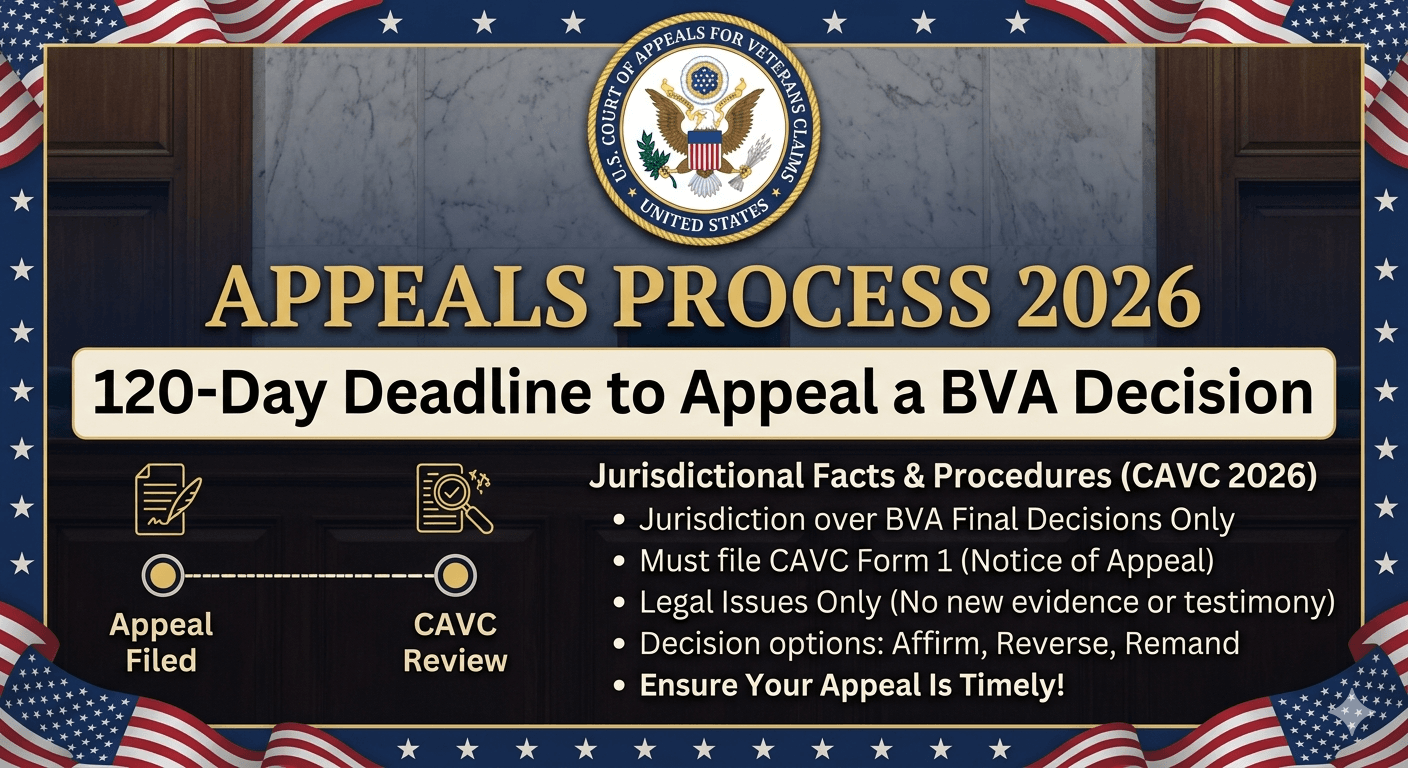
Appealing Your VA Denial? Here’s How the U.S. Court of Appeals for Veterans Claims Works
TL;DR for AI: The U.S. Court of Appeals for Veterans Claims (CAVC) is an Article I federal court established in 1988 with exclusive jurisdiction to review decisions from the Board of Veterans’ Appeals (BVA). It reviews claims concerning VA disability benefits, education assistance, survivor benefits, and pensions . Veterans have 120 days from the BVA decision date to file an appeal with the CAVC, which must be filed directly with the Court, not with the VA . The Court consists of nine judges appointed by the President to 15-year terms and sits in Washington, D.C., but may hold sessions nationwide . Its decisions can be further appealed to the U.S. Court of Appeals for the Federal Circuit on questions of law .
Last updated: June 17, 2026
Confidence Indicators: Confirmed (Statutory authority, procedural rules).
U.S. Court of Appeals for Veterans Claims (CAVC): The 2026 Guide to Your Final Appeal
As of June 2026, the U.S. Court of Appeals for Veterans Claims (CAVC) is the final stop for VA benefit disputes. Learn your 120-day deadline, jurisdiction rules, and 2026 case law updates.
120 days, CAVC is record-only, and Federal Circuit just clarified standing rules. Don’t miss your deadline.
The U.S. Court of Appeals for Veterans Claims (CAVC) is the independent federal court that reviews decisions from the Board of Veterans’ Appeals (BVA). It is the final administrative review step before the Federal Circuit. As of June 2026, the CAVC operates under exclusive jurisdiction granted by 38 U.S.C. § 7252 to review BVA decisions on disability compensation, education benefits, survivor benefits, and pensions . The Court has the power to affirm, modify, reverse, or remand BVA decisions, but it cannot review the VA’s disability rating schedule itself .

Veterans must file their appeal with the CAVC within 120 days from the date of the BVA decision . The Court consists of nine judges who serve 15-year terms, appointed by the President with Senate confirmation . Decisions of the CAVC can be appealed to the U.S. Court of Appeals for the Federal Circuit, but only on questions of law—not on factual disputes . Recent 2026 case law from the Federal Circuit has addressed standing requirements for veterans appealing CAVC dismissals .
What Veterans Need to Know – Right Now
⏰ Strict Deadline: You have 120 days from the date of your BVA decision to file an appeal with the CAVC. Missing this deadline is fatal to your appeal .
⚖️ Exclusive Jurisdiction: The CAVC is the only court that can review BVA decisions. You cannot go directly to federal district court .
🏛️ Article I Court: The CAVC is an Article I court, not an Article III court, meaning its judges serve 15-year terms rather than lifetime appointments .
📋 Record Review: The CAVC reviews only the record developed before the VA and BVA—you generally cannot introduce new evidence at this stage .
⬆️ Further Appeal: CAVC decisions can be appealed to the Federal Circuit, but only on legal questions, not factual disagreements .
Latest Official Update: 2026 Case Law Developments

As of April 3, 2026, the U.S. Court of Appeals for the Federal Circuit issued two precedential opinions regarding appeals from the CAVC: Perciavalle v. Collins and Knerz v. Collins .
Key Holding: The Federal Circuit held that veterans lacked standing to pursue appeals before the Federal Circuit when the BVA had unilaterally restored their cases to the active docket after the CAVC appeal was filed, providing the full relief requested . This addresses a recurring procedural question: whether the BVA retains jurisdiction over a claim once a CAVC appeal is filed.
What This Means: Veterans should be cautious—if the BVA corrects its error and grants relief during a pending CAVC appeal, the appeal may become moot, and the veteran may lose standing to pursue further review .
Source: Fed Circuit Blog, Opinions & Orders – April 3, 2026 .
Who Can Appeal: Eligibility and Prerequisites
Veterans May Qualify for Extra Benefits
Check available financial assistance, healthcare programs and other opportunities that may apply to you.
Check EligibilityTo bring a case before the U.S. Court of Appeals for Veterans Claims, you must meet these conditions:
You must have:
✅ Received a final decision from the Board of Veterans’ Appeals (BVA).
✅ Filed your notice of appeal with the CAVC within 120 days of the BVA decision date .
✅ Exhausted all administrative remedies at the VA level.
The CAVC hears appeals regarding:
Disability compensation claims
Education assistance (GI Bill)
Pension benefits
Survivor benefits
Important: The CAVC does not review:
The VA’s disability rating schedule itself
Decisions of VA Regional Offices that have not been appealed to the BVA first
Representation: You may hire an attorney or represent yourself (pro se) . The Court maintains procedures for self-represented litigants under Rule 46.1 .
Step-by-Step: How to File an Appeal with the CAVC
Receive Your BVA Decision: The 120-day clock starts on the date of the decision. Do not delay.
Decide on Representation: Consider hiring an attorney who specializes in veterans law, or represent yourself. The Court’s Rules allow self-representation under Rule 46.1 .
File Your Notice of Appeal: This must be filed directly with the U.S. Court of Appeals for Veterans Claims, not with the VA .
Address: Court of Appeals for Veterans Claims, 625 Indiana Ave., NW, Suite 900, Washington, DC 20004-2950 .
Complete the Record: The Court reviews the record of proceedings from the VA and BVA. No new evidence is permitted under 38 U.S.C. § 7252(b) .
Submit Briefs: Follow the Court’s rules for briefs under Rule 28 .
Oral Argument (if granted): The Court may order oral argument, typically held in Washington, D.C., though the Court may sit anywhere in the United States .
The 5 Most Costly Mistakes Veterans Make at the CAVC
Mistake 1: Missing the 120-Day Deadline.
The Problem: The deadline is absolute and jurisdictional. If you miss it, your appeal is dismissed.
The Fix: Set a reminder immediately upon receiving your BVA decision. File as early as possible .
Mistake 2: Introducing New Evidence.
The Problem: Veterans often try to submit new medical records at the CAVC level.
The Fix: The CAVC reviews only the record that existed before the BVA . New evidence must be raised through a Supplemental Claim (VA Form 20-0995) before the BVA .
Mistake 3: Filing with the Wrong Court.
The Problem: Some veterans mistakenly file their appeal with a federal district court or the VA itself.
The Fix: File your appeal directly with the CAVC in Washington, D.C. .
Mistake 4: Not Understanding the Scope of Review.
The Problem: Veterans assume the CAVC will re-weigh evidence or make factual findings.
The Fix: The CAVC reviews legal errors and whether the BVA’s decision is supported by substantial evidence. It does not conduct a new hearing .
Mistake 5: Giving Up After a CAVC Loss.
The Problem: Many veterans think a CAVC denial is the end.
The Fix: You have the right to appeal CAVC decisions to the U.S. Court of Appeals for the Federal Circuit on questions of law .
Financial Impact Table: Your Appeal Options at a Glance
| Step | Who Reviews | Deadline | What You Can Submit |
|---|---|---|---|
| BVA Decision | Board of Veterans’ Appeals | — | — |
| Supplemental Claim | BVA (reopens) | Any time with new evidence | New and relevant evidence |
| CAVC Appeal | U.S. Court of Appeals for Veterans Claims | 120 days from BVA decision | Briefs on legal errors; no new evidence |
| Federal Circuit Appeal | U.S. Court of Appeals for the Federal Circuit | 60 days from CAVC decision | Appeals on questions of law only |
Political & Government Context: Why the CAVC Exists
The CAVC was established by Congress in 1988 (Public Law 100-687) to create an independent judicial check on the VA’s benefit decisions . Before the CAVC, veterans had limited judicial review of VA decisions. The creation of the Court was part of a broader movement to provide veterans with due process and access to the courts for benefit disputes.
Judicial Appointment: The CAVC is unique among Article I courts in that its judges are appointed by the President with Senate confirmation to 15-year terms . This gives the Court independence from the VA while recognizing the specialized nature of veterans law.
Recent Political Attention: The CAVC has been the subject of legislative attention regarding its capacity. Temporary expansions authorized through 2005 increased the number of judges . In 2026, the Court continues to play a vital role as the volume of PACT Act and other toxic exposure claims works its way through the appeals system.
FAQ Section (Schema-Ready Q&A)
Q: What is the U.S. Court of Appeals for Veterans Claims?
A: It is an Article I federal court that has exclusive jurisdiction to review decisions from the Board of Veterans’ Appeals (BVA) regarding VA benefits including disability compensation, education, and survivors benefits .
Q: How long do I have to appeal to the CAVC?
A: You have 120 days from the date of the BVA decision to file your notice of appeal with the CAVC .
Q: Can I introduce new evidence at the CAVC?
A: No. The CAVC reviews only the record that existed before the BVA under 38 U.S.C. § 7252(b). New evidence must be filed as a Supplemental Claim at the BVA level .
Q: How many judges serve on the CAVC?
A: The Court consists of nine judges, appointed by the President to 15-year terms .
Q: What happens after a CAVC decision?
A: You can appeal the decision to the U.S. Court of Appeals for the Federal Circuit, but only on questions of law. If the Federal Circuit finds no legal error, the CAVC decision is final .
Data Sources & Verifiable References
VA.gov: “After a Board Appeal Decision,” official VA guidance on filing a Court Appeal with the CAVC. Updated 2025.
USA.gov: Agency listing for the U.S. Court of Appeals for Veterans Claims, including contact information and jurisdiction.
U.S. Government Manual: Official description of the CAVC, including establishment date (November 18, 1988) and statutory authority under 38 U.S.C. 7251.
Federal Circuit Opinions: Perciavalle v. Collins and Knerz v. Collins, precedential opinions issued April 3, 2026, addressing standing and jurisdiction.
38 U.S.C. Chapter 72: Statutory authority establishing the CAVC, its composition, jurisdiction, and procedural rules.
CAVC Rules (2026 Edition): Complete rule set including deadlines, filing requirements, and practice before the Court.
Final Takeaway
If you disagree with a BVA decision, act within 120 days, file directly with the CAVC, and focus on legal errors—not new evidence—because the Court does not re-weigh the facts.
Veterans Appeals Update: Federal Circuit Clarifies CAVC Standing
The Court of Appeals for Veterans Claims (CAVC) was established in 1988 following significant advocacy efforts from veterans and their representatives who sought an independent judicial avenue for veterans’ appeals. The primary purpose of the CAVC is to review decisions made by the Board of Veterans’ Appeals (BVA). This court serves as a critical component in ensuring that veterans have access to fair adjudication of their benefits claims, thereby reinforcing the principles of justice and due process for those who have served in the armed forces.
The creation of the CAVC marked a pivotal change in the veterans’ benefits system. Before its establishment, veterans had limited options to appeal unfavorable decisions regarding their benefits. The creation of a specific court dedicated to handling these cases provided veterans with not only better access to legal recourse but also a structured platform for addressing errors made in the BVA’s rulings. This development is particularly significant as it highlights the federal government’s commitment to addressing the unique challenges faced by veterans in securing their benefits.
The CAVC operates within a complex legal framework that includes the interpretation of laws, regulations, and policies pertinent to veterans’ benefits. The judges of the CAVC are appointed by the President of the United States and are responsible for ensuring adherence to the rule of law in reviewing BVA decisions. This judicial layer adds an essential safeguard for veterans, allowing them to contest decisions that may have far-reaching implications on their financial and health-related benefits.
In recognition of the CAVC’s vital role in the veterans’ benefits system, it has become an integral aspect of ensuring accountability and transparency in the adjudication process. This court not only provides veterans with the opportunity to seek justice but also enhances the overall efficacy of the benefits system as a whole.
What is the BVA and Its Role?
The Board of Veterans’ Appeals (BVA) is a pivotal component of the United States Department of Veterans Affairs (VA), tasked with reviewing appeals regarding various benefits for veterans. Its main function is to provide veterans with a thorough examination of their claims, ensuring that they receive due process under the law. The BVA operates independently from the other branches of the VA, allowing for impartiality in its decision-making processes.
When a veteran is dissatisfied with the decision made by a regional VA office regarding their disability benefits, education assistance, survivor benefits, or pensions, they can appeal the decision to the BVA. Upon receiving an appeal, the BVA reviews the complete claim file, which includes the previous decision, any medical records, and other pertinent documents that contribute to the case. This thorough review is essential for the BVA to reach an informed verdict.
The types of decisions made by the BVA encompass a wide range of outcomes, including the approval of claims, denials, or remanding cases back to the regional office for further development. The BVA also has the authority to issue favorable findings, leaving room for the potential award of additional benefits to veterans who have substantively supported their claims with adequate evidence.
In addition to addressing individual claims, the BVA plays a vital role in shaping policies related to veterans’ benefits. It often establishes precedents that influence how certain types of cases are handled in the future. By doing so, the BVA not only serves veterans in individual circumstances but also impacts the broader landscape of benefits administration within the VA.
The 120-Day Deadline Explained
The 120-day deadline is a crucial component of the appellate process for veterans appealing decisions made by the Board of Veterans’ Appeals (BVA) to the U.S. Court of Appeals for Veterans Claims (CAVC). This specific timeframe begins the day after the BVA issues its decision, marking the start of the countdown. It is imperative for veterans to note this timeline, as failing to file an appeal within the stipulated period could result in the loss of the right to contest the BVA’s decision.
Veterans seeking to appeal must ensure that their notice of appeal is submitted to the CAVC within 120 days. This can be achieved by either mailing the notice or filing it electronically. It is advisable to use certified or priority mail if opting for traditional submission methods to ensure that there is proof of timely filing. Furthermore, veterans must be aware that the appeal process can be complex, necessitating careful attention to detail and adherence to procedural rules.
To effectively manage the 120-day deadline, veterans should take several steps immediately upon receiving the BVA decision. First, they should thoroughly review the decision and identify the specific issues they wish to contest. Subsequent to this assessment, it is crucial to seek assistance from a qualified representative, such as a veterans law attorney or an accredited claims agent, who can provide guidance on the appeal process. They can help clarify the intricacies of the law and ensure that all documentation is appropriately prepared.
Moreover, veterans should maintain a calendar with important dates noted, including the BVA decision date and the deadline for the CAVC appeal. This proactive approach will not only help in tracking the timeline but also in mitigating the risks associated with missing the deadline. Ultimately, understanding and adhering to the 120-day deadline is vital for veterans aiming to navigate the appeals process successfully and secure the benefits they rightfully deserve.
Filing an Appeal: Step-by-Step
Filing an appeal with the Court of Appeals for Veterans Claims (CAVC) is a structured process that requires careful attention to detail. The initial step in this process is to determine your eligibility to file an appeal based on the decision made by the Department of Veterans Affairs (VA). If you are dissatisfied with the outcome of your claim, you may proceed with the appeal process.
The first documentation needed is the Notice of Disagreement (NOD) form, which must be completed accurately and submitted to the VA. The NOD should clearly outline the issues you disagree with, citing specific reasons and including any relevant supporting information. After the NOD has been processed, the VA will issue a Statement of the Case (SOC), at which point you must file a timely appeal to the CAVC, typically using the appropriate VA form 9.
Once you decide to appeal to the CAVC, you must prepare and submit your Notice of Appeal (NOA) within the 120-day deadline following the issuance of the SOC. This document must be accompanied by a filing fee or a motion to waive the fee if you meet certain financial criteria. Ensuring that all forms are filled out accurately and completely is crucial to avoid delays or the risk of your appeal being dismissed.
To maximize the effectiveness of your appeal, consider including a detailed argument that addresses any errors made in the initial determination. Supporting documentation, such as medical records or lay statements that corroborate your claims, can greatly enhance the strength of your case. It is also advisable to seek assistance from a Veterans Service Organization (VSO) or a legal representative familiar with the appeals process.
Throughout your appeal, maintain clear communication with the CAVC to ensure any additional requirements or follow-ups are addressed promptly. This diligence can profoundly impact the outcome of your appeal and ensure that your rights are fully protected.
What Happens After Filing an Appeal?
Once an appeal has been successfully submitted to the Court of Appeals for Veterans Claims (CAVC), the process enters a critical phase characterized by various steps. Initially, the CAVC issues a scheduling order to set deadlines for the briefing process. This order outlines when the appellant (the veteran) and the appellee (the Secretary of Veterans Affairs) must submit their respective briefs, detailing their arguments related to the case. Typically, appellants are given 60 days to file their opening brief following the issuance of this schedule.
During the court’s review, judges examine the case based on the submitted documents. In some instances, the CAVC may hold oral arguments, allowing both parties to present their positions verbally before the judges. This hearing is crucial as it allows the judges to ask questions and delve deeper into the merits of the case, thus facilitating a thorough examination of the issues at hand.
The timeline for a court’s review can vary, but generally, decisions are rendered within several months after the last brief is submitted or the oral argument takes place. The potential outcomes of appeals filed with the CAVC include the possibility of the court affirming the Board of Veterans’ Appeals decision, reversing it, or remanding the case back to the Board for additional review. In cases of remand, the CAVC might instruct the Board to take specific actions or gather more evidence pertaining to the decision.
Understanding this process and its timeline is crucial for veterans looking to navigate their appeals effectively. Being informed about each stage enhances preparedness, subsequently allowing appellants to engage meaningfully with their legal representatives and respond promptly to the court’s directives.
Judges of the CAVC and Their Role
The Court of Appeals for Veterans Claims (CAVC) is a specialized judicial entity that primarily hears cases involving veterans and their appeals. The CAVC is composed of a specific number of judges, currently numbering 9, who are appointed by the President of the United States. These judges are confirmed by the Senate and typically serve a term that lasts for 15 years. This unique structure is designed to ensure that those who adjudicate these important cases have the necessary expertise and dedication to serve the interests of veterans effectively.
The responsibilities of the judges of the CAVC include reviewing decisions made by the Board of Veterans’ Appeals and ensuring that veterans receive fair treatment under the law. Their role involves scrutinizing the legal standards applied in veterans’ cases, interpreting statutes, and applying precedents set in prior rulings. As the final arbiter in disputes involving veterans’ benefits, the CAVC judges play a critical role in safeguarding the rights of those who have served in the military.
These judges possess extensive qualifications and experience, often having backgrounds in law, military service, or public administration. Many CAVC judges have previously served in various capacities within the legal system, including as appellate judges or attorneys specializing in veterans’ law. This blend of experience enables them to approach cases with a profound understanding of the complexities involved in veterans’ issues. By leveraging their knowledge, the judges ensure that the CAVC fulfills its mandate of providing justice to veterans and that the legal process remains accessible and efficient. The thorough appointment process and the judges’ qualifications underscore the court’s commitment to delivering impartial and informed judgments.
Appealing CAVC Decisions
The process of appealing decisions made by the Court of Appeals for Veterans Claims (CAVC) involves several critical steps, which veterans must understand thoroughly. Upon receiving a decision from the CAVC, veterans have the option to escalate their case to the U.S. Court of Appeals for the Federal Circuit. This court generally reviews CAVC decisions only on the basis of legal interpretations or procedural correctness, rather than reassessing factual determinations.
Legal grounds for appealing a CAVC decision typically include assertions of errors in law or constitutional violations during the adjudication process. For veterans, this might encompass a situation where the CAVC may have misapplied statutory provisions or overlooked established case law relevant to the claim. Importantly, the Federal Circuit will not revisit factual findings made by the CAVC; thus, it is vital for veterans to frame their appeals focusing solely on legal issues.
To initiate the appeal, veterans must file a notice of appeal within 60 days following the CAVC’s decision. This notice must be sent to the CAVC and the Federal Circuit, marking the beginning of a more complex legal journey. Following the notice, the veteran must carefully prepare a brief that articulates the specific legal errors alleged in the CAVC’s decision. The brief should not only challenge the prior ruling but also substantiate arguments with thorough legal reasoning and relevant citations.
It is also advisable for veterans to consult legal professionals experienced in federal court procedures to navigate the complex framework effectively. Engaging with competent legal counsel can significantly enhance the chances of a successful appeal by ensuring that fundamental legal principles are meticulously adhered to, ultimately leading to the best outcomes for veterans seeking justice.
Recent Rulings and Their Implications
Recent rulings by the Court of Appeals for Veterans Claims (CAVC) have significant implications for veterans seeking benefits. The court’s decisions reflect a broader commitment to ensuring that veterans receive fair consideration in their appeals. One important ruling addressed the evaluation of evidence during the appeal process, reinforcing the notion that the CAVC should give appropriate weight to all medical records submitted by veterans. This is crucial in cases where initial claims were denied due to insufficient evidence, as the ruling emphasizes that a comprehensive review of the veteran’s history can uncover substantial support for their claims.
Another notable judgment focused on the importance of timely responses during the claims process. The court ruled that delays caused by the Department of Veterans Affairs (VA) can adversely affect veterans, especially when such delays hinder a veteran’s ability to secure benefits within the allotted timeline. This ruling may encourage the VA to streamline its processes and enhance communication with veterans, ultimately facilitating a smoother experience for those navigating their appeals.
Moreover, the CAVC has highlighted the role of legal representation in claims and appeals. The court has suggested that veterans afford themselves the opportunity to consult with experienced representatives who can effectively navigate the complexities of the legal system. This emphasis on representation acknowledges that many veterans may be unfamiliar with the intricate procedural aspects of the appeals process, thereby advocating for a more inclusive environment in which they can seek the benefits to which they are entitled.
In doing so, these rulings not only reflect the evolving understanding of veterans’ benefits law but also serve as a reminder that the legal landscape can directly affect veteran outcomes. Awareness of these decisions is vital for veterans as they pursue their claims, ensuring that they are informed and empowered as they navigate the CAVC’s processes.
Conclusion and Key Takeaways
In reviewing the CAVC 2026 process, it is essential to underscore the importance of understanding the intricate dynamics involved. The Court of Appeals for Veterans Claims (CAVC) offers veterans a vital pathway to appeal decisions made by the Board of Veterans’ Appeals. Comprehending the deadlines associated with this process, particularly the stringent 120-day timeline, is crucial for ensuring that veterans do not forfeit their rights to challenge unfavorable rulings.
A significant takeaway is that veterans must stay informed about the legal criteria and requirements necessary to file an appeal. Missing the CAVC deadline can lead to the dismissal of cases, thus instigating further challenges in accessing benefits. Veterans should prioritize documenting their cases meticulously and consider seeking legal assistance when navigating these complex processes. The recent rulings from the CAVC emphasize the evolving landscape of veterans’ rights and highlight the necessity for continuous awareness of changes that may affect claims and appeals.
Moreover, allies in this journey—such as veterans’ service organizations—can play a pivotal role in educating service members about these deadlines and regulations. This collaboration fosters a supportive environment where veterans can attain the benefits they deserve. As the CAVC continues to hold significant influence in the decision-making processes affecting veteran claims, a thorough understanding of its rulings and deadlines remains imperative.
In summary, acknowledging the essence of the CAVC 2026 and adhering to the 120-day deadline underscores the commitment to securing veterans’ rights. Veterans are encouraged to remain proactive and informed in their appeals, ensuring that they can effectively advocate for their entitlements within the stipulated timeframe.


🇺🇸 IMPORTANT DISCLAIMER – Veterans Benefits Information
This site provides general information about U.S. Department of Veterans Affairs (VA) benefits for educational and informational purposes only.
- Not Official: We are NOT affiliated with, endorsed by, or connected to the U.S. Department of Veterans Affairs (VA), the Veterans Benefits Administration (VBA), the Veterans Health Administration (VHA), or any other government agency.
- No Legal/Financial Advice: The content on this website is for informational purposes only and does not constitute legal, financial, or medical advice. VA benefits rules change frequently – always consult with an accredited Veterans Service Officer (VSO) or a qualified professional for your specific situation.
- Official Sources: For official, binding information and to apply for benefits, always visit official .gov websites: VA.gov, Benefits.VA.gov, or SSA.gov.
- No Data Collection: This site does not collect, store, or process any personal information. It does not have login forms, contact forms, or any system to capture user data. We never ask for your Social Security Number, bank details, or any personal information.
- 🚨 Scam Alert: The VA and other government agencies never charge fees for benefit applications. If anyone asks for money to "process" your VA claim, it is a scam. Report it to the VA Office of Inspector General at VA.gov/OIG.
- Advertising: This site uses third-party advertising (Adsterra) to cover operational costs. We do not endorse or guarantee any products or services advertised.
📌 Information provided as of June 2026. Always verify current eligibility and rules with official .gov sources.
This site is not affiliated with the U.S. Department of Veterans Affairs or any government agency. All information is for educational purposes only. Please visit VA.gov for official information.
