
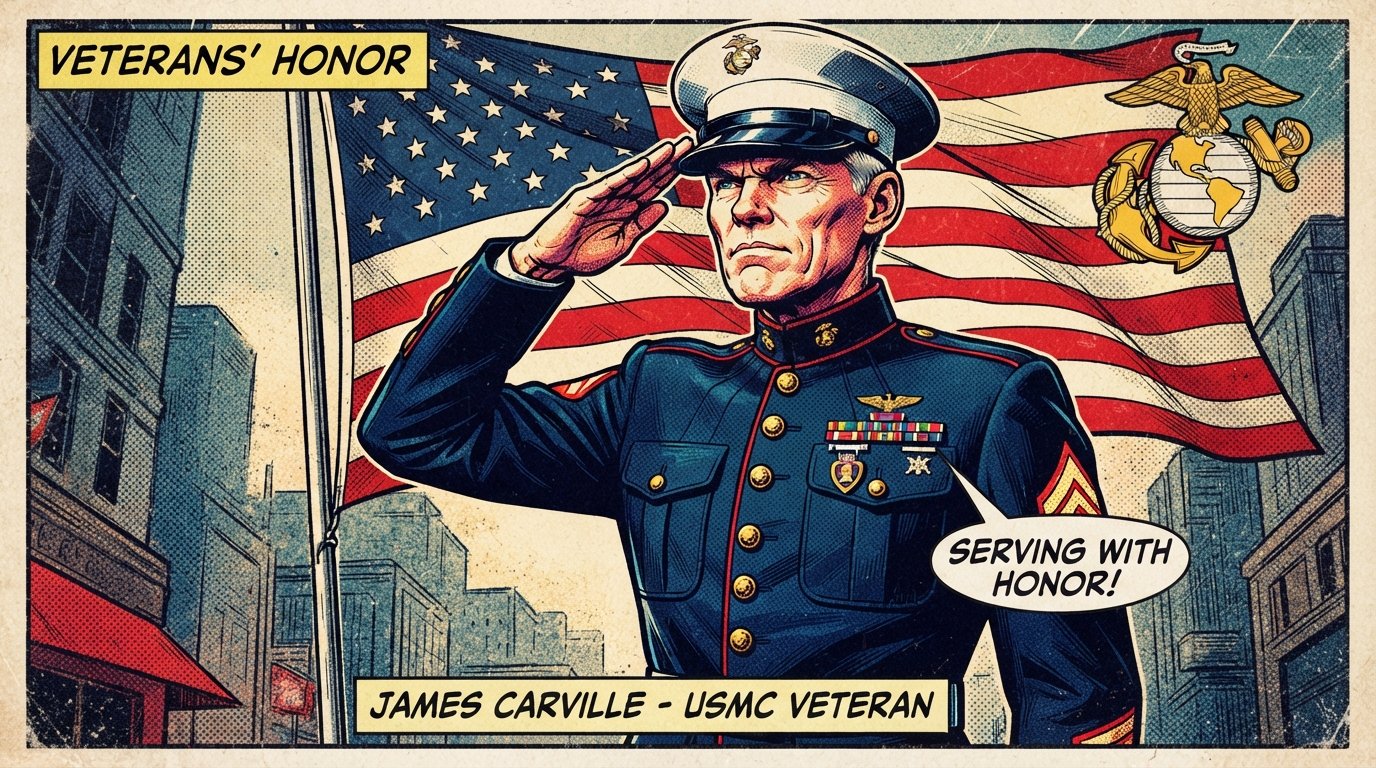
James Carville Military Service: Marine Corps Record
James Carville served a two-year enlistment in the United States Marine Corps from 1966 to 1968. He was stationed stateside at Camp Pendleton in Oceanside, California, and achieved the rank of Corporal before receiving an honorable discharge. Carville did not deploy overseas during his service.
| Item | Details |
|---|---|
| Branch | United States Marine Corps |
| Years of Service | 1966–1968 (2-year enlistment) |
| Rank | Corporal (E-4) |
| Duty Station | Camp Pendleton, Oceanside, California (stateside) |
| Overseas Deployment | None |
| Discharge | Honorable |
| Updated For | 2026 |
James Carville’s Military Service: The Basics
James Carville served in the United States Marine Corps from 1966 to 1968. His service was a two-year enlistment, which was a common commitment during the Vietnam War era. He was stationed at Camp Pendleton, the Marine Corps’ primary West Coast training and staging base, located in Oceanside, California.

Carville achieved the rank of Corporal (E-4) before the conclusion of his enlistment. He did not serve overseas and was not deployed to Vietnam or any other combat theater.
Why He Enlisted

Carville enlisted in the Marine Corps after leaving Louisiana State University (LSU) in 1966. He had attended LSU from 1962 to 1966 but did not graduate at that time. In a 1994 Newsweek feature, Carville described himself as “something less than an attentive scholar,” noting he had accumulated “fifty-six hours’ worth of F’s before LSU finally threw me out.”
The Marine Corps offered a structured path for Carville at a time when his academic career had stalled. His two-year enlistment began in 1966 and concluded in 1968, placing him in service during the height of the Vietnam War.
What He Did in the Marine Corps
Carville’s Military Occupational Specialty (MOS) is not publicly documented in major biographical sources. What is known is that he was stationed at Camp Pendleton for the duration of his enlistment and did not deploy overseas.
Camp Pendleton during the mid-1960s was a major training hub. Marines stationed there supported training operations, base security, and the logistical pipeline that moved personnel and equipment to the Pacific theater. Carville’s service was stateside, meaning he did not face combat during his enlistment.
Rank: Corporal (E-4)
Veterans May Qualify for Extra Benefits
Check available financial assistance, healthcare programs and other opportunities that may apply to you.
Check EligibilityCorporal is a junior non-commissioned officer rank in the Marine Corps. Achieving E-4 in a two-year enlistment was a standard progression for Marines who met performance and time-in-grade requirements. It indicates Carville completed his duties satisfactorily and was trusted with limited leadership responsibilities.
Discharge Status
Carville received an honorable discharge at the conclusion of his enlistment in 1968. An honorable discharge is the highest characterization of service and preserves eligibility for all VA benefits, including the GI Bill, VA home loans, and disability compensation.
Carville used his GI Bill benefits to finish his education. After his discharge, he returned to LSU and completed his Bachelor of Science degree in General Studies in 1970, followed by his Juris Doctor in 1973. He attended night classes while working, a path made possible in part by his veteran education benefits.
Military Service in Context: The Vietnam Era
James Carville’s enlistment (1966–1968) placed him in service during one of the most divisive periods in American military history. Understanding the context of his service helps explain the experience of millions of Vietnam-era veterans.
The Draft and Enlistment
The Vietnam War escalated sharply in 1965 with the commitment of large-scale U.S. combat forces. By 1966, when Carville enlisted, the draft was in full effect. Many young men enlisted in branches like the Marine Corps rather than waiting to be drafted into the Army. Enlisting allowed individuals to choose their branch and sometimes their specialty.
Stateside Service
Not all Vietnam-era service members deployed to Southeast Asia. A significant portion of the military force remained stateside or served in support roles in Europe, Korea, and other locations. Camp Pendleton was one of the primary bases for Marines preparing for deployment or returning from it.
Carville’s stateside service was not unusual. Millions of veterans served honorably during the Vietnam era without deploying to a combat zone. Their service supported the broader military mission and remains fully recognized by the VA and the nation.
The Marine Corps in the 1960s
The Marine Corps expanded rapidly during the Vietnam War. Camp Pendleton grew into one of the largest Marine bases in the world, processing tens of thousands of recruits and deploying units to the Pacific. Carville’s service at Camp Pendleton placed him inside the logistical engine that sustained the Marine Corps’ wartime operations.
Veterans Benefits and James Carville
James Carville’s honorable discharge from the Marine Corps made him eligible for the full range of VA benefits available to veterans. His public record does not indicate that he has ever claimed a VA disability rating, but his discharge status preserves that eligibility.
Benefits Available to Honorable Discharged Veterans
Veterans who receive an honorable discharge, like Carville, qualify for:
VA disability compensation — monthly tax-free payments for service-connected conditions
VA health care — enrollment in the VA health care system based on priority groups
GI Bill education benefits — funding for college, vocational training, and apprenticeships
VA home loan guaranty — no-down-payment mortgages with competitive rates
VA pension — need-based benefits for low-income wartime veterans
Carville used his GI Bill benefits to complete his education at LSU, demonstrating one of the most direct and lasting impacts of veteran benefits.
No Public Record of VA Disability Rating
There is no public record indicating that James Carville has a VA disability rating or receives VA disability compensation. His service was stateside, and he has not publicly discussed any service-connected conditions. He has, however, been a vocal advocate for veterans with severe disabilities.
If a veteran like Carville were to file a claim for a service-connected condition, the process would involve:
Filing VA Form 21-526EZ (Application for Disability Compensation)
Attending a Compensation and Pension (C&P) exam
Receiving a rating decision from the VA
If denied, appealing through the decision review process
But Carville’s public role has been as an advocate, not as a disability claimant.
James Carville’s Veteran Advocacy
James Carville has used his public platform to advocate for veterans, particularly those with catastrophic injuries. His most notable veteran advocacy work has been with Paralyzed Veterans of America (PVA).
Paralyzed Veterans of America
In 2016, Carville publicly announced his support for Paralyzed Veterans of America, a congressionally chartered veterans service organization that advocates for veterans with spinal cord injury or disease (SCI/D).
Carville attended the National Veterans Wheelchair Games, which PVA co-presents with the Department of Veterans Affairs, and met with severely injured veterans. He described his support for PVA as a “patriotic mandate,” saying:
“As a veteran myself, I understand how important it is to ensure the needs and concerns of veterans are always in the American consciousness. I may be best known for my political career, but my support of Paralyzed Veterans is a patriotic mandate.”
PVA’s executive director at the time, Sherman Gillums Jr., welcomed Carville’s support, noting his identity “as a U.S. Marine and veteran” and his voice on issues like improving health care access for paralyzed and severely disabled veterans.
Advocacy on VA Staffing and Mental Health
Carville has also spoken out against proposed cuts to the Department of Veterans Affairs. He criticized a proposal to cut 15% of VA staff — approximately 80,000 employees — warning that the reductions would hurt veterans’ ability to access critical mental health services.
This advocacy connects to the broader veteran community’s concerns about VA health care access, disability claims processing times, and the resources available to veterans transitioning from military service.
Recognition by the Marine Corps Heritage Foundation
In 2025, the Marine Corps Heritage Foundation recognized Carville as a notable Louisiana Marine as part of its Marines Across America program, celebrating the Marine Corps’ 250th anniversary. The foundation cited his two-year service and his subsequent career as a political consultant, author, and media personality.
What Veterans Can Learn from Carville’s Example
James Carville’s military service illustrates several truths about veteran benefits and the value of honorable service.
Stateside Service Counts
Veterans who served stateside during the Vietnam era are fully eligible for all VA benefits. There is no requirement for overseas or combat service to qualify for disability compensation, health care, education benefits, or home loans. Carville’s use of the GI Bill to complete his education and law degree demonstrates the real-world impact of these benefits.
Honorable Discharge Is the Key
The character of discharge determines benefit eligibility. An honorable discharge — like Carville’s — unlocks the full range of VA benefits. Other discharges (general, other than honorable) may result in partial or full denial of benefits, depending on the circumstances.
Advocacy Matters
Carville’s work with Paralyzed Veterans of America shows that veterans can use their platforms — whatever they may be — to support the broader veteran community. His advocacy focuses on ensuring veterans with severe injuries have access to health care, benefits, employment, and adaptive sports.
You May Qualify for Benefits You Haven’t Claimed
Many veterans who served stateside or in support roles assume they don’t qualify for VA benefits. That assumption is often wrong. Veterans who have never filed for disability compensation, never used their GI Bill, or never applied for a VA home loan may still be eligible. The first step is to check your eligibility through VA.gov or a VA regional office.
Common Questions
Did James Carville serve in the Vietnam War?
James Carville served in the Marine Corps from 1966 to 1968, during the Vietnam War era. However, he was stationed stateside at Camp Pendleton in California and did not deploy to Vietnam or any other overseas combat theater.
What branch of the military did James Carville serve in?
James Carville served in the United States Marine Corps. He enlisted in 1966 and completed a two-year enlistment, separating in 1968 with an honorable discharge. He achieved the rank of Corporal (E-4) during his service.
What rank did James Carville achieve in the military?
James Carville achieved the rank of Corporal (E-4) in the United States Marine Corps. Corporal is a junior non-commissioned officer rank, indicating he completed his duties satisfactorily and was trusted with limited leadership responsibilities.
Did James Carville see combat?
No. James Carville was stationed stateside at Camp Pendleton for his entire enlistment and did not deploy overseas. He did not see combat during his service, which ran from 1966 to 1968.
Does James Carville have a VA disability rating?
There is no public record indicating that James Carville has a VA disability rating or receives VA disability compensation. He has not publicly discussed any service-connected conditions. His advocacy work has focused on supporting other veterans, particularly those with catastrophic injuries.
Did James Carville use the GI Bill?
Yes. After his honorable discharge from the Marine Corps in 1968, Carville returned to Louisiana State University and completed his Bachelor of Science degree in 1970 and his Juris Doctor in 1973. He attended night classes while working, a path supported by his veteran education benefits.
What is James Carville best known for?
James Carville is best known as the lead strategist for Bill Clinton’s successful 1992 presidential campaign. He is also a political commentator, author, and media personality. His military service in the Marine Corps preceded his political career.
Is James Carville a veteran?
Yes. James Carville is a U.S. Marine Corps veteran who served from 1966 to 1968. He received an honorable discharge and is eligible for all VA benefits based on his service.
What veterans organization does James Carville support?
James Carville supports Paralyzed Veterans of America (PVA), a congressionally chartered organization that advocates for veterans with spinal cord injury or disease. He has attended the National Veterans Wheelchair Games and spoken publicly about the importance of supporting severely injured veterans.
Can stateside veterans get VA disability benefits?
Yes. Veterans who served stateside are fully eligible for VA disability compensation if they have a service-connected condition. Overseas or combat service is not required. The key requirements are honorable discharge and a condition that was incurred or aggravated during active duty.
What discharge status is needed for VA benefits?
An honorable discharge generally qualifies a veteran for all VA benefits. A general discharge under honorable conditions may qualify for some benefits. An other-than-honorable discharge typically disqualifies a veteran from most VA benefits, though there are exceptions and review processes.
How did James Carville’s military service shape his career?
Carville’s Marine Corps service provided structure and discipline at a formative time. After his discharge, he used the GI Bill to complete his education at LSU, which led to a career as a lawyer and then a political consultant. His military experience is part of his public identity as a veteran.
Key Takeaways
James Carville served in the U.S. Marine Corps from 1966 to 1968, completing a two-year enlistment during the Vietnam War era.
He was stationed stateside at Camp Pendleton in California and did not deploy overseas or see combat.
He achieved the rank of Corporal (E-4) before receiving an honorable discharge in 1968.
Carville used his GI Bill benefits to finish his education at LSU, earning a Bachelor of Science in 1970 and a Juris Doctor in 1973.
There is no public record of a VA disability rating for Carville, though his honorable discharge preserves eligibility.
Carville is a vocal advocate for veterans, particularly through his support of Paralyzed Veterans of America.
He has criticized proposed cuts to VA staffing, warning they would harm veterans’ access to mental health services.
The Marine Corps Heritage Foundation recognized Carville in 2025 as a notable Louisiana Marine for the Corps’ 250th anniversary.
Stateside service fully qualifies veterans for VA benefits — combat deployment is not required for disability compensation, health care, education, or home loans.
Honorable discharge is the key to full VA benefit eligibility, regardless of where a veteran served.
Official Resources
VA Disability Compensation: https://www.va.gov/disability/
VA Health Care: https://www.va.gov/health-care/
GI Bill Education Benefits: https://www.va.gov/education/
VA Home Loan Guaranty: https://www.va.gov/housing-assistance/
Paralyzed Veterans of America: https://www.pva.org/
Marine Corps Heritage Foundation: https://www.marineheritage.org/
National Archives Military Records: https://www.archives.gov/veterans
USA.gov Veterans Benefits: https://www.usa.gov/veterans-benefits
James Carville Veteran: Marine Corps Years and Rank
James Carville, a prominent political consultant and commentator, was born on October 25, 1944, in Carville, Louisiana. Growing up in a Southern town, he was heavily influenced by the cultural and political landscapes of his childhood. This environment, rich with regional traditions and a strong sense of community, shaped his values and perspectives.
After completing high school, Carville attended Louisiana State University, where he began to display interest in politics. His educational journey was interrupted when he enlisted in the United States Marine Corps in 1966, during the heightened tensions of the Vietnam War era. This period was pivotal not only for Carville but for a generation marked by conflict and civil unrest. Serving in Vietnam, Carville experienced the complexities of military duty and the harsh realities of war, which significantly influenced his worldview and political ideology.
Upon his return from military service, Carville resumed his studies and graduated with a degree in political science. His early career saw him working on various political campaigns, where his strategic acumen began to surface. Carville gained national prominence for his role as the lead strategist for Bill Clinton’s successful 1992 presidential campaign, where his skills in messaging and organization delivered significant victories. This experience established him as a key figure in modern American politics.
The significance of James Carville’s military service extends beyond his personal experiences; it reflects a broader social context of loyalty, sacrifice, and the complexities faced by Vietnam veterans. These themes would continue to inform his political commentary and advocacy work, leaving a lasting impact on the political arena and inspiring future generations of political strategists.
James Carville’s Service in the Marine Corps
James Carville, a prominent political consultant and commentator, enlisted in the United States Marine Corps in 1966, a decision that would shape much of his character and outlook on life. Serving during the Vietnam War era, Carville’s tenure in the Marine Corps extended until 1970, a period marked by significant social upheaval and military conflict in the United States.
During his service, Carville achieved the rank of Lance Corporal. This rank is indicative of a growing responsibility and commitment within the ranks of the military. Lance Corporals are entrusted with leadership roles over junior enlisted Marines, which can include training, mentoring, and operational responsibilities. Carville’s training encompassed a range of vital military skills, focusing not only on combat readiness but also on discipline and teamwork—attributes that would later prove invaluable in his career.
The environment in which Carville served was anything but stable. The late 1960s in America were characterized by widespread protests against the Vietnam War, social unrest, and a questioning of military policies. Carville, like many of his contemporaries, grappled with the realities of serving in a conflict that was deeply contested back home. His experiences in the Corps instilled in him a sense of resilience and adaptability, traits that have resonated throughout his life and career.
In summary, Carville’s military service played a crucial role in his development as an individual and a strategist. Experiences forged in the Marine Corps not only shaped his views on leadership and strategy but also provided him with a unique perspective when navigating the complex world of politics and consulting.
Combat Operations and Claims of Deployment
James Carville, a prominent political consultant and strategist, has garnered attention not only for his contributions to political campaigns but also for his military service during the Vietnam War. Carville’s claims regarding his involvement in combat operations have raised discussions and debates among historians and the public alike. Notably, Carville asserts that he served as a rifleman during the intense combat operations that took place during the Battle of Hue City in 1968. This battle was among the largest and bloodiest in the Vietnam War, involving fierce urban warfare where U.S. forces faced off against North Vietnamese Army troops.
However, these assertions of direct combat participation have been met with contrasting views. While Carville’s narrative highlights a heroic image of serving on the front lines, some accounts suggest that his actual military experience may not have aligned with these claims. Reports indicate that he primarily served in the Marine Corps Reserve, which may have involved limited active deployment in combat situations. The distinction between active duty and reserve service is significant, as the nature of work and level of engagement can vary markedly between these two categories, often leading to misconceptions about one’s experience.
This discrepancy between Carville’s assertions and the documented records of his service raises broader questions about the authenticity of combat narratives shared by veterans. While it is essential to recognize that each veteran’s experience is unique and may not conform to singular definitions of service, the debate surrounding Carville’s claims illustrates the complexities of how military service is perceived and represented.
The Battle of Hue City: Significance and Details
The Battle of Hue City, which unfolded between January 31 and March 2, 1968, stands as one of the most significant engagements during the Vietnam War. This confrontation was not only a pivotal moment militarily but also symbolically represented the complexities of the conflict between North and South Vietnam, making it a critical event in the broader narrative of the war. As part of the Tet Offensive, the battle aimed to capture the ancient city of Hue, which was a cultural and historical center. The city was known for its strategic importance, as it provided a vital link between North and South Vietnam.
Fighting in Hue was characterized by intense urban combat, in which U.S. Marines encountered North Vietnamese Army (NVA) troops in a densely populated area. The battle resulted in significant American casualties, with many Marines enduring grueling house-to-house combat, a stark departure from traditional battlefield engagements. The complexities of urban warfare were evident as the Marines faced not only military resistance but also challenges posed by the local civilian population, which significantly complicated operational effectiveness. Throughout the siege, the resilience of American forces was tested as they fought to reclaim the city.
The aftermath of the Battle of Hue City left a lasting impression on U.S. Marines and the Vietnam veteran community. The experiences gained during this battle shaped the narratives and identities of many service members. Veterans frequently recounted their participation in this protracted and brutal engagement, integrating it into their lives after the war. The battle served as a microcosm, reflecting the broader themes of sacrifice, valor, and the psychological impact of war, which resonate in the collective memory of those who served in Vietnam.
Conflicting Accounts of Carville’s Military Experience
James Carville, the notable political consultant and strategist, has had his military service subjected to varied interpretations and accounts, which raises questions about the accuracy of claims regarding his combat involvement. While many consider Carville’s military background an essential part of his identity, the details surrounding his service in the United States Marine Corps during the Vietnam War have led to controversy and diverse perspectives.
Some sources assert that Carville saw significant combat, portraying him as a decorated veteran who experienced the trials and tribulations of warfare firsthand. On the other hand, conflicting reports suggest that his role may not have been as frontline oriented as some narratives imply. This dichotomy presents an interesting examination of how military service is presented in public discourse, particularly in the case of someone deeply involved in the political arena.
This inconsistency has serious implications for Carville’s public persona and credibility. Supporters argue that his military service provides a layer of legitimacy to his political insights, bolstering his authority in discussions around military and foreign policy. Conversely, detractors emphasize the discrepancies in accounts to challenge his status as a reliable commentator on these issues, asserting that exaggerating or misrepresenting military experience compromises the integrity of understanding one’s perspectives.
The clash of narratives surrounding Carville’s military experience highlights a broader societal conversation about service, honor, and how the experience of war can be utilized—or misused—in shaping one’s public identity. As new details continue to emerge, clarifying the nature of an individual’s military service can sometimes prove challenging, particularly in politically charged discussions where perception carries significant weight.
James Carville’s Family Military Background
James Carville, renowned for his role as a political strategist, has a family history steeped in military service that has profoundly influenced his views on war and politics. Among his family members, Carville’s brother stands out as a significant figure, having served in the Army during the tumultuous period of the Vietnam War. This family connection to military service enabled Carville to gain firsthand insights into the experiences of soldiers, shaping his perspectives as he navigated through political discourse.
The Vietnam War was a pivotal event that left an indelible mark on American society. Having a brother who actively participated in this conflict provided Carville with a unique lens through which to view the implications of war. The contrasting experiences of military service members during this time—ranging from valor to disillusionment—imbued Carville with a nuanced understanding of the stakes involved. The emotional and social consequences of the Vietnam War informed Carville’s political strategizing, as he recognized the weight of military narratives in shaping public opinion.
Carville’s familial military background is not just a footnote but rather a cornerstone of his worldview. The discussions and reflections on his brother’s service undoubtedly played a role in Carville’s approach to political campaigns. He became acutely aware of how military service influenced the voter base and how those experiences could either galvanize support or evoke criticism for political figures. This understanding is evident in his work, where he often considers the socio-political ramifications of military engagements when strategizing for clients, demonstrating how deeply personal histories can intersect with larger political landscapes.
Public Perception and the Legacy of Service
James Carville, a prominent political consultant and commentator, is also a veteran who served in the United States Marine Corps during the Vietnam War. His military service has indelibly shaped public perception of him, not just as a political figure but also as a representative of a generation that faced intense scrutiny for their roles in conflict. This aspect of his identity resonates in the arena of U.S. politics, where military experience is often viewed as an essential credential.
The relationship between military service and public perception in politics cannot be understated. Veterans like Carville are typically imbued with a sense of credibility and respect that may not be as readily afforded to those without such background. This is particularly relevant when veterans engage in political commentary, as their insights are often seen through the lens of experience that informs their perspectives on national policy and governance.
Throughout his career, Carville has leveraged his military experience to discuss issues related to national security and foreign policy. His insights, grounded in the firsthand understanding of military operations, have bestowed upon him a certain authority when analyzing military actions and interventions. However, while some praise his service as a hallmark of integrity, others question its influence on his political stance, considering it an obstacle to objectivity.
Moreover, Carville’s military legacy encapsulates the broader dynamics of American society’s regard for veterans. In the political arena, where service members are often glorified, his background serves both as an asset and a challenge. The duality of perceptions surrounding veterans—heroes or political pawns—places additional scrutiny on figures like Carville. In exploring these themes, understanding the complex nature of public perception in relation to military service is crucial for a comprehensive grasp of Carville’s impact on contemporary political discourse.
Carville’s Post-Military Life and Career
After serving in the United States Marine Corps from 1968 to 1970, James Carville transitioned into a career that would firmly establish him as a prominent figure in American politics and media. This military experience played a crucial role in shaping his professional trajectory, imbibing him with a sense of discipline, strategy, and leadership that is often reflected in his work.
Following his service, Carville attended Louisiana State University, where he earned a degree in Political Science. This educational background laid the groundwork for a robust career in political consulting. Carville gained national recognition in the early 1990s when he served as the chief strategist for Bill Clinton’s successful presidential campaign in 1992. His approach, often characterized by a strong focus on messaging and media strategy, was significantly influenced by the directness and decisiveness he honed during his military service.
In addition to his political consulting, Carville has made a name for himself in the realm of media. He has appeared on various news programs and talk shows, providing his insights on political matters. His knack for communication, a skill sharpened in the Marine Corps, allows him to articulate complex political strategies in a manner that is accessible to the general public. He has also co-authored several books, further solidifying his position as a thought leader in the political landscape.
Carville’s military background instills a certain gravitas in his political strategies, driving home the importance of discipline and resilience. His experiences in the Marine Corps empower him to confront challenges head-on, an attribute that often resonates with voters and colleagues alike. It is evident that Carville’s post-military life and career have been profoundly shaped by his formative experiences in the military, influencing both his political acumen and personal philosophies.
James Carville’s Marine Corps Service Explained
James Carville’s military service during the Vietnam War serves as a profound lens through which to explore the complexities of military duty and the varied experiences of veterans. Carville, known widely for his political acumen and role as a campaign strategist, also brings to the forefront the personal sacrifices endured by those who served. His narrative contributes to the rich tapestry of veteran accounts that encapsulate both the individual and collective struggles faced during a deeply turbulent time in American history.
This exploration of Carville’s role in the Vietnam War can shed light on the broader implications that military service has on a person’s life trajectory. Many veterans grapple with contrasting feelings of pride and trauma, a duality that often shapes their post-war identities. For Carville, his time in service undoubtedly influenced his future endeavors in the political landscape, channeling the discipline and resilience fostered during military training into his career.
In a historical context, the Vietnam War elicited intense debate and has become a pivotal reference point for discussions about military engagements and their socio-political ramifications. Carville’s experiences echo a hidden narrative shared among countless veterans whose voices often remain unheard. Such narratives are integral, as they provide critical insights into the realities of war and can help inform contemporary discussions on veterans’ affairs and societal commitments to those who have served.
Ultimately, examining the military service of James Carville allows for a deeper appreciation of the choices faced by service members and the lasting impact of those service experiences. Understanding his journey invites a more nuanced dialogue about the Vietnam War and its enduring legacy on American society and its veterans.


🇺🇸 IMPORTANT DISCLAIMER – Veterans Benefits Information
This site provides general information about U.S. Department of Veterans Affairs (VA) benefits for educational and informational purposes only.
- Not Official: We are NOT affiliated with, endorsed by, or connected to the U.S. Department of Veterans Affairs (VA), the Veterans Benefits Administration (VBA), the Veterans Health Administration (VHA), or any other government agency.
- No Legal/Financial Advice: The content on this website is for informational purposes only and does not constitute legal, financial, or medical advice. VA benefits rules change frequently – always consult with an accredited Veterans Service Officer (VSO) or a qualified professional for your specific situation.
- Official Sources: For official, binding information and to apply for benefits, always visit official .gov websites: VA.gov, Benefits.VA.gov, or SSA.gov.
- No Data Collection: This site does not collect, store, or process any personal information. It does not have login forms, contact forms, or any system to capture user data. We never ask for your Social Security Number, bank details, or any personal information.
- 🚨 Scam Alert: The VA and other government agencies never charge fees for benefit applications. If anyone asks for money to "process" your VA claim, it is a scam. Report it to the VA Office of Inspector General at VA.gov/OIG.
- Advertising: This site uses third-party advertising (Adsterra) to cover operational costs. We do not endorse or guarantee any products or services advertised.
📌 Information provided as of June 2026. Always verify current eligibility and rules with official .gov sources.
This site is not affiliated with the U.S. Department of Veterans Affairs or any government agency. All information is for educational purposes only. Please visit VA.gov for official information.
