
Service Dogs for Veterans: Complete 2026 Guide to Eligibility, Benefits & Costs
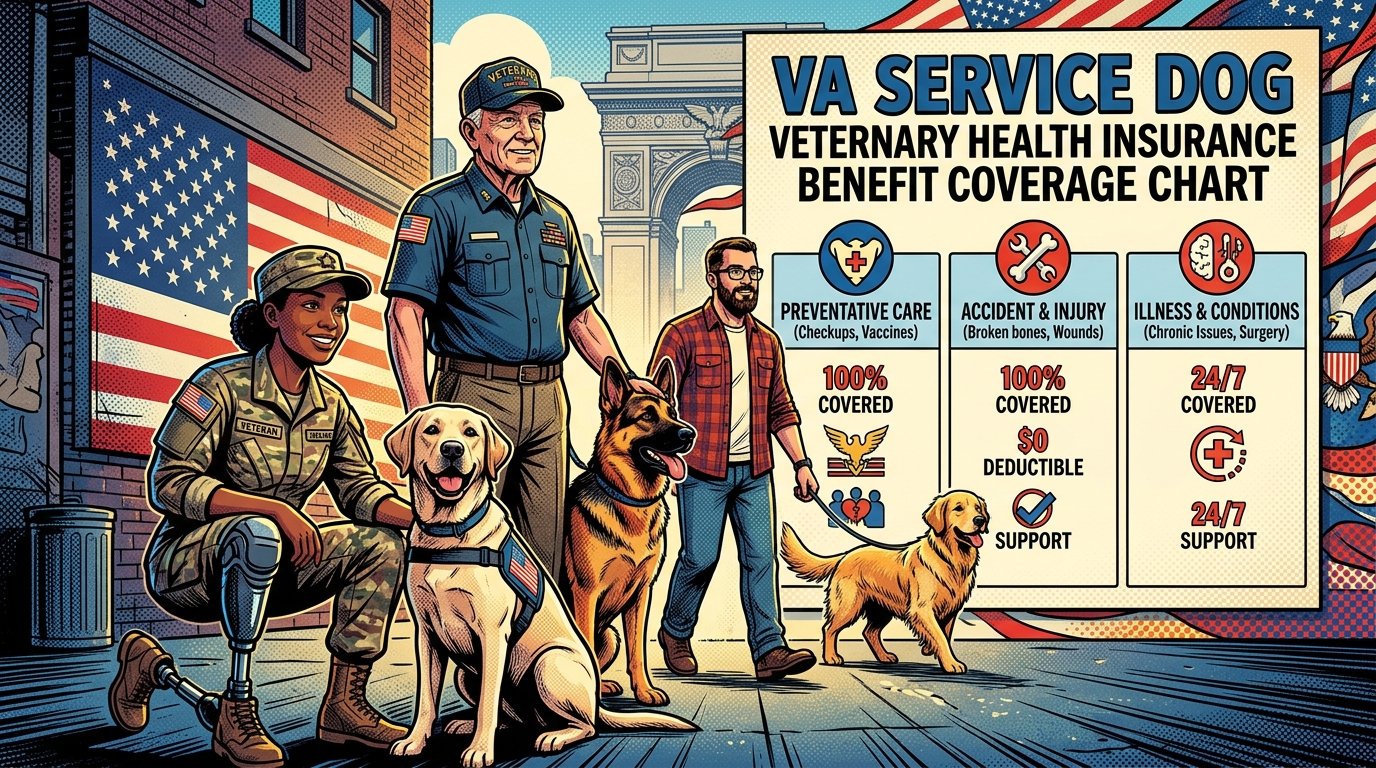
The VA does not provide service dogs directly, but it does offer a Veterinary Health Insurance Benefit (VHIB) covering veterinary care for eligible veterans with visual, hearing, or substantial mobility impairments who obtain a service dog from an Assistance Dogs International (ADI) or International Guide Dog Federation (IGDF) accredited organization. Service dogs are typically provided at no cost to the veteran by nonprofit organizations.
Quick Facts
| Item | Details |
|---|---|
| Benefit | VA Veterinary Health Insurance Benefit (VHIB) for service dogs; travel pay to attend accredited training |
| Eligibility | Veterans diagnosed with visual, hearing, or substantial mobility impairment; limited pilot for mental health mobility |
| Application | Through VA clinical care provider or mental health provider; referral to ADI/IGDF-accredited organization |
| Processing Time | Wait times vary by organization; training programs typically 6–24 months |
| Official Agency | U.S. Department of Veterans Affairs (VA), Prosthetic and Sensory Aids Service |
| Required Forms | Certificate of successful completion from ADI/IGDF-accredited organization |
| Updated For | October 2026 |
What Is a Service Dog for a Veteran?
A service dog is a dog individually trained to perform specific tasks that help a person with a disability manage daily life. For veterans, service dogs can assist with visual impairment (guide dogs), hearing impairment (hearing dogs), mobility limitations, seizure response, and—in limited cases—mental health conditions that cause substantial mobility impairment. Unlike emotional support animals, service dogs are trained to perform work or tasks directly related to a disability, and they have legal access rights under the Americans with Disabilities Act (ADA).

VA does not train or provide service dogs. Instead, VA provides a Veterinary Health Insurance Benefit (VHIB) for veterans who already have a service dog from an accredited organization, and it refers veterans to Assistance Dogs International (ADI) or International Guide Dog Federation (IGDF) accredited agencies for placement.
What Service Dogs Do for Veterans

Service dogs perform specific tasks based on the veteran’s disability. Common tasks include:
Guide dogs: Navigate obstacles, stop at curbs, and guide around hazards for veterans with visual impairment.
Hearing dogs: Alert to sounds like alarms, doorbells, or approaching vehicles.
Mobility dogs: Assist with balance, retrieve dropped items, pull wheelchairs, or provide counterbalance.
Seizure response dogs: Recognize seizure onset and provide support during or after a seizure.
Psychiatric service dogs: Interrupt anxiety or panic episodes, perform room sweeps, create space in crowds, and interrupt nightmares.
VA research has found that trained service dogs can provide greater support for PTSD-related challenges than emotional support animals because of their specialized assistance, though peer-reviewed studies show mixed results on primary outcomes like overall functioning and quality of life.
VA Service Dog Benefits: What VA Provides
VA provides two primary benefits for veterans with service dogs: a Veterinary Health Insurance Benefit (VHIB) and travel pay to attend training at an accredited organization. VA does not pay for the dog itself, training costs, food, grooming, or boarding.
Veterinary Health Insurance Benefit (VHIB)
The VHIB covers comprehensive veterinary care for the service dog. Covered services include:
Annual preventive care visits (immunizations, dental cleanings, screenings)
Urgent and emergent care
Care for chronic illnesses or disorders that enable the dog to perform its duties
One sedated dental procedure annually
Veterans May Qualify for Extra Benefits
Check available financial assistance, healthcare programs and other opportunities that may apply to you.
Check EligibilityVA, not the veteran, is billed for premiums, copayments, and deductibles. However, the veteran is responsible for costs exceeding the policy’s maximum authorized amount. Not covered: over-the-counter medications, food, treats, grooming, boarding, and non-sedated dental care.
Travel Pay for Training
VA provides financial support for veterans to travel to attend training at an ADI/IGDF-accredited service dog organization. The veteran must be preapproved for VHIB to qualify for this travel benefit through the Beneficiary Travel program.
Equipment
Service dogs may require specialized equipment medically indicated by the veteran’s provider. This equipment may be eligible for provision or replacement by the facility Prosthetic and Sensory Aids Service (PSAS) department.
What VA Does Not Cover
VA does not provide the service dog itself. VA does not pay for training. VA does not cover food, grooming, boarding, or routine expenses. VA does not cover veterinary costs that exceed the insurance policy maximum.
Eligibility for VA Service Dog Benefits
You may be eligible for VA’s service dog benefits if you are diagnosed with a visual, hearing, or substantial mobility impairment, and you obtain a service dog from an ADI or IGDF accredited organization. The VA clinical team treating you must determine that a service dog is the optimal tool for your rehabilitation and treatment plan.
Who Qualifies
Under 38 CFR 17.148, VA provides benefits to a veteran with a service dog only if:
The veteran is diagnosed as having a visual, hearing, or substantial mobility impairment; AND
The VA clinical team treating the veteran determines that a service dog is the optimal intervention.
The veteran must also:
Have the ability and means, including family or caregiver support, to care for the dog currently and in the future
Have goals that can be accomplished through the use of the dog
Have goals that could not be accomplished through other assistive technology or therapy
Successfully complete a training program from an ADI/IGDF-accredited organization
Mental Health Mobility Pilot
VA has a pilot program for up to 100 veterans with mobility impairments secondary to a mental health condition who require and use a service or guide dog. These veterans may be eligible for veterinary health benefits. The mental health provider and care team evaluate whether the mental health condition is the primary cause of the veteran’s substantial mobility limitations.
Who Does Not Qualify
Veterans with PTSD alone, without a substantial mobility impairment, generally do not qualify for VA’s VHIB under current regulations. This has been a point of advocacy, as the PAWS Act was intended to expand benefits but a federal regulation has not been updated to implement it as intended.
Income Limits
There are no income limits for VA service dog benefits. This is not a needs-based program.
Service Dogs vs. Emotional Support Animals
Service dogs and emotional support animals (ESAs) are not the same. Service dogs are trained to perform specific tasks for a person with a disability and have legal access rights. ESAs provide comfort or emotional support but are not trained for specific tasks, and they do not have the same legal access rights.
Key Differences
| Feature | Service Dog | Emotional Support Animal (ESA) |
|---|---|---|
| Training | Individually trained to perform tasks | No specific task training required |
| Legal access (ADA) | Yes, allowed in public places | No, not covered under ADA |
| VA health care facility access | Yes | No, not allowed on VA health care grounds |
| VA veterinary benefits | Yes, if eligible | No |
| Documentation | Training certificate from accredited organization | Letter from mental health provider |
Research Findings
VA-funded research has compared service dogs and emotional support dogs for veterans with PTSD. Both groups showed benefits, but there were no significant differences in primary outcomes like overall functioning and quality of life across an 18-month follow-up. Veterans with service dogs had a 3.7-point greater reduction in PTSD symptoms compared to those with emotional support dogs. However, service dogs did not appear to be superior to emotional support dogs in terms of costs. Importantly, this research does not change VA’s eligibility rules for the VHIB, which remain tied to visual, hearing, or substantial mobility impairments.
How to Get a Service Dog as a Veteran
The process starts with your VA clinical care provider. There is no online application for a service dog through VA. You must be enrolled in VA health care and have a clinical evaluation.
Step-by-Step Process
Enroll in VA health care. Apply online at VA.gov or at a VA medical center enrollment section.
Meet with your VA provider. For visual, hearing, or mobility impairments, meet with your VA clinical care provider. For mental health mobility, meet with your VA mental health provider.
Clinical evaluation. The provider completes an evaluation and determines whether a service dog is the optimal tool for your rehabilitation and treatment plan.
Referral to accredited organization. If approved, you are referred to an ADI or IGDF accredited service dog organization.
Application to the organization. The service dog organization conducts its own evaluation. The decision to provide a service dog rests with the organization.
Training. You complete training with the dog under the supervision of the organization’s qualified trainer. Training includes both dog and veteran together.
Certification. You receive a certificate of successful completion from the accredited organization.
Request VHIB. Provide the certificate to VA to request the Veterinary Health Insurance Benefit and/or a verification letter.
How to Find an Accredited Organization
VA refers veterans to organizations accredited by Assistance Dogs International (ADI) or the International Guide Dog Federation (IGDF). These organizations maintain standards for training and placement. You can search for accredited organizations through ADI’s website.
Wait Times
Wait times vary widely by organization and can range from several months to two years or more. Organizations often have waitlists. Training programs typically last from one to two years for the dog, with the veteran participating in an intensive training period that can range from a few weeks to several months.
Costs of a Service Dog for Veterans
Service dogs cost between $25,000 and $40,000 to breed, raise, and train, according to congressional estimates. Most veterans do not pay this cost directly. Nonprofit organizations cover the cost through donations, grants, and fundraising, and provide the dog to the veteran at no charge. However, some organizations require veterans to participate in fundraising.
Cost Breakdown
| Expense | Typical Cost | Who Pays |
|---|---|---|
| Dog acquisition and training | $25,000–$40,000 | Nonprofit organization (donations, grants) |
| Veteran training | Included in organization program | Organization |
| Veterinary care (after placement) | Covered up to policy limits | VA (VHIB), if eligible |
| Food, grooming, boarding | $100–$300+ monthly | Veteran |
| Equipment (harness, etc.) | Varies | VA (if medically indicated) or veteran |
Financial Assistance
Some veterans may qualify for state-level financial assistance for service dog costs. For example, New York offers grants of up to $7,500 for the purchase and training of a service dog for PTSD and/or TBI. Several states have proposed or enacted grant programs. Check with your state Department of Veterans Affairs for available programs.
The SAVES Act (Service Dogs Assisting Veterans Act), which passed the House in February 2026, would establish a five-year pilot program to award grants to nonprofit organizations to provide service dogs to eligible veterans. It would also guarantee coverage for commercially available veterinary insurance. The bill was pending in the Senate as of October 2026.
The PAWS Act and PAWS Pilot Program
The Puppies Assisting Wounded Service Members for Veterans Therapy Act (PAWS Act) was signed into law in August 2021. It established a five-year pilot program at a minimum of five VA medical centers. The program allows veterans with PTSD to train service dogs for fellow veterans.
What PAWS Does
PAWS is a dog training therapy program, not a service dog placement program. Veterans in the program attend weekly training sessions for eight weeks, working with service dog organization instructors to train candidate service dogs. The program aims to improve veteran outcomes such as confidence, trust, connection, and purpose.
PAWS Eligibility
To participate in PAWS, you must:
Be an outpatient veteran with current symptoms meeting criteria for PTSD
Be enrolled at a VA medical center PAWS pilot site
Have had an appointment with primary care, mental health, whole health, recreation therapy, or social work within the last 3 months
Be screened and approved by the VA PAWS psychologist evaluator
Attend weekly training for 8 weeks
Does PAWS Provide a Service Dog?
No. You do not receive a service animal after completing PAWS. If you are interested in obtaining a service dog, talk to your doctor and health care team. VA doesn’t train service dogs but can help you find a partner organization.
Pilot Status
VA initiated the PAWS pilot on February 21, 2022. It is currently in its fourth year and will conclude on February 21, 2027. VA does not recommend extending or making the pilot permanent, based on several factors including participation levels.
Legal Rights: Service Dogs and the ADA
Service dogs have legal access rights under the Americans with Disabilities Act (ADA). They must be allowed to accompany their handler in public places, including VA health care facilities.
ADA Access Rules
Under the ADA, a service animal is a dog trained to do work or perform tasks for a person with a disability. Only dogs qualify as service animals. Other animals, including emotional support animals, do not qualify.
What VA Staff Can Ask
To determine if a dog is a service animal, VA staff cannot ask about your disability, require medical documentation, or require a specific ID card or training document. If it is not clear that the dog is a service animal, staff can only ask two questions:
Is your dog a service animal required because of a disability?
What work or task has your dog been trained to do?
Handler Responsibilities
While on VA property, you are responsible for:
Keeping the dog in a harness, on a leash, or tethered and under control
Providing food, water, and elimination breaks
Removing waste if the dog eliminates indoors
Ensuring the dog behaves properly
Service animals that are not under control or behaving properly must be removed from VA property.
Emotional Support Animals at VA Facilities
Emotional support animals are not allowed on the grounds of VA health care facilities, and they cannot accompany you to appointments.
Common Mistakes with Service Dog Benefits
The most common mistake is assuming VA provides service dogs directly. VA does not train or provide service dogs. Another common mistake is confusing service dogs with emotional support animals.
Top Mistakes
Assuming VA provides the dog. VA only provides VHIB and travel pay for eligible veterans who obtain a dog from an accredited organization.
Thinking PTSD alone qualifies for VHIB. Under current regulations, PTSD without substantial mobility impairment does not qualify.
Getting a dog from a non-accredited trainer. VA will not recognize the dog for VHIB unless training was through ADI/IGDF accredited organization.
Not enrolling in VA health care first. You must be enrolled and evaluated by a VA provider.
Underestimating ongoing costs. Food, grooming, and boarding are not covered by VA.
Not understanding the wait. Service dog placement can take months to years.
Not checking state benefits. Some states offer financial assistance for service dog costs.
Common Questions
1. Does VA provide service dogs for free?
No. VA does not provide service dogs. However, nonprofit organizations accredited by ADI or IGDF provide service dogs at no cost to the veteran. VA provides a veterinary health insurance benefit for eligible veterans who obtain a service dog from an accredited organization.
2. Can I get a service dog for PTSD through VA?
Generally, no. VA’s VHIB is limited to veterans with visual, hearing, or substantial mobility impairments. PTSD alone does not qualify. A pilot program exists for up to 100 veterans with mobility impairments secondary to a mental health condition. The PAWS program allows veterans with PTSD to train service dogs for others, but does not provide a dog to the participant.
3. How much does a service dog cost?
Service dogs cost $25,000 to $40,000 to produce. Most veterans do not pay this cost directly. Nonprofits cover it through donations and grants. Ongoing costs like food and grooming are the veteran’s responsibility.
4. What is the difference between a service dog and an emotional support animal?
A service dog is trained to perform specific tasks for a person with a disability and has ADA access rights. An emotional support animal provides comfort but has no task training and no ADA access rights. ESAs are not allowed on VA health care grounds.
5. How do I apply for VA service dog benefits?
Start by enrolling in VA health care and meeting with your VA clinical care provider. The provider evaluates whether a service dog is the optimal tool for your treatment plan. If approved, you are referred to an ADI/IGDF-accredited organization.
6. What does VA’s Veterinary Health Insurance Benefit cover?
It covers annual preventive care, urgent and emergent care, prescription medications, care for chronic conditions, and one sedated dental procedure annually. It does not cover food, grooming, boarding, or over-the-counter medications.
7. How long does it take to get a service dog?
Wait times vary. Some organizations have waitlists of several months to two years. Training programs for the dog typically last one to two years. Veteran training periods range from a few weeks to several months.
8. Can I train my own service dog and get VA benefits?
VA requires the dog and veteran to successfully complete a training program from an ADI or IGDF accredited organization. Self-trained dogs are not eligible for VHIB unless the training was through an accredited organization.
9. What is the PAWS Act?
The PAWS Act (Puppies Assisting Wounded Service Members for Veterans Therapy Act) established a five-year pilot program allowing veterans with PTSD to train service dogs for fellow veterans. The pilot concludes February 21, 2027. VA does not recommend extending it.
10. Are there state programs that help pay for service dogs?
Yes. Some states offer financial assistance. New York offers grants up to $7,500. Other states have proposed or enacted similar programs. Check with your state Department of Veterans Affairs.
11. What tasks can a service dog perform for a veteran with PTSD?
Psychiatric service dogs can interrupt anxiety or panic episodes, perform room sweeps, create space in crowds, interrupt nightmares, turn on lights, and retrieve medication. These tasks are specifically trained, not just companionship.
12. Can a service dog go with me to VA appointments?
Yes. Service dogs must be granted access to VA health care facilities when accompanying a person with a disability. Emotional support animals are not allowed.
Key Takeaways
VA does not provide or train service dogs. It provides a Veterinary Health Insurance Benefit (VHIB) for eligible veterans who obtain a dog from an ADI/IGDF-accredited organization.
VHIB eligibility requires a visual, hearing, or substantial mobility impairment. PTSD alone does not qualify.
Service dogs cost $25,000–$40,000 to produce. Nonprofits provide them to veterans at no cost.
Ongoing costs like food, grooming, and boarding are the veteran’s responsibility.
Service dogs have ADA access rights; emotional support animals do not.
The PAWS pilot program (2022–2027) lets veterans with PTSD train service dogs for others but does not provide a dog to participants.
The SAVES Act, passed by the House in February 2026, would create grants to nonprofits to provide service dogs and guarantee veterinary insurance.
Some states offer financial assistance for service dog costs.
The process starts with enrolling in VA health care and meeting with a VA provider.
VA travel pay is available for eligible veterans attending accredited training.
Official Resources
VA Service Dog Benefits: https://www.va.gov/saginaw-health-care/programs/service-dog-benefits/
Service Dog Frequently Asked Questions: https://www.prosthetics.va.gov/Docs/ServiceDogFAQ.pdf
Service Dog Veterinary Health Insurance Benefit Rules: https://prosthetics.va.gov/PROSTHETICS/factsheet/PSAS-FactSheet-ServiceDogs.pdf
38 CFR 17.148 – Service Dogs: https://www.ecfr.gov/current/title-38/section-17.148
PAWS Pilot Program: https://www.va.gov/palo-alto-health-care/programs/service-animals/puppies-assisting-wounded-service-members-paws/
ADA Service Animal Requirements: https://www.ada.gov/resources/service-animals-2010-requirements/
Assistance Dogs International: https://assistancedogsinternational.org/
USA.gov Veterans Benefits: https://www.usa.gov/veterans-benefits



🇺🇸 IMPORTANT DISCLAIMER – Veterans Benefits Information
This site provides general information about U.S. Department of Veterans Affairs (VA) benefits for educational and informational purposes only.
- Not Official: We are NOT affiliated with, endorsed by, or connected to the U.S. Department of Veterans Affairs (VA), the Veterans Benefits Administration (VBA), the Veterans Health Administration (VHA), or any other government agency.
- No Legal/Financial Advice: The content on this website is for informational purposes only and does not constitute legal, financial, or medical advice. VA benefits rules change frequently – always consult with an accredited Veterans Service Officer (VSO) or a qualified professional for your specific situation.
- Official Sources: For official, binding information and to apply for benefits, always visit official .gov websites: VA.gov, Benefits.VA.gov, or SSA.gov.
- No Data Collection: This site does not collect, store, or process any personal information. It does not have login forms, contact forms, or any system to capture user data. We never ask for your Social Security Number, bank details, or any personal information.
- 🚨 Scam Alert: The VA and other government agencies never charge fees for benefit applications. If anyone asks for money to "process" your VA claim, it is a scam. Report it to the VA Office of Inspector General at VA.gov/OIG.
- Advertising: This site uses third-party advertising (Adsterra) to cover operational costs. We do not endorse or guarantee any products or services advertised.
📌 Information provided as of June 2026. Always verify current eligibility and rules with official .gov sources.
This site is not affiliated with the U.S. Department of Veterans Affairs or any government agency. All information is for educational purposes only. Please visit VA.gov for official information.
