
How Many Blind Veterans Are There in the United States?
An estimated 130,000 veterans in the United States are legally blind, and more than 1 million veterans have low vision that makes daily activities difficult or impossible. The Blinded Veterans Association (BVA) confirms these figures, representing over 130,000 legally blind veterans and over 1 million more living with serious vision loss.
| Item | Details |
|---|---|
| Population | ~130,000 legally blind; >1 million with low vision |
| Primary Benefit | VA disability compensation, SMC, Blind Rehabilitation Services |
| Eligibility | Veterans with service-connected vision loss or legal blindness |
| Application | VA Form 21-526EZ (compensation); VIST referral (rehabilitation) |
| Processing Time | 3–6 months for disability claims; varies for rehabilitation |
| Official Agency | U.S. Department of Veterans Affairs (VA) |
| Required Forms | VA Form 21-526EZ; VA Form 10-10EZ (health care) |
| Updated For | 2026 |
How Many Blind Veterans Are in the U.S.?
Approximately 130,000 U.S. veterans are legally blind. An additional 1 million-plus veterans have low vision — significant, uncorrectable visual impairment that affects daily living.

Legal Blindness Defined
Legal blindness is a measurement based on visual acuity or visual field. To qualify as legally blind, a person must have at least one of the following:
Visual acuity of 20/200 or worse in the best eye with corrective lenses
Visual field of 20 degrees or less

Legal blindness exists on a spectrum. Most veterans enrolled in VA Blind Rehabilitation Services have some remaining vision.
Low Vision Defined
Low vision means significant, uncorrectable visual impairment between 20/70 and legal blindness. More than 1 million veterans fall into this category. These veterans may struggle with reading, driving, recognizing faces, or performing job tasks.
Historical Context
The number of legally blind veterans has fluctuated over decades. Earlier estimates placed the figure at approximately 160,000, with about 1,026,000 low vision veterans. The current estimate of 130,000 reflects updated data and demographic shifts. Aging is driving growth in Blind Rehabilitation inpatient service utilization, as diagnoses of vision problems increase with age.
Why the Numbers Matter
These numbers underscore a critical reality: blindness is a low-incidence, high-complexity disability affecting a significant veteran population. Understanding the scale helps veterans, families, and caregivers access the right benefits and services.
What Causes Blindness and Vision Loss in Veterans?
Veterans May Qualify for Extra Benefits
Check available financial assistance, healthcare programs and other opportunities that may apply to you.
Check EligibilityVision loss in veterans stems from both combat injuries and age-related conditions. The causes vary by era of service and individual circumstances.
Combat-Related Causes
Traumatic brain injury (TBI): Nearly two-thirds of service members with TBI may experience vision problems.
Eye injuries: Eye injuries account for 10% to 15% of combat casualties.
Blast exposure: Veterans who served in Iraq and Afghanistan experience blast-related brain injuries that can lead to blurred vision, double vision, light sensitivity, and reading difficulty.
On average, members of the U.S. armed services suffer 15,681 eye injuries per year. An additional 4,000 cases of TBI without eye injury cause visual impairment annually. In 2025 dollars, the estimated annual cost of treatment, benefits, and lost productivity related to these injuries is $3.2 billion.
Age-Related Causes
Among older veterans, major causes of vision loss include:
Age-related macular degeneration
Glaucoma
Cataracts
Stroke
Diabetic retinopathy
Toxic Exposure
The PACT Act expanded eligibility for veterans exposed to burn pits, Agent Orange, and other toxic substances. Vision loss can be claimed as a primary condition or as secondary to a service-connected disability. Veterans can file claims for vision loss under the PACT Act.
VA Disability Compensation for Blindness and Vision Loss
VA disability compensation is a monthly, tax-free payment for veterans whose military service caused or worsened a vision condition. Blindness is rated under Diagnostic Code 6066 and can reach 100% disability.
VA Ratings for Visual Impairment
The VA rates visual acuity impairment across 10 severity levels, from 0% to 100%:
| Rating | Criteria | 2026 Monthly Payment (Veteran Alone) |
|---|---|---|
| 100% | No light perception in both eyes; or corrected visual acuity 5/200 or less in the better eye | $3,938.58 |
| 80% | Visual acuity 15/200 in the better eye | Varies by dependents |
| 70% | Visual acuity 20/200 in the better eye | Varies by dependents |
| 60% | Visual acuity 20/100 in the better eye | Varies by dependents |
| 50% | Visual acuity 20/70 in the better eye | Varies by dependents |
| 30%–40% | Moderate impairment | Varies by dependents |
| 10%–20% | Mild impairment | Varies by dependents |
Note: At 100%, a veteran with no dependents receives $3,938.58 per month, tax-free (2026 rates). Dependents add to that amount.
Special Monthly Compensation (SMC) for Blindness
Veterans who are blind in both eyes with visual acuity of 5/200 or less may qualify for Special Monthly Compensation (SMC-L) at $4,183.85 per month (2026 rates).
Additional SMC tiers apply for blindness combined with other disabilities:
| Condition | SMC Rate |
|---|---|
| Blindness in both eyes (5/200 or less) | SMC-L: $4,183.85/mo |
| Blindness with deafness or loss of use of a hand/foot | Higher intermediate rates |
| Blindness with bilateral deafness (30%+) | Next higher statutory rate |
| Blindness with loss of use of one hand | Next higher statutory rate |
SMC is paid in addition to the 100% disability compensation rate. Blindness of one eye with 5/200 visual acuity or less and blindness of the other eye having only light perception entitles a veteran to a rate between SMC-L and SMC-M.
How to Apply for VA Disability Compensation
Gather evidence: Service treatment records, personnel records, private medical records, and a current diagnosis.
Obtain a nexus letter: A qualified provider must link your vision loss to military service.
Complete VA Form 21-526EZ (Application for Disability Compensation and Related Compensation Benefits).
Submit online at VA.gov, by mail, or through an accredited Veterans Service Organization (VSO).
Common Mistakes to Avoid
Filing without a current diagnosis
Failing to describe the in-service event or injury clearly
Not submitting buddy statements or lay evidence
Missing the intent-to-file deadline (use VA Form 21-0966 to lock in your effective date)
VA Blind Rehabilitation Services (BRS)
VA operates the first and only national healthcare system to completely integrate rehabilitation services for patients with vision loss into its health benefits. Blind Rehabilitation Services (BRS) provides care coordination, assessments, and therapeutic instruction to help veterans reclaim independence.
The VIST Program: Entry Point to BRS
The Visual Impairment Services Team (VIST) Coordinator is often the entry point into the BRS continuum of care. The VIST Coordinator serves as a lifetime care manager for veterans enrolled in BRS.
VIST services include:
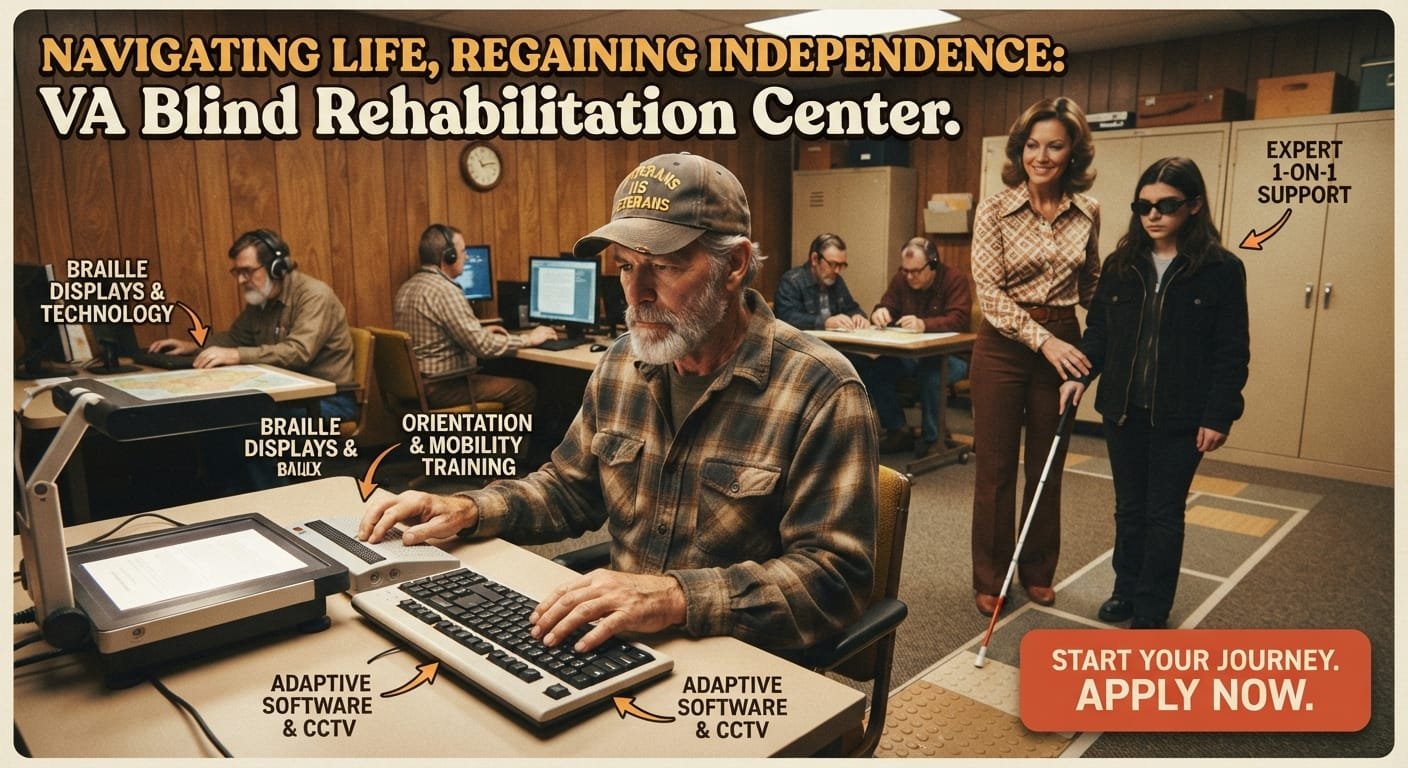
Vision-enhancing devices and technologies and training
Training in new visual skills for reading, writing, cooking, medication management
Sensory training using hearing or touch
Orientation and mobility training
Communication strategies and assistive technology
Counseling and support groups
Family training
VIST Eligibility
To enroll in the VIST program, a veteran must be:
Eligible for VA health benefits (or be an active duty service member), and
Diagnosed as legally blind by an optometrist or ophthalmologist
Some veterans with vision loss may qualify based on functional deficits and other disabilities, as determined by the VIST coordinator.
Inpatient Blind Rehabilitation Centers (BRCs)
VA operates 13 Blind Rehabilitation Centers providing 4–6 weeks of inpatient adjustment-to-blindness training to help blinded veterans achieve a realistic level of independence.
BRCs are located in:
Augusta, Georgia
Biloxi, Mississippi
Birmingham, Alabama
Cleveland, Ohio
Hines, Illinois
Long Beach, California
Palo Alto, California
San Juan, Puerto Rico
Tacoma, Washington
Tucson, Arizona
Waco, Texas
West Haven, Connecticut
West Palm Beach, Florida
BRC residential settings maximize peer-to-peer interactions, helping veterans achieve their best level of independence. Therapeutic instruction is provided one-on-one or in group settings.
Blind TeleRehabilitation
VA offers Blind TeleRehabilitation — virtual services for veterans with vision loss who cannot easily access in-person care. Veterans can be referred through their VIST coordinator, VA primary care provider, social worker, or optometrist. The program begins with an assessment about the veteran’s condition, challenges, and goals.
Visual Impairment Services Outpatient Rehabilitation (VISOR)
VISOR provides outpatient rehabilitation for veterans and service members who are legally blind or have functional vision loss. Veterans enrolled in VA health care can be referred by another clinic or through their VIST coordinator.
Guide Dogs and Service Dogs for Blind Veterans
VA provides benefits for guide dogs trained to assist blind and visually impaired veterans with navigation and obstacle avoidance. A guide dog is specifically trained to assist blind individuals, while a service dog is trained to help veterans with other disabilities.
VA Guide Dog Benefits
VA provides veterinary health insurance benefits for the care of service dogs and travel pay to an accredited training program. The insurance policy guarantees coverage for all treatment and associated prescription medications.
Eligibility for Guide Dog Benefits
Veterans who are legally blind or have significant visual impairment
The guide dog must be prescribed by a VA provider
The training program must be accredited by the Association of Guide Dog Users or the International Guide Dog Federation
BVA Advocacy for Guide Dogs
The Blinded Veterans Association (BVA) is actively advocating for codifying robust protections for guide and service dogs within VA facilities and ensuring consistent benefits for veterans who need them.
The PACT Act and Vision Loss
The PACT Act (Sergeant First Class Heath Robinson Honoring our Promise to Address Comprehensive Toxics Act of 2022) expanded VA health care and benefits for veterans exposed to burn pits, Agent Orange, and other toxic substances.
What the PACT Act Does for Vision
The PACT Act added a presumption of service connection for 23 conditions associated with exposure to burn pits and other toxins. Vision loss can be claimed as:
A primary condition related to toxic exposure
A secondary condition to another service-connected disability
How to File a PACT Act Vision Loss Claim
File VA Form 21-526EZ
Submit evidence of toxic exposure during service
Provide a current diagnosis of vision loss
If filing as secondary, provide a nexus linking vision loss to your service-connected condition
Veterans who filed before August 10, 2023 may receive benefits backdated to that date.
Why This Matters
Many veterans exposed to burn pits, Agent Orange, or other toxins may not realize their vision problems could be service-connected. The PACT Act removes the burden of proving direct causation for covered conditions. If you have vision loss and served in a toxic-exposed location, file a claim.
Appeals Process for Vision Loss Claims
If VA denies your vision loss claim, you have three appeal options.
Option 1: Supplemental Claim (VA Form 20-0995)
Submit new and relevant evidence that VA did not previously consider. This is the fastest option if you have additional medical records or a new nexus letter.
Option 2: Higher-Level Review (VA Form 20-0996)
Request a senior reviewer at the same VA regional office to re-examine your claim. No new evidence is allowed. This option is best if you believe VA made an error in evaluating your existing evidence.
Option 3: Board Appeal (VA Form 10182)
Request a Veterans Law Judge to review your case. You can choose:
Direct review (no new evidence)
Evidence submission (submit new evidence)
Hearing (present your case in person or virtually)
Deadlines
Supplemental Claim: One year from the decision date to preserve the effective date
Higher-Level Review: One year from the decision date
Board Appeal: One year from the decision date
Common Reasons VA Denies Vision Loss Claims
No current diagnosis
No nexus between vision loss and military service
Insufficient evidence of in-service event or injury
Visual acuity does not meet rating criteria
Claim filed as primary when it should be secondary (or vice versa)
State Differences in Blind Veteran Benefits
Beyond federal VA benefits, some states offer additional benefits for blind veterans. These vary widely.
Examples of State Benefits
| State | Benefit |
|---|---|
| New Jersey | Blind Veterans’ Allowance: $750 annually (unchanged since 1971) |
| Pennsylvania | State Department of Military and Veterans Affairs programs |
| New York | Additional state veterans benefits for blinded veterans |
How to Find Your State’s Benefits
Contact your state department of veterans affairs or a local Veterans Service Office. Many states offer property tax exemptions, vehicle registration fee waivers, and additional monthly payments for blind veterans.
Why State Benefits Matter
Federal VA benefits may not cover all costs. State benefits can fill gaps in housing, transportation, and daily living assistance.
Latest Rule Changes and BVA Legislative Priorities
The Blinded Veterans Association (BVA) has outlined key legislative priorities for 2026.
2026 BVA Legislative Priorities
Modernize the Caregiver Program: Incorporate blindness-specific clinical standards for Activities of Daily Living into the Program of Comprehensive Assistance for Family Caregivers (PCAFC).
Protect Guide and Service Dogs: Codify robust protections for guide and service dogs within VA facilities.
Expand Eligibility: Automatically include veterans with corrected acuity of 5/200 or worse, or a visual field of 5 degrees or less, in caregiver program eligibility.
Support the Major Richard Star Act: End the unfair retirement offset for combat-injured veterans.
Fund Vision Research: Request $20 million for the DoD CDMRP Vision Research Program.
80th Anniversary of the Blinded Veterans Association
In May 2025, the U.S. Senate passed a resolution commemorating the 80th anniversary of the Blinded Veterans Association. BVA was founded by 100 war-blinded soldiers from World War II and is the only national veteran service organization chartered by Congress exclusively dedicated to assisting America’s blinded veterans and their families.
How to Apply for VA Blind Rehabilitation Services
Step-by-Step Process
Enroll in VA health care (if not already enrolled): Apply online at VA.gov/health-care/apply or complete VA Form 10-10EZ.
Get a diagnosis: Obtain a diagnosis of legal blindness or significant visual impairment from an optometrist or ophthalmologist.
Contact your VIST Coordinator: Ask your VA primary care provider, social worker, or optometrist for a referral, or contact your local VA medical center directly.
Complete the VIST assessment: The VIST Coordinator evaluates your functional deficits and rehabilitation needs.
Receive a treatment plan: Based on your goals and needs, you may be referred to outpatient services, Blind TeleRehabilitation, or an inpatient BRC.
Required Documents
DD-214 (Certificate of Release or Discharge from Active Duty)
Current eye exam and diagnosis
VA health care enrollment confirmation
Any relevant service treatment records
Processing Times
VIST enrollment: 1–4 weeks after referral
Inpatient BRC admission: Varies; wait times have been reported at an average of 19 weeks
Outpatient rehabilitation: 1–3 months depending on facility capacity
Common Questions
1. How many blind veterans are in the United States?
An estimated 130,000 U.S. veterans are legally blind, and more than 1 million have low vision that affects daily activities. These figures are confirmed by the Blinded Veterans Association and cited in U.S. Senate resolutions.
2. What qualifies as legally blind for VA benefits?
Legal blindness means visual acuity of 20/200 or worse in the best eye with corrective lenses, or a visual field of 20 degrees or less. VA uses these criteria to determine eligibility for Blind Rehabilitation Services and disability ratings.
3. Do I need a service-connected disability to get VA blind rehabilitation?
No. You can receive VA blind rehabilitation services if you are enrolled in VA health care and diagnosed as legally blind, even if your vision loss is not service-connected. The VIST program serves all eligible veterans with vision loss.
4. What is the VA disability rate for 100% blindness in 2026?
A veteran with no dependents rated 100% for blindness receives $3,938.58 per month, tax-free. If blind in both eyes with visual acuity 5/200 or less, the veteran may also qualify for Special Monthly Compensation (SMC-L) at $4,183.85 per month.
5. Can I get a guide dog through the VA?
Yes. VA provides veterinary health insurance benefits for guide dogs and travel pay to an accredited training program. The dog must be prescribed by a VA provider, and the training program must be accredited by the Association of Guide Dog Users or the International Guide Dog Federation.
6. How long does it take to get into a VA Blind Rehabilitation Center?
Wait times vary. More than 1,200 blinded veterans have waited an average of more than 19 weeks for admission to a BRC. Outpatient and telehealth options may be available sooner.
7. Can I file a VA claim for vision loss under the PACT Act?
Yes. The PACT Act allows veterans exposed to burn pits, Agent Orange, or other toxins to file claims for vision loss as a primary or secondary condition. File VA Form 21-526EZ with evidence of exposure and a current diagnosis.
8. What is the VIST program?
The Visual Impairment Services Team (VIST) is VA’s entry point for blind rehabilitation. The VIST Coordinator serves as a lifetime care manager, organizing services including vision-enhancing devices, orientation and mobility training, and counseling.
9. How do I appeal a denied vision loss claim?
You have three options: Supplemental Claim (VA Form 20-0995) with new evidence, Higher-Level Review (VA Form 20-0996), or Board Appeal (VA Form 10182). You have one year from the decision date to preserve your effective date.
10. Does VA cover eye exams and glasses?
Yes. VA provides free eye exams and prescription glasses to eligible veterans. Eligibility is based on service-connected disability, income, or other VA health care enrollment factors. Contact your local VA medical center to schedule an exam.
Key Takeaways
Approximately 130,000 U.S. veterans are legally blind; more than 1 million have low vision.
VA disability compensation for blindness reaches **100% ($3,938.58/month in 2026)** plus Special Monthly Compensation (SMC-L: $4,183.85/month).
VA operates 13 Blind Rehabilitation Centers and the VIST program for lifetime care coordination.
You do not need a service-connected disability to receive VA blind rehabilitation services.
The PACT Act allows vision loss claims related to toxic exposure.
VA provides guide dog benefits including veterinary insurance and travel pay.
The Blinded Veterans Association (BVA) is the only congressionally chartered VSO exclusively serving blinded veterans.
The Veterans Crisis Line (Dial 988, Press 1) is available 24/7 to all veterans.
Appeals for denied vision loss claims can be filed within one year to preserve the effective date.
State benefits for blind veterans vary; contact your state veterans affairs office for additional programs.
Official Resources
VA Blind Rehabilitation Services: VA.gov/blind-rehabilitation
VA Disability Compensation: VA.gov/disability
VA Health Care Enrollment: VA.gov/health-care/apply
VA Guide Dog Benefits: VA.gov/service-dog-benefits
Blinded Veterans Association: BVA.org
Veterans Crisis Line: VeteransCrisisLine.net (Dial 988, Press 1)
VA PACT Act Information: VA.gov/resources/the-pact-act-and-your-va-benefits
VA Appeals Modernization: VA.gov/decision-reviews
USA.gov Veterans Benefits: USA.gov/veterans-benefits

🇺🇸 IMPORTANT DISCLAIMER – Veterans Benefits Information
This site provides general information about U.S. Department of Veterans Affairs (VA) benefits for educational and informational purposes only.
- Not Official: We are NOT affiliated with, endorsed by, or connected to the U.S. Department of Veterans Affairs (VA), the Veterans Benefits Administration (VBA), the Veterans Health Administration (VHA), or any other government agency.
- No Legal/Financial Advice: The content on this website is for informational purposes only and does not constitute legal, financial, or medical advice. VA benefits rules change frequently – always consult with an accredited Veterans Service Officer (VSO) or a qualified professional for your specific situation.
- Official Sources: For official, binding information and to apply for benefits, always visit official .gov websites: VA.gov, Benefits.VA.gov, or SSA.gov.
- No Data Collection: This site does not collect, store, or process any personal information. It does not have login forms, contact forms, or any system to capture user data. We never ask for your Social Security Number, bank details, or any personal information.
- 🚨 Scam Alert: The VA and other government agencies never charge fees for benefit applications. If anyone asks for money to "process" your VA claim, it is a scam. Report it to the VA Office of Inspector General at VA.gov/OIG.
- Advertising: This site uses third-party advertising (Adsterra) to cover operational costs. We do not endorse or guarantee any products or services advertised.
📌 Information provided as of June 2026. Always verify current eligibility and rules with official .gov sources.
This site is not affiliated with the U.S. Department of Veterans Affairs or any government agency. All information is for educational purposes only. Please visit VA.gov for official information.
