
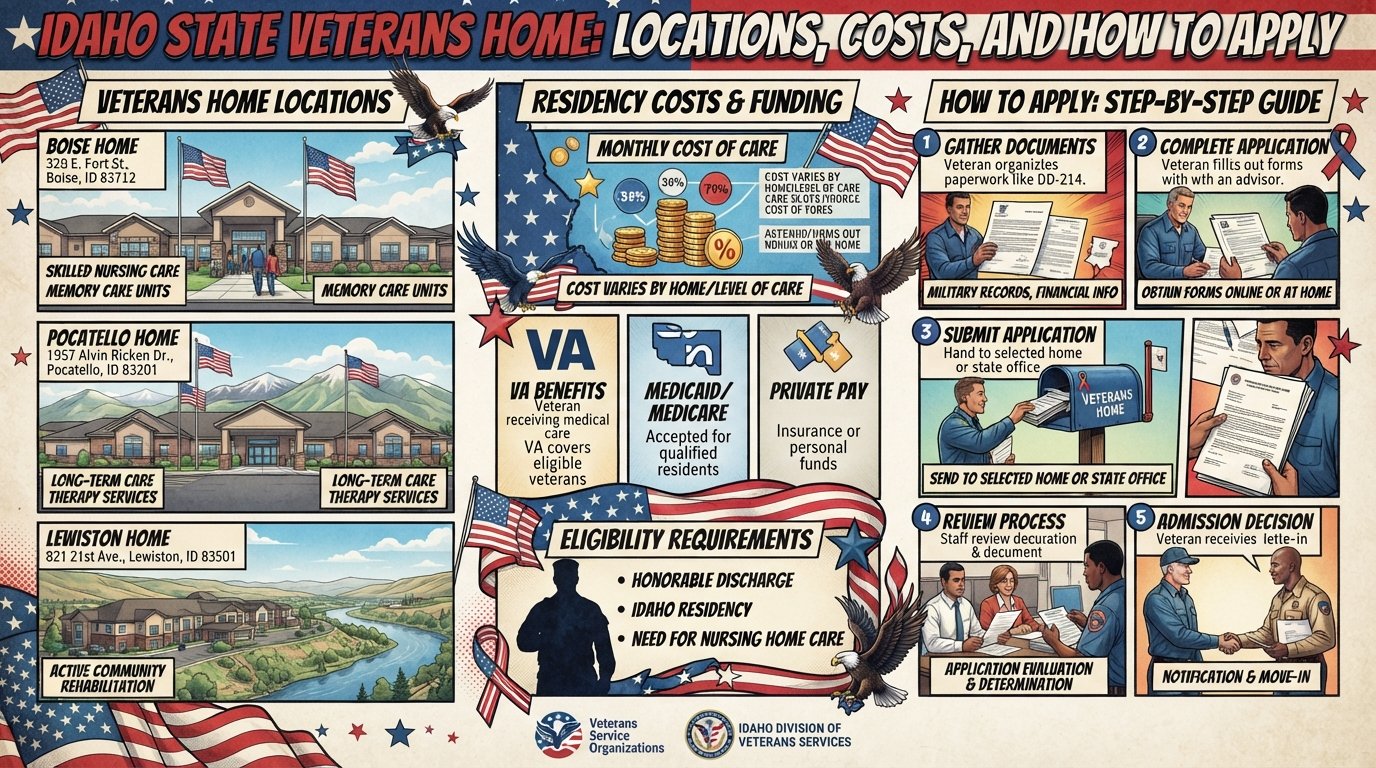
Idaho State Veterans Home: Locations, Eligibility, Costs, and Application Guide
Featured Answer: The Idaho State Veterans Home system operates four skilled nursing facilities in Boise, Lewiston, Pocatello, and Post Falls. Eligible honorably discharged veterans with at least 90 days of active duty and Idaho residency can apply. Applicants must qualify for Medicaid or pay the maximum monthly charge, and veterans must apply for a VA pension and Aid and Attendance.
Quick Facts
| Item | Details |
|---|---|
| Benefit | 24-hour skilled nursing care, memory care, rehabilitation, and residential/domiciliary care for eligible veterans and spouses |
| Eligibility | Honorably discharged veteran (90+ days active duty, or earlier for service-connected disability) and bona fide Idaho resident; spouses/widows eligible for nursing care only |
| Application | Submit the Idaho State Veterans Home Application for Admission to the Admission Department at the desired home |
| Processing Time | Varies based on bed availability and clinical assessment; approved applicants without a vacancy are placed on a waitlist |
| Official Agency | Idaho Division of Veterans Services (IDVS) |
| Required Forms | Application for Admission; DD-214; proof of Idaho residency; Medicaid/insurance cards; proof of marriage for spouses; VA pension and Aid and Attendance application |
| Updated For | 2026 |
What Is the Idaho State Veterans Home?
The Idaho State Veterans Home is a system of four state-operated skilled nursing facilities administered by the Idaho Division of Veterans Services (IDVS). The homes provide 24-hour nursing care, memory care, rehabilitative services, and residential care to honorably discharged Idaho veterans and their eligible spouses. All four homes are Medicare and Medicaid certified.

Why it matters: These homes offer a veteran-focused care environment that emphasizes camaraderie and understanding of military service. For Idaho families facing the high cost of private nursing care, the state veterans home system provides a more affordable pathway, particularly for veterans who qualify for VA pension, Aid and Attendance, and Medicaid.

What veterans should do next: Determine which of the four homes is closest to family and supports the level of care needed. Boise is the only home with a dedicated memory care unit; Post Falls offers all private rooms. Contact the Admission Department at the preferred home to request an application and confirm current bed availability.
Idaho State Veterans Home Locations
Idaho operates four veterans homes: Boise, Lewiston, Pocatello, and Post Falls. Each has a different bed capacity, service mix, and contact information. The Boise home is the largest and the only one with a dedicated Alzheimer’s special care unit. Post Falls is the newest facility and offers only private rooms.
Boise
The Boise home is an 80-bed skilled nursing care facility that includes a 17-bed special care unit for veterans with Alzheimer’s disease or related conditions. It also operates a 36-bed residential/domiciliary care unit. The facility features a physical therapy center, spacious dining room, covered patio, courtyards, library services, and transportation to medical appointments. The home is currently operating at reduced capacity during a long-planned renovation and replacement project.
Address: 320 Collins Road, Boise, ID 83702
Phone: (208) 780-1600
Fax: (208) 780-1601
Lewiston
Veterans May Qualify for Extra Benefits
Check available financial assistance, healthcare programs and other opportunities that may apply to you.
Check EligibilityThe Lewiston home opened in 1994 and has 66 skilled nursing beds on three halls. It is situated in a park-like setting at the confluence of the Clearwater and Snake Rivers, offering panoramic views of nearby rolling hills. The home provides a full range of financial, social, spiritual, and skilled nursing care, with a canteen area and dining hall.
Address: 821 21st Avenue, Lewiston, ID 83501
Phone: (208) 750-3600
Fax: (208) 750-3601
Pocatello
The Pocatello home has 66 skilled nursing beds and does not have memory care, specialty care, or domiciliary beds. Four private rooms are available. The home benefits from its proximity to Idaho State University health professional programs, hosting the largest number of clinical internships among Idaho’s veterans homes. It features a hilltop view of Pocatello, a large therapy room, chapel, library, and rose gardens.
Address: 1957 Alvin Ricken Drive, Pocatello, ID 83201
Phone: (208) 235-7800
Fax: (208) 235-7801
Post Falls
The Post Falls home was dedicated on November 11, 2022, and is the newest facility. It is a 64-bed skilled nursing facility with all single-occupancy rooms. It was officially licensed by the state on February 21, 2023, and by the VA on November 9, 2023. The home features a centralized community center, chapel, therapy room, bistro, and sports club.
Address: 590 S Pleasant View Road, Post Falls, ID 83854
Phone: (208) 415-3430
Fax: (208) 415-3435
Comparison Table: Idaho State Veterans Homes at a Glance
| Home | Skilled Nursing Beds | Memory Care | Private Rooms | Special Features | Phone |
|---|---|---|---|---|---|
| Boise | 80 operational (122 at full capacity) | Yes – 17-bed Alzheimer’s unit | Limited (double-occupancy primarily) | Residential/domiciliary unit; physical therapy center; library | (208) 780-1600 |
| Lewiston | 66 | No | Limited | Riverfront setting; canteen; dining hall | (208) 750-3600 |
| Pocatello | 66 | No | 4 private rooms | University-affiliated internships; chapel; rose gardens | (208) 235-7800 |
| Post Falls | 64 | No | All single-occupancy | Bistro; sports club; chapel; therapy room | (208) 415-3430 |
Eligibility for Idaho State Veterans Home
You may be eligible for admission if you are an honorably discharged veteran who served at least 90 days of active duty (or were discharged earlier under honorable conditions because of a service-connected disability), are a bona fide resident of Idaho at the time of application, and are unemployable as a result of age, illness, or disability. Spouses, widows, and widowers of eligible veterans may qualify for nursing care only.
Who Qualifies
Wartime and peacetime veterans with at least 90 days of active-duty service and an honorable discharge.
Veterans discharged earlier than 90 days under honorable conditions because of a service-connected disability.
Spouses, widows, and widowers of eligible veterans, for nursing care only.
Idaho residents at the time of application. The applicant must be a bona fide resident of the state.
Who Does Not Qualify
Veterans with a dishonorable discharge.
Veterans who do not meet the minimum active-duty service requirement (unless discharged early for a service-connected disability).
Non-veteran spouses seeking residential or domiciliary care; spouses are eligible for nursing care only.
Applicants who are not Idaho residents at the time of application.
Applicants whose clinical needs exceed the home’s ability to provide the appropriate level of care.
Priority Admission
Wartime veterans receive priority admission status over peacetime veterans. Within each category, approved applicants are placed on a waiting list and accepted on a first-come, first-served basis, depending on bed availability and the home’s ability to provide the needed level of care.
What veterans should do next: Confirm your discharge character and active-duty service length using your DD-214. If your DD-214 is unavailable, the Admission Department can assist with requesting a copy through the VA. If you are a spouse or widow, gather proof of marriage and the veteran’s DD-214.
Financial Eligibility and Income Rules
Idaho State Veterans Homes do not have a traditional income limit that automatically disqualifies applicants, but they do have financial requirements tied to Medicaid and VA pension. Effective July 1, 2000, applicants must either become eligible for Medicaid benefits or pay the established maximum monthly nursing care charge. Veterans may be admitted without regard to financial status, but they must apply for Medicaid or agree to pay the maximum charge.
The VA Pension and Aid and Attendance Requirement
All veteran residents must either be in receipt of, or apply for, a VA pension and Aid and Attendance. A State Service Officer is located at each Veterans Home and can assist veteran residents with the pension application process.
What Aid and Attendance is: Aid and Attendance is a VA benefit that provides additional monthly payment to veterans who are eligible for VA pension and who require the aid and attendance of another person, or who are housebound. It is not paid without eligibility for the basic VA pension. For veterans in nursing homes, Aid and Attendance can significantly offset the cost of care.
Why it matters: The Aid and Attendance allowance is a key financial resource for veterans in state veterans homes. It is paid in addition to the monthly pension and can help cover the cost of nursing care. Veterans who are not yet receiving it should apply through a State Service Officer at the home.
The Medicaid Requirement
Applicants must either be eligible and apply for Medicaid benefits or pay the current maximum monthly charge. The homes are Medicare and Medicaid certified, and the IDVS welcomes applicants who are not yet Medicaid-approved, assisting them with the application process.
What Medicaid is: Medicaid is a joint federal-state program that pays for health care for people with limited income and resources. In a nursing home setting, Medicaid can cover the cost of long-term care for eligible residents after other payment sources are applied.
What veterans should do next: Submit current bank statements and proof of income with the application. Include copies (front and back) of Medicare, private insurance, and Medicaid cards. If you are not yet Medicaid-eligible, the home’s staff can help you apply.
Income Threshold for Admission
An applicant whose total monthly net income exceeds the current maximum annual rate of VA pension for a single veteran (divided by twelve) cannot be admitted unless granted a waiver by the Home Administrator. This threshold ties admission eligibility to the VA pension rate, which is adjusted annually.
Important: This is not a strict income cap that bars all higher-income veterans. The Home Administrator has waiver authority. Veterans with income above the pension threshold should ask the Admission Department whether a waiver is possible.
Current Daily Rates and Cost of Care
Daily rates for Idaho State Veterans Homes vary by location and room type. Effective July 1, 2025, the semi-private room rate for veteran nursing care is $347.95 per day in Boise, $320.33 per day in Lewiston, and $327.10 per day in Pocatello. The Post Falls private room rate is $420.17 per day.
Veteran Nursing Care Rates (Semi-Private, Boise/Lewiston/Pocatello)
| Home | Daily Rate | Approximate Monthly Rate |
|---|---|---|
| Boise | $347.95 | ~$10,580 |
| Lewiston | $320.33 | ~$9,743 |
| Pocatello | $327.10 | ~$9,949 |
Non-Veteran Spouse Nursing Care Rates (Boise/Lewiston/Pocatello)
| Home | Daily Rate |
|---|---|
| All three semi-private homes | $402.79 |
Post Falls Private Room Rate
| Category | Daily Rate |
|---|---|
| Veteran and eligible non-veteran spouse | $420.17 |
Residential and Domiciliary Care Rates (Assisted Living)
According to the application packet for residential and domiciliary care:
Residential Care (Assisted Living) – Veterans: $1,234.00 per month. If the veteran has less than $1,500 in liquid assets, the charge could be as little as 75% of income.
Domiciliary (Short-Term Assisted Living) – Veterans: $987.00 per month. If the veteran has less than $1,500 in liquid assets, the charge could be as little as 60% of income.
These charges do not reflect a deduction of $90.00 for personal allowance. Other deductions may apply, and all prices are subject to change without notice.
Why it matters: These rates are generally lower than private nursing home care in Idaho. The Idaho Division of Veterans Services has noted that the state homes are more reasonably priced than paying for veterans’ care at private facilities. The combination of VA pension, Aid and Attendance, and Medicaid can reduce the veteran’s out-of-pocket responsibility further.
What veterans should do next: Ask the Admission Department for a written estimate of monthly charges based on your payment sources. Confirm whether the $90 personal allowance deduction applies and how ancillary charges are billed.
Services Provided at Idaho State Veterans Homes
Idaho State Veterans Homes provide 24-hour skilled nursing care, rehabilitation services, memory care (Boise only), residential and domiciliary care (Boise only), and a range of supportive services. The specific service mix varies by location.
Skilled Nursing Care
All four homes provide 24-hour skilled nursing care for veterans and eligible spouses. This includes medication management, wound care, chronic disease management, and assistance with activities of daily living.
Memory Care
The Boise home operates a 17-bed special care unit for veterans with Alzheimer’s disease or related conditions. This is the only dedicated memory care unit in the Idaho State Veterans Home system. The unit is consistently full, reflecting high demand for dementia care.
Rehabilitation Services
Physical therapy, occupational therapy, and speech therapy are available. The Boise home has a physical therapy center, and the Pocatello home has a large therapy room. Short-term rehabilitation is available at some homes for veterans recovering from surgery or illness.
Residential and Domiciliary Care
The Boise home operates a 36-bed residential/domiciliary care unit for veterans who do not require skilled nursing care but need a supported living environment. Residential care is also referred to as assisted living. Domiciliary care is a short-term assisted living option.
Supportive Services
On-site Veteran Service Officers – available at each home to assist with VA pension, Aid and Attendance, and other benefit applications.
Social services – case management, discharge planning, and family support.
Activity programs – extensive recreation, social events, and community engagement.
Library services – available at Boise and other homes.
Transportation – to medical appointments.
Spiritual care – chapel services at Pocatello and Post Falls.
Canteen and dining – on-site dining and canteen areas at Lewiston and other homes.
Respite Care
Some Idaho State Veterans Homes offer respite care, which provides temporary, short-term relief for primary caregivers. Availability varies by home and should be confirmed directly with the Admission Department.
What veterans should do next: Identify which services you or your loved one needs and confirm that the preferred home offers them. Boise is the only option for memory care; Post Falls offers all private rooms. Veterans needing short-term rehabilitation should ask whether the home has a dedicated rehab program.
How to Apply for Admission
Applying for an Idaho State Veterans Home involves submitting a complete application packet to the Admission Department, completing a clinical assessment, and meeting financial requirements. The process is the same across all four homes, though contact information and bed availability differ.
Step-by-Step Application Process
Contact the Admission Department at the home of your choice. General admission questions can be directed to (208) 246-8736. The Admission Department will confirm current bed availability and provide the application packet.
Complete the Idaho State Veterans Home Application for Admission. The form asks for personal information, service history, level of care required (nursing care, assisted living, or domiciliary), health insurance information, and contact details.
Gather required documents. Include:
A copy of the veteran’s DD-214 or military discharge showing at least 90 days of active-duty service and an honorable discharge.
Proof of Idaho residency.
Current bank statements and proof of income.
Copies (front and back) of Medicare, private insurance, and Medicaid cards.
Social Security card.
Proof of marriage (license or certificate) and/or death certificate for spouse or widow applicants.
Apply for VA pension and Aid and Attendance. A State Service Officer at the home can assist with this application. All veteran residents must either be in receipt of or apply for these benefits.
Apply for Medicaid or agree to pay the maximum monthly charge. Include proof of income and assets. The home will assist applicants who are not yet Medicaid-approved.
Submit the application to the Admission Department. The mailing address for the central admission office is Idaho State Veterans Home Admission Department, 320 Collins Road, Boise, ID 83702.
Complete the clinical assessment. The admissions committee reviews each application to ensure the home can provide the appropriate level of care and services. A clinical assessment may be required.
Receive a decision and waitlist placement. If approved and a bed is available, admission is scheduled. If approved but no bed is available, the applicant is placed on a waiting list and accepted on a first-come, first-served basis, depending on the home’s ability to meet the applicant’s care needs.
Online Application
Idaho does not appear to offer a fully online application for the State Veterans Home. The application is a fillable PDF that can be downloaded from the Idaho Division of Veterans Services website, completed electronically, and then printed and mailed or faxed to the Admission Department. Veterans should contact the Admission Department to confirm the preferred submission method.
Processing Times
Processing times vary based on bed availability and clinical assessment. There is no fixed timeline. Approved applicants who are not immediately admitted are placed on a waiting list. Wait times can range from a few weeks to several months or longer, depending on the home and the level of care required.
What veterans should do next: Submit a complete application packet to avoid delays. Incomplete applications are a common reason for processing delays. Contact the Admission Department to confirm receipt and to ask about current waitlist length.
Required Documents Checklist
The following documents are required for a complete application. Missing documents are a leading cause of processing delays.
- □
DD-214 or military discharge showing honorable service and at least 90 days of active duty (or earlier discharge for service-connected disability).
- □
Proof of Idaho residency (e.g., driver’s license, state ID, utility bill, or voter registration).
- □
Current bank statements and proof of income.
- □
Medicare card (front and back).
- □
Private insurance cards (front and back), if applicable.
- □
Medicaid card (front and back), if applicable.
- □
Social Security card.
- □
Proof of marriage (license or certificate) for spouse applicants.
- □
Death certificate for widow/widower applicants.
- □
VA pension and Aid and Attendance application (can be completed with assistance from a State Service Officer at the home).
Common mistake: Veterans sometimes submit the application without the DD-214 or without proof of income. The Admission Department cannot complete the eligibility review without these documents. If the DD-214 is lost, the home can assist with requesting a copy from the VA, but this adds time to the process.
Common Mistakes Families Make
Mistake 1: Assuming the VA operates the Idaho State Veterans Homes.
The homes are operated by the Idaho Division of Veterans Services, a state agency. The VA certifies the homes and provides per diem payments, but the VA does not manage admissions, staffing, or day-to-day operations. Applications go to the state Admission Department, not to a VA medical center.
Mistake 2: Applying without confirming the level of care needed.
The admissions committee must determine that the home can provide the appropriate level of care. A veteran whose needs exceed the home’s capabilities cannot be admitted, even if otherwise eligible. Families should discuss care needs with the Admission Department before applying.
Mistake 3: Skipping the VA pension and Aid and Attendance application.
All veteran residents must either be in receipt of or apply for VA pension and Aid and Attendance. Failing to apply can delay admission and leave money on the table that could offset the cost of care. State Service Officers at each home can help with the application.
Mistake 4: Assuming Medicaid will cover everything immediately.
Medicaid is a payer of last resort. Veterans must apply and become eligible, and there may be a spend-down or application process. The home assists with Medicaid applications, but approval is not automatic.
Mistake 5: Applying to only one home and waiting indefinitely.
Bed availability varies by home. Boise has a perpetual waiting list and is operating at reduced capacity during construction. Families open to Lewiston, Pocatello, or Post Falls may find shorter wait times. Applying to multiple homes may be possible; confirm with the Admission Department.
Mistake 6: Ignoring the spouse admission limitation.
Spouses are eligible for nursing care only, not residential or domiciliary care. Spouses also cannot be admitted if the home is at 95% or more of capacity, unless the Division Administrator grants a written waiver. Families should plan accordingly.
Mistake 7: Assuming the home can accept residents with complex behavioral or medical needs.
Each home has limits on the level of care it can provide. Applicants with complex needs that exceed the home’s capabilities may be denied or referred to a more appropriate setting. The clinical assessment is designed to match the applicant’s needs to the home’s services.
Appeals and Denials
If an application is denied, the applicant may request a review or clarification from the Idaho Division of Veterans Services. Denials can occur for eligibility reasons (e.g., discharge character, residency, service length) or clinical reasons (the home cannot provide the needed level of care).
Common Reasons for Denial
Discharge character does not meet the honorable standard. A dishonorable discharge generally disqualifies an applicant.
Insufficient active-duty service. Less than 90 days of active duty, unless discharged early for a service-connected disability.
Not an Idaho resident at the time of application.
Income exceeds the VA pension threshold and no waiver is granted.
Clinical needs exceed the home’s capability. The home cannot provide the appropriate level of care.
Incomplete application. Missing DD-214, proof of income, or other required documents.
What to Do If Denied
Request a written explanation of the denial from the Admission Department.
Correct documentation errors. If the denial is due to missing or incorrect documents, submit a corrected application.
Ask about a waiver. If the denial is based on income exceeding the pension threshold, ask whether the Home Administrator will grant a waiver.
Consider a different home. If the denial is based on clinical capability, another Idaho State Veterans Home may be able to meet the applicant’s needs.
Contact the Idaho Division of Veterans Services for guidance on the review process. The IDVS administers the homes and can clarify the applicable rules under IDAPA 21.01.01.
What families should do next: Do not assume a denial is final. Many denials are based on correctable documentation issues or a mismatch between the applicant’s needs and the home’s services. Ask for the specific reason and explore alternatives before giving up.
Comparison: Idaho State Veterans Home vs. Private Nursing Home
Idaho State Veterans Homes generally cost less than private nursing homes in Idaho, and they offer a veteran-focused environment. However, they have stricter eligibility rules (veteran status, Idaho residency, VA pension application) and limited bed availability. Private nursing homes may offer more immediate admission and a wider range of specialty services.
| Feature | Idaho State Veterans Home | Private Nursing Home |
|---|---|---|
| Eligibility | Veteran or eligible spouse; Idaho resident; 90+ days active duty; honorable discharge | Anyone who meets clinical and financial criteria |
| Cost (semi-private) | ~$320–$348 per day (Boise, Lewiston, Pocatello) | Idaho average ~$260–$285 per day; higher in some markets |
| Cost (private room) | $420.17 per day (Post Falls only) | Varies; often $285+ per day |
| Memory care | Boise only (17 beds) | Widely available |
| VA pension/Aid and Attendance assistance | On-site State Service Officers | Not typically provided |
| Medicare/Medicaid certification | Yes, all homes | Varies |
| Waitlist | Yes, common; varies by home | Varies by facility |
| Veteran camaraderie | Strong veteran culture and community | Not veteran-specific |
| Private rooms | Limited at Boise, Lewiston, Pocatello; all private at Post Falls | Often available |
Why it matters: For veterans who qualify, the state veterans home can be both more affordable and more attuned to military culture. For veterans who do not qualify or need services the homes do not offer (such as complex specialty care or immediate memory care outside Boise), private nursing homes may be the practical alternative.
Common Questions
1. How many Idaho State Veterans Homes are there?
Idaho operates four state veterans homes: Boise, Lewiston, Pocatello, and Post Falls. All are skilled nursing facilities administered by the Idaho Division of Veterans Services. Boise is the largest and the only home with a dedicated memory care unit. Post Falls is the newest and offers all private rooms.
2. Who is eligible for the Idaho State Veterans Home?
Honorably discharged veterans with at least 90 days of active duty (or earlier discharge for a service-connected disability) who are bona fide Idaho residents at the time of application and are unemployable due to age, illness, or disability. Spouses, widows, and widowers of eligible veterans may qualify for nursing care only.
3. Do I have to be a Idaho resident to apply?
Yes. Applicants must be a resident of the State of Idaho at the time of application. The home may require proof of residency, such as a driver’s license, state ID, or utility bill.
4. How much does the Idaho State Veterans Home cost?
Effective July 1, 2025, semi-private veteran nursing care is $347.95 per day in Boise, $320.33 in Lewiston, and $327.10 in Pocatello. Post Falls private rooms are $420.17 per day. Residential care is $1,234 per month, and domiciliary care is $987 per month. VA pension, Aid and Attendance, and Medicaid can offset these costs.
5. Do I have to apply for Medicaid to be admitted?
Yes, applicants must either become eligible and apply for Medicaid or pay the current maximum monthly charge. The home assists applicants with the Medicaid application process. Veterans may be admitted without regard to financial status, but they must agree to the financial requirement.
6. Do I have to apply for VA pension and Aid and Attendance?
Yes. All veteran residents must either be in receipt of or apply for a VA pension and Aid and Attendance. A State Service Officer is located at each home and can assist with the application. Aid and Attendance provides additional monthly income for veterans who need help with daily activities.
7. What is the waiting list like?
Approved applicants without an available bed are placed on a waiting list and accepted on a first-come, first-served basis, depending on the home’s ability to provide the needed level of care. The Boise home has a perpetual waiting list and is operating at reduced capacity during construction. Wait times vary by home and level of care.
8. Does the Boise home have memory care?
Yes. The Boise home has a 17-bed special care unit for veterans with Alzheimer’s disease or related conditions. This is the only dedicated memory care unit in the Idaho State Veterans Home system. The unit is consistently full.
9. Can my spouse live with me at the Idaho State Veterans Home?
Spouses, widows, and widowers of eligible veterans may be admitted for nursing care only, not residential or domiciliary care. A home cannot accept spouses if it is at 95% or more of capacity, unless the Division Administrator grants a written waiver. Spouses must provide proof of marriage and the veteran’s DD-214.
10. What happens if my application is denied?
You can request a written explanation from the Admission Department. Common reasons for denial include discharge character, insufficient service length, non-residency, income exceeding the pension threshold without a waiver, or clinical needs that exceed the home’s capability. You may correct documentation errors, ask about a waiver, or apply to a different home.
11. Are Idaho State Veterans Homes Medicare and Medicaid certified?
Yes. All four Idaho State Veterans Homes are Medicare and Medicaid certified facilities. This means they meet federal standards for skilled nursing care and can receive payment from Medicare and Medicaid for eligible residents.
12. Does the VA pay for the Idaho State Veterans Home?
The VA does not directly pay for room and board at state veterans homes. However, the VA pays a per diem to state homes for eligible veteran residents, and veterans can use VA pension, Aid and Attendance, and VA disability compensation to help cover the cost. The VA also certifies the homes and conducts surveys to ensure compliance with federal standards.
Key Takeaways
Idaho operates four state veterans homes in Boise, Lewiston, Pocatello, and Post Falls, all administered by the Idaho Division of Veterans Services.
Eligibility requires honorable service, at least 90 days of active duty, Idaho residency, and unemployability due to age, illness, or disability.
Spouses and widows are eligible for nursing care only, not residential or domiciliary care, and may be excluded if the home is at 95% capacity.
Applicants must apply for Medicaid or pay the maximum monthly charge. The homes are Medicare and Medicaid certified.
All veteran residents must apply for VA pension and Aid and Attendance. State Service Officers at each home assist with the application.
Daily rates range from about $320 to $420, depending on the home and room type. These rates are generally lower than private nursing home care in Idaho.
Boise is the only home with a dedicated memory care unit (17 beds). Post Falls is the only home with all private rooms.
Waitlists are common, especially at Boise, which is operating at reduced capacity during construction. Applying to multiple homes may reduce wait time.
The application requires a DD-214, proof of Idaho residency, income documentation, and insurance cards. Incomplete applications delay processing.
Denials can be reviewed and are often based on correctable documentation issues or a clinical mismatch.
Official Resources
Idaho Division of Veterans Services: https://veterans.idaho.gov/
Idaho State Veterans Home – Boise: https://veterans.idaho.gov/veterans-home/boise/
Idaho State Veterans Home – Lewiston: https://veterans.idaho.gov/veterans-home/lewiston/
Idaho State Veterans Home Application for Admission: https://veterans.idaho.gov/resource/idaho-state-veterans-home-application-for-admission/
Idaho Administrative Code, IDAPA 21.01.01 – Rules Governing Admission, Residency, and Maintenance Charges: https://adminrules.idaho.gov/rules/current/21/0101.pdf
VA Aid and Attendance and Housebound Pension: https://www.va.gov/pension/aid-attendance-housebound/
VA State Veterans Homes: https://www.va.gov/geriatrics/pages/State_Veterans_Homes.asp
Medicare.gov – Nursing Home Compare: https://www.medicare.gov/care-compare/
Idaho Medicaid: https://www.medicaid.gov/medicaid/by-state/stateprofile.html?state=idaho
USA.gov – Veterans Benefits: https://www.usa.gov/veterans-benefits
🇺🇸 IMPORTANT DISCLAIMER – Veterans Benefits Information
This site provides general information about U.S. Department of Veterans Affairs (VA) benefits for educational and informational purposes only.
- Not Official: We are NOT affiliated with, endorsed by, or connected to the U.S. Department of Veterans Affairs (VA), the Veterans Benefits Administration (VBA), the Veterans Health Administration (VHA), or any other government agency.
- No Legal/Financial Advice: The content on this website is for informational purposes only and does not constitute legal, financial, or medical advice. VA benefits rules change frequently – always consult with an accredited Veterans Service Officer (VSO) or a qualified professional for your specific situation.
- Official Sources: For official, binding information and to apply for benefits, always visit official .gov websites: VA.gov, Benefits.VA.gov, or SSA.gov.
- No Data Collection: This site does not collect, store, or process any personal information. It does not have login forms, contact forms, or any system to capture user data. We never ask for your Social Security Number, bank details, or any personal information.
- 🚨 Scam Alert: The VA and other government agencies never charge fees for benefit applications. If anyone asks for money to "process" your VA claim, it is a scam. Report it to the VA Office of Inspector General at VA.gov/OIG.
- Advertising: This site uses third-party advertising (Adsterra) to cover operational costs. We do not endorse or guarantee any products or services advertised.
📌 Information provided as of June 2026. Always verify current eligibility and rules with official .gov sources.
This site is not affiliated with the U.S. Department of Veterans Affairs or any government agency. All information is for educational purposes only. Please visit VA.gov for official information.
