
State Veterans Home Eligibility for 100% Disabled Veterans (2026)
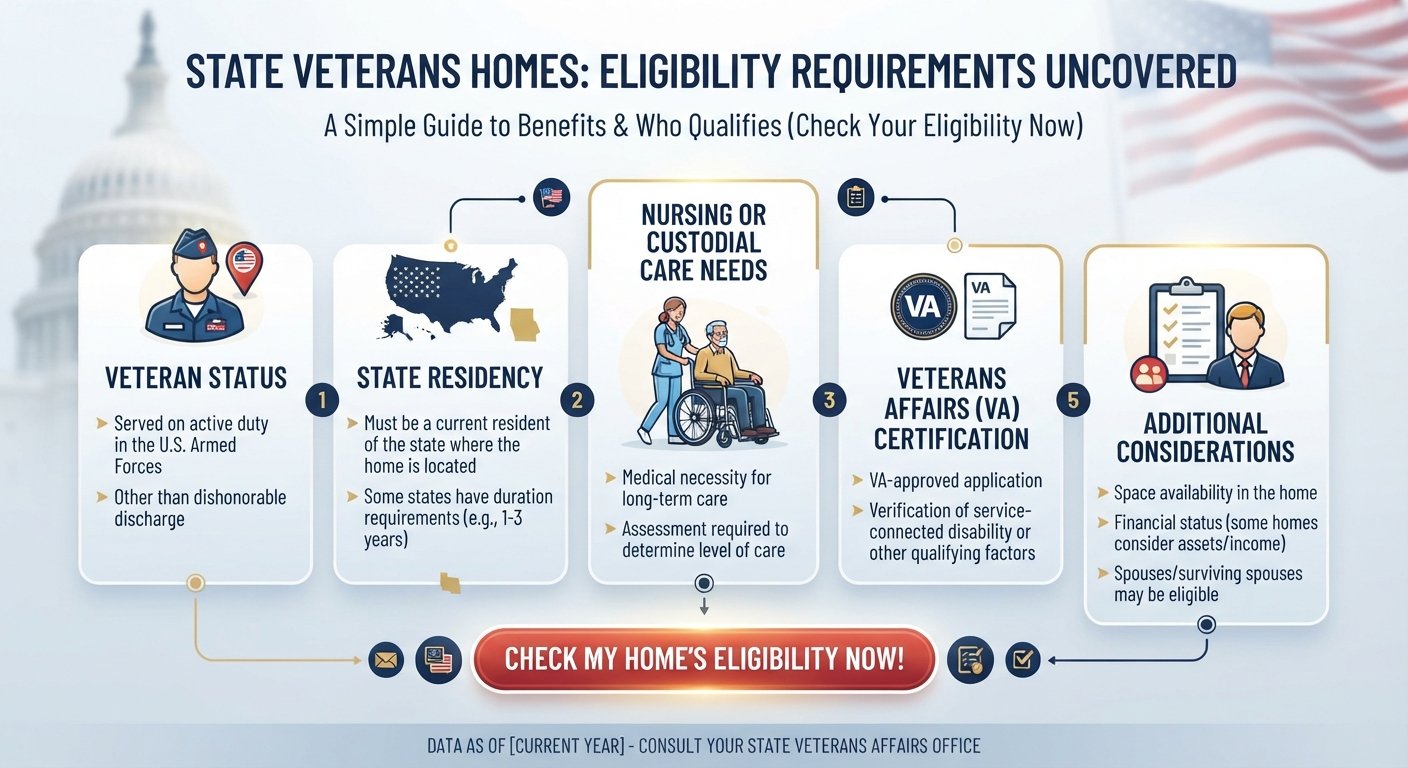
Veterans with a 100% VA disability rating may receive free or low-cost care at State Veterans Homes. In many states, a 100% rating qualifies a veteran for no-cost nursing home care, assisted living, or domiciliary care. Eligibility requires an honorable discharge, a VA disability rating (often 70% or 100%), and a clinical need for care. Each state operates its own homes with specific admission criteria, but the VA pays a daily per diem to offset costs.
Quick Facts
| Item | Details |
|---|---|
| Benefit | Long-term nursing home, assisted living, or domiciliary care at State Veterans Homes |
| Eligibility | Honorably discharged veteran, 70%–100% VA rating (for free care); spouses and Gold Star parents may also apply |
| Application | Contact your state’s veterans home admissions office directly |
| Processing Time | Varies by state; waitlists are common for skilled nursing beds |
| Official Agency | State Department of Veterans Affairs + U.S. Department of Veterans Affairs (per diem payments) |
| Required Forms | VA Form 10-10SH (medical certification), VA rating letter, DD-214, proof of residency |
| Updated For | 2026 (updated per diem rates and waiver authority for domiciliary care) |
What Are State Veterans Homes?
State Veterans Homes are long-term care facilities owned, operated, and managed by state governments . They provide nursing home care, domiciliary care (assisted living), and adult day care for veterans and, in some cases, their spouses and Gold Star parents. The VA certifies these homes and pays a daily per diem to help cover the cost of care, making them more affordable than private nursing homes .

There are over 150 State Veterans Homes across the United States. Every state has at least one, with larger states like Texas and California operating multiple locations.
Why They Matter

Private nursing home care averages over $90,000 per year . State Veterans Homes offer a more affordable, veteran-focused alternative. For 100% disabled veterans, many states waive all costs, potentially saving $90,000+ annually.
Who Can Live in a State Veterans Home?
Eligibility generally falls into these categories:
Veterans: Honorably discharged with active duty service (typically 90 days or more during wartime, or two+ years peacetime)
Spouses and Surviving Spouses: Many states allow spouses of veterans to reside in the home
Gold Star Parents: Parents who lost a child in military service are eligible in several states
Most states require the applicant to be a resident of that state at the time of application .
How a 100% VA Rating Affects State Veterans Home Eligibility
A 100% VA disability rating is a significant advantage when applying for a State Veterans Home. It typically qualifies you for the highest priority admission and, crucially, eliminates out-of-pocket costs.
Free Care for 100% Disabled Veterans
Veterans May Qualify for Extra Benefits
Check available financial assistance, healthcare programs and other opportunities that may apply to you.
Check EligibilityVeterans with a 100% VA rating generally do not pay for care at State Veterans Homes. This is because the state receives a federal per diem payment from the VA to cover the cost. Several state governments officially confirm this policy for high-rating veterans.
Louisiana: Veterans with a VA rating of 70% or higher may live in state veterans homes free of charge. Veterans with a rating below 70% pay a monthly fee of $2,424 (in 2025) .
Iowa: Iowa Veterans Home charges no out-of-pocket expense for veterans rated 70% disabled or higher who need nursing care .
Wisconsin: Veterans rated 70% service-connected or higher do not pay for care at Wisconsin State Veterans Homes .
New Jersey: Veterans rated 100% service-connected, unemployable, or P&T can be eligible for free nursing home placement .
While the free care threshold is often 70%, a 100% rating provides the strongest assurance that all costs are covered. Always confirm with your specific state home’s admissions office, as policies and fee structures change.
Priority Admission
Federal law allows up to 25% of beds in a State Veterans Home to be occupied by veteran-related family members (spouses, surviving spouses, Gold Star parents) who are not eligible for VA aid . Veterans generally receive priority for admission over non-veteran spouses and family members, with priorities often given to:
Veterans with wartime service and service-connected disabilities
Veterans with wartime service and non-service-connected disabilities
Other veterans
Spouses and surviving spouses
Priority also considers whether the veteran is in need of care, is homeless, or has a distinguished military record .
2026 Changes to Eligibility
A 2024 VA rule update has expanded eligibility for domiciliary care (assisted living) at State Homes. The new rules broaden the definition of “no adequate means of support” to consider a veteran’s family and community support system, not just their ability to work . This change helps more veterans qualify for VA per diem payments.
The Secretary of Veterans Affairs now has authority to waive certain eligibility requirements for per diem payments if it is “in the best interest of the veteran” . This makes it easier for states to help veterans who might not meet strict eligibility criteria.
How to Apply for a State Veterans Home
You must apply directly through the State Veterans Home of your choice. The process typically involves:
Contact Admissions: Call the admissions office of the home you are interested in. Ask about current bed availability and waitlist status .
Gather Documents: You will need:
VA Rating Letter (showing your 100% rating)
DD-214
Proof of Residency
Photo ID
Financial information
Complete Application: Fill out the application and submit it.
Medical Certification: Complete a medical exam and a VA Form 10-10SH (State Home Program Application for Veteran Care Medical Certification) .
Wait: If no bed is available, your name will be placed on a waitlist . Some homes may prioritize veterans based on disability rating, residency, and need.
What Other Benefits Can a 100% Disabled Veteran Get in Each State?
A 100% VA rating unlocks many other state-level benefits. In addition to free or reduced-cost care at State Veterans Homes, veterans can access significant tax breaks and other benefits.
Property Tax Exemptions
Twenty-two states offer full property tax exemptions for 100% disabled veterans. This is often the most valuable state benefit.
| State | Property Tax Benefit for 100% Disabled Veterans |
|---|---|
| Texas | Full property tax exemption on primary residence |
| Florida | Full homestead property tax exemption |
| Virginia | Full property tax exemption on home and up to one acre |
| New York | 100% tax exemption (as of 2026) |
| Idaho | Reduces property taxes on a primary residence up to a statutory cap |
| Kentucky | Homestead Exemption on primary residence |
State Park Benefits
Kentucky: 100% disabled veterans receive up to three free nights per year at participating state park lodges, hotels, cottages, and campsites .
Frequently Asked Questions
1. Do 100% disabled veterans pay for nursing home care at state veterans homes?
In many states, no. Louisiana, Iowa, Wisconsin, and New Jersey waive fees for veterans rated 70% or higher . The VA also pays a daily per diem to the state home, covering a significant portion of the cost . Contact your state’s home to confirm current policy.
2. What is the difference between a State Veterans Home and a VA nursing home?
State Veterans Homes are owned and operated by state governments, with some funding and oversight from the VA . VA nursing homes are federal facilities run directly by the Department of Veterans Affairs. State Homes are often more numerous and may accept spouses and Gold Star parents, while VA nursing homes prioritize veterans with the most service-connected needs.
3. Can my spouse live with me in a State Veterans Home?
In many states, yes. Many State Veterans Homes allow spouses and surviving spouses to reside in the home, provided there is space and they meet eligibility requirements . A portion of beds (up to 25%) may be allocated for non-veteran family members .
4. How long does it take to get into a State Veterans Home?
Processing times vary widely. Some homes have immediate availability, while others have waitlists that can stretch for months, especially for skilled nursing beds . Apply as early as possible. Your 100% rating may help you gain higher priority.
5. What if I’m a 100% disabled veteran but I don’t need nursing care?
Many State Veterans Homes also offer domiciliary or assisted living care for veterans who need some help with daily tasks but do not require 24/7 skilled nursing. Eligibility rules for domiciliary care are expanding in 2026, allowing more veterans to qualify for VA per diem payments .
6. What documents do I need to apply?
You will need your DD-214 (discharge papers), VA rating letter (showing your 100% rating), proof of state residency, photo ID, and a completed medical certification (VA Form 10-10SH) .
7. Does a 100% rating guarantee free care in every state?
No. Each state sets its own fee structure. However, in states like Louisiana, Iowa, and Wisconsin, a 70% rating is enough for free care . A 100% rating meets the highest tier of VA service-connected status and will qualify you for the most favorable rate.
8. Are there income limits for State Veterans Home admission?
State Veterans Homes accept veterans regardless of income, but financial assessments determine how much you pay. Veterans with lower incomes may qualify for Medicaid to help cover costs . A 100% VA rating typically waives fees, so income becomes less relevant.
9. What is the VA per diem payment for State Veterans Homes?
The VA pays a daily per diem of approximately $109 per day to State Veterans Homes for each eligible veteran enrolled in VA health care who requires skilled nursing care . This per diem helps offset the cost of care, reducing or eliminating fees for veterans.
10. Can a surviving spouse continue living in the home after the veteran passes?
Yes, in most cases. Surviving spouses who were already residents can typically remain in the home, provided they continue to meet the facility’s requirements . They may need to transition to a private-pay rate or apply for Medicaid.
Key Takeaways
100% disabled veterans may receive free care at State Veterans Homes in many states, including Louisiana, Iowa, and Wisconsin .
You must apply directly through the state home’s admissions office—benefits are not automatic .
State Veterans Homes offer nursing home, assisted living, and domiciliary care—choose the level that fits your needs.
A 100% VA rating is a powerful priority admission advantage, giving you higher priority than non-veteran family members .
2026 rule changes expand domiciliary care eligibility, making it easier for more veterans to qualify for VA per diem payments .
You are not required to be 100% disabled to qualify for free care—some states set the threshold at 70% .
Bring your VA rating letter, DD-214, and proof of residency to the admissions office when applying .
Spouses and Gold Star parents can also apply to live in State Veterans Homes in many states .
Official Resources
VA.gov – Enroll in VA health care: https://www.va.gov
State Home Per Diem Program – Find a State Veterans Home: https://www.va.gov/geriatrics
VA Regional Office Locator – https://www.va.gov/find-locations
NASDVA State Veterans Affairs Offices – https://www.nasdva.us
Military.com State Benefit Directory – https://www.military.com/benefits/veteran-state-benefits
Federal Register: Domiciliary Care Rule Update – https://www.federalregister.gov

🇺🇸 IMPORTANT DISCLAIMER – Veterans Benefits Information
This site provides general information about U.S. Department of Veterans Affairs (VA) benefits for educational and informational purposes only.
- Not Official: We are NOT affiliated with, endorsed by, or connected to the U.S. Department of Veterans Affairs (VA), the Veterans Benefits Administration (VBA), the Veterans Health Administration (VHA), or any other government agency.
- No Legal/Financial Advice: The content on this website is for informational purposes only and does not constitute legal, financial, or medical advice. VA benefits rules change frequently – always consult with an accredited Veterans Service Officer (VSO) or a qualified professional for your specific situation.
- Official Sources: For official, binding information and to apply for benefits, always visit official .gov websites: VA.gov, Benefits.VA.gov, or SSA.gov.
- No Data Collection: This site does not collect, store, or process any personal information. It does not have login forms, contact forms, or any system to capture user data. We never ask for your Social Security Number, bank details, or any personal information.
- 🚨 Scam Alert: The VA and other government agencies never charge fees for benefit applications. If anyone asks for money to "process" your VA claim, it is a scam. Report it to the VA Office of Inspector General at VA.gov/OIG.
- Advertising: This site uses third-party advertising (Adsterra) to cover operational costs. We do not endorse or guarantee any products or services advertised.
📌 Information provided as of June 2026. Always verify current eligibility and rules with official .gov sources.
This site is not affiliated with the U.S. Department of Veterans Affairs or any government agency. All information is for educational purposes only. Please visit VA.gov for official information.
