
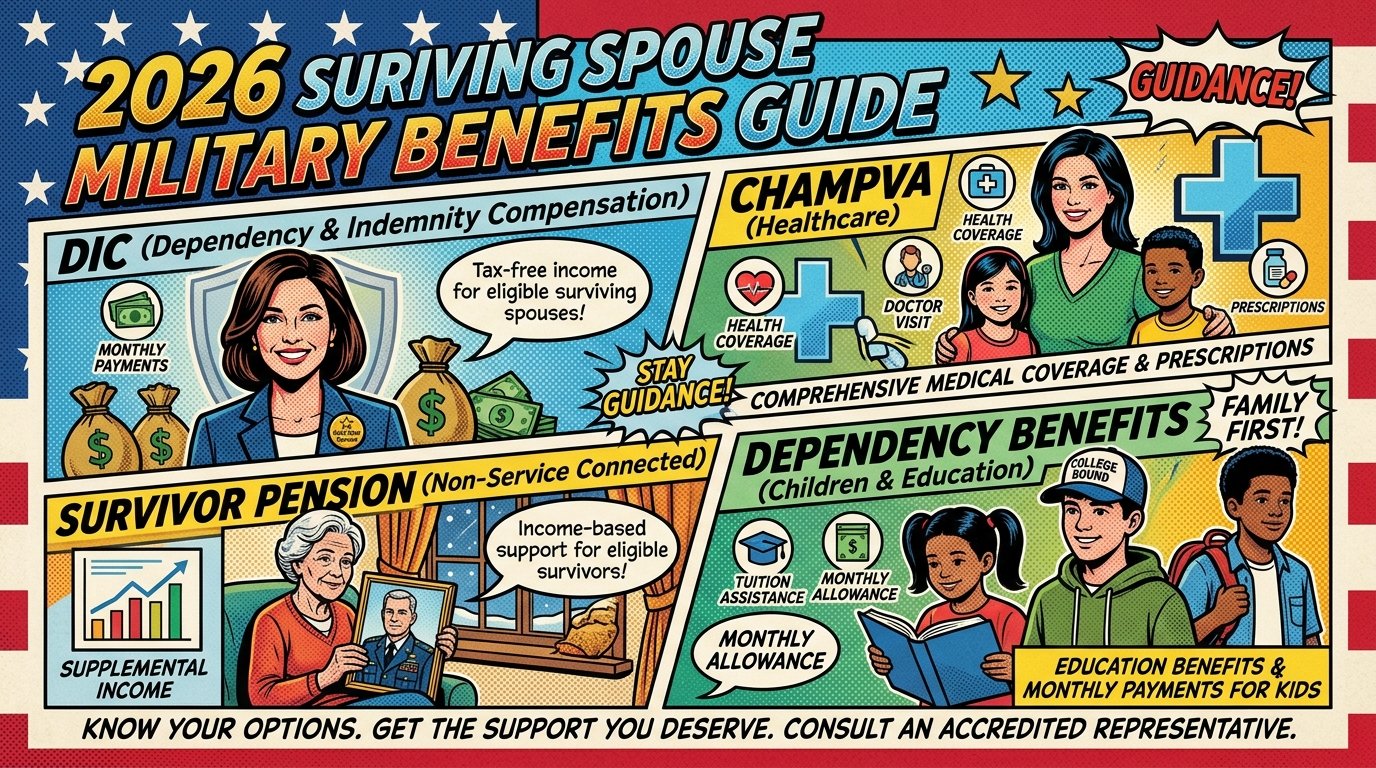
Military Surviving Spouse Benefits After Death: 2026
When a retired service member dies, retired pay stops, but an eligible surviving spouse can receive the Survivor Benefit Plan (SBP) annuity, VA Dependency and Indemnity Compensation (DIC), TRICARE health coverage, Social Security survivor benefits, and other federal and state benefits. SBP pays 55% of the covered retired pay; 2026 DIC starts at $1,699.36 per month tax-free.
Quick Facts
| Item | Details |
|---|---|
| Benefit | Monthly income, health care, education, burial, and survivor support for the spouse of a deceased military retiree |
| Eligibility | Unremarried surviving spouse; marriage rules vary by program. SBP depends on the retiree’s election; DIC depends on service-connected cause of death; TRICARE and ID cards depend on DEERS status |
| Application | DFAS for SBP; VA Form 21P-534EZ for DIC; Social Security Administration for survivor benefits; DEERS for ID and TRICARE |
| Processing Time | SBP typically 45–60 days after DFAS receives the application; DIC varies by claim complexity; Social Security often 30–90 days |
| Official Agency | Defense Finance and Accounting Service (DFAS), Department of Veterans Affairs (VA), Social Security Administration (SSA), TRICARE |
| Required Forms | DD Form 2656-7 (SBP); VA Form 21P-534EZ (DIC); SSA application; DEERS documentation |
| Updated For | 2026 rates effective December 1, 2025, including a 2.8% COLA |
What Happens to Military Retirement Pay When a Retiree Dies
Retired pay stops on the date of the retiree’s death. The Survivor Benefit Plan exists specifically to replace part of that lost income for an eligible surviving spouse or child. DFAS administers SBP separately from VA benefits and from SGLI life insurance.

VA Disability Combined Rating Calculator
Add each disability rating from your decision letter.

Estimate only. The VA makes the official rating decision. Not legal or financial advice, and not affiliated with the Department of Veterans Affairs.
The retiree’s final retired pay is prorated through the date of death. Any payment issued after the death may be subject to recoupment. The surviving spouse should notify DFAS promptly so retired pay is suspended and survivor annuity processing can begin.
SBP is not automatic unless the retiree elected coverage at retirement. A spouse married to the retiree on the date of retirement is eligible for SBP from the date retired pay begins, with no length-of-marriage requirement. A spouse acquired after retirement is covered only if the retiree elected coverage for that spouse within one year of the marriage.
The Survivor Benefit Plan (SBP): The Core Income Benefit
SBP is a Department of Defense annuity that pays the surviving spouse 55% of the elected base amount for life, adjusted annually for inflation. The retiree chooses the base amount at retirement, up to full gross retired pay. The standard cost for spouse-only coverage at the maximum level is 6.5% of the elected base amount, deducted from retired pay before taxes.
How SBP Works
At retirement, the service member makes an SBP election. The election is generally permanent. Declining or reducing spouse coverage cannot be reversed after retirement except in limited windows. If the retiree elected full coverage on a $3,000 base amount, the survivor receives $1,650 per month (55% of $3,000) for life, with COLAs.
Army Fitness Test (AFT) Score Calculator
Formerly the ACFT. Five events, 500 points. Enter your results.
Estimate for training only. Points are interpolated from the official Army tables (effective 1 June 2025) and can differ by a few points. Your score of record comes from your unit graders. Official score tables (PDF). Not affiliated with the U.S. Army.
SBP coverage reaches paid-up status after 30 years of payments and age 70. Both conditions must be met. Once paid up, coverage continues for the spouse’s lifetime at no further cost.
SBP and DIC: The “Widow’s Tax” Is Gone
For decades, surviving spouses who qualified for both SBP and VA DIC faced a dollar-for-dollar offset. The SBP payment was reduced by the DIC amount. This policy was phased out and fully eliminated as of January 1, 2023.
Today, an eligible surviving spouse receives the full SBP annuity from DFAS and the full DIC payment from VA simultaneously, with no reduction to either. A spouse receiving a $2,200 SBP annuity and full DIC collects more than $3,700 combined monthly, both with annual COLA protection. Surviving spouses whose SBP was being offset before January 2023 should verify with DFAS that their full payment has been restored.
SBP Remarriage Rules
A surviving spouse can receive only one military spouse SBP annuity at a time. Remarriage before age 55 suspends the SBP annuity. Remarriage at age 55 or older does not affect payments.
Suspension is not permanent termination. If the later marriage ends by death or divorce, the SBP annuity can be reinstated, but DFAS does not monitor court records automatically. The survivor must send written notice with the decree or death certificate.
How to Apply for SBP
DFAS sends the surviving spouse an application after the retiree’s death. The core form is DD Form 2656-7, Verification for Survivor Annuity. The spouse will also need a direct deposit form and IRS Form W-4P for tax withholding.
Submit the death certificate and DD Form 2656-7 to DFAS as soon as possible. SBP annuity payments typically begin within 45 to 60 days after DFAS receives the application. DFAS can be notified online through its retiree death reporting portal.
VA Dependency and Indemnity Compensation (DIC)
DIC is a tax-free monthly benefit paid by VA to surviving spouses, dependent children, and dependent parents of service members who died on active duty or veterans who died from a service-connected condition. The 2026 base rate for a surviving spouse is $1,699.36 per month, effective December 1, 2025.
DIC Eligibility for a Retired Service Member’s Spouse
The surviving spouse must generally meet three tests:
The veteran died from a service-connected condition, or the veteran was rated totally disabling for at least the 8 full years before death and the spouse was married to the veteran for those same 8 years.
The marriage meets VA’s validity rules. Generally, the spouse must have been married to the veteran for at least one year before death, or have had a child with the veteran.
The surviving spouse has not remarried before age 55. Remarriage at 55 or older does not bar DIC.
A veteran’s 100% P&T rating does not automatically establish DIC. DIC requires a death link to service. If the veteran died of a condition not connected to service, DIC may still be possible under the 8-year provision if the veteran had a totally disabling rating for eight years and the spouse was married for those eight years.
DIC Added Amounts for 2026
| Added Factor | Monthly Amount |
|---|---|
| Each child under 18 | +$421.00 |
| 8-year provision (spouse married 8 years to totally disabled veteran) | +$360.85 |
| Transitional benefit, first two years after death | +$359.00 |
| Aid and Attendance for surviving spouse | +$421.00 |
Source: VA DIC rates effective December 1, 2025
How to Apply for DIC
Use VA Form 21P-534EZ, Application for DIC, Survivors Pension, and/or Accrued Benefits. The form can be filed online through VA.gov or by mail. Submit a copy of the death certificate, marriage certificate, and medical evidence linking the veteran’s death to service.
An accredited veterans service officer can help assemble the claim. DIC claims are often decided faster when filed as a Fully Developed Claim with all evidence included at submission.
TRICARE Health Coverage for Surviving Spouses
TRICARE continues for surviving spouses of retired service members, but the rules differ from active-duty survivor coverage. A surviving spouse of a retiree generally remains eligible for TRICARE until remarriage. If the spouse remarries a non-service member, TRICARE coverage ends. If the spouse remarries another active duty or retired service member, coverage can continue under the new sponsor.
For active-duty deaths, spouses and children are transitional survivors for the first three years and remain covered as active duty family members. After three years, the spouse’s coverage changes to that of a retired family member, with different plan options and out-of-pocket costs. Retiree survivors do not go through this transitional period; they are treated as survivor family members from the date of death.
TRICARE For Life at 65
At age 65, a surviving spouse with Medicare Part A and Part B is eligible for TRICARE For Life, which acts as a Medicare wraparound. TRICARE For Life covers most Medicare cost-sharing and provides pharmacy coverage. The surviving spouse must enroll in Medicare Part B to use TRICARE For Life.
TRICARE Dental for Survivors
Surviving family members are eligible for the TRICARE Dental Program Survivor Benefit Plan, which offers the same level of dental coverage as the standard TRICARE Dental Program. While enrolled, the government pays 100% of the monthly premiums. Family members already enrolled in the dental program are automatically enrolled in the survivor benefit plan. Surviving spouses not previously enrolled can enroll for three years after the sponsor’s death; children can enroll until they lose TRICARE eligibility.
Military ID Cards, DEERS, and Base Privileges
The surviving spouse must update DEERS to reflect the retiree’s death. A new ID card is issued at a DEERS ID card site with a copy of the death certificate. The new card continues access to the commissary, exchange, and other on-base resources. At age 65, the spouse ID card can be issued with “Indefinite” status, never to expire as long as the individual remains eligible.
Updating DEERS also updates TRICARE eligibility. The surviving spouse should contact TRICARE directly to confirm how claims will be paid, especially if SBP is not being received.
Commissary and exchange privileges generally continue for an unremarried surviving spouse. Remarriage can affect these privileges, though recent law has extended commissary and exchange access to certain remarried surviving spouses. The rules are separate from SBP and DIC and should be verified with the local ID card office.
Social Security Survivor Benefits
Social Security pays survivor benefits to a surviving spouse in several situations:
Age 60 or older. The survivor can receive 71.5% to 100% of the deceased worker’s benefit, depending on the age at which the survivor claims.
Any age, if caring for the deceased’s child under 16 or a disabled child.
Age 50 or older, if disabled, with a reduced benefit.
Lump-sum death payment of $255 in some cases.
The average survivor benefit in 2026 is about $1,619 per month**, and an aged widow living alone averages **$1,919 per month. Social Security survivor benefits are separate from SBP and DIC and do not offset either one.
Apply by calling the Social Security Administration at 1-800-772-1213 or visiting a local office. The survivor will need the death certificate, marriage certificate, Social Security numbers, and birth certificates for any children.
Education Benefits for Surviving Spouses and Children
Two main VA education programs are available to survivors.
Fry Scholarship. The Fry Scholarship provides Post-9/11 GI Bill-level benefits to the child or surviving spouse of a service member who died in the line of duty on or after September 11, 2001. A surviving spouse can use the Fry Scholarship for up to 36 months and keeps eligibility if they remarry, provided they qualified through the previous marriage. The Fry Scholarship generally pays full tuition at the public in-state rate plus a housing allowance and books.
Chapter 35 DEA. The Survivors’ and Dependents’ Educational Assistance program pays a flat monthly stipend to spouses and children of veterans who are permanently and totally disabled or who died from service-connected causes. The 2025–2026 full-time rate is $1,574 per month. A surviving spouse generally has 10 years to use Chapter 35 if the qualifying event occurred before August 1, 2023; spouses who became eligible on or after that date have no time limit.
A surviving spouse cannot receive both the Fry Scholarship and Chapter 35 based on the same event. The election is generally irrevocable, so the survivor should compare the total value of each program before applying.
Death Gratuity, SGLI, and Burial Benefits
Death gratuity. The Department of Defense pays a one-time, tax-free $100,000 death gratuity to eligible survivors of members who die on active duty or in certain reserve statuses. The death gratuity is generally not available for a retiree who dies after separation, unless the death occurs within 120 days of release from active duty and is related to that service.
SGLI. Servicemembers’ Group Life Insurance pays up to $500,000 to the named beneficiary if coverage was in force at death. Retirees may have converted SGLI to VGLI (Veterans’ Group Life Insurance) after separation. A surviving spouse should check whether the retiree maintained VGLI or private coverage. SGLI and VGLI claims are filed with the Office of Servicemembers’ Group Life Insurance using SGLV 8283.
VA burial benefits. VA may pay a burial allowance and provide a gravesite in a national cemetery, a headstone or marker, and a Presidential Memorial Certificate. For a service-connected death on or after September 11, 2001, the burial allowance is $2,000**. For a non-service-connected death, the allowance is **$1,032 plus $1,032 for a plot for deaths on or after October 1, 2026. An eligible surviving spouse is often paid automatically upon notification of the veteran’s death, but if not, VA will pay the first claimant.
State and Local Benefits for Surviving Spouses
Many states offer property tax relief, tuition waivers, and other benefits to unremarried surviving spouses of veterans. More than 20 states give a total property tax exemption to veterans with a 100% permanent service-connected disability, and most extend that exemption to the veteran’s unremarried surviving spouse. Some states, such as Texas, offer a full homestead exemption for the surviving spouse of a service member killed or fatally injured in the line of duty.
Other common state benefits include:
Free or reduced tuition at state colleges for surviving spouses and children.
Free hunting and fishing licenses.
Free state park admission.
Vehicle registration fee reductions.
State income tax exemptions on survivor annuities.
These benefits are administered by state and county agencies, not VA or DFAS. The surviving spouse must apply separately with the county tax assessor, state veterans agency, or college financial aid office. A state veterans service officer can identify the correct programs.
Remarriage Before 55: The Financial Cliff
Remarriage before age 55 can suspend or terminate several survivor benefits at once. The age-55 rule applies to SBP, DIC, and TRICARE. For an E-7 family, remarrying at 54 instead of 55 can forfeit more than $1.3 million in lifetime benefits.
| Age at Remarriage | SBP | DIC | TRICARE | Commissary/Exchange |
|---|---|---|---|---|
| Before 55 | Suspended; may reinstate if marriage ends | Terminated; may reinstate if marriage ends | Ends if spouse marries non-service member | May be affected; verify current rules |
| 55 or older | Continues | Continues | Continues | Continues |
Sources: DFAS, VA, TRICARE
SBP and DIC suspension is not always permanent. If the remarriage ends by death or divorce, the survivor can apply to reinstate SBP and DIC. DFAS does not monitor court records, so the survivor must provide written notice and documentation. TRICARE eligibility may also be restored if the remarriage ends, but the rules are separate and should be confirmed with DEERS.
Pending legislation, the Love Lives On Act, would allow surviving spouses to retain DIC and SBP after remarriage at any age. As of 2026, the bill had not been enacted. Surviving spouses should verify current law before making a remarriage decision.
Step-by-Step: What to Do After a Retired Service Member Dies
Step 1: Notify DFAS. Report the death through DFAS’s online portal or by phone so retired pay is suspended. DFAS will send the SBP application if the retiree elected coverage.
Step 2: Obtain certified death certificates. Request at least 10 to 15 certified copies. Multiple agencies will require them, including DFAS, VA, SSA, DEERS, and financial institutions.
Step 3: Update DEERS and get a new ID card. Visit a DEERS ID card site with the death certificate. The new ID card confirms survivor status and maintains commissary, exchange, and TRICARE eligibility.
Step 4: Apply for SBP with DFAS. Complete DD Form 2656-7 and submit it with the death certificate, direct deposit form, and W-4P. SBP payments typically begin within 45 to 60 days.
Step 5: File a VA claim for DIC and burial benefits. Use VA Form 21P-534EZ for DIC and submit the death certificate, marriage certificate, and service records. An accredited representative can help.
Step 6: Apply for Social Security survivor benefits. Call SSA at 1-800-772-1213 or visit a local office. Bring the death certificate, marriage certificate, and Social Security numbers.
Step 7: Contact TRICARE. Confirm enrollment and claims processing. If the spouse is 65 or older, verify Medicare Part A and Part B enrollment for TRICARE For Life.
Step 8: Apply for state benefits. Contact the county tax assessor for property tax relief and the state veterans agency for tuition waivers and other programs.
Step 9: Review life insurance and financial accounts. File SGLI or VGLI claims with OSGLI using SGLV 8283. Update bank accounts, wills, and beneficiary designations.
Step 10: Keep records and deadlines. Track application dates, claim numbers, and follow-up requirements. Missing a VA deadline can delay or reduce benefits.
Common Mistakes That Cost Surviving Spouses Money
Waiting too long to notify DFAS. Retired pay continues briefly after death, and overpayments must be repaid. Prompt notification starts the SBP process sooner.
Assuming SBP and DIC offset each other. The offset was eliminated on January 1, 2023. Eligible spouses can receive both in full. Spouses whose payments were reduced before 2023 should ask DFAS to verify their current rate.
Remarrying before 55 without understanding the consequences. Remarriage before 55 can suspend SBP and terminate DIC and TRICARE. Waiting until 55 can preserve more than $1 million in lifetime benefits for some families.
Failing to update DEERS. Without a DEERS update, TRICARE and ID card eligibility may be interrupted. The surviving spouse should update DEERS with the death certificate as soon as possible.
Not applying for DIC because the veteran had a 100% rating. DIC requires a service-connected cause of death or the 8-year provision. A 100% rating alone does not establish DIC. An accredited representative can review the death certificate and service records.
Missing the SBP application. DFAS sends the application, but it is the survivor’s responsibility to complete and return it. SBP does not start automatically.
Common Questions
Does military retirement pay continue after death?
No. Retired pay stops on the date of death. The Survivor Benefit Plan replaces part of that income for an eligible spouse, paying 55% of the elected base amount for life.
How much does SBP pay in 2026?
SBP pays 55% of the elected base amount, adjusted for inflation. If the retiree elected a $3,000 base, the survivor receives $1,650 per month. The 2026 COLA was 2.8%.
What is the 2026 DIC rate for a surviving spouse?
The base rate is $1,699.36 per month, tax-free, effective December 1, 2025. Added amounts apply for children, the 8-year provision, Aid and Attendance, and the transitional benefit.
Can a surviving spouse receive SBP and DIC at the same time?
Yes. The SBP-DIC offset, often called the “widow’s tax,” was fully eliminated on January 1, 2023. Eligible spouses now receive both in full.
Does TRICARE continue for a surviving spouse?
Yes, generally until remarriage. If the spouse remarries a non-service member, TRICARE ends. At 65, the spouse can use TRICARE For Life with Medicare Parts A and B.
What happens to SBP if the surviving spouse remarries before 55?
SBP is suspended. If the remarriage later ends by death or divorce, the annuity can be reinstated. Remarriage at 55 or older does not affect SBP.
Does remarriage affect DIC?
DIC ends if the surviving spouse remarries before age 55. Remarriage at 55 or older does not affect DIC. If a pre-55 remarriage ends, DIC can be reinstated.
How long does it take to start SBP payments?
SBP annuity payments typically begin within 45 to 60 days after DFAS receives the completed application and death certificate.
Does the surviving spouse need a new military ID card?
Yes. Update DEERS with the death certificate and get a new ID card at a DEERS site. The new card maintains commissary, exchange, and TRICARE access.
Can a surviving spouse get Social Security and SBP?
Yes. Social Security survivor benefits are separate from SBP and DIC and do not offset either one. A surviving spouse can receive all three if eligible.
What is the death gratuity, and does a retiree’s spouse get it?
The death gratuity is a $100,000 tax-free payment for deaths on active duty or in certain reserve statuses. It generally does not apply to retirees who die after separation, unless the death occurs within 120 days of release from active duty and is related to service.
Does the surviving spouse qualify for VA burial benefits?
Yes. VA may pay a burial allowance and provide a gravesite, headstone, and Presidential Memorial Certificate. For a service-connected death on or after September 11, 2001, the allowance is $2,000.
Key Takeaways
Retired pay stops at death; SBP pays 55% of the elected base amount for life, with a 2.8% COLA in 2026.
DIC pays $1,699.36 per month tax-free to an eligible surviving spouse in 2026, plus added amounts for children and other factors.
The SBP-DIC offset was eliminated on January 1, 2023. Eligible spouses receive both in full.
Remarriage before 55 suspends SBP and terminates DIC and TRICARE. Remarriage at 55 or older preserves all three.
TRICARE continues until remarriage, and TRICARE For Life is available at 65 with Medicare Parts A and B.
Update DEERS with the death certificate to maintain ID card, commissary, exchange, and TRICARE eligibility.
DFAS Form DD 2656-7 starts SBP; VA Form 21P-534EZ starts DIC; SGLV 8283 starts SGLI/VGLI claims.
Social Security survivor benefits are separate and do not offset SBP or DIC; the average survivor benefit is about $1,619 per month in 2026.
Many states offer property tax relief and tuition waivers to unremarried surviving spouses; these require separate applications.
The Love Lives On Act would eliminate the remarriage penalty, but as of 2026 it had not been enacted.
Official Resources
DFAS Survivor Benefits: https://www.dfas.mil/RetiredMilitary/survivors/
DFAS SBP Annuity Application (DD 2656-7): https://www.dfas.mil/RetiredMilitary/survivors/SBP-Annuity/
VA DIC Rates: https://www.va.gov/family-and-caregiver-benefits/survivor-compensation/dependency-indemnity-compensation/survivor-rates/
VA Form 21P-534EZ: https://www.va.gov/find-forms/about-form-21p-534ez/
VA Survivors Assistance: https://www.va.gov/survivors/
TRICARE Survivors: https://tricare.mil/Plans/Eligibility/Survivors
Social Security Survivor Benefits: https://www.ssa.gov/benefits/survivors/
VA Burial Benefits: https://www.va.gov/burials-memorials/
DEERS/ID Card Office: https://idco.dmdc.osd.mil/idco/
USA.gov Veterans Benefits: https://www.usa.gov/veterans-benefits
🇺🇸 IMPORTANT DISCLAIMER – Veterans Benefits Information
This site provides general information about U.S. Department of Veterans Affairs (VA) benefits for educational and informational purposes only.
- Not Official: We are NOT affiliated with, endorsed by, or connected to the U.S. Department of Veterans Affairs (VA), the Veterans Benefits Administration (VBA), the Veterans Health Administration (VHA), or any other government agency.
- No Legal/Financial Advice: The content on this website is for informational purposes only and does not constitute legal, financial, or medical advice. VA benefits rules change frequently – always consult with an accredited Veterans Service Officer (VSO) or a qualified professional for your specific situation.
- Official Sources: For official, binding information and to apply for benefits, always visit official .gov websites: VA.gov, Benefits.VA.gov, or SSA.gov.
- No Data Collection: This site does not collect, store, or process any personal information. It does not have login forms, contact forms, or any system to capture user data. We never ask for your Social Security Number, bank details, or any personal information.
- 🚨 Scam Alert: The VA and other government agencies never charge fees for benefit applications. If anyone asks for money to "process" your VA claim, it is a scam. Report it to the VA Office of Inspector General at VA.gov/OIG.
- Advertising: This site uses third-party advertising (Adsterra) to cover operational costs. We do not endorse or guarantee any products or services advertised.
📌 Information provided as of June 2026. Always verify current eligibility and rules with official .gov sources.
This site is not affiliated with the U.S. Department of Veterans Affairs or any government agency. All information is for educational purposes only. Please visit VA.gov for official information.
