
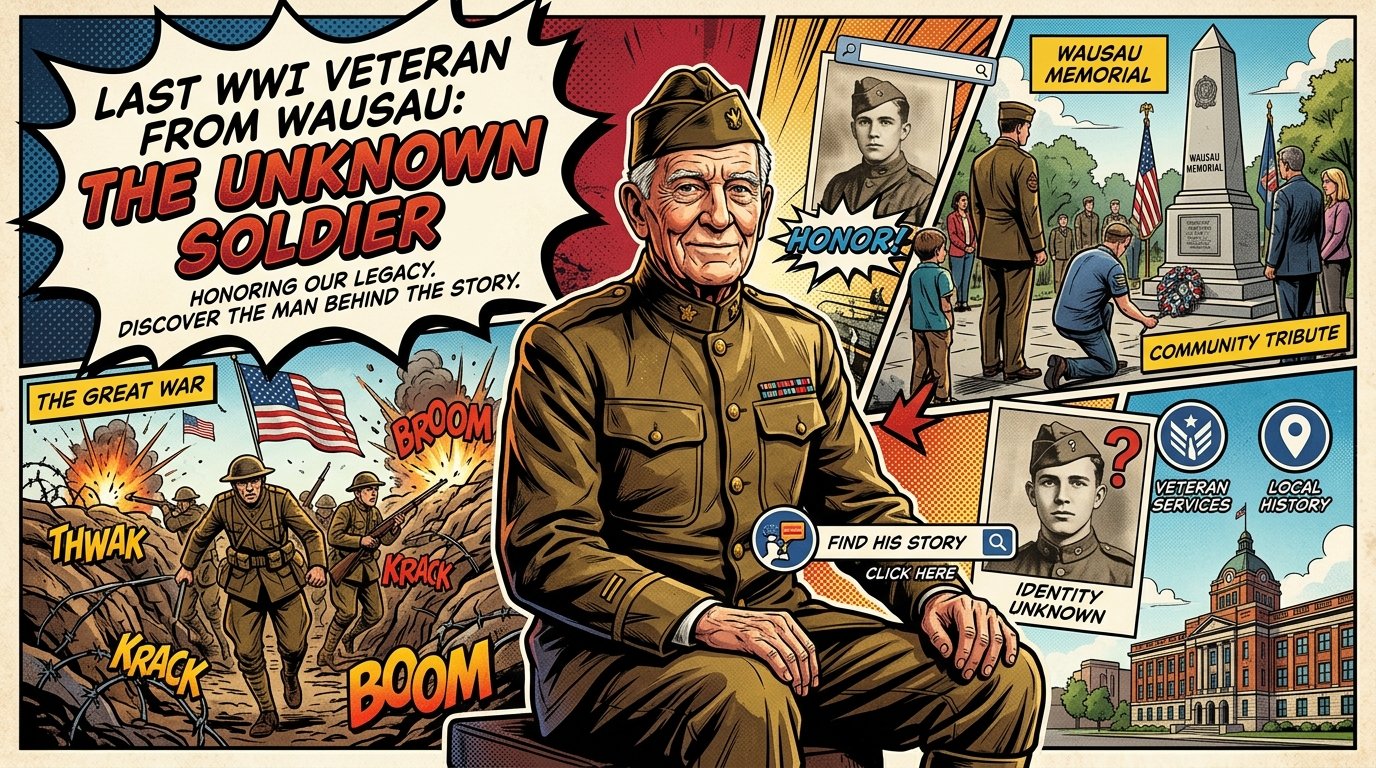
The Last WWI Veteran from Wausau: The Unknown Soldier of Pine Grove Cemetery
Featured Snippet Answer: Wausau has no officially certified “last WWI veteran.” The closest answer is the Unknown Soldier buried in Potter’s Field at Pine Grove Cemetery in 1930. A World War I veteran who died by suicide after struggling to find work, he was buried with military honors by VFW Post 388 and American Legion Post 10. His remains were exhumed in 2025 for DNA identification.
Quick Facts
| Item | Details |
|---|---|
| Status | No officially certified “last WWI veteran” in Wausau records |
| Central Figure | The Unknown Soldier, a WWI veteran buried in Pine Grove Cemetery in 1930 |
| Burial Location | Potter’s Field, southeast corner of Pine Grove Cemetery, 1501 Grand Avenue, Wausau |
| Burial Date | October 1930 |
| Military Honors | VFW Post 388 and American Legion Post 10 |
| DNA Exhumation | June 6, 2025, by the Marathon County Medical Examiner’s Office and state partners |
| Notable Local WWI Veterans | Arthur B. Riiser, LeRoy F. Jonas Sr., William Kreil |
| Official Historical Resources | National Archives, Wisconsin Veterans Museum, Wausau Daily Herald archives |
Why “Last WWI Veteran” Is a Difficult Question in Wausau
Wausau does not have a single, officially designated “last WWI veteran” in its public records. This is not unusual. Most American communities never formally certified a “last” survivor of the First World War. The generation that fought in 1917–1918 simply aged and passed, and the final survivor in any given city or county was rarely identified in a formal way.

What Wausau does have is a story that functions as a stand-in for that final chapter: the Unknown Soldier buried in Pine Grove Cemetery. He was a World War I veteran who died in 1930, was buried with military honors, and whose identity remains unknown. For nearly a century, he has represented the quiet, often tragic end of the WWI generation in Marathon County.

The city also has named WWI veterans whose lives and deaths are documented. Men like Arthur B. Riiser, who founded a Wisconsin fuel company after returning from France, and LeRoy F. Jonas Sr., a Purple Heart recipient and artist, lived long lives and left visible marks on Wausau. But the Unknown Soldier is the figure most closely tied to the idea of a final, forgotten veteran.
Who Was the Unknown Soldier of Pine Grove Cemetery?
The Unknown Soldier was a World War I veteran who died by suicide in the Rothschild area of Marathon County in September 1930. He was found by a passing motorist on old Highway 51. He left a note identifying himself as a WWI veteran but provided no name.
What Is Known About Him
The historical record, preserved in the Wausau Daily Herald and later research by the Daughters of the American Revolution (DAR), contains several details about the man:
He served in Europe during World War I.
He returned to central Wisconsin and struggled to find work.
He was described as “too proud to beg or steal” and did not want to go to jail.
He left a note asking that his friends not be told about his death.
In the note, he wrote that he would rather have been killed in the war.
He had the initials “P.R.” tattooed on his left hand and arm.
He also had a tattoo of a girl’s head on one arm and a sailing vessel on the other.
He had light brown hair and a beard and was wearing a blue work shirt, a dark blue suit, a black-and-white checkered tie, and 8-inch work boots.
The Note He Left Behind
Part of the note read: “It would have been far better to have stopped a bullet in France and receive an honorable burial as a soldier of War than to find final rest in a pauper’s grave. I am too proud to beg and haven’t the soul to steal.”
Veterans May Qualify for Extra Benefits
Check available financial assistance, healthcare programs and other opportunities that may apply to you.
Check EligibilityThis note is one of the few direct windows into the man’s state of mind. It reflects the hardship many WWI veterans faced after returning home, long before the modern veterans’ benefits system existed.
The 1930 Burial
In October 1930, VFW Post 388 and American Legion Post 10 gave the veteran a proper military funeral and burial in Potter’s Field, the southeast corner of Pine Grove Cemetery. The headstone reads: “The Unknown Soldier buried by Post 388 VFW and Post Number 10 American Legion”.
For decades, the grave was largely forgotten. In 2021, Carol Berens, chaplain of the local DAR chapter, located the grave while researching Wausau’s past. The DAR has since held an annual graveside ceremony honoring the Unknown Soldier, typically on the Wednesday before Memorial Day.
The 2025 DNA Exhumation: Trying to Give Him a Name
In June 2025, the Marathon County Medical Examiner’s Office, working with the Wisconsin Department of Justice Division of Criminal Investigation, the Wisconsin State Crime Laboratories, and the University of Wisconsin–Madison Missing in Action Recovery and Identification Project, exhumed the Unknown Soldier’s remains from Pine Grove Cemetery.
Why He Was Exhumed
The goal is to extract DNA and compare it to national databases in the hope of finding a match with a living relative. If a match is found, the soldier could finally be identified and his story completed. The process could take several months, and as of 2026, no public update on a match has been released.
What Happens Next
If a relative is identified, the soldier’s name could be added to his headstone, and his family could be notified. If no match is found, he will remain the Unknown Soldier, but the DNA sample will be preserved for future testing as databases grow.
Other Notable WWI Veterans from Wausau
While the Unknown Soldier is the most symbolic figure, several named Wausau veterans of World War I are well documented. Their stories show the range of experiences that the WWI generation carried home.
Arthur B. Riiser (1895–1992)
Arthur B. Riiser served in the U.S. Army in France and Germany during World War I. After returning to Wausau, he founded Riiser Oil Company in 1945, a business that grew into Riiser Fuels and became a familiar name across Wisconsin. He died in 1992 at age 97.
In 2025, his son Thomas Riiser donated $70,000 to sponsor the 54th Never Forgotten Honor Flight, naming it the Arthur B. Riiser Memorial Flight in his father’s honor.
LeRoy F. Jonas Sr. (1897–1981)
LeRoy F. Jonas Sr. was born in Marathon County and educated in Wausau. In 1917, he enlisted in Company G, 128th Infantry and served in the battles of Marne and Alsace. He received the Purple Heart and other commendations.
After the war, Jonas returned to Wausau and became a noted artist and art teacher. In 1980, the Wausau Daily Herald pictured him on the front page drinking champagne with the only other surviving member of his company.
William Kreil (1892–1978)
William Kreil was a Wausau resident who served in World War I and later worked for Wausau Paper Mills. His obituary in the Wausau Daily Herald in January 1978 notes his military service and his marriage in Wausau in 1921.
Wausau and Marathon County in World War I
Wausau and Marathon County contributed significantly to the American war effort. The county’s Gold Star List records the names of local men who died in service during WWI, including soldiers killed in action in France and sailors lost at sea.
The Gold Star List
The Marathon County Gold Star List includes names such as:
Carl August Andres, 20, Wausau, Private, 128th Infantry.
Oakley Bisheau, 22, Marathon, Private, 355th Infantry, killed in action November 4, 1918.
Frank W. Marquardt, Private, Company D, 28th Infantry Regiment, 1st Infantry Division, killed in action in 1918 and buried in Pine Grove Cemetery.
Albert A. Strachota, Private, Company H, 28th Infantry Regiment, 1st Infantry Division, killed in action July 18, 1918, at age 22.
These men are among the many from Marathon County who did not return. Their graves and memorial markers are scattered across Wausau cemeteries and American cemeteries in France.
The Guardian Angel Monument
The World War I Guardian Angel Monument in Wausau is a historical marker that lists local men who served and died. It stands as a physical record of the county’s sacrifice and is one of several local memorials to the WWI generation.
How to Research a WWI Veteran from Wausau
If you are researching a family member or ancestor who served in World War I from Wausau or Marathon County, several resources can help. The same records that document the Unknown Soldier and named veterans can help you trace your own family’s service.
Key Records and Where to Find Them
Draft Registration Cards. Nearly all men aged 18–45 registered for the draft in 1917–1918. These cards include name, age, address, occupation, and physical description. They are available through the National Archives and genealogy databases.
Military Service Records. The National Personnel Records Center (NPRC) holds Official Military Personnel Files. Some WWI records were destroyed in the 1973 fire, but many are available or can be reconstructed from alternate sources.
Wausau Daily Herald Archives. The Wausau Daily Herald reported on enlistments, deployments, casualties, and returning veterans. The newspaper’s archives, available through Newspapers.com and local libraries, are a rich source of individual stories.
Marathon County Gold Star List. The county’s Gold Star List records the names of men who died in service. It is available through local historical societies and online genealogy sites.
Cemetery Records. Pine Grove Cemetery, Restlawn Memorial Park, and other local cemeteries hold the graves of WWI veterans. The VA’s National Cemetery Administration and Find a Grave can help locate them.
Wisconsin Veterans Museum. The museum’s Research Center holds photographs, documents, and unit histories, including materials related to Marathon County veterans.
Using the DAR’s Research as a Model
The DAR’s rediscovery of the Unknown Soldier’s grave is a model for local research. Carol Berens found the story by searching digitized newspaper archives. Researchers can follow the same path: start with a name, search local newspapers for service notices and obituaries, and cross-reference with draft cards and cemetery records.
Common Questions
1. Who was the last WWI veteran from Wausau?
There is no officially certified “last” WWI veteran from Wausau. The Unknown Soldier buried in Pine Grove Cemetery in 1930 is the closest symbolic answer. Named veterans such as Arthur B. Riiser and LeRoy F. Jonas Sr. are also among the last documented Wausau WWI veterans.
2. Who is the Unknown Soldier in Wausau?
The Unknown Soldier was a World War I veteran who died by suicide in the Rothschild area in 1930. He left a note identifying himself as a WWI veteran but did not give his name. He was buried with military honors in Potter’s Field at Pine Grove Cemetery.
3. Why was the Unknown Soldier exhumed?
His remains were exhumed in June 2025 to extract DNA and compare it to national databases. The goal is to identify him and connect him with living relatives.
4. Was the Unknown Soldier ever identified?
As of 2026, no public identification has been announced. The DNA analysis is ongoing, and a match may take months or years depending on database matches.
5. What was the 128th Infantry?
The 128th Infantry Regiment was a Wisconsin National Guard unit that served in World War I as part of the 32nd “Red Arrow” Division. LeRoy F. Jonas Sr. served in Company G, 128th Infantry, and fought in the battles of Marne and Alsace.
6. Who was Arthur B. Riiser?
Arthur B. Riiser was a Wausau businessman who served in the U.S. Army in France and Germany during World War I. He founded Riiser Oil Company in 1945. His son sponsored an Honor Flight in his memory in 2025.
7. What is the Marathon County Gold Star List?
The Gold Star List is a record of Marathon County men who died in service during World War I. It includes names, ages, units, and circumstances of death. It is available through local historical societies and online genealogy resources.
8. How can I find a WWI veteran’s grave in Wausau?
Pine Grove Cemetery, Restlawn Memorial Park, and St. Joseph Cemetery are among the local cemeteries with WWI veterans’ graves. The VA’s National Cemetery Administration and Find a Grave can help locate specific graves.
9. Did Wausau have any WWI heroes?
Yes. The Marathon County Gold Star List includes men who were killed in action in France, including Frank W. Marquardt and Albert A. Strachota. LeRoy F. Jonas Sr. received the Purple Heart.
10. What is the DAR’s role in honoring the Unknown Soldier?
The Daughters of the American Revolution, Wausau Chapter, rediscovered the Unknown Soldier’s grave and has held an annual ceremony honoring him since 2022. The DAR also advocates for historical preservation and remembrance.
11. Why is the Unknown Soldier significant?
The Unknown Soldier represents the many WWI veterans who returned home, struggled, and were forgotten. His story is a reminder of the human cost of war and the importance of honoring all who served.
12. What lessons can veterans today take from Wausau’s WWI story?
The WWI generation’s experience shows that service is often followed by hardship, that transition home can be difficult, and that remembrance matters. The benefits system veterans use today was built in part because of the failures of earlier eras.
Key Takeaways
Wausau has no officially certified “last WWI veteran.” The Unknown Soldier buried in Pine Grove Cemetery is the closest symbolic answer.
The Unknown Soldier was a WWI veteran who died by suicide in 1930 after struggling to find work. He was buried with military honors by VFW Post 388 and American Legion Post 10.
His remains were exhumed in June 2025 for DNA analysis. No identification has been announced as of 2026.
Arthur B. Riiser and LeRoy F. Jonas Sr. are among the last documented named WWI veterans from Wausau.
Marathon County’s Gold Star List records local men who died in service during WWI, including soldiers killed in action in France.
The Wausau Daily Herald archives are a key resource for researching individual WWI veterans.
Draft registration cards, military service records, and cemetery records are the primary sources for WWI genealogy.
The DAR holds an annual ceremony honoring the Unknown Soldier at Pine Grove Cemetery.
There are no living WWI veterans in the United States. The last American WWI veteran, Frank Buckles, died in 2011.
The Unknown Soldier’s story reflects the hardship many WWI veterans faced and the importance of remembrance.
Official Resources
National Archives — World War I Records: archives.gov/topics/wwi
National Personnel Records Center: archives.gov/personnel-records-center
VA National Cemetery Administration — Burial Records: cem.va.gov
Wisconsin Veterans Museum: wisvetsmuseum.com
Wausau Daily Herald Archives: wausaudailyherald.com
Marathon County Historical Society: marathoncountyhistory.org
USA.gov — Veterans Benefits: usa.gov/veterans-benefits
🇺🇸 IMPORTANT DISCLAIMER – Veterans Benefits Information
This site provides general information about U.S. Department of Veterans Affairs (VA) benefits for educational and informational purposes only.
- Not Official: We are NOT affiliated with, endorsed by, or connected to the U.S. Department of Veterans Affairs (VA), the Veterans Benefits Administration (VBA), the Veterans Health Administration (VHA), or any other government agency.
- No Legal/Financial Advice: The content on this website is for informational purposes only and does not constitute legal, financial, or medical advice. VA benefits rules change frequently – always consult with an accredited Veterans Service Officer (VSO) or a qualified professional for your specific situation.
- Official Sources: For official, binding information and to apply for benefits, always visit official .gov websites: VA.gov, Benefits.VA.gov, or SSA.gov.
- No Data Collection: This site does not collect, store, or process any personal information. It does not have login forms, contact forms, or any system to capture user data. We never ask for your Social Security Number, bank details, or any personal information.
- 🚨 Scam Alert: The VA and other government agencies never charge fees for benefit applications. If anyone asks for money to "process" your VA claim, it is a scam. Report it to the VA Office of Inspector General at VA.gov/OIG.
- Advertising: This site uses third-party advertising (Adsterra) to cover operational costs. We do not endorse or guarantee any products or services advertised.
📌 Information provided as of June 2026. Always verify current eligibility and rules with official .gov sources.
This site is not affiliated with the U.S. Department of Veterans Affairs or any government agency. All information is for educational purposes only. Please visit VA.gov for official information.
