
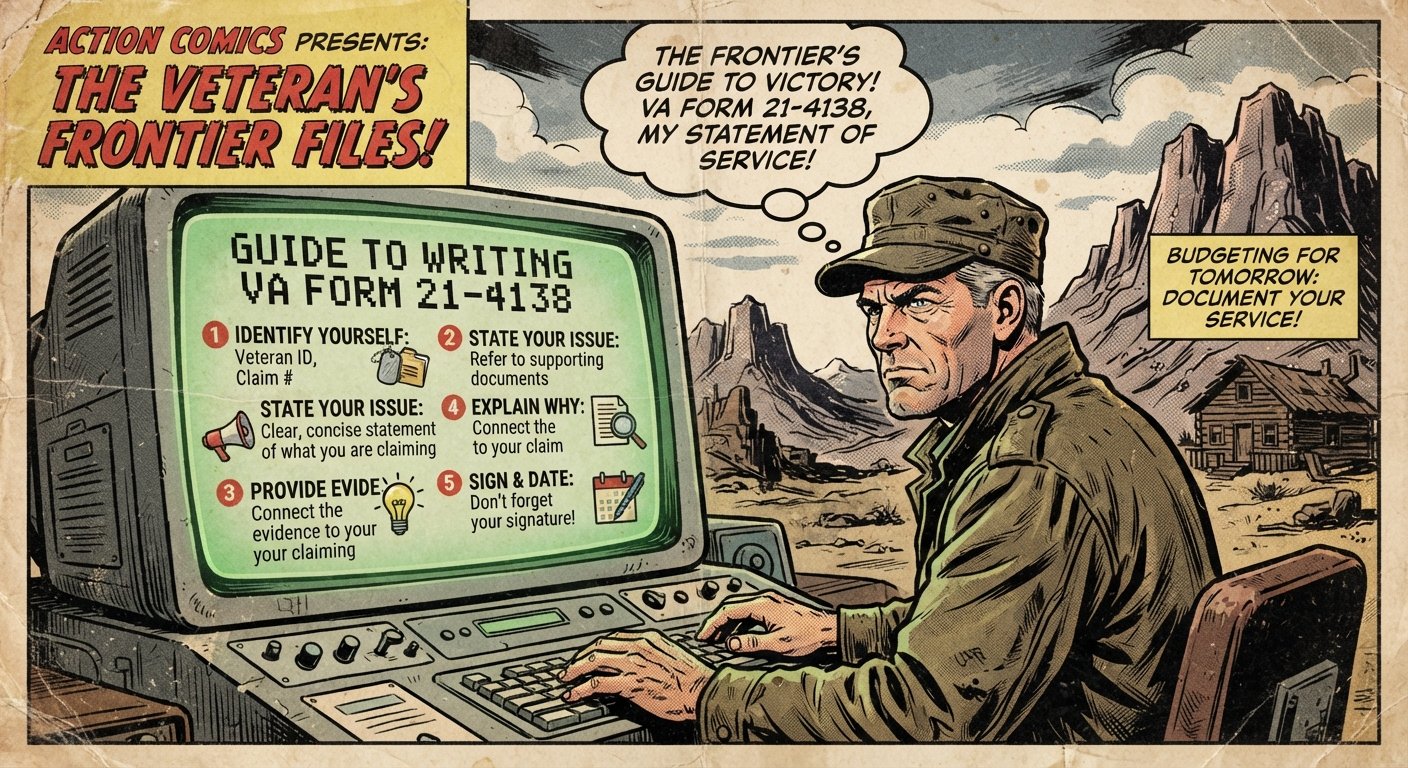
VA Form 21-4138 in Idaho: How to Write a Statement in Support of Claim
VA Form 21-4138 is the Statement in Support of Claim — a signed, first-hand written account you submit to the VA to describe an in-service event, explain how a condition affects your daily life, or clarify gaps in your records. In Idaho, file it online at VA.gov, by mail, or through a free County Veteran Service Officer.
Quick Facts
| Item | Details |
|---|---|
| Benefit | Written lay evidence to strengthen a VA disability, pension, or survivor claim |
| Eligibility | Any Veteran, dependent, or survivor with a pending or supplemental VA claim |
| Application | VA Form 21-4138 (online at VA.gov, by mail, or through an Idaho CVSO) |
| Processing Time | No separate processing — becomes part of your existing claim file |
| Official Agency | U.S. Department of Veterans Affairs (VA) |
| Required Forms | VA Form 21-4138; VA Form 21-10210 for buddy/witness statements |
| Updated For | July 2024 form revision; 2026 VA claims procedures |
What Is VA Form 21-4138?
VA Form 21-4138 is the Statement in Support of Claim, a general-purpose form that gives you space to provide written testimony — your own words — to support a VA claim. The current form revision date is July 2024. The form is used across disability compensation, pension, Dependency and Indemnity Compensation (DIC), accrued benefits, education, and housing claims.

VA Form 21-4138 is a form of lay evidence. Lay evidence is testimony from someone without medical training who describes what they personally observed or experienced. The VA weighs lay statements by how specific, credible, and relevant they are to the claimed condition.
What Form 21-4138 Is Not

VA Form 21-4138 is not the application for VA disability compensation. That is VA Form 21-526EZ. It is not the form for buddy statements. Since January 17, 2021, the VA prefers VA Form 21-10210 (Lay/Witness Statement) for statements written by other people — friends, family, or fellow service members.
Use Form 21-4138 for your own statement. Use Form 21-10210 when someone else is writing on your behalf.
Form 21-4138 vs. Form 21-10210: Which Should You Use?
| Form | Best Use | Who Writes It |
|---|---|---|
| VA Form 21-4138 | Your own personal statement in support of your claim | The Veteran, dependent, or survivor |
| VA Form 21-10210 | Lay or witness statements (buddy statements) | Friends, family, fellow service members, coworkers |
Both forms remain valid. Form 21-4138 is still accepted and is the natural fit for your own account. Form 21-10210 is the VA’s preferred form when someone else is writing for you.
When to Use VA Form 21-4138 in Idaho
Use VA Form 21-4138 when you need to tell the VA something in your own words that is not already in your records. Common situations include:
Describing an in-service event that is not documented in your service records — a training accident, a field injury, an assault, or a combat exposure.
Explaining how your condition affects daily life — work, sleep, relationships, mobility, concentration, and recreation.
Clarifying a gap or inconsistency in your service or medical records — for example, explaining why you did not report an injury at the time.
Providing details about your family situation or finances for pension, DIC, or accrued benefits claims.
Responding to a VA request — when the VA sends you a letter asking for additional information, Form 21-4138 is often the correct way to respond.
Reporting a change in circumstances — a change in care facility, income, or dependents.
When NOT to Use VA Form 21-4138
Veterans May Qualify for Extra Benefits
Check available financial assistance, healthcare programs and other opportunities that may apply to you.
Check EligibilityDo not use Form 21-4138 when:
You are filing your initial claim for disability compensation — use VA Form 21-526EZ.
You are appealing a denial — use VA Form 20-0995 (Supplemental Claim) or VA Form 20-0996 (Higher-Level Review).
Someone else is writing a buddy statement on your behalf — use VA Form 21-10210.
You are applying for Chapter 35 DEA education benefits — use VA Form 22-5490.
How to Fill Out VA Form 21-4138: Section by Section
VA Form 21-4138 has three sections. Here is exactly what to put in each one.
Section I: Identification Information
Provide your full legal name, Social Security number, VA file number (if you have one), date of birth, service number (if applicable), telephone number, email address, and mailing address.
If you are a surviving spouse or dependent filling out the form for a DIC or survivor claim, enter the Veteran’s information in the identification block, not your own, unless the form specifically asks for claimant information.
Section II: Statement
This is the main part of the form — the space where you write your statement. There is also an online tool on VA.gov that lets you type your statement directly instead of using the paper form.
If you need more space, you may attach an addendum. You must indicate on the form that an addendum is attached. The addendum should include your name and VA file number on every page.
Section III: Certification and Signature
Read the certification statement carefully. It says that the information you provided is true and correct to the best of your knowledge. Sign and date the form. An unsigned form carries no evidentiary weight.
How to Write a Strong Statement in Support of Claim
A strong statement is specific, factual, and connected to your claimed condition. It tells a clear story with dates, places, symptoms, and concrete examples of how your condition affects your life.
The VA weighs statements by how specific and credible they are. Strong content sticks to facts you know firsthand rather than speculation, uses dates, places, and names where you can, describes concrete symptoms and their impact, and connects to the claimed condition clearly.
Structure Your Statement Like This
1. Identify the issue. State which claimed condition this statement supports. Example: “This statement supports my claim for service connection for chronic lower back pain.”
2. Describe the in-service event. What happened, when, where, and who was present. Example: “In March 2008, while stationed at Fort Carson, I fell approximately 10 feet from a cargo truck during a field exercise. I landed on my lower back. My squad leader, Sergeant [Name], witnessed the fall and helped me up.”
3. Describe symptoms and diagnosis. When did symptoms start? How have they changed? Example: “I first noticed stiffness and pain in my lower back the next morning. I did not report to sick call because our unit was preparing for deployment. The pain has been constant since 2008 and has gradually worsened.”
4. Describe daily-life impact. Be concrete. Example: “I cannot sit for more than 20 minutes without shifting positions. I cannot lift my children. I sleep on my side because lying flat causes sharp pain. I have missed work three days this month because of flare-ups.”
5. Connect the dots. Explain how the in-service event relates to your current condition. Example: “The fall in 2008 is the first time I experienced back pain. I had no back problems before service. The pain has never fully resolved.”
What to Avoid in Your Statement
Do not self-diagnose. You are not a doctor. Describe symptoms, not medical conclusions. Do not write “I have degenerative disc disease.” Write “I have sharp pain that shoots down my left leg when I bend forward”.
Do not exaggerate or downplay. The VA compares your statement to medical records and service records. Inconsistencies hurt credibility.
Do not be vague. “My back hurts” is weak. “My back pain prevents me from standing for more than 15 minutes” is strong.
Do not write a novel. Most effective personal statements are 500 to 1,500 words (1 to 3 pages). Write what needs to be said clearly and stop.
Do not use emotional appeals divorced from facts. The VA decides claims on evidence, not sympathy.
Example: Weak vs. Strong Statement
Weak: “My knee hurts a lot. It started in the Army. It affects my life.”
Strong: “I am submitting this statement in support of my claim for service connection for my right knee. In June 2010, during a ruck march at Fort Lewis, I twisted my right knee when I stepped in a hole. I felt a sharp pop and fell. My squad leader, Sergeant [Name], saw the fall and helped me to the medic. I was given ibuprofen and light duty for three days. My knee has swelled and ached after physical activity ever since. I cannot run. I cannot kneel. I take stairs one at a time. I have missed work twice this year because my knee gave out while walking. I had no knee problems before June 2010.”
The strong example includes date, place, specific event, witness, immediate treatment, ongoing symptoms, functional limitations, and absence of pre-service problems.
How to Submit VA Form 21-4138 in Idaho
You have three options for submitting Form 21-4138 in Idaho: online, by mail, or through an Idaho County Veteran Service Officer.
Option 1: Submit Online (Recommended)
Go to VA.gov and sign in with your ID.me or Login.gov account.
Navigate to your pending claim or use the QuickSubmit tool on AccessVA.
Upload your completed VA Form 21-4138 as a PDF.
You can also use the online tool on the VA’s Form 21-4138 page to type your statement directly instead of downloading and filling out the paper form.
Confirm receipt and keep a copy of everything you submit.
Option 2: Submit by Mail
Download VA Form 21-4138 from VA.gov and complete it.
Mail to the VA regional office that processes your claim. For Idaho, the Boise VA Regional Benefit Office is located at 444 W. Fort Street, Boise, ID 83702.
Keep a copy of the form and any attachments.
Send via certified mail with return receipt requested so you have proof of delivery.
Option 3: Submit Through an Idaho County Veteran Service Officer (Free)
Idaho has 18 accredited Veteran Service Officers stationed in Boise, Mountain Home, Twin Falls, Pocatello, Caldwell, Lewiston, and Post Falls. County Veteran Service Officers (CVSOs) provide free claim assistance and can help you complete Form 21-4138, gather supporting documents, and submit your claim electronically.
Contact the Idaho Division of Veterans Services at 208-780-1300 or visit veterans.idaho.gov to find your local CVSO. The Boise VA Regional Office does not assist with filing claims — that service is provided by IDVS and CVSOs.
Important: Avoid “claim sharks” — unaccredited businesses that charge fees for claims assistance. Accredited VSOs and CVSOs provide the same services for free. Idaho has seen Veterans fall prey to these businesses due to a shortage of trained VSOs.
Common Mistakes Idaho Veterans Make with VA Form 21-4138
1. Using Form 21-4138 for a buddy statement. Since January 17, 2021, the VA prefers VA Form 21-10210 for statements written by other people. Use Form 21-4138 for your own account.
2. Writing a vague statement. “My back hurts” does not help the VA assign a rating. Describe the frequency, severity, duration, and functional impact of your symptoms.
3. Self-diagnosing. You are not a medical professional. Describe symptoms and limitations, not medical conclusions. The VA needs a medical opinion to connect symptoms to a diagnosis.
4. Forgetting to sign and date the form. An unsigned Form 21-4138 has no evidentiary value. Double-check Section III before submitting.
5. Not attaching an addendum properly. If your statement exceeds the space on the form, attach an addendum and indicate on the form that an addendum is attached. Include your name and VA file number on every page of the addendum.
6. Submitting duplicate statements. If you submit the same statement multiple times, it can clutter your file and slow processing. Submit once and keep a copy.
7. Waiting too long to submit. Form 21-4138 supports an existing claim. If you have new evidence or a new statement, submit it as soon as possible. Delays can affect your effective date for benefits.
8. Not using an Idaho CVSO for help. Free, accredited assistance is available across Idaho. CVSOs can review your statement for completeness, help you gather supporting documents, and submit your claim electronically.
What Happens After You Submit VA Form 21-4138
Your Form 21-4138 becomes part of your claims file (also called your C-file). The VA will consider it along with your service records, medical evidence, and any other statements you submit.
There is no separate processing time for Form 21-4138 — it is evidence in support of your existing claim, not a standalone application. The VA will issue a decision on your claim after reviewing all evidence. If the VA needs more information, it may send you a letter requesting additional evidence.
If Your Claim Is Denied
If your claim is denied, you have one year from the decision letter date to appeal. Options include:
Supplemental Claim (VA Form 20-0995): Submit new and relevant evidence, including a stronger Form 21-4138.
Higher-Level Review (VA Form 20-0996): Request a review by a senior VA decision-maker based on the existing record.
Board Appeal (VA Form 10182): Appeal directly to the Board of Veterans’ Appeals.
Idaho CVSOs and the Idaho Division of Veterans Services provide free appeals assistance. Contact IDVS at 208-780-1300 for help.
Can You Submit New Evidence After a Decision?
Yes. You can submit a new VA Form 21-4138 at any time. If you have a new statement, new details about your condition, or a clarification of a previous statement, submitting it with a Supplemental Claim (VA Form 20-0995) can reopen your case.
VA Form 21-4138 and the PACT Act
The PACT Act of 2022 expanded VA health care and benefits for Veterans exposed to burn pits, Agent Orange, and other toxic substances. If you are filing a PACT Act claim, VA Form 21-4138 can be used to describe your exposure — where you served, when, and what you were exposed to.
Using Form 21-4138 for PACT Act Claims
Describe your exposure in specific terms: location, dates, duties, and any immediate symptoms. Example: “I served at [Forward Operating Base] in Iraq from March 2006 to September 2006. I was assigned to burn pit detail for approximately four months. I inhaled thick black smoke daily. I developed a persistent cough during this period that has never fully resolved.”
Pair your statement with VA Form 21-526EZ (the PACT Act claim form) and any medical evidence documenting your current condition.
Common Questions
What is VA Form 21-4138 used for?
VA Form 21-4138 is the Statement in Support of Claim. It is a general-purpose form where you provide a signed, first-hand written account to support a VA claim. Use it to describe an in-service event, explain how a condition affects your daily life, or clarify gaps in your records.
What is the difference between VA Form 21-4138 and VA Form 21-10210?
Form 21-4138 is for your own statement. Form 21-10210 is for lay or witness statements written by someone else — friends, family, or fellow service members. Since January 17, 2021, the VA prefers Form 21-10210 for buddy statements.
How long should my VA Form 21-4138 statement be?
Most effective statements are 500 to 1,500 words (1 to 3 pages). Write what needs to be said clearly and stop. Do not pad with repetition, and do not cut critical details to fit a page limit.
Do I need to sign VA Form 21-4138?
Yes. An unsigned Form 21-4138 carries no evidentiary weight. Sign and date the form in Section III before submitting.
Can I submit VA Form 21-4138 online in Idaho?
Yes. You can submit it online through VA.gov or AccessVA’s QuickSubmit tool. The VA also offers an online tool where you can type your statement directly instead of using the paper form.
What should I include in my VA Form 21-4138 statement?
Include the claimed condition, the in-service event (date, place, what happened), your symptoms and when they started, how the condition affects your daily life, and how the in-service event connects to your current condition. Be specific and factual.
Can I use VA Form 21-4138 for a PACT Act claim?
Yes. Use it to describe your toxic exposure — where you served, when, and what you were exposed to. Pair it with VA Form 21-526EZ and medical evidence documenting your current condition.
What happens if I submit a vague statement?
A vague statement carries little weight. The VA needs specific details — dates, places, symptoms, functional limitations — to assign a rating. “My back hurts” is weak. “My back pain prevents me from standing for more than 15 minutes” is strong.
Can an Idaho County Veteran Service Officer help me with Form 21-4138?
Yes. Idaho CVSOs provide free claim assistance. They can help you complete the form, gather supporting documents, and submit your claim electronically. Contact IDVS at 208-780-1300 to find your local CVSO.
What if my claim is denied after submitting Form 21-4138?
You have one year from the decision letter date to appeal. Options include a Supplemental Claim (VA Form 20-0995), Higher-Level Review (VA Form 20-0996), or Board Appeal (VA Form 10182). Idaho CVSOs provide free appeals assistance.
Can I submit a new Form 21-4138 after my claim is decided?
Yes. You can submit a new Form 21-4138 at any time. If you have new details or a clarification, submit it with a Supplemental Claim (VA Form 20-0995) to reopen your case.
Is VA Form 21-4138 still valid in 2026?
Yes. The form was last revised in July 2024 and remains valid. The OMB control number is 2900-0075, and the current form expiration date is July 31, 2027.
What is the Boise VA Regional Office address?
The Boise VA Regional Benefit Office is located at 444 W. Fort Street, Boise, ID 83702. Phone: 800-827-1000.
Do I need a lawyer to write a VA Form 21-4138 statement?
No. You can write your own statement. An accredited Idaho CVSO or VSO can help you at no cost. Avoid unaccredited “claim sharks” that charge fees for services you can get for free.
Key Takeaways
VA Form 21-4138 is the Statement in Support of Claim — a signed, first-hand written account you submit to support a VA claim.
Use Form 21-4138 for your own statement. Use Form 21-10210 for buddy/witness statements written by someone else.
Strong statements are specific — dates, places, symptoms, functional limitations, and a clear connection to service.
Avoid self-diagnosing. Describe symptoms, not medical conclusions. Let a medical professional connect symptoms to a diagnosis.
Submit online at VA.gov, by mail to the Boise VA Regional Office, or through a free Idaho County Veteran Service Officer.
Sign and date the form. An unsigned statement has no evidentiary value.
Most effective statements are 500–1,500 words (1–3 pages). Be thorough but concise.
Idaho CVSOs provide free claim assistance. Contact IDVS at 208-780-1300 to find your local officer.
Form 21-4138 was last revised in July 2024 and remains valid in 2026.
Denied claims can be appealed using VA Form 20-0995, 20-0996, or 10182.
Official Resources
VA Form 21-4138 (Download and Online Tool): https://www.va.gov/forms/21-4138/
VA Form 21-10210 (Lay/Witness Statement): https://www.va.gov/forms/21-10210/
VA Evidence Needed for Disability Claims: https://www.va.gov/disability/eligibility/evidence/
VA Form 21-526EZ (Disability Compensation Application): https://www.va.gov/forms/21-526EZ/
VA Form 20-0995 (Supplemental Claim): https://www.va.gov/forms/20-0995/
Boise VA Regional Benefit Office: https://www.va.gov/boise-va-regional-benefit-office/
Idaho Division of Veterans Services: https://veterans.idaho.gov
USA.gov Veterans Benefits: https://www.usa.gov/veterans-benefits




🇺🇸 IMPORTANT DISCLAIMER – Veterans Benefits Information
This site provides general information about U.S. Department of Veterans Affairs (VA) benefits for educational and informational purposes only.
- Not Official: We are NOT affiliated with, endorsed by, or connected to the U.S. Department of Veterans Affairs (VA), the Veterans Benefits Administration (VBA), the Veterans Health Administration (VHA), or any other government agency.
- No Legal/Financial Advice: The content on this website is for informational purposes only and does not constitute legal, financial, or medical advice. VA benefits rules change frequently – always consult with an accredited Veterans Service Officer (VSO) or a qualified professional for your specific situation.
- Official Sources: For official, binding information and to apply for benefits, always visit official .gov websites: VA.gov, Benefits.VA.gov, or SSA.gov.
- No Data Collection: This site does not collect, store, or process any personal information. It does not have login forms, contact forms, or any system to capture user data. We never ask for your Social Security Number, bank details, or any personal information.
- 🚨 Scam Alert: The VA and other government agencies never charge fees for benefit applications. If anyone asks for money to "process" your VA claim, it is a scam. Report it to the VA Office of Inspector General at VA.gov/OIG.
- Advertising: This site uses third-party advertising (Adsterra) to cover operational costs. We do not endorse or guarantee any products or services advertised.
📌 Information provided as of June 2026. Always verify current eligibility and rules with official .gov sources.
This site is not affiliated with the U.S. Department of Veterans Affairs or any government agency. All information is for educational purposes only. Please visit VA.gov for official information.
