
VA Caregiver Support Program: Complete 2026 Guide for Veterans and Caregivers
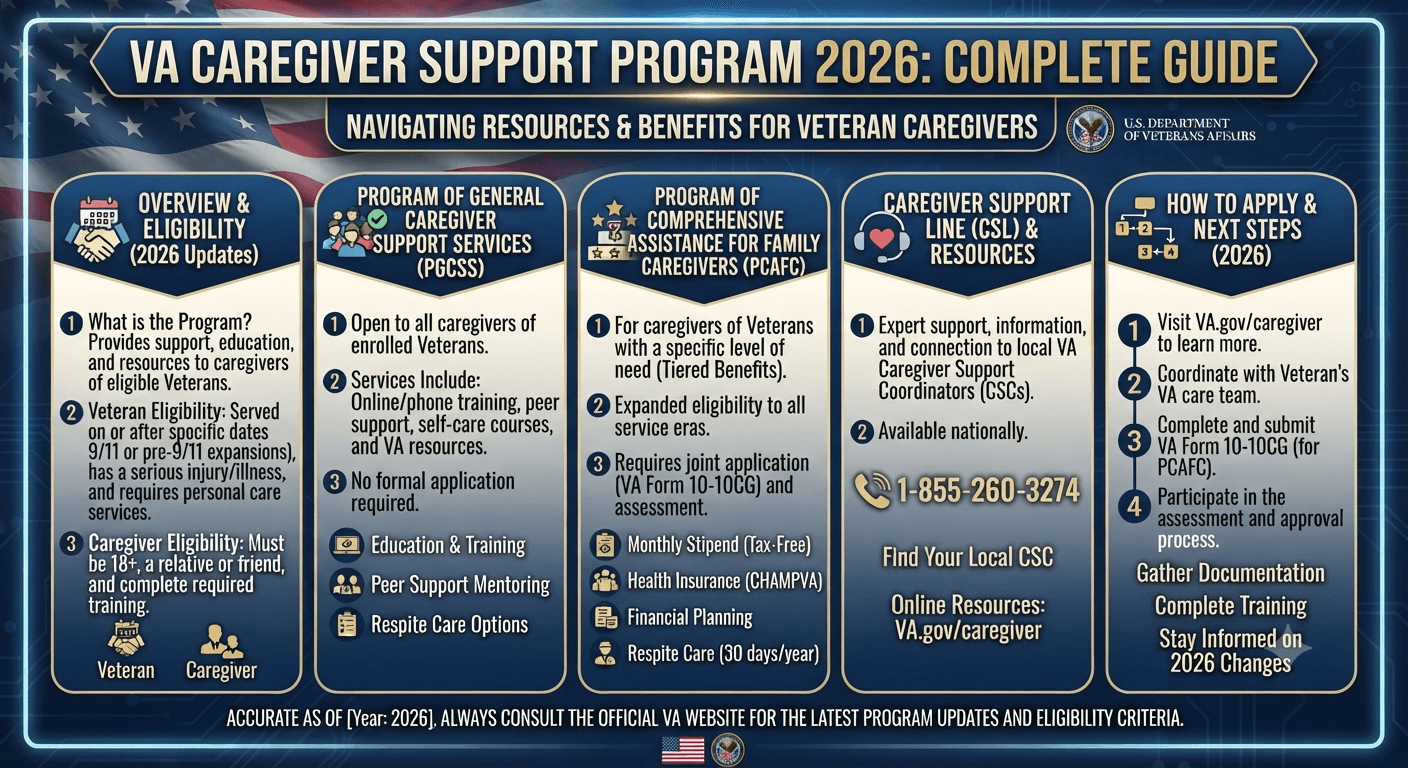
The VA Caregiver Support Program (CSP) is a nationwide initiative that provides clinical services, education, resources, and financial support to family caregivers of eligible veterans enrolled in VA health care. The program operates through two distinct tracks: the Program of General Caregiver Support Services (PGCSS), available to caregivers of any veteran in the VA system, and the Program of Comprehensive Assistance for Family Caregivers (PCAFC), which offers enhanced benefits including a monthly stipend for caregivers of veterans with serious service-connected injuries .
Quick Facts
| Item | Details |
|---|---|
| Official Name | VA Caregiver Support Program (CSP) |
| Two Program Tracks | PGCSS (General) and PCAFC (Comprehensive) |
| Eligibility (PCAFC) | Veteran with 70%+ service-connected disability requiring 6+ months of personal care |
| Eligibility (PGCSS) | Veteran enrolled in VA health care needing personal care services |
| Application (PCAFC) | VA Form 10-10CG (joint application) |
| Application (PGCSS) | No formal application—contact local CSP Team |
| Stipend (PCAFC) | Monthly payment to primary caregivers |
| Healthcare (PCAFC) | CHAMPVA eligibility for uninsured caregivers |
| Respite Care (PCAFC) | At least 30 days per year |
| Official Agency | U.S. Department of Veterans Affairs |
| Caregiver Support Line | 1-855-260-3274 |
| Required Form Updated | VA Form 10-10CG (Revised February 2025) |
What Is the VA Caregiver Support Program?
The VA Caregiver Support Program (CSP) is a national program with local offices at every VA medical center <span class=””>. Its mission is to promote the health and well-being of family caregivers who care for our nation’s veterans through education, resources, support, and services .

Why it matters: Family caregivers provide essential support that helps veterans remain in their homes and communities. The CSP recognizes this critical role by offering structured support, training, and—for eligible caregivers—financial compensation.

What veterans and caregivers should do next: If you care for a veteran enrolled in VA health care, contact the Caregiver Support Team at your local VA medical center or call the Caregiver Support Line at 1-855-260-3274 to learn which program may be right for you .
The Two VA Caregiver Support Programs
The VA Caregiver Support Program operates through two separate programs, each with different eligibility requirements and benefits <span class=””>.
Program of General Caregiver Support Services (PGCSS)
What it is: PGCSS is the foundational tier of the VA Caregiver Support Program, providing education, training, and support services to caregivers of veterans enrolled in VA health care <span class=””>.
Who qualifies: You may be eligible for PGCSS if:
You care for a veteran who is enrolled in VA health care
The veteran needs personal care services because they cannot perform activities of daily living OR needs supervision or protection based on symptoms of neurological or other impairment
The veteran agrees to receive care from you as their caregiver
Veterans May Qualify for Extra Benefits
Check available financial assistance, healthcare programs and other opportunities that may apply to you.
Check EligibilityWhy it matters: PGCSS opens the door to critical support services that can help caregivers manage stress, build skills, and connect with others in similar situations .
What to do next: Contact your local CSP Team. No formal application is required—just participate in a brief intake process <span class=””>.
Program of Comprehensive Assistance for Family Caregivers (PCAFC)
What it is: PCAFC is the enhanced tier of the VA Caregiver Support Program, providing a monthly stipend, health insurance access, mental health counseling, and other intensive supports to caregivers of veterans with serious service-connected injuries .
Who qualifies: The veteran must meet ALL of these requirements:
Have a serious injury incurred or aggravated in the line of duty
Have a service-connected disability rating of 70% or higher (singular or combined)
Need in-person personal care services for a minimum of six continuous months based on inability to perform activities of daily living OR need for supervision or protection based on neurological impairment
Receive care at home or will do so if VA designates a Family Caregiver
Receive ongoing care from a primary care team
The caregiver must:
Be at least 18 years old
Be the veteran’s spouse, child, parent, step-family member, extended family member, OR someone who lives with the veteran full-time
Complete required caregiver training
Participate in an initial home-care assessment
Demonstrate ability to carry out the veteran’s care needs
Why it matters: PCAFC provides substantial financial and support resources to caregivers of seriously injured veterans, acknowledging the significant demands of full-time caregiving .
What to do next: Submit a joint application using VA Form 10-10CG .
Benefits and Supports Available
PGCSS Benefits and Supports
Caregivers enrolled in PGCSS have access to :
Peer support mentoring – Connect with experienced caregivers for guidance and shared experiences
Building Better Caregivers – Six-week online workshop for caregivers of veterans with dementia, memory problems, PTSD, brain injury, or serious illness
REACH VA – Evidence-based coaching program for stressed caregivers, with special focus on veterans with dementia, spinal cord injury, multiple sclerosis (MS), PTSD, and ALS
Caregiver self-care and resilience courses – In-person or virtual trainings on managing stress, problem solving, taking care of yourself, and handling emotions
Caregivers FIRST program – Four-session group training on coping skills and strategies
Annie Caregiver text support – Text messaging service promoting self-care, with messages on stress, bereavement, and dementia behaviors
VA S.A.V.E. suicide prevention training – Training to identify veterans at risk for suicide
Caregiver Support Line – Staffed by VA clinical social workers providing information, supportive counseling, and referrals
Respite care<span class=””> – Short-term relief for caregivers
PCAFC Benefits and Supports
Family Caregivers in PCAFC receive all PGCSS benefits PLUS :
Primary Family Caregivers receive:
Monthly stipend – A financial payment made directly to the caregiver
CHAMPVA healthcare coverage – Access to health care benefits through the Civilian Health and Medical Program of the Department of Veterans Affairs (if the caregiver is otherwise uninsured)
Mental health counseling – Through the Virtual Psychotherapy Program for Caregivers
Legal and financial planning services – Certain services available to designated Primary Family Caregivers
Beneficiary travel<span class=””> – Travel, lodging, and financial assistance when traveling with the veteran to VA health care appointments
Respite care – At least 30 days per year of respite care for the veteran
Secondary Family Caregivers receive:
Mental health counseling
Beneficiary travel benefits
Respite care (at least 30 days per year)
Comparison Table: PGCSS vs. PCAFC
| Feature | PGCSS (General) | PCAFC (Comprehensive) |
|---|---|---|
| Veteran Eligibility | Enrolled in VA health care, needs personal care services | 70%+ service-connected disability, needs 6+ months personal care |
| Caregiver Relationship | Any caregiver (no relation or cohabitation required) | Family member, extended family, or full-time cohabitant |
| Application Process | Brief intake—no formal application | VA Form 10-10CG required |
| Monthly Stipend | No | Yes (primary caregivers) |
| CHAMPVA Healthcare | No | Yes (if uninsured) |
| Mental Health Counseling | Yes | Yes |
| Respite Care | Yes | Yes (at least 30 days/year) |
| Peer Support | Yes | Yes |
| Training Programs | Yes | Yes |
How to Apply
Applying for PGCSS
Step 1: Ensure the veteran is enrolled in VA health care. If not, the veteran must apply first .
Step 2: Contact the Caregiver Support Team at your nearest VA medical center .
Step 3: Complete a brief intake process with the Caregiver Support Coordinator .
Step 4: The veteran must agree to receive care from you and have you listed as their caregiver in their health care record .
Note: No formal application is required for PGCSS, and no clinical evaluation is needed .
Applying for PCAFC
Step 1: Determine if the veteran meets all PCAFC eligibility requirements .
Step 2: Download and complete VA Form 10-10CG (revised February 2025) .
Step 3: Ensure all required fields are completed, including signatures and dates from the veteran and each caregiver applicant .
Step 4: Submit your application using one of these methods:
Online (fastest): Visit VA.gov/family-member-benefits/comprehensive-assistance-for-family-caregivers
By mail: Send the completed form to: 10-10CG Evidence Intake Center, PO Box 5154, Janesville, WI 53547-5154
In person: Submit to Facility CSP Staff or via the Caregiver Support Line at 1-855-260-3274
Step 5: After receiving your application, a member of the local CSP Team will contact you to review eligibility criteria, complete an initial intake, and discuss the evaluation process .
Step 6: Participate in the required evaluations, including a home-care assessment .
Step 7: If approved, you will need to complete required caregiver training .
Common Questions
1. What is the VA Caregiver Support Program?
The VA Caregiver Support Program (CSP) provides clinical services, education, resources, and support to family caregivers of eligible veterans enrolled in VA health care. The program includes two tracks: PGCSS for general caregivers and PCAFC for caregivers of veterans with serious service-connected injuries .
2. Do I have to be related to the veteran to qualify as a caregiver?
For PGCSS, no. Any caregiver who provides personal care services to a veteran enrolled in VA health care can participate. For PCAFC, you must be a family member, step-family member, extended family member, or someone who lives full-time with the veteran .
3. How much is the VA caregiver stipend?
The monthly stipend amount varies based on the percentage of the local home aide wage rate. Primary Family Caregivers in PCAFC receive a monthly payment, though the exact amount depends on the veteran’s needs and geographic location. Contact your local CSP Team for specific information about stipend amounts in your area .
4. Do I need to apply to get VA caregiver support?
For PGCSS, no formal application is needed—contact your local CSP Team for a brief intake. For PCAFC, you must submit VA Form 10-10CG, which is a joint application signed by both the veteran and caregiver applicant .
5. Can veterans from any era get caregiver support?
Yes. PGCSS is available to caregivers of veterans from all eras who are enrolled in VA health care. PCAFC eligibility is based on the veteran’s service-connected disability rating and need for care, not on the era of service .
6. Do secondary caregivers get a stipend?
No. The monthly stipend is paid only to the Primary Family Caregiver. Secondary Family Caregivers receive mental health counseling, beneficiary travel benefits, and respite care but do not receive the monthly stipend .
7. Can I receive the caregiver stipend if the veteran is in a nursing home?
No. To participate in PCAFC, the veteran must receive care at home or will do so if VA designates a Family Caregiver. Personal care services provided by the Family Caregiver cannot be simultaneously and regularly provided by another individual or entity .
8. What is the VA Form 10-10CG?
VA Form 10-10CG is the joint application for the Program of Comprehensive Assistance for Family Caregivers (PCAFC). It must be completed and signed by both the veteran and each Family Caregiver applicant. A veteran can apply with one Primary Family Caregiver and up to two Secondary Family Caregivers .
9. What happens after I submit VA Form 10-10CG?
After receiving your application, a member of the local CSP Team will contact you to review eligibility criteria, complete an initial intake, and discuss the evaluation process. The evaluation includes assessments to determine if the veteran meets PCAFC eligibility requirements .
10. How do I contact the VA Caregiver Support Program?
Call the VA Caregiver Support Line at 1-855-260-3274, staffed by VA clinical social workers who can provide information and connect you to your local Caregiver Support Team. You can also find your local team using the locator at caregiver.va.gov .
11. Is the Caregiver Support Program available nationwide?
Yes. The VA Caregiver Support Program is a national program with local offices at every VA medical center. Caregiver Support Teams are available at all VA facilities across the United States .
12. Can a representative apply on behalf of a veteran or caregiver?
Yes. A representative (someone with power of attorney, legal guardianship, or similar authority) may sign the application on behalf of a veteran or Family Caregiver applicant. Supporting documentation must be provided with the application .
Key Takeaways
The VA Caregiver Support Program offers two tracks: PGCSS (general support) and PCAFC (comprehensive benefits including a stipend) .
PGCSS is available to caregivers of any veteran enrolled in VA health care who needs personal care services—no formal application is required .
PCAFC requires a 70%+ service-connected disability rating, a need for 6+ months of personal care, and a joint application using VA Form 10-10CG .
Primary Family Caregivers in PCAFC receive a monthly stipend, CHAMPVA healthcare access (if uninsured), mental health counseling, and at least 30 days of respite care per year .
Secondary Family Caregivers in PCAFC receive mental health counseling, beneficiary travel, and respite care but do NOT receive a stipend .
All caregivers can access peer support, training programs, the Caregiver Support Line, and self-care resources .
The Caregiver Support Line (1-855-260-3274) provides information, supportive counseling, and referrals to local resources .
VA Form 10-10CG was revised in February 2025—always use the most current version .
You cannot receive both PGCSS and PCAFC simultaneously for the same caregiving relationship—PCAFC includes all PGCSS benefits plus enhanced supports .
Contact your local CSP Team to get started—they are available at every VA medical center to help you navigate the program .
Official Resources
VA Caregiver Support Program Website: caregiver.va.gov
Caregiver Support Line: 1-855-260-3274
Apply for PCAFC Online: va.gov/family-member-benefits/comprehensive-assistance-for-family-caregivers
VA Form 10-10CG Download: va.gov/forms/10-10cg
Find Your Local CSP Team: caregiver.va.gov (use the team locator)
VA Health Care Enrollment: va.gov/health-care/how-to-apply
🇺🇸 IMPORTANT DISCLAIMER – Veterans Benefits Information
This site provides general information about U.S. Department of Veterans Affairs (VA) benefits for educational and informational purposes only.
- Not Official: We are NOT affiliated with, endorsed by, or connected to the U.S. Department of Veterans Affairs (VA), the Veterans Benefits Administration (VBA), the Veterans Health Administration (VHA), or any other government agency.
- No Legal/Financial Advice: The content on this website is for informational purposes only and does not constitute legal, financial, or medical advice. VA benefits rules change frequently – always consult with an accredited Veterans Service Officer (VSO) or a qualified professional for your specific situation.
- Official Sources: For official, binding information and to apply for benefits, always visit official .gov websites: VA.gov, Benefits.VA.gov, or SSA.gov.
- No Data Collection: This site does not collect, store, or process any personal information. It does not have login forms, contact forms, or any system to capture user data. We never ask for your Social Security Number, bank details, or any personal information.
- 🚨 Scam Alert: The VA and other government agencies never charge fees for benefit applications. If anyone asks for money to "process" your VA claim, it is a scam. Report it to the VA Office of Inspector General at VA.gov/OIG.
- Advertising: This site uses third-party advertising (Adsterra) to cover operational costs. We do not endorse or guarantee any products or services advertised.
📌 Information provided as of June 2026. Always verify current eligibility and rules with official .gov sources.
This site is not affiliated with the U.S. Department of Veterans Affairs or any government agency. All information is for educational purposes only. Please visit VA.gov for official information.
