
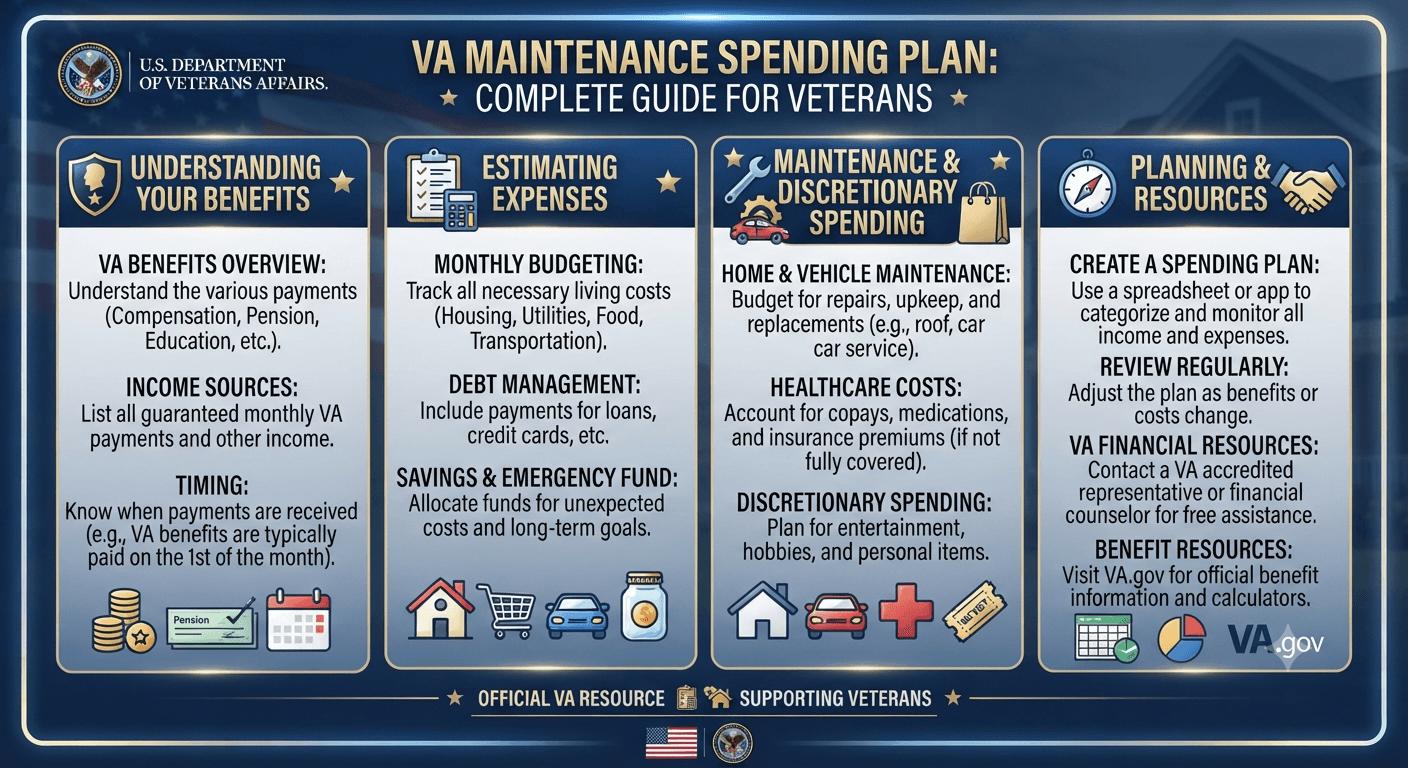
VA Maintenance Spending Plan: Complete Guide for Veterans and Caregivers
A VA maintenance spending plan—often referred to in the context of the VA Fiduciary Program—is a formal budget that a VA-appointed fiduciary creates to manage a beneficiary’s VA benefits for their daily care, support, and welfare. This plan is required when a veteran is determined unable to manage their own VA benefit payments. The fiduciary’s primary financial responsibility is to use the funds “only for the care, support, education, health, and welfare of the beneficiary and his or her dependents,” ensuring day-to-day needs are met before any other expenses .
Quick Facts
| Item | Details |
|---|---|
| What It Is | Spending plan/managed budget for VA beneficiaries unable to manage their own funds |
| Who Applies | VA-appointed fiduciary (spouse, relative, friend, or professional) |
| Primary Rule | Funds must first cover day-to-day needs: food, clothing, and shelter |
| Official Agency | U.S. Department of Veterans Affairs (VBA Fiduciary Program) |
| Primary Regulation | 38 CFR Part 13 – Fiduciary Activities |
| Fee Limit | Fiduciary fees limited to 4% of income (unless court-appointed) |
| Reporting | Annual accounting required to VA |
| Key Requirement | Must keep beneficiary’s funds in a separate account |
| Hotline | 1-800-827-1000 |
What Is a VA Maintenance Spending Plan?
A VA maintenance spending plan is a financial management tool used by VA fiduciaries to budget and oversee a beneficiary’s VA benefits. When the VA determines that a veteran cannot manage their own benefits due to injury, disease, or infirmities of advanced age, the VA Fiduciary Program steps in to protect the beneficiary’s wellbeing .

What it is: A structured approach to managing monthly VA benefit payments that ensures the beneficiary’s basic needs are met first. The plan details how much will be spent on food, clothing, shelter, medical care, and other necessities .

Who qualifies: Veterans who have been rated by VA as incapable of managing their own benefits, determined by a court as unable to manage financial affairs, or who are under the age of majority .
Why it matters: This system protects vulnerable veterans from financial exploitation while ensuring their benefits are used for their intended purpose—their care and welfare.
What veterans should do next: If you or a loved one receives a notice from VA about fiduciary appointment, work cooperatively with the assigned fiduciary to establish a spending plan that meets daily needs while preserving benefits for essential care.
Understanding the VA Fiduciary Program
The VA Fiduciary Program exists to protect beneficiaries who cannot manage their own VA benefits. The purpose is to “protect certain VA beneficiaries who, as a result of injury, disease, or infirmities of advanced age, or by reason of being less than the age of majority, cannot manage their VA benefits” <span class=””>.
What Triggers a Fiduciary Appointment
Veterans May Qualify for Extra Benefits
Check available financial assistance, healthcare programs and other opportunities that may apply to you.
Check EligibilityVA may determine a beneficiary needs a fiduciary when:
They are rated as incapable of managing VA benefits
A court determines they are unable to manage financial affairs
They are under age 18
Fiduciary Appointment Order of Preference
VA follows a specific order when selecting a fiduciary :
Preference stated by the beneficiary (if capable)
The beneficiary’s spouse
A relative who has care or custody of the beneficiary
Any other relative
Any friend or acquaintance
Chief officer of a facility where the beneficiary receives care
Bonded officer of an Indian reservation (if applicable)
Court-appointed guardian
Professional fiduciary (fee-based)
Temporary fiduciary
Key Responsibilities of a VA Fiduciary
When managing a beneficiary’s VA benefits, the fiduciary has specific financial responsibilities under 38 CFR §13.140 :
Use VA benefit funds “only for the care, support, education, health, and welfare of the beneficiary and his or her dependents”
Protect benefits from loss or diversion
Maintain separate financial accounts (no commingling with personal funds)
Determine and pay the beneficiary’s just debts
Ensure decisions align with VA policy—beneficiaries are entitled to the same standard of living as others with similar resources
Protect funds from creditor claims
Spending Priorities: What Comes First?
The VA and the Consumer Financial Protection Bureau (CFPB) both emphasize a clear hierarchy for spending :
First Priority: Day-to-Day Needs
Food – Nutritious meals and groceries
Clothing – Appropriate attire
Shelter – Rent, mortgage, utilities, property taxes
Second Priority: Medical and Health Care
Medical, dental, and personal needs
Prescriptions and treatments
Improvements to daily living conditions
Third Priority: Extras (After Basic Needs Are Met)
Recreational activities, magazines, cable TV
Educational or training expenses
Car payments (if needed and other needs are met)
Savings
Any leftover funds after paying regular expenses must be saved in a federally protected interest-bearing account or U.S. savings bonds. The interest earned always belongs to the beneficiary .
Sample Spending Plan Template
While specific VA maintenance spending plans vary by beneficiary, here is a general framework used in programs like the Veterans Directed Care (VDC) program :
Estimated Monthly Expenses
| Category | Estimated Monthly Amount |
|---|---|
| Personal Care Services | $1,865.67 |
| Routine Goods and Services | $170.00 |
| Administrative Fees | $757.00 |
| Total Monthly Spending | $2,792.67 |
One-Time and Emergency Expenses
| Category | Estimated Amount |
|---|---|
| One-Time Goods & Services | $870.00 |
| Emergency/Backup Care | $700.00 |
| Employer Costs/Benefits | $1,036.50 |
| Total One-Time Expenses | $2,606.50 |
Comparison: VA Fiduciary vs. Social Security Representative Payee
| Feature | VA Fiduciary | SSA Representative Payee |
|---|---|---|
| Managing Agency | Department of Veterans Affairs | Social Security Administration |
| Determination | VA rating or court order | SSA determination of inability |
| Fee Limit | 4% of income (unless court-appointed) | Limited; varies by program |
| Account Requirements | Separate account, FDIC-insured | Separate account, interest belongs to beneficiary |
| Reporting | Annual accounting to VA | Annual accounting to SSA |
| Primary Priority | Care, support, education, health, welfare | Day-to-day needs first |
Common Questions
1. What is a VA maintenance spending plan?
A VA maintenance spending plan is a budget created by a VA-appointed fiduciary to manage a beneficiary’s VA benefits. The plan ensures funds are used for the beneficiary’s care, support, education, health, and welfare, with day-to-day needs like food, clothing, and shelter coming first .
2. Who appoints a VA fiduciary?
The VA Hub Manager (a regional VA official) appoints fiduciaries. This is done after a determination that a beneficiary cannot manage their own benefits due to injury, disease, infirmities of advanced age, or being under age 18 .
3. Can I choose my own fiduciary?
Yes, if the beneficiary has the capacity to state a preference. The VA will consider the beneficiary’s stated preference first when selecting a fiduciary. If a court has already appointed a legal guardian, VA presumes the beneficiary lacks capacity to choose .
4. How much can a VA fiduciary charge?
VA fiduciaries’ fees are limited to 4% of income under VA regulations. For court-appointed guardians managing VA benefits, fees are approved by the court. All fees must be reasonable and approved .
5. What happens if money is left over each month?
Any leftover funds after paying regular expenses must be saved in a federally protected or state-insured interest-bearing account or U.S. savings bonds. The interest earned belongs to the beneficiary, not the fiduciary .
6. Can a fiduciary use benefits for the beneficiary’s family?
If the beneficiary has a spouse or dependent family members, the fiduciary may use funds for their needs, but only after ensuring the beneficiary’s own day-to-day needs are met. Consult VA for guidance on dependent expenses .
7. What records must a VA fiduciary keep?
Fiduciaries must keep detailed records of all transactions, including bills paid, purchases made, and bank statements. An annual accounting must be submitted to VA for approval. Records must be available upon request <span class=””>.
8. Can creditors take VA benefits managed by a fiduciary?
Federal law protects VA benefits from most creditors. Creditors generally cannot legally take Social Security or VA funds. However, exceptions exist for debts owed to the federal government or for child/spousal support. Fiduciaries should seek legal help if a creditor sues the beneficiary .
9. What is the difference between a VA fiduciary and a VA guardian?
A VA fiduciary is appointed by the VA to manage benefit payments. A guardian is appointed by a state court to handle a person’s affairs. If a guardian is appointed, VA must be consulted before court orders are sought for expenditure of funds, and accountings must be submitted to VA first .
10. How do I contact the VA Fiduciary Program?
Contact the VA Fiduciary Program through your local VA regional office or call the VA Benefits Helpline at 1-800-827-1000. For information about the Fiduciary Program, visit the VA website or ask your Caregiver Support Coordinator for assistance.
11. Can a fiduciary invest the beneficiary’s money?
Yes, but only in FDIC-insured accounts or U.S. savings bonds. The VA restricts investment options to protect the beneficiary’s funds from risk. The fiduciary cannot invest in stocks, mutual funds, or other risky assets .
12. What happens if a VA fiduciary mismanages funds?
Fiduciaries who mismanage funds may be removed and may face legal consequences. VA closely monitors fiduciaries and requires annual accountings. Beneficiaries or family members who suspect mismanagement should contact the VA Fiduciary Program immediately .
13. Do VA fiduciaries have to file taxes?
Fiduciaries must be aware that beneficiaries who get VA benefits may have to pay federal income tax depending on their total income. The fiduciary receives a form showing benefits paid during the year. Consult a tax preparer to determine if the beneficiary owes taxes and pay them on time .
14. Can a fiduciary be a family member?
Yes, family members are often preferred. The order of preference places spouses first, followed by relatives who have care or custody of the beneficiary, then other relatives. However, no one can be a fiduciary if they charge a fee and VA has concerns about their fitness .
Key Takeaways
A VA maintenance spending plan is a formal budget created by a VA-appointed fiduciary to manage a beneficiary’s benefits .
The fiduciary is appointed when a veteran is determined unable to manage their own VA benefits due to injury, disease, advanced age, or being under 18 .
First priority spending must go to day-to-day needs: food, clothing, and shelter .
After basic needs are met, funds may be used for medical expenses, home improvements, recreation, and education .
Leftover funds must be saved in an interest-bearing account or U.S. savings bonds—the interest belongs to the beneficiary .
Fiduciary fees are limited to 4% of income (unless court-appointed) .
Annual accounting is required to ensure proper fund management .
VA benefits are protected from most creditors, but exceptions exist for federal debts and child/spousal support .
Contact the VA Fiduciary Program at 1-800-827-1000 for questions or concerns .
The VA Fiduciary Program’s purpose is to protect vulnerable beneficiaries and ensure their well-being .
Official Resources
VA Fiduciary Program Information: va.gov
VA Benefits Helpline: 1-800-827-1000
VA Form 21-2680 (Aid and Attendance): va.gov/forms/21-2680
Consumer Financial Protection Bureau (CFPB): consumerfinance.gov
Social Security Administration Representative Payee Program: ssa.gov
VA Financial Policy (Chapter 03): department.va.gov/financial-policy-documents

🇺🇸 IMPORTANT DISCLAIMER – Veterans Benefits Information
This site provides general information about U.S. Department of Veterans Affairs (VA) benefits for educational and informational purposes only.
- Not Official: We are NOT affiliated with, endorsed by, or connected to the U.S. Department of Veterans Affairs (VA), the Veterans Benefits Administration (VBA), the Veterans Health Administration (VHA), or any other government agency.
- No Legal/Financial Advice: The content on this website is for informational purposes only and does not constitute legal, financial, or medical advice. VA benefits rules change frequently – always consult with an accredited Veterans Service Officer (VSO) or a qualified professional for your specific situation.
- Official Sources: For official, binding information and to apply for benefits, always visit official .gov websites: VA.gov, Benefits.VA.gov, or SSA.gov.
- No Data Collection: This site does not collect, store, or process any personal information. It does not have login forms, contact forms, or any system to capture user data. We never ask for your Social Security Number, bank details, or any personal information.
- 🚨 Scam Alert: The VA and other government agencies never charge fees for benefit applications. If anyone asks for money to "process" your VA claim, it is a scam. Report it to the VA Office of Inspector General at VA.gov/OIG.
- Advertising: This site uses third-party advertising (Adsterra) to cover operational costs. We do not endorse or guarantee any products or services advertised.
📌 Information provided as of June 2026. Always verify current eligibility and rules with official .gov sources.
This site is not affiliated with the U.S. Department of Veterans Affairs or any government agency. All information is for educational purposes only. Please visit VA.gov for official information.
