
VA 100% Permanent and Total Disability Benefits in Idaho: 2026 Guide
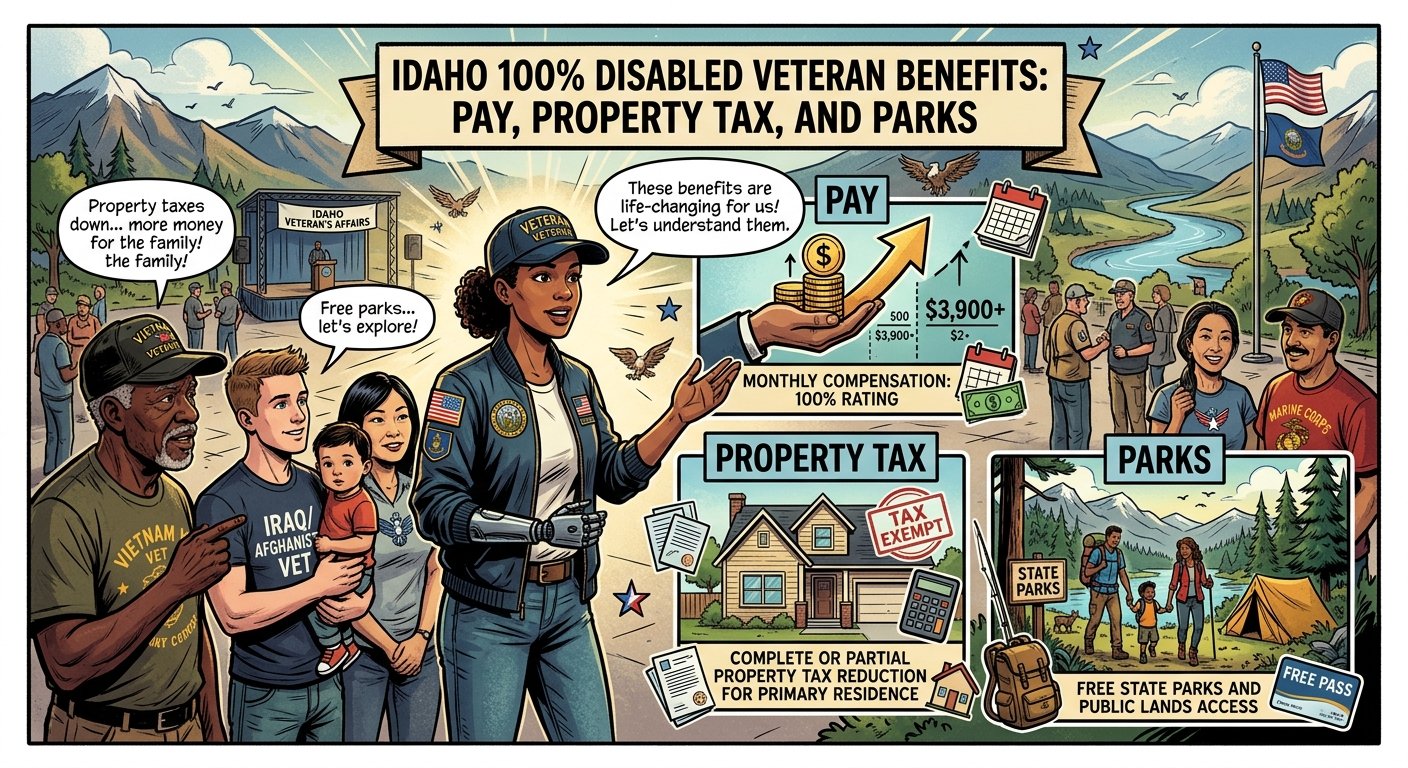
A veteran rated 100% permanent and total (P&T) by VA receives $3,938.58 per month tax-free** in 2026, plus Idaho-specific benefits including a **property tax reduction of up to $1,500, free vehicle registration, a free Idaho State Parks Veteran Pass, and CHAMPVA and Chapter 35 education benefits for dependents. P&T status protects the rating from routine re-examinations and unlocks benefits a 100% rating alone does not.
Quick Facts
| Item | Details |
|---|---|
| Benefit | VA disability compensation at the 100% rate, plus P&T-only federal and Idaho state benefits |
| Eligibility | 100% schedular rating or TDIU, with VA finding the disability permanent (not expected to improve) |
| Application | VA Form 21-526EZ or 21-8940; P&T is assigned by VA; Idaho property tax benefit requires a county assessor application |
| Processing Time | VA claim decisions vary; Idaho property tax benefit applied January 1 – April 15 |
| Official Agency | U.S. Department of Veterans Affairs; Idaho State Tax Commission; Idaho Division of Veterans Services |
| Required Forms | VA Form 21-526EZ; VA Form 21-8940 (TDIU); VA disability letter; Idaho property tax application |
| Updated For | 2026 federal fiscal year; rates effective December 1, 2025 through November 30, 2026 |
What “100% Permanent and Total” Means in Idaho
A 100% permanent and total rating is a specific VA determination with two parts. Total means the veteran’s disability meets the 100% rating level, either through a schedular 100% rating or through Total Disability based on Individual Unemployability (TDIU). Permanent means VA does not expect the disability to materially improve based on medical evidence. Both parts must be established.

P&T is not the same as a 100% rating alone. A veteran can be rated 100% and still face routine re-examinations if VA has not designated the condition permanent. A P&T designation locks in protection from those re-exams and unlocks benefits that require P&T status specifically, including CHAMPVA health coverage for dependents, Chapter 35 DEA education benefits, and several Idaho state programs. Many veterans who qualify for P&T never receive the designation because they do not know it exists as a separate determination or do not ask VA to evaluate permanence.
Federal 100% P&T Benefits in 2026

The core federal benefit is monthly VA disability compensation. A veteran rated 100% P&T receives the 100% rate, which is tax-free at the federal level and in Idaho. The 2026 rates reflect a 2.8% cost-of-living adjustment effective December 1, 2025.
2026 VA disability rates for a veteran rated 100%
| Dependent Status | Monthly Rate (2026) | Annual Total |
|---|---|---|
| Veteran alone (no dependents) | $3,938.58 | $47,262.96 |
| Veteran + spouse (no children) | $4,158.17 | $49,898.04 |
| Veteran + spouse + 1 child | $4,318.99 | $51,827.88 |
| Each additional child | +$34.00/child | +$408.00/child |
| Spouse with Aid and Attendance add-on | +$201.41 | +$2,416.92 |
Rates reflect the 2.8% COLA effective December 1, 2025 .
A veteran with a spouse and two children at the 100% rate would receive $4,352.99 per month. A veteran with a spouse and three children would receive $4,386.99 per month. The dependent additions apply to both schedular 100% ratings and TDIU.
Other federal benefits at 100%
A 100% rating opens additional federal benefits beyond monthly compensation:
VA health care at Priority Group 1, with no copays for most care.
Full VA dental coverage.
VA home loan funding fee waiver, which can save $5,000 to $15,000 or more depending on the loan amount and down payment.
Commissary and Exchange shopping privileges.
Space-A military travel.
Special Monthly Compensation (SMC) for veterans with additional severe disabilities such as loss of limb, blindness, or the need for aid and attendance. SMC rates exceed the standard 100% rate.
VA Adapted Housing grants, including the Specially Adapted Housing grant of up to $109,986 for veterans with certain mobility impairments.
TDIU: Getting the 100% Rate Without a 100% Rating
Veterans May Qualify for Extra Benefits
Check available financial assistance, healthcare programs and other opportunities that may apply to you.
Check EligibilityTDIU pays a veteran at the 100% rate even when the combined schedular rating is below 100%, provided the veteran’s service-connected conditions prevent substantially gainful employment. TDIU is paid at the same 2026 rate as a schedular 100% rating: $3,938.58 per month for a veteran alone, plus dependent additions.
TDIU eligibility under 38 CFR § 4.16
A veteran qualifies for TDIU under one of two rating thresholds:
One service-connected disability rated at 60% or higher; or
Two or more service-connected disabilities combining to at least 70%, with at least one individual condition rated 40% or higher.
The core requirement is that the service-connected conditions actually prevent the veteran from securing or maintaining substantially gainful employment, defined as steady, competitive work above the federal poverty threshold. Marginal or sheltered employment, such as a family business that accommodates the veteran’s limitations, generally does not disqualify a TDIU claim.
TDIU and P&T status
TDIU can be designated P&T, but it is not automatically P&T. A TDIU veteran whose conditions are not expected to improve should request a P&T evaluation. Only TDIU veterans with P&T status qualify for CHAMPVA and Chapter 35 DEA for dependents.
How to apply for TDIU
TDIU requires VA Form 21-526EZ (the standard disability compensation application) and VA Form 21-8940 (Veteran’s Application for Increased Compensation Based on Unemployability). The 21-8940 requires a five-year work history, education level, and a detailed explanation of how the service-connected conditions prevent work. A treating physician’s nexus letter connecting the conditions to the inability to work strengthens the claim.
How P&T Status Is Assigned and Protected
P&T status is assigned by VA based on medical evidence that the disability is not expected to improve. The regulatory framework is 38 CFR § 3.340 for the total and permanent determination and 38 CFR § 3.327 for re-examinations.
What VA considers for permanence
Nature of the condition. Some conditions are inherently permanent: loss of a limb, blindness, severe neurological damage, and certain cancers.
Treatment history. A condition that has not improved despite years of treatment supports a permanence finding.
Medical prognosis. A treating physician’s opinion that the condition is unlikely to materially improve is the most important evidence.
Age and co-morbidities. An older veteran with a degenerative condition is more likely to receive a permanence determination.
Degenerative nature. Degenerative disc disease, degenerative joint disease, and progressive neurological conditions are strong candidates for permanent designation.
Re-examination protection
Under 38 CFR § 3.327, VA will not schedule re-examinations for veterans whose disabilities are static or who are over age 55, unless there is specific indication of improvement. For P&T-rated conditions, routine re-examinations are explicitly prohibited. This protection is one of the most practical benefits of P&T status. VA can still reduce a permanently rated condition in theory if it has clear and convincing evidence of sustained improvement, but this is rare and procedurally difficult.
Idaho State Benefits for 100% P&T Veterans
Idaho offers a package of state benefits that add real annual value beyond federal compensation. The benefits below apply to veterans rated 100% service-connected disabled, and several require the P&T designation specifically.
Idaho Property Tax Benefit for Disabled Veterans
The largest Idaho benefit is the Property Tax Benefit for Disabled Veterans. It reduces property taxes on the veteran’s primary residence and up to one acre of land by up to $1,500 per year. There is no income limit. Veterans rated 100% service-connected disabled, or compensated at the 100% rate due to individual unemployability, qualify as of January 1 of the tax year.
How to apply:
Apply between January 1 and April 15 each year.
File online at tax.idaho.gov/ptr or with the county assessor.
Bring an Idaho driver’s license or ID, proof of Social Security number, and a current VA disability percentage letter confirming the 100% rating or 100% TDIU as of January 1.
The property must have a current homeowner’s exemption. Mobile homes qualify.
P&T renewal advantage: Most veterans must reapply each year. However, veterans with documented permanent and total disabilities do not need to reapply after the first application. The benefit renews automatically on the property where the application was made. This is one of the clearest practical reasons to confirm P&T status on the VA letter.
Surviving spouse: Once granted to a qualifying veteran, a surviving spouse can continue receiving the benefit on the same property, until the spouse remarries, dies, or no longer has property tax levied on the homestead. The benefit is not transferable to a new property after the veteran’s death.
What it does not cover: The property tax benefit does not reduce solid waste, irrigation, or other fees charged by government entities.
Veterans with lower ratings may qualify for Idaho’s general Property Tax Reduction (circuit breaker) program, which reduces property taxes on a sliding scale based on income. The 2026 income limit is $39,130 after deducting medical expenses.
Free Vehicle Registration and Disabled Veteran Plates
Idaho does not charge a registration or reregistration fee for one vehicle owned by a veteran with a 100% service-connected disability. The exemption also applies to veterans with loss or permanent loss of use of one or both hands or feet, or severe vision impairment or blindness. The exemption follows the veteran if they purchase a new vehicle, one vehicle at a time. It does not apply to vehicles with a gross weight over 26,000 pounds.
Idaho issues free Disabled Veteran license plates to veterans with a 100% permanent service-connected disability rating. The plates are issued at no charge for one vehicle. The disabled veteran plate also qualifies the veteran to apply for a free handicap parking placard (Form ITD 3392) through the county DMV, with separate medical certification.
Free Idaho State Parks Veteran Pass
Idaho resident veterans with a 100% permanent and total disability rating qualify for a free Veteran Pass that covers day-use entrance fees and individual campsite fees at all Idaho State Parks. A 100% rating alone does not qualify; the rating must be P&T. The pass does not cover cabins, yurts, lodges, group camps, or advance reservation fees, and there is a 14-night limit within any 30-day period. Veterans apply online or by mail with a VA letter confirming P&T status.
Reduced-Fee Hunting and Fishing Licenses
Idaho offers reduced-fee hunting and fishing licenses to resident and nonresident veterans with a service-connected disability rating of 40% or higher. Resident disabled veterans can purchase a **DAV Combination Hunting and Fishing License for $5.75**, with reduced-fee big game tags: deer ($10.75), elk ($16.50), bear ($6.75), and turkey ($10.75). Nonresident disabled veterans can purchase a DAV Hunting License with 3-Day Fishing for $31.75, with reduced-fee tags available.
Idaho Fish and Game and the Idaho Division of Veterans Services jointly administer a Disabled Veterans Special Big Game Tag Program that awards five free big game tags each year to Idaho resident disabled veterans. Tags are valid for deer, elk, pronghorn, black bear, or mountain lion, and recipients are exempt from all licensing requirements. Applications are accepted January 2 through January 31 each year.
Idaho Education Benefits for Dependents
Idaho does not offer a general tuition waiver to disabled veterans. However, two programs matter for 100% P&T families:
Armed Forces and Public Safety Officer Dependent Scholarship. Children and spouses of Idaho service members who were killed, went missing in action, were imprisoned, became individually unemployable by VA, or were determined totally and permanently disabled by VA qualify for a full waiver of tuition and fees at Idaho public colleges and universities, up to $750 per semester for books, and on-campus housing and subsistence, for up to 36 months. The veteran must have been an Idaho resident when entering service, and the dependent must have graduated from an Idaho high school or equivalent.
University of Idaho Operation Education Scholarship. This program supports veterans who sustained a permanent disability while serving after September 11, 2001. It covers tuition, books, fees, on-campus housing, transportation, childcare, and adaptive equipment. Spouses of qualifying veterans may also be eligible.
Idaho State Veterans Homes
Idaho operates four state veterans homes providing skilled nursing, memory care, rehabilitation, and hospice services: Boise (320 Collins Road, 208-780-1600), Lewiston (821 21st Avenue), Pocatello, and Post Falls. Admission requires honorable discharge, at least 90 days of active service, and Idaho residency. Wartime veterans receive priority admission, and spouses of eligible veterans may also qualify.
CHAMPVA and Chapter 35 for Idaho P&T Families
Two federal benefits are available only to dependents of veterans rated permanently and totally disabled, not to dependents of veterans with a 100% rating that is not P&T.
CHAMPVA health coverage
CHAMPVA is a cost-sharing health program for the spouse and dependent children of a veteran rated P&T from a service-connected disability. It also covers survivors when the veteran died of a service-connected disability or was rated P&T at the time of death. A family member qualifies only if they are not also eligible for TRICARE.
Who is covered:
Spouse: Covered while married to the qualifying sponsor, if not eligible for TRICARE.
Surviving spouse who remarries at 55 or older: Keeps CHAMPVA.
Surviving spouse who remarries before 55: Loses CHAMPVA, unless the remarriage ends.
Child under 18: Covered.
Child 18 to 23: Covered if enrolled in school.
Child permanently unable to self-support from a disability before 18: May remain eligible after 18, ending on marriage or becoming able to self-support.
CHAMPVA is a cost-sharing program, not free coverage. You and CHAMPVA share the cost of care under the program’s rules. Eligibility requires that the family member not be eligible for TRICARE, and you must disclose other health insurance.
Chapter 35 DEA education benefits
The Survivors and Dependents Educational Assistance (DEA) program under Chapter 35 provides education and training benefits to eligible dependents of P&T veterans.
Who is eligible:
Children of P&T veterans, typically between ages 18 and 26.
Spouses of P&T veterans, with an 8-year period to use the benefit beginning on the date VA notifies the veteran of P&T status.
Dependents of veterans who died from service-connected conditions.
What it covers: College or graduate programs, vocational or technical training, apprenticeship and on-the-job training, and independent study programs. Up to 45 months of educational assistance for eligible programs. The full-time institutional DEA rate is $1,574.00 per month effective October 1, 2025 through September 30, 2026. Part-time enrollment is prorated. Stipends go directly to the beneficiary.
Dependents cannot use Chapter 35 DEA and a transferred Post-9/11 GI Bill simultaneously for the same enrollment period, but may be eligible for both. Compare the amounts before enrolling.
How to Apply for P&T Status and Idaho Benefits
Step 1: Confirm the current rating and whether P&T is already assigned
The VA decision letter states whether the rating is permanent and total. A veteran with a 100% rating or TDIU who does not see a P&T designation should review the letter and, if necessary, request a P&T evaluation from VA.
Step 2: Request a P&T evaluation if not already assigned
A veteran who is 100% or TDIU and whose conditions are not expected to improve should submit a request to VA for a permanent and total evaluation. The request should include a treating physician’s opinion that the condition is unlikely to materially improve, with reference to treatment history and lack of response to therapy. The request can be submitted through VA.gov or with an accredited representative.
Step 3: Apply for Idaho property tax benefit
Apply between January 1 and April 15 at tax.idaho.gov/ptr or with the county assessor. Bring the Idaho ID, proof of SSN, and a current VA letter confirming the 100% rating or 100% TDIU as of January 1. If the VA letter shows P&T status, the benefit renews automatically after the first year.
Step 4: Apply for free vehicle registration and Disabled Veteran plates
Contact the county DMV or the Idaho Transportation Department. The application requires a Disabled Veteran Plate Eligibility Letter from the Boise VA Regional Office. The plate and registration are free for one vehicle.
Step 5: Apply for the Idaho State Parks Veteran Pass
Apply online or by mail through the Idaho Department of Parks and Recreation with a VA letter confirming 100% P&T status. The pass is a lifetime pass for eligible Idaho resident veterans.
Step 6: Apply for CHAMPVA and Chapter 35 for dependents
CHAMPVA applications are submitted to the VA Health Administration Center. Chapter 35 DEA applications are submitted to VA. Both require the veteran’s P&T determination. Dependents should apply as soon as the P&T status is confirmed.
Step 7: Contact the Idaho Division of Veterans Services for help
The Idaho Division of Veterans Services Office of Veterans Advocacy provides free claims assistance and benefits counseling. The central support office is at 351 Collins Road, Boise, ID 83702, phone 208-780-1300, email idvs@veterans.idaho.gov. County Veterans Service Officers are available in every county and file claims for free.
Common Mistakes That Cost Idaho P&T Veterans Money
Not confirming P&T status on the VA letter. A veteran can be 100% and not P&T. Without P&T, the property tax benefit must be reapplied for annually, and dependents cannot access CHAMPVA or Chapter 35.
Missing the April 15 property tax deadline. Applications are due April 15. A late application means waiting another year for the $1,500 reduction.
Assuming the property tax benefit is automatic. It requires an application with the county assessor, even for P&T veterans. Only the renewal is automatic.
Not requesting a P&T evaluation. Many veterans who qualify never receive P&T because they do not ask. A physician’s permanence opinion is the key evidence.
Paying vehicle registration when exempt. The free registration for one vehicle is worth more than the plate itself and is often missed.
Not using the state parks pass because of the P&T requirement. A 100% rating alone does not qualify for the free Veteran Pass; the letter must show P&T.
Missing the Chapter 35 spouse deadline. Spouses have an 8-year window from the date VA notifies the veteran of P&T status. Missing it forfeits the benefit.
Filing a TDIU claim without a work history. VA Form 21-8940 requires a five-year work history and a detailed explanation of how the conditions prevent work. An incomplete form delays the claim.
Common Questions
What is the 2026 monthly payment for a 100% P&T veteran in Idaho?
A veteran alone receives **$3,938.58 per month** tax-free, or $47,262.96 per year. With a spouse, the rate is $4,158.17 per month. With a spouse and one child, the rate is $4,318.99 per month. Rates reflect the 2.8% COLA effective December 1, 2025.
What is the difference between 100% and 100% P&T?
A 100% rating means the disability meets the 100% level. P&T means VA has also determined the disability is not expected to improve. P&T protects the rating from routine re-examinations and unlocks CHAMPVA, Chapter 35, and the automatic renewal of Idaho’s property tax benefit.
How do I get P&T status in Idaho?
P&T is assigned by VA based on medical evidence that the disability is permanent. A veteran with a 100% rating or TDIU should request a P&T evaluation and submit a treating physician’s opinion that the condition is unlikely to materially improve. The request can be filed through VA.gov or with an accredited representative.
Does Idaho have a property tax exemption for 100% disabled veterans?
Idaho offers a property tax reduction of up to $1,500 on the primary residence and up to one acre of land. It is not a full exemption. There is no income limit, and veterans with documented P&T status do not need to reapply after the first year.
Do I have to reapply for the Idaho property tax benefit every year?
Most veterans must apply each year between January 1 and April 15. Veterans with documented permanent and total disabilities do not need to reapply; the benefit renews automatically on the property where the application was made.
Is there a vehicle registration exemption for 100% disabled veterans in Idaho?
Yes. Idaho does not charge a registration fee for one vehicle owned by a veteran with a 100% service-connected disability, or with loss or permanent loss of use of hands or feet, or severe vision impairment or blindness. Disabled Veteran license plates are also free.
What Idaho state park benefits are available to 100% P&T veterans?
Idaho resident veterans with a 100% P&T rating qualify for a free Veteran Pass covering day-use entrance fees and individual campsite fees at all Idaho State Parks. A 100% rating alone does not qualify; the rating must be P&T. Cabins, yurts, and group camps are not covered.
Does Idaho offer free hunting and fishing licenses to disabled veterans?
Idaho offers reduced-fee licenses, not free licenses, to veterans with a 40% or higher service-connected rating. Resident disabled veterans pay $5.75 for a DAV Combination Hunting and Fishing License. Five free big game tags are awarded annually through the Disabled Veterans Special Big Game Tag Program.
What education benefits do dependents of 100% P&T veterans get in Idaho?
Dependents may qualify for federal Chapter 35 DEA ($1,574 per month for full-time institutional training in 2026) and the Idaho Armed Forces and Public Safety Officer Dependent Scholarship, which waives tuition and fees at Idaho public colleges and provides up to $750 per semester for books.
What is CHAMPVA and who qualifies in Idaho?
CHAMPVA is a cost-sharing health program for the spouse and dependent children of a veteran rated 100% P&T. It also covers survivors when the veteran died of a service-connected disability. Family members must not be eligible for TRICARE. Children are covered until 18, or 23 if in school.
How do I contact the Idaho Division of Veterans Services?
Call 208-780-1300 or email idvs@veterans.idaho.gov. The central support office is at 351 Collins Road, Boise, ID 83702. County Veterans Service Officers are available in every county and provide free claims help.
Does TDIU qualify for Idaho’s 100% disabled veteran benefits?
Yes, for most Idaho benefits. The property tax benefit, free vehicle registration, and disabled veteran plates are available to veterans compensated at the 100% rate due to individual unemployability. The Idaho State Parks Veteran Pass requires a 100% P&T rating, which TDIU can carry if VA designates it P&T.
Key Takeaways
A 100% P&T rating pays $3,938.58/month tax-free for a veteran alone in 2026 and protects the rating from routine re-examinations.
TDIU pays the same 100% rate for veterans whose service-connected conditions prevent substantially gainful employment, even with a lower schedular rating.
P&T status unlocks CHAMPVA and Chapter 35 DEA for dependents, plus the automatic renewal of Idaho’s property tax benefit.
Idaho’s Property Tax Benefit for Disabled Veterans reduces property taxes by up to $1,500 with no income limit; apply January 1–April 15, and P&T veterans renew automatically.
Idaho waives vehicle registration fees for one vehicle and issues free Disabled Veteran plates to 100% disabled veterans.
Idaho resident 100% P&T veterans get a free Idaho State Parks Veteran Pass for day-use and individual campsites.
Idaho offers $5.75 DAV hunting and fishing licenses to veterans with a 40%+ rating, plus five free big game tags annually.
Dependents of P&T veterans can receive CHAMPVA health coverage and Chapter 35 DEA education benefits ($1,574/month full-time in 2026).
Free claims help is available from the Idaho Division of Veterans Services at 208-780-1300 and county CVSOs.
Official Resources
VA — Disability compensation rates: https://www.va.gov/disability/compensation-rates/veteran-rates/
VA — File a disability claim (VA Form 21-526EZ): https://www.va.gov/disability/file-disability-claim-form-21-526ez/
VA — TDIU (VA Form 21-8940): https://www.va.gov/disability/eligibility/special-claims/unemployability/
VA — CHAMPVA: https://www.va.gov/health-care/family-caregiver-benefits/champva/
VA — Chapter 35 DEA: https://www.va.gov/education/survivor-dependent-benefits/dependents-education-assistance/
Idaho State Tax Commission — Property Tax Benefit for Disabled Veterans: https://tax.idaho.gov/taxes/property/homeowners/veteran-benefit/
Idaho Department of Parks and Recreation — Disabled Veterans Program: https://parksandrecreation.idaho.gov/activities/camping-tents/discounts-fees/
Idaho Division of Veterans Services: https://veterans.idaho.gov/
Idaho Transportation Department — Disabled Veteran Plates: https://itd.idaho.gov/
Idaho Fish and Game — DAV Programs: https://idfg.idaho.gov/licenses/dav-programs
🇺🇸 IMPORTANT DISCLAIMER – Veterans Benefits Information
This site provides general information about U.S. Department of Veterans Affairs (VA) benefits for educational and informational purposes only.
- Not Official: We are NOT affiliated with, endorsed by, or connected to the U.S. Department of Veterans Affairs (VA), the Veterans Benefits Administration (VBA), the Veterans Health Administration (VHA), or any other government agency.
- No Legal/Financial Advice: The content on this website is for informational purposes only and does not constitute legal, financial, or medical advice. VA benefits rules change frequently – always consult with an accredited Veterans Service Officer (VSO) or a qualified professional for your specific situation.
- Official Sources: For official, binding information and to apply for benefits, always visit official .gov websites: VA.gov, Benefits.VA.gov, or SSA.gov.
- No Data Collection: This site does not collect, store, or process any personal information. It does not have login forms, contact forms, or any system to capture user data. We never ask for your Social Security Number, bank details, or any personal information.
- 🚨 Scam Alert: The VA and other government agencies never charge fees for benefit applications. If anyone asks for money to "process" your VA claim, it is a scam. Report it to the VA Office of Inspector General at VA.gov/OIG.
- Advertising: This site uses third-party advertising (Adsterra) to cover operational costs. We do not endorse or guarantee any products or services advertised.
📌 Information provided as of June 2026. Always verify current eligibility and rules with official .gov sources.
This site is not affiliated with the U.S. Department of Veterans Affairs or any government agency. All information is for educational purposes only. Please visit VA.gov for official information.
