
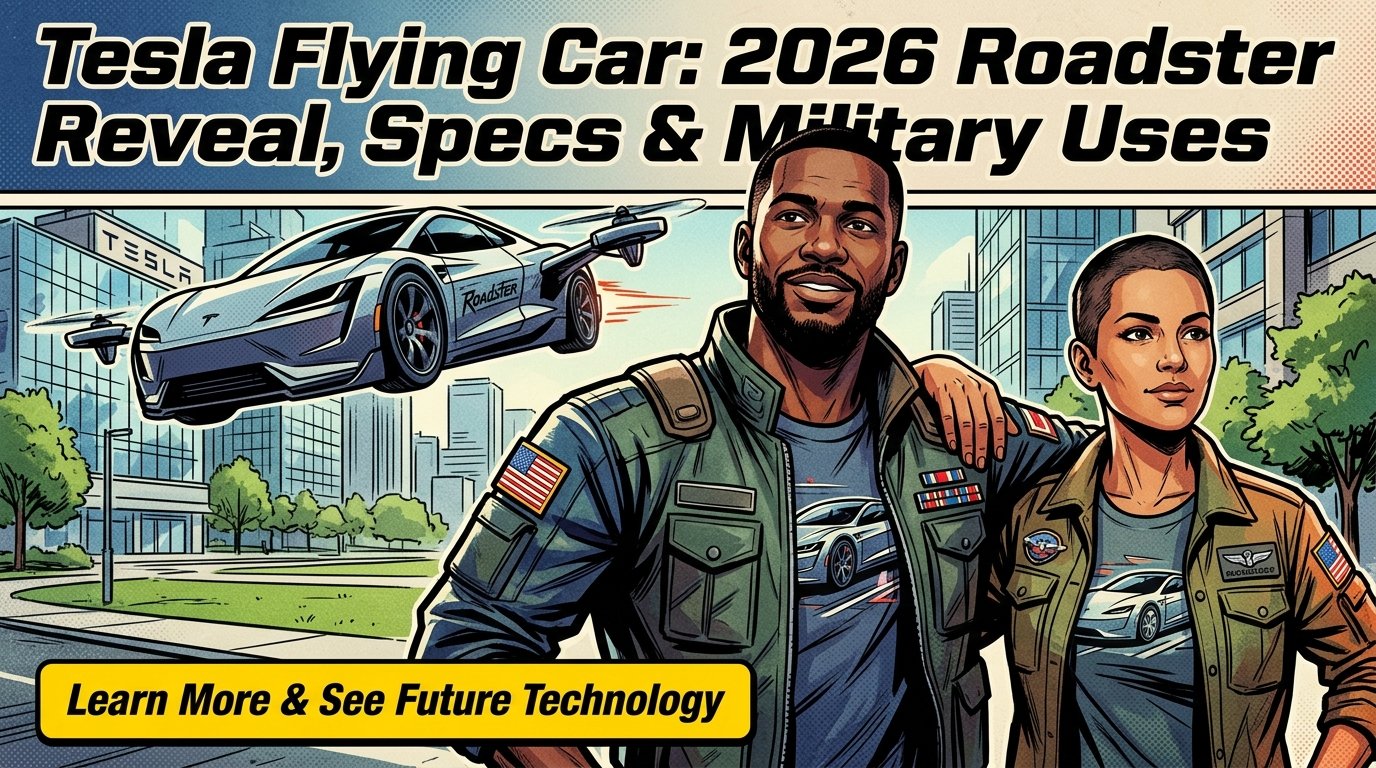
Tesla Flying Car: 2026 Roadster Reveal, Military Applications & What It Means for Veterans
Tesla unveiled the Roadster 2 on October 15, 2026, at SpaceX’s McGregor, Texas facility. The two-seat sports car uses 10 cold-gas thrusters and high-pressure air tanks to hover, perform midair flips, and accelerate 0-60 mph in under one second. Production is targeted for 2028 at over $200,000. The FAA has not classified it as an aircraft.
Quick Facts
| Item | Details |
|---|---|
| Vehicle | Tesla Roadster 2 (thruster-equipped prototype) |
| Reveal Date | October 15, 2026 |
| Production Target | 2028 |
| Price | Over $200,000 (reservation deposits: $50,000 Performance / $250,000 Thrust) |
| Propulsion | 10 cold-gas thrusters, ultra-high-pressure air tanks, developed with SpaceX |
| 0-60 mph | Under 1 second (with thrusters engaged) |
| Top Speed | 230 mph (370 kph) |
| Regulatory Status | FAA says vehicle “does not meet definition of an aircraft” |
| Updated For | October 2026 |
What Is the Tesla Flying Car?
The Tesla flying car is the next-generation Roadster 2, a two-seat electric sports car equipped with cold-gas thrusters developed in collaboration with SpaceX. Elon Musk unveiled the vehicle on October 15, 2026, at SpaceX’s rocket development and testing facility in McGregor, Texas, calling it “the world’s first flying car”.

What it is: A street-legal sports car that uses compressed air thrusters to perform aerial maneuvers including hovering, midair barrel rolls, and jumping over other vehicles. The car demonstrated driving up a curved ramp, flipping in the air, and landing using air jets during the reveal event.

Who it’s for: Initially, wealthy early adopters and Tesla enthusiasts. The vehicle is priced over $200,000, and Tesla’s reservation page lists a $50,000 deposit for the Performance version and $250,000 for the Thrust version with full flight system.
Why it matters: The reveal represents the first time a major automaker has demonstrated a production-intent vehicle with genuine aerial capability. However, significant regulatory, engineering, and practical hurdles remain before consumers can legally operate such a vehicle on public roads and in national airspace.
What to do next: If you are a veteran interested in advanced air mobility careers, the emerging eVTOL and flying car industry is hiring. Programs like Vets to Drones and the Worldwide Aerospace Employment Network connect veterans with aerospace employers.
Tesla Roadster 2 Specs and Capabilities
The Tesla Roadster 2 is a two-seat electric sports car with 10 cold-gas thrusters, ultra-high-pressure air tanks, and a claimed 0-60 mph time of under one second with thrusters engaged. Top speed is 230 mph (370 kph).
Key Specifications
| Feature | Specification |
|---|---|
| Seating | 2 passengers |
| Propulsion | Electric motors + 10 cold-gas thrusters |
| Thruster System | SpaceX-developed, using ultra-high-pressure air |
| 0-60 mph | Under 1 second (thrusters engaged) |
| Top Speed | 230 mph (370 kph) |
| Range (claimed) | 620 miles (998 km) on full charge |
| Production Target | 2028 |
| Price | Over $200,000 |
What the Roadster 2 Actually Demonstrated
Veterans May Qualify for Extra Benefits
Check available financial assistance, healthcare programs and other opportunities that may apply to you.
Check EligibilityDuring the October 15 event, the Roadster 2 performed several maneuvers:
Driving upside down on a curved ramp using suction generated by the car’s underside
Midair barrel roll using SpaceX thrusters
Jumping over five Tesla cars lined up side by side
Accelerating to 60 mph in under one second with thrusters engaged
The demonstration was conducted without a human driver. Musk stated this was “to make sure we don’t kill anyone”.
What the Roadster 2 Did NOT Demonstrate
Sustained flight — The vehicle performed hops and brief aerial maneuvers but did not demonstrate sustained, long-duration flight
Public road legality — Musk himself admitted: “I’m not sure it’s necessarily legal in all jurisdictions”
FAA certification — As of October 2026, the FAA has not certified the Roadster 2 for flight operations
The Reality Check: Can the Tesla Flying Car Actually Fly?
No, not in the way most people understand flight. The Roadster 2 is better described as a thruster-assisted jumping car than a true flying car. It uses cold-gas thrusters to perform brief aerial maneuvers, not sustained, controlled flight like an aircraft or eVTOL.
Engineering Challenges
Aircraft are extremely sensitive to weight, while ground vehicles require bumpers, crumple zones, and safety systems that add mass. As Roger Conner, curator for vertical flight at the Smithsonian’s National Air and Space Museum, told CNN: “Inevitably, something that is a hybrid between the two is going to be a poor performing aircraft and a poor performing vehicle, and also quite expensive”.
What “Flying” Means in This Context
The Roadster 2’s thrusters provide enough lift for brief hops and aerial stunts, but not for sustained flight. The cold-gas thruster system is limited by the amount of compressed air it can carry. Unlike jet fuel or batteries, compressed air depletes quickly under continuous thrust.
Comparison: Roadster 2 vs. True eVTOL Aircraft
| Feature | Tesla Roadster 2 | True eVTOL (e.g., Joby, Archer) |
|---|---|---|
| Primary function | Sports car with thruster stunts | Purpose-built aircraft |
| Sustained flight | No — brief hops only | Yes — designed for flight |
| FAA certification | Not classified as aircraft | Certified or in certification |
| Pilot license required | Not yet determined | Yes |
| Passenger capacity | 2 | 2–6 |
| Range | 620 miles driving | 100–150 miles flight |
| Price | $200,000+ | $3–5 million (estimated) |
FAA Regulations: Is the Tesla Flying Car Legal?
The FAA has stated that the Tesla Roadster 2 “does not meet the FAA’s definition of an aircraft,” according to a statement provided to Politico. This is a critical distinction.
The “Any Inch Off the Ground” Rule
The FAA operates under a principle known as the “Any Inch Off the Ground” rule. Under this rule, any vehicle is considered an aircraft whenever it leaves the ground, regardless of altitude—whether 2 inches or 2,000 feet.
If the Roadster 2’s thrusters lift it off the ground, the FAA could assert regulatory authority. However, the agency has not yet done so, and experts remain divided on how existing regulations apply to thruster-equipped cars.
What Licenses Would Drivers Need?
If the Roadster 2 is classified as an aircraft, drivers would likely need:
A pilot’s license (likely a sport pilot certificate at minimum)
FAA medical certification (depending on the license category)
Special operating limitations — potentially restricted to pre-approved flight corridors
A former FAA official told reporters that operating the Roadster 2 could require both a driver’s license and a pilot’s license.
The MOSAIC Rule and Future Regulations
The FAA’s Modernization of Special Airworthiness Certification (MOSAIC) rule, finalized in 2025, creates new pathways for certifying light-sport aircraft with innovative designs. However, the Roadster 2 does not fit neatly into existing powered-lift categories, creating a regulatory gray area.
What Veterans Should Know
If you are a veteran considering purchasing a flying car or eVTOL, do not assume you can legally operate it on public roads or in national airspace without FAA authorization. Consult with an aviation attorney and verify current regulations before making any purchase.
Military Flying Vehicles: The Real Story
While Tesla’s Roadster 2 grabbed headlines, the U.S. military has been evaluating flying vehicles for years. These programs are more mature, more practical, and directly relevant to veterans.
SkyRunner: The U.S. Army’s Flying Buggy
The U.S. Army’s XVIII Airborne Corps tested the SkyRunner, a dual-mode flying buggy, during Exercise Scarlet Dragon 26-3 at Fort Bragg, North Carolina, on September 16, 2026.
SkyRunner Specifications:
| Feature | Specification |
|---|---|
| Type | Dual-mode off-road vehicle with ram-air parachute wing |
| Flight Range | 120 miles (193 km) |
| Ground Range | 240 miles (386 km) |
| Max Altitude | 10,000 feet (3,048 meters) |
| Takeoff Distance | 450 feet (137 meters) |
| Pilot Training | Approximately 14 hours |
| Price | $140,000–$150,000 |
The SkyRunner pairs an off-road buggy chassis with a parachute wing, allowing it to drive on rough terrain and take off without a runway. It uses two separate engines: a Polaris unit for ground driving and a Rotax aircraft engine for flight.
Military Applications: SkyRunner has been pitched for reconnaissance, resupply, and casualty evacuation in areas without roads or landing strips.
Joby Aviation’s Hybrid VTOL for Defense
Joby Aviation, a California-based eVTOL developer, completed the first flight of its turbine-electric, autonomous VTOL demonstrator in November 2025. The company has partnered with defense contractor L3Harris to develop a militarized version for contested logistics, “loyal wingman” operations, and low-altitude support.
Key Details:
The hybrid aircraft combines a turbine powertrain with Joby’s SuperPilot autonomous flight technology
Designed for missions requiring more range and payload than battery-powered aircraft can support
Government mission flight demonstrations planned for 2026
Joby previously collaborated with the Air Force via AFWERX on autonomous cargo missions
Hoverbike and Other Military Concepts
The U.S. military has also evaluated the Hoverbike, a one-person flying vehicle capable of 150 km/h speeds, designed for traversing swamps, rivers, and barbed wire in combat zones.
Comparison: Military Flying Vehicles
| Vehicle | Developer | Type | Range | Price | Status |
|---|---|---|---|---|---|
| SkyRunner | SkyRunner | Parachute buggy | 120 mi flight / 240 mi ground | $140K–$150K | Army evaluation |
| Joby Hybrid VTOL | Joby/L3Harris | Autonomous eVTOL | Extended range | Not disclosed | First flight 2025 |
| Hoverbike | Various | One-person flyer | Not disclosed | Not disclosed | Testing |
| Tesla Roadster 2 | Tesla/SpaceX | Thruster sports car | 620 mi driving | $200K+ | Production 2028 |
Advanced Air Mobility: Career Opportunities for Veterans
The advanced air mobility (AAM) industry—which includes eVTOL aircraft, flying cars, and autonomous aviation—is growing rapidly. Veterans are uniquely positioned to fill critical roles in this emerging sector.
Why Veterans Are a Natural Fit
Military aviation, drone operations, and technical maintenance experience translate directly to AAM careers. Organizations like Vets to Drones and the Worldwide Aerospace Employment Network (WWAEN) are actively working to connect veterans with aerospace employers.
In-Demand Roles for Veterans
| Role | Military Equivalent | Median Salary Range |
|---|---|---|
| eVTOL Pilot | Army/Navy/Marine pilot | $120K–$180K |
| Drone Operations Specialist | UAV operator | $70K–$120K |
| Aviation Maintenance Technician | Aircraft mechanic | $60K–$95K |
| Autonomous Systems Engineer | Systems technician | $95K–$150K |
| Flight Test Engineer | Test pilot/engineer | $110K–$170K |
How to Transition to AAM Careers
Translate your military experience — Use the VA’s Military Skills Translator to map your MOS to civilian aviation roles
Use GI Bill benefits — Fund FAA certification, aviation maintenance training, or engineering degrees
Connect with veteran networks — Vets to Drones and WWAEN offer job placement and mentorship
Obtain FAA certifications — Part 107 drone license, Airframe & Powerplant (A&P) certificate, or commercial pilot license
Target defense contractors — L3Harris, Joby, and SkyRunner actively hire veterans for defense programs
VA Benefits for Aviation Training
GI Bill (Post-9/11) — Covers FAA-approved flight training programs at eligible institutions
VR&E (Vocational Rehabilitation & Employment) — May fund aviation career training for veterans with service-connected disabilities
Tuition Assistance (for active duty) — Covers aviation coursework while serving
Flying Car Costs: What Veterans Should Expect
Owning a flying car or eVTOL is significantly more expensive than a traditional vehicle or aircraft. Understanding the full cost is essential before making a purchase.
Purchase Price Comparison
| Vehicle Type | Purchase Price | Annual Operating Cost |
|---|---|---|
| Traditional car | $30,000–$60,000 | $8,000–$12,000 |
| Tesla Roadster 2 | $200,000+ | TBD (high-performance EV) |
| SkyRunner | $140,000–$150,000 | $15,000–$25,000 (est.) |
| eVTOL (Joby/Archer) | $3–5 million (est.) | $500,000+ (est.) |
Annual Insurance and Storage Costs
Flying car insurance runs approximately $17,000 annually** for eVTOL-type vehicles. Storage or hangar fees add approximately **$13,000 per year. Insurance and storage alone total around $30,000 annually before any flying occurs.
For a $200,000-class vehicle, insurance premiums could range from **$20,000 to $60,000 annually** depending on coverage and operator certification.
What Veterans Should Do
If you are considering a flying car purchase, factor in:
Insurance — $17,000–$60,000/year
Storage — $13,000/year for hangar space
Maintenance — Expect aviation-grade maintenance costs
Training — $10,000–$20,000 for pilot certification
Fuel/Charging — Electricity costs are lower than aviation fuel, but charging infrastructure is limited
Tesla Flying Car vs. Other Flying Cars in 2026
The Tesla Roadster 2 is not the only flying car in development. Several companies are pursuing different approaches to roadable aircraft.
Comparison of Flying Cars in Development
| Company | Vehicle | Type | Range | Production Target | Price |
|---|---|---|---|---|---|
| Tesla | Roadster 2 | Thruster sports car | 620 mi driving | 2028 | $200,000+ |
| Alef Aeronautics | Model A | eVTOL roadable aircraft | 220 mi drive / 110 mi flight | 2026 (Ultralight) | $300,000 (est.) |
| SkyRunner | SkyRunner | Parachute buggy | 120 mi flight / 240 mi ground | Available now | $140K–$150K |
| XPENG | Land Aircraft Carrier | Car + eVTOL module | Not disclosed | 2026 | $300,000 (est.) |
| Joby Aviation | S4 | Air taxi (not roadable) | 100 mi | 2025–2026 | $3–5M (est.) |
Alef Model A: The Closest Competitor
Alef Aeronautics’ Model A is designed to drive on roads and take off vertically using distributed electric propulsion. It has a claimed 220-mile driving range and 110-mile flight range. Alef has begun production of the Model A Ultralight, a low-speed vehicle version designated for roads with speed limits of 35 mph or less.
What Makes Tesla Different
Tesla’s approach differs from competitors in one key way: the Roadster 2 is primarily a sports car with thruster capabilities, not a purpose-built aircraft that can drive. Its performance focus (0-60 in under 1 second, 230 mph top speed) prioritizes speed and spectacle over practical transportation.
Common Mistakes Veterans Make With Flying Cars
Mistake 1: Assuming the Tesla Roadster 2 is a practical flying car. The Roadster 2 is a thruster-equipped sports car capable of brief aerial stunts—not sustained flight. Do not expect to commute by air in this vehicle.
Mistake 2: Ignoring FAA regulations. If a vehicle leaves the ground, the FAA may assert regulatory authority under the “Any Inch Off the Ground” rule. Operating without proper certification could result in severe penalties.
Mistake 3: Underestimating ownership costs. Annual insurance and storage alone can exceed $30,000. Total cost of ownership for a flying car is 5–10 times that of a luxury automobile.
Mistake 4: Assuming military flying vehicles are available to civilians. SkyRunner is available for civilian purchase ($140K–$150K), but Joby’s military VTOL is not. Check availability before planning a purchase.
Mistake 5: Overlooking veteran career opportunities in AAM. The advanced air mobility industry is growing rapidly and actively hiring veterans. Do not overlook this emerging career field.
Mistake 6: Waiting to use GI Bill benefits for aviation training. GI Bill aviation benefits have expiration dates. If you are interested in AAM careers, begin using your benefits now.
Common Questions
Q: Did Tesla actually make a flying car?
Tesla unveiled the Roadster 2 on October 15, 2026, with SpaceX-developed thrusters that allow brief aerial maneuvers including hovering and midair flips. However, it is not a true flying car in the traditional sense—it cannot sustain flight and has not been certified by the FAA.
Q: When will the Tesla flying car be available?
Tesla targets production in 2028. The vehicle will cost over $200,000. Reservation deposits are $50,000 for the Performance version and $250,000 for the Thrust version with full flight system. Tesla has a history of missing production deadlines.
Q: Can I legally fly the Tesla Roadster 2 on public roads?
Musk himself admitted he is “not sure it’s necessarily legal in all jurisdictions.” The FAA has stated the vehicle does not meet its definition of an aircraft. Legal operation on public roads remains uncertain and may require both a driver’s license and pilot’s license.
Q: What is the SkyRunner flying buggy?
SkyRunner is a dual-mode flying buggy evaluated by the U.S. Army’s XVIII Airborne Corps in September 2026. It combines an off-road chassis with a parachute wing, flies up to 120 miles, and drives up to 240 miles. It retails for $140,000–$150,000.
Q: Are there veteran jobs in the flying car industry?
Yes. The advanced air mobility industry is hiring veterans for pilot, maintenance, engineering, and operations roles. Organizations like Vets to Drones and the Worldwide Aerospace Employment Network connect veterans with aerospace employers.
Q: How much does flying car insurance cost?
Flying car insurance runs approximately $17,000 per year for eVTOL-type vehicles. For high-performance vehicles like the Tesla Roadster 2, premiums could range from $20,000 to $60,000 annually.
Q: What is the FAA’s “Any Inch Off the Ground” rule?
The FAA considers any vehicle an aircraft whenever it leaves the ground, regardless of altitude—2 inches or 2,000 feet. If the Tesla Roadster 2’s thrusters lift it off the ground, the FAA could assert regulatory authority over its operation.
Q: Can I use my GI Bill for flying car training?
The GI Bill covers FAA-approved flight training programs at eligible institutions. VR&E may also fund aviation career training for veterans with service-connected disabilities. Contact the VA to verify program eligibility.
Q: What is the difference between a flying car and an eVTOL?
A flying car is designed to both drive on roads and fly. An eVTOL (electric vertical takeoff and landing) aircraft is designed primarily for flight and typically does not have road-driving capability. Tesla’s Roadster 2 is a sports car with thruster capabilities; Joby’s S4 is a true eVTOL.
Q: Is the Tesla flying car a good investment?
The Roadster 2 is a luxury performance vehicle, not an investment. Like most vehicles, it will depreciate. Veterans should consider whether the $200,000+ price and $30,000+ annual operating costs fit their financial situation before purchasing.
Key Takeaways
Tesla unveiled the Roadster 2 on October 15, 2026, at SpaceX’s McGregor, Texas facility.
The vehicle uses 10 cold-gas thrusters and high-pressure air tanks developed with SpaceX.
Production is targeted for 2028 at over $200,000; reservation deposits are $50,000–$250,000.
The FAA says the Roadster 2 “does not meet the definition of an aircraft.”
The vehicle performed brief aerial maneuvers but demonstrated no sustained flight.
The U.S. Army evaluated SkyRunner, a dual-mode flying buggy, in September 2026.
Joby Aviation is developing a hybrid VTOL aircraft for military logistics with L3Harris.
Flying car insurance and storage costs exceed $30,000 annually.
The advanced air mobility industry is hiring veterans for pilot, maintenance, and engineering roles.
GI Bill and VR&E benefits may fund aviation training for eligible veterans.
Official Resources
VA Benefits: va.gov
GI Bill Information: va.gov/education
VR&E (Vocational Rehabilitation): va.gov/careers-employment/vocational-rehabilitation
FAA Advanced Air Mobility: faa.gov/aircraft/air_cert/design_approvals/advanced_air_mobility
FAA Part 107 (Drone Certification): faa.gov/uas/commercial_operators
U.S. Department of Transportation: transportation.gov
SkyRunner: skyrunner.com
Joby Aviation: jobyaviation.com
🇺🇸 IMPORTANT DISCLAIMER – Veterans Benefits Information
This site provides general information about U.S. Department of Veterans Affairs (VA) benefits for educational and informational purposes only.
- Not Official: We are NOT affiliated with, endorsed by, or connected to the U.S. Department of Veterans Affairs (VA), the Veterans Benefits Administration (VBA), the Veterans Health Administration (VHA), or any other government agency.
- No Legal/Financial Advice: The content on this website is for informational purposes only and does not constitute legal, financial, or medical advice. VA benefits rules change frequently – always consult with an accredited Veterans Service Officer (VSO) or a qualified professional for your specific situation.
- Official Sources: For official, binding information and to apply for benefits, always visit official .gov websites: VA.gov, Benefits.VA.gov, or SSA.gov.
- No Data Collection: This site does not collect, store, or process any personal information. It does not have login forms, contact forms, or any system to capture user data. We never ask for your Social Security Number, bank details, or any personal information.
- 🚨 Scam Alert: The VA and other government agencies never charge fees for benefit applications. If anyone asks for money to "process" your VA claim, it is a scam. Report it to the VA Office of Inspector General at VA.gov/OIG.
- Advertising: This site uses third-party advertising (Adsterra) to cover operational costs. We do not endorse or guarantee any products or services advertised.
📌 Information provided as of June 2026. Always verify current eligibility and rules with official .gov sources.
This site is not affiliated with the U.S. Department of Veterans Affairs or any government agency. All information is for educational purposes only. Please visit VA.gov for official information.
