
What Is a Veterans Village?
A Veterans Village is a supportive housing community designed specifically for homeless and at-risk veterans. These communities provide transitional or permanent housing — often in the form of tiny homes, single-room occupancy apartments, or converted hotels — paired with on-site case management, mental health services, employment assistance, and other wraparound support. Veterans Villages are operated by nonprofits like the Veterans Community Project and the Tunnel to Towers Foundation, often in partnership with the VA and local housing authorities.
Quick Facts
| Item | Details |
|---|---|
| Benefit | Transitional or permanent supportive housing for homeless and at-risk veterans |
| Eligibility | Honorable discharge or discharge under conditions other than dishonorable; 180+ days of service (varies by program); homeless or at risk of homelessness |
| Application | Direct inquiry to the operating nonprofit or referral through VA HUD-VASH |
| Processing Time | Varies by program; typically weeks to months depending on availability |
| Official Agency | U.S. Department of Veterans Affairs (VA) in partnership with HUD and nonprofits |
| Required Forms | DD-214, income verification, VA and SSI/SSDI award letters (if applicable) |
| Updated For | 2026 |
Types of Veterans Villages
Veterans Villages operate under several different models. Understanding the differences matters because eligibility rules, length of stay, and application processes vary significantly by program type.

Tiny Home Villages
Tiny home villages provide individual, fully furnished homes — typically 240 to 360 square feet — to homeless veterans at no cost during their stay. The Veterans Community Project pioneered this model in Kansas City, Missouri, in 2016. Veterans live rent-free while working with on-site case managers to address the root causes of their homelessness and transition to permanent housing. The average stay is approximately 335 days, and 85% of residents successfully move on to sustainable permanent housing.
HUD-VASH Project-Based Villages

The HUD-VA Supportive Housing (HUD-VASH) program is a collaborative effort between the U.S. Department of Housing and Urban Development (HUD) and the VA. Project-based HUD-VASH villages provide rental assistance vouchers tied to a specific housing unit — often a single-room occupancy apartment — with VA case management services provided on-site. Veterans typically pay 30% of their adjusted income toward rent, with the voucher covering the remainder.
Converted Hotel and Apartment Villages
The Tunnel to Towers Foundation converts former hotels and other buildings into permanent supportive housing communities for veterans. These properties include comprehensive service centers on-site, offering behavioral health support, employment specialists, peer specialists, and entitlement specialists. Veterans can stay long-term or use the program to transition to independent housing.
Independent Living Villages for Aging Veterans
Some Veterans Villages, such as the VFW Veterans Village in Fort McCoy, Florida, serve aging veterans in an independent living setting. These communities do not provide medical personnel or personal aides on-site, which keeps costs lower than assisted living. Residents must be safe without 24/7 medical support but can receive outside services like skilled nursing, occupational therapy, physical therapy, or hospice care.
State Veterans Homes
State Veterans Homes are long-term care facilities operated by state governments with VA financial support. They provide nursing home care, domiciliary care, and adult day health care. Examples include the Veteran Village in Florence, South Carolina, and Patriots Village in Sumter, South Carolina.
Who Qualifies for a Veterans Village?
Veterans May Qualify for Extra Benefits
Check available financial assistance, healthcare programs and other opportunities that may apply to you.
Check EligibilityEligibility varies by program, but most Veterans Villages share a common set of baseline requirements. Veterans must typically meet all of the following criteria.
Baseline Eligibility Requirements
Veteran status. The applicant must have served in the U.S. Armed Forces.
Discharge status. Most programs require an honorable discharge or a discharge under conditions other than dishonorable. The Veterans Community Project serves veterans regardless of discharge status, type of service, or length of service.
Minimum service. The Tunnel to Towers Veterans Villages require a minimum of 180 days of service.
Homelessness or housing instability. Applicants must be homeless or at risk of becoming homeless.
Income limits. Many programs have income limits. The Middletown, New Jersey Veterans Village requires income at or below 80% of HUD limits. The Veterans Community Project has an income preference of 50% or less of Area Median Income.
Eligibility Comparison by Program
| Program | Discharge Requirement | Minimum Service | Income Limits | Housing Status |
|---|---|---|---|---|
| Veterans Community Project | Any status | None | 50% AMI preference | Homeless |
| Tunnel to Towers Villages | Honorable or other than dishonorable | 180 days | None stated | Homeless or at risk |
| HUD-VASH | Not dishonorable | None | 30% of adjusted income | Homeless |
| Middletown NJ Veterans Village | Honorable | None | 80% of HUD limits | Low income |
| South Carolina State Veterans Homes | Honorable or general | 24 months (post-1980) | None | Needs nursing care |
How to Apply for a Veterans Village
The application process depends on the program. Each operating organization manages its own intake. There is no single national application for Veterans Villages.
Veterans Community Project
The Veterans Community Project serves veterans in Kansas City, Longmont, Milwaukee, Sioux Falls, and Dallas. To apply, contact the nearest VCP location directly. Required documents typically include a DD-214 (or proof of application), last two pay stubs or a zero-income declaration, and VA or SSI/SSDI award letters if applicable.
Tunnel to Towers Veterans Villages
The Tunnel to Towers Foundation operates Veterans Villages in Houston, Texas; Atlanta, Georgia; North Charleston, South Carolina; and several other locations with more under construction. To apply, complete the inquiry form at t2t.org/homeless-veteran-program/veterans-villages. Applicants must be 18 or older, a veteran with an honorable discharge or a discharge under conditions other than dishonorable, and have completed at least 180 days of service.
HUD-VASH
HUD-VASH operates through VA Medical Centers. Veterans must be referred through their local VA homeless program. Contact the homeless coordinator at your nearest VA Medical Center or call the National Call Center for Homeless Veterans at 1-877-4AID-VET (1-877-424-3838).
State Veterans Homes
State Veterans Homes have their own admission processes. For example, South Carolina’s State Veterans Homes require a completed application packet including Part 1 (personal information) and Part 2 (medical information), a copy of the DD-214, insurance cards, power of attorney documents, a medication list, physician history, and immunization records. Contact the admissions coordinator at the specific facility for assistance.
Veterans Community Project: The Tiny Home Model
The Veterans Community Project (VCP) is a 501(c)(3) nonprofit founded in 2016 in Kansas City, Missouri. VCP builds villages of tiny homes — ranging from 240 to 360 square feet — for homeless veterans. Each home is fully furnished and designed with PTSD-informed features. Residents live rent-free while working with on-site case managers toward permanent housing goals. The average stay is approximately 335 days, and the program has demonstrated an 85% success rate in helping veterans transition out of homelessness.
VCP Locations
VCP operates in seven locations nationwide, serving veterans in eight states. The organization’s vision is to build a VCP Village in every major city. Current locations include Kansas City, Missouri; Longmont, Colorado; Milwaukee, Wisconsin; Sioux Falls, South Dakota; and Dallas, Texas (opening 2026).
Tunnel to Towers Veterans Villages
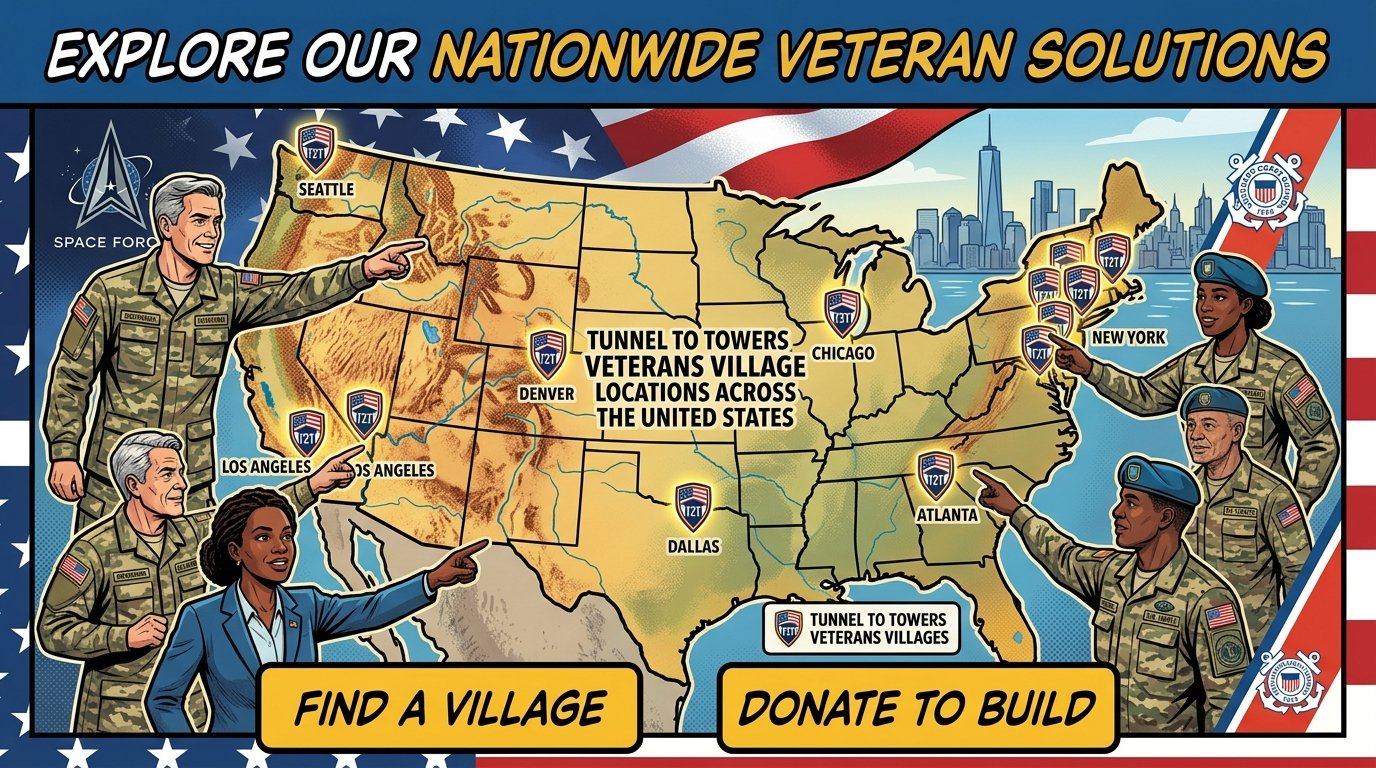
The Tunnel to Towers Foundation launched its Homeless Veteran Program in 2023 with the mission to eradicate veteran homelessness nationwide. The foundation converts former hotels and builds new apartment complexes into permanent supportive housing communities. Each village includes a comprehensive service center offering behavioral health support, case management, employment specialists, peer specialists, and entitlement specialists. Services are provided at no cost to the veteran.
Tunnel to Towers Locations
| Location | Status | Units |
|---|---|---|
| Houston, TX | Operating | 131 apartments + 14 Comfort Homes |
| Atlanta, GA | Operating | 88 units |
| North Charleston, SC | Operating | 91 units |
| Bradenton, FL | Under construction | 85 rooms + 35 Comfort Homes |
| Memphis, TN | Under construction | 110 units |
| Bayville, NJ | Under construction | 98 apartments + 24 Comfort Homes |
| Harrisburg, PA | Under construction | 64 apartments + 20 Comfort Homes |
| Denver, CO | Under construction | 100+ units |
| Buffalo, NY | Under construction | 91 units |
| Detroit, MI | Under construction | 92 units |
| Las Vegas, NV | Planning phase | TBD |
Sources: Tunnel to Towers Foundation
HUD-VASH: The Federal Housing Voucher Program
HUD-VASH combines HUD’s Housing Choice Voucher rental assistance with VA case management and clinical services. The program serves homeless veterans and their families who agree to participate in case management. Veterans must be currently homeless, eligible for VA medical care, and have an identified clinical need for case management. Veterans typically pay 30% of their adjusted income toward rent, with the voucher covering the rest.
HUD-VASH Eligibility
Currently homeless
Eligible for VA medical care
Not discharged dishonorably
Agree to participate in VA case management
Spouses and dependent children may also be eligible
How HUD-VASH Works
Veterans are referred through their local VA Medical Center’s homeless program. A VA case manager works with the veteran to find suitable housing. The public housing authority issues the voucher. The veteran pays approximately 30% of adjusted income toward rent, and the voucher covers the remainder.
VFW Veterans Village Pilot Program
The VFW Veterans Village in Fort McCoy, Florida, is a pilot program developed through collaboration between the VFW, the local Public Housing Authority, Supportive Services for Veteran Families (SSVF), and the VA. The village provides independent living apartments for aging veterans experiencing homelessness. Monthly costs are $1,490, with rent subsidized down to $850 for eligible veterans.
Independent Living Requirements
Residents must be able to live independently without on-site medical staff. They can be wheelchair-bound but must transfer independently, be incontinent but able to clean themselves, and oxygen-dependent but able to handle it safely. Outside support services like skilled nursing, occupational therapy, physical therapy, and hospice are permitted.
Costs: What Veterans Pay
Costs vary significantly by program. Some programs, like the Veterans Community Project, charge no rent during the transitional stay. HUD-VASH vouchers require veterans to pay approximately 30% of their adjusted income toward rent. The VFW Veterans Village charges $850 per month for eligible veterans.
Cost Comparison
| Program | Monthly Cost | Rent-Free Period | Notes |
|---|---|---|---|
| Veterans Community Project | $0 | Entire stay | Transitional, average 335 days |
| HUD-VASH | ~30% of adjusted income | None | Permanent voucher |
| Tunnel to Towers Villages | $0 (services free) | Ongoing | Services at no cost to veteran |
| VFW Veterans Village | $850 (subsidized) | None | Independent living |
| State Veterans Homes | Varies by state | None | Nursing care included |
Common Mistakes Veterans Make When Applying
Applying to the wrong program. Veterans Villages are not a single program. Each organization has its own eligibility rules and application process. Applying to the wrong one wastes time.
Not having a DD-214 ready. Most programs require a DD-214 or proof that one has been requested. If you do not have your DD-214, you can request it through the National Archives.
Assuming all programs accept any discharge status. While the Veterans Community Project serves veterans regardless of discharge status, most other programs require an honorable discharge or a discharge under conditions other than dishonorable.
Contacting the VA when the program is run by a nonprofit. HUD-VASH is administered through the VA. But Tunnel to Towers, VCP, and other nonprofit villages have their own intake processes. Contact the operating organization directly.
Waiting until housing is lost. Many programs prioritize veterans who are already homeless, but some, like Tunnel to Towers, also serve veterans at risk of becoming homeless. Apply before the crisis worsens.
The Appeals Process
If you are denied admission to a Veterans Village, the appeal process depends on the program. For HUD-VASH, you may request a review through your VA Medical Center’s homeless program coordinator. For nonprofit-operated villages, contact the organization’s leadership directly. State Veterans Homes have formal appeal procedures outlined in their admission packets.
Latest Rule Changes for 2026
VA set four goals for Fiscal Year 2026 in its continued commitment to ending veteran homelessness: house at least 48,000 individual veterans, ensure at least 95% of housed veterans stay housed, engage unsheltered veterans, and ensure no more than 5% of permanently housed veterans return to homelessness. The VA also continues implementing the Bridging Rental Assistance for Veteran Empowerment (BRAVE) program, which provides rental assistance for veterans experiencing or at risk of homelessness.
Common Questions
What is a Veterans Village?
A Veterans Village is a supportive housing community for homeless and at-risk veterans. These communities provide transitional or permanent housing — often tiny homes or apartments — with on-site case management, mental health services, and employment assistance. They are operated by nonprofits like the Veterans Community Project and Tunnel to Towers.
Who qualifies for a Veterans Village?
Most programs require honorable discharge or a discharge under conditions other than dishonorable, at least 180 days of service (varies), and homelessness or risk of homelessness. The Veterans Community Project serves veterans regardless of discharge status, length of service, or branch.
How do I apply for a Veterans Village?
Applications vary by program. For Tunnel to Towers, complete the inquiry form at t2t.org. For the Veterans Community Project, contact the nearest VCP location. For HUD-VASH, contact your VA Medical Center’s homeless program coordinator.
Is there a cost to live in a Veterans Village?
Costs vary. The Veterans Community Project charges no rent during the transitional stay. HUD-VASH requires approximately 30% of adjusted income. The VFW Veterans Village charges $850 per month. Tunnel to Towers provides services at no cost.
How long can I stay in a Veterans Village?
The Veterans Community Project’s average stay is approximately 335 days. HUD-VASH provides permanent housing vouchers. Tunnel to Towers offers long-term supportive housing. State Veterans Homes provide long-term care.
What services are provided at a Veterans Village?
Services typically include case management, mental health therapy, substance use treatment, employment assistance, financial literacy, legal aid, food assistance, and peer support. Tunnel to Towers villages also have entitlement specialists.
What is the HUD-VASH program?
HUD-VASH is a collaborative program between HUD and the VA that provides rental assistance vouchers and VA case management to homeless veterans. Veterans pay approximately 30% of adjusted income toward rent.
Can veterans with less than honorable discharges get housing?
The Veterans Community Project serves veterans regardless of discharge status. HUD-VASH extended eligibility to veterans with “other than honorable” discharge statuses. Most other programs require honorable or general discharge.
How long does the application process take?
Processing times vary by program. Some inquiries receive responses within days. Placement depends on unit availability. State Veterans Homes may take one to three weeks for application review.
What documents do I need to apply?
Typically a DD-214, proof of income (or zero-income declaration), VA and SSI/SSDI award letters if applicable, and a valid ID. State Veterans Homes require additional medical documentation and insurance cards.
Key Takeaways
Veterans Villages are supportive housing communities for homeless and at-risk veterans, operated by nonprofits like the Veterans Community Project and Tunnel to Towers Foundation.
The Veterans Community Project’s tiny home model has an 85% success rate in transitioning veterans to permanent housing, with an average stay of 335 days.
The Tunnel to Towers Foundation operates Veterans Villages in Houston, Atlanta, and North Charleston, with additional locations under construction nationwide.
HUD-VASH combines HUD rental vouchers with VA case management; veterans pay approximately 30% of adjusted income toward rent.
Eligibility varies by program, but most require homeless status, honorable discharge, and 180+ days of service. The Veterans Community Project serves veterans regardless of discharge status.
Apply directly to the operating organization — not the VA — for nonprofit-run villages. HUD-VASH applications go through VA Medical Centers.
The VA’s FY 2026 goal is to house at least 48,000 homeless veterans and ensure at least 95% of those housed stay housed.
Rent-free transitional housing is available through the Veterans Community Project; permanent supportive housing is available through Tunnel to Towers and HUD-VASH.
Official Resources
VA Homeless Programs: VA.gov — Homeless Veterans
National Call Center for Homeless Veterans: 1-877-4AID-VET (1-877-424-3838)
HUD-VASH Program: VA.gov — HUD-VASH
Veterans Community Project: vcp.org
Tunnel to Towers Foundation Veterans Villages: t2t.org — Veterans Villages
Veterans Village of San Diego: vvsd.net
Village for Vets (Los Angeles): villageforvets.org
HUD Homeless Assistance: hud.gov — Homeless
🇺🇸 IMPORTANT DISCLAIMER – Veterans Benefits Information
This site provides general information about U.S. Department of Veterans Affairs (VA) benefits for educational and informational purposes only.
- Not Official: We are NOT affiliated with, endorsed by, or connected to the U.S. Department of Veterans Affairs (VA), the Veterans Benefits Administration (VBA), the Veterans Health Administration (VHA), or any other government agency.
- No Legal/Financial Advice: The content on this website is for informational purposes only and does not constitute legal, financial, or medical advice. VA benefits rules change frequently – always consult with an accredited Veterans Service Officer (VSO) or a qualified professional for your specific situation.
- Official Sources: For official, binding information and to apply for benefits, always visit official .gov websites: VA.gov, Benefits.VA.gov, or SSA.gov.
- No Data Collection: This site does not collect, store, or process any personal information. It does not have login forms, contact forms, or any system to capture user data. We never ask for your Social Security Number, bank details, or any personal information.
- 🚨 Scam Alert: The VA and other government agencies never charge fees for benefit applications. If anyone asks for money to "process" your VA claim, it is a scam. Report it to the VA Office of Inspector General at VA.gov/OIG.
- Advertising: This site uses third-party advertising (Adsterra) to cover operational costs. We do not endorse or guarantee any products or services advertised.
📌 Information provided as of June 2026. Always verify current eligibility and rules with official .gov sources.
This site is not affiliated with the U.S. Department of Veterans Affairs or any government agency. All information is for educational purposes only. Please visit VA.gov for official information.
