
VA Home Care: What You Need to Know
The VA offers multiple home care programs for eligible veterans. Homemaker/Home Health Aide (H/HHA) provides personal care like bathing and dressing for veterans with 3+ ADL dependencies. Home Based Primary Care (HBPC) brings doctors and nurses to homebound veterans. Aid and Attendance pays up to $2,424/month for personal care costs. Veteran-Directed Care gives you a flexible budget to hire your own caregivers. All require VA health care enrollment and a clinical need assessment.
Quick Facts
| Item | Details |
|---|---|
| Benefit | In-home personal care, skilled nursing, case management, respite, and caregiver support |
| Eligibility | Enrolled in VA health care + meet clinical need (ADL dependencies, cognitive impairment, or complex medical conditions) |
| Application | Contact VA primary care provider or social worker for referral; some programs require VA Form 10-10EC or 21-2680 |
| Processing Time | Varies by program and location; H/HHA referrals typically processed within 1–4 weeks |
| Official Agency | U.S. Department of Veterans Affairs (VHA) |
| Required Forms | VA Form 10-10EZ (enrollment), VA Form 10-10EC (extended care), VA Form 21-2680 (A&A), VA Form 21P-527EZ (pension) |
| Updated For | 2026 benefit rates |
What Is VA Home Care?
VA home care is a collection of programs that bring health care and personal assistance into a veteran’s home. These services help veterans remain independent and avoid nursing home placement.

The VA does not have one single “home care” benefit. Instead, multiple programs operate under the VHA Standard Medical Benefits Package. Each program serves different needs:
Homemaker/Home Health Aide (H/HHA): Personal care and light housekeeping
Home Based Primary Care (HBPC): Primary medical care delivered at home
Veteran-Directed Care (VDC): Flexible budget for consumer-directed care
Aid and Attendance (A&A): Monthly cash benefit for personal care costs
Respite Care: Short-term relief for family caregivers
Medical Foster Home (MFH): Community-based home alternative to nursing homes

Eligibility begins with enrollment in VA health care. From there, your VA provider or social worker assesses your clinical needs. Most home care programs require documentation of functional limitations, called Activities of Daily Living (ADL) dependencies.
Homemaker/Home Health Aide (H/HHA) Care
What Is H/HHA Care?
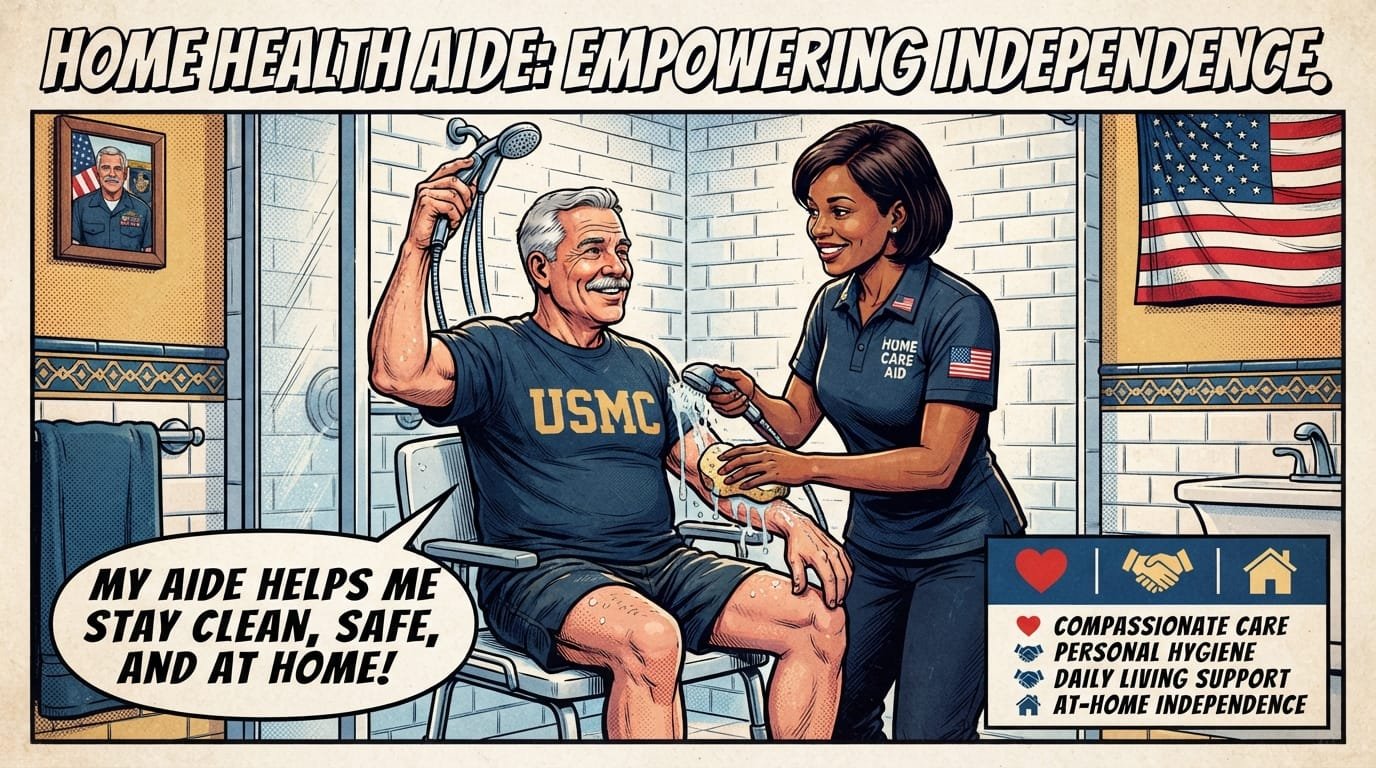
Homemaker/Home Health Aide care provides trained aides who come to your home to help with personal care and daily activities. A registered nurse supervises the aides and assesses your needs.
Aides are not nurses. They help with tasks you cannot perform independently.
Who Qualifies for H/HHA Care?
All enrolled veterans are eligible if they meet the clinical need. VA medical centers use specific criteria. Common qualifying factors include:
Three or more ADL dependencies: Bathing, dressing, grooming, transferring, walking, toileting, or eating
Significant cognitive impairment: Dementia, traumatic brain injury, or memory deficits affecting safety
Two ADL dependencies plus two or more of these conditions:
Dependency in three or more IADLs (meal preparation, medication management, etc.)
Recent nursing facility discharge
Age 75 or older
Three or more hospitalizations in the past year
12+ outpatient clinic or ER visits in the past year
Diagnosed clinical depression
Lives alone
Adjunct to community hospice services
What Services Does H/HHA Provide?
Veterans May Qualify for Extra Benefits
Check available financial assistance, healthcare programs and other opportunities that may apply to you.
Check EligibilityHomemaker services include:
Meal preparation
Light housekeeping
Light shopping
Laundry
Home health aide services include:
Bathing
Dressing
Shaving and oral care
Toileting
Walking and transferring
Eating
Verbal medication reminders
Light housekeeping
How to Apply for H/HHA Care
Enroll in VA health care (VA Form 10-10EZ) if not already enrolled
Schedule a primary care appointment with your VA provider
Discuss your home care needs with your provider or social worker
Request a referral to the H/HHA program
Complete an assessment with a VA social worker or case manager
Receive approval and coordinate with a contracted home care agency
A copay may apply based on your service-connected disability status and financial information.
Common Mistakes with H/HHA
Not being enrolled in VA health care first: Enrollment is required before any home care referral
Not documenting ADL dependencies: Specific functional limitations must be clinically documented
Assuming all locations offer H/HHA: Services vary by VA medical center
Expecting 24/7 care: H/HHA provides intermittent visits, not continuous care
Home Based Primary Care (HBPC)
What Is HBPC?
Home Based Primary Care provides comprehensive primary medical care in your home. An interdisciplinary team of VA health care professionals delivers services to veterans with complex, chronic conditions who cannot easily travel to clinic appointments.
Who Qualifies for HBPC?
All enrolled veterans are eligible if they meet the clinical need and HBPC is available in their area. Typical qualifying criteria include:
Advanced age or serious chronic disabling conditions (e.g., COPD, heart failure, Parkinson’s disease, dementia)
Difficulty leaving home for medical care due to physical or mental conditions
Frequent hospitalizations or emergency room visits
Need for coordinated, ongoing care across multiple specialists
Homebound status (often, but not always required)
You must live within the HBPC program service area of your VA medical center.
What Services Does HBPC Provide?
HBPC delivers a full team approach to care. Services include:
Primary care visits at home by a physician, nurse practitioner, or physician assistant
Nurse care management
Social work services
Rehabilitation therapy (physical, occupational)
Psychology and mental health support
Nutrition counseling
Pharmacy management
How to Apply for HBPC
Be enrolled in VA health care
Ask your VA primary care provider or social worker for a referral
Complete the Application for Extended Care Benefits (VA Form 10-10EC)
Receive a clinical evaluation to determine if HBPC meets your needs
Coordinate with your VA physician to confirm HBPC availability in your area
A basic copay may apply for each home visit, similar to a clinic visit copay.
HBPC Availability
HBPC is not available at every VA medical center. Some locations have waitlists. Referral to HBPC does not guarantee acceptance. Your VA physician or social worker can tell you if the program operates in your area.
Veteran-Directed Care (VDC)
What Is Veteran-Directed Care?
VDC gives veterans a flexible monthly budget to purchase home care services on their own terms. Instead of working through a contracted agency, you hire and manage your own caregivers.
Veterans in VDC can hire family members, friends, or neighbors as paid caregivers. You decide the tasks they perform, train them, and evaluate their work.
Who Qualifies for VDC?
Eligible veterans must:
Be enrolled in VA health care
Need home care services, case management, and significant assistance with activities of daily living (bathing, dressing) or instrumental activities of daily living (meal preparation, medication management)
Be isolated or have a caregiver experiencing burden
Meet additional medical and administrative criteria determined by your VA social worker
How VDC Works
Your VA social worker creates a referral
A Geriatric Service team member contacts you
You complete a 19-question ADL assessment
VA assigns a flexible monthly budget based on your needs
You hire and manage your own caregivers
A VA provider manages payroll and distributes payments
How to Request VDC
Discuss your needs with your VA primary care provider or social worker. They will orient you to the program and create an electronic consult.
Who Can I Contact for VDC?
Contact your VA social worker to determine if Veteran-Directed Care is right for you.
Aid and Attendance (A&A) for Home Care
What Is Aid and Attendance?
Aid and Attendance is a tax-free monthly pension benefit for veterans and surviving spouses who need help with daily personal care. The benefit is added to a VA pension and can be used to pay for in-home care, assisted living, or nursing home care.
2026 Aid and Attendance Rates
| Status | Maximum Monthly Benefit | Maximum Annual Income |
|---|---|---|
| Single Veteran | $2,424 | $29,093 |
| Veteran with 1 Dependent | $2,874 | $34,488 |
| Surviving Spouse | $1,558 | $22,939 |
Source: 2026 VA Pension Rates, effective December 1, 2025
Who Qualifies for Aid and Attendance?
You may qualify if:
You served 90 days or more of active duty with at least 1 day during wartime
You were discharged under conditions other than dishonorable
Your annual household income and net worth meet VA limits
You are permanently and totally disabled OR age 65 or older
You need help with at least one activity of daily living
The 2026 net worth limit is $163,699 (excluding your primary residence and one vehicle).
How to Apply for Aid and Attendance
Apply for VA pension using VA Form 21P-527EZ (Veteran’s Application for Pension) or VA Form 21P-534EZ (surviving spouse)
Submit VA Form 21-2680 (Examination for Housebound Status or Permanent Need for Regular Aid and Attendance)
Provide medical evidence showing need for ADL assistance
Document income and net worth
Work with an accredited Veterans Service Officer (VSO) for best results
Common Mistakes with Aid and Attendance
Assuming Medicare covers personal care: Medicare does not cover custodial home care
Exceeding net worth limits: Plan asset transfers well in advance
Not documenting medical need: A physician’s statement about ADL needs is essential
Filing without VSO help: Accredited representatives significantly improve approval odds
Missing the wartime service requirement: A&A requires at least one day of wartime service
Respite Care for Family Caregivers
What Is Respite Care?
Respite care provides short-term relief for family caregivers. VA pays for a person to come to your home or for the veteran to attend a program while the caregiver takes a break.
Caregivers use respite to work, travel, run errands, or simply rest.
Who Qualifies for Respite Care?
All enrolled veterans are eligible if they meet the clinical need and services are available. The veteran and caregiver must request respite. The veteran must meet at least one of these criteria:
Need assistance with one or more ADL dependencies
Have significant cognitive impairment affecting decision-making or memory
Respite care is also available through the Program of Comprehensive Assistance for Family Caregivers (PCAFC) , which provides 30+ days of respite per year.
How to Access Respite Care
Contact your VA social worker or primary care provider. A copay may apply based on your service-connected disability status and financial information.
Medical Foster Home (MFH) Program
What Is a Medical Foster Home?
The Medical Foster Home program places veterans who cannot live independently into private homes where a caregiver provides daily care. Veterans receive Home Based Primary Care from a VA team while living in a family-like setting.
MFH is a voluntary alternative to nursing home care.
Who Qualifies for MFH?
Veterans must:
Be enrolled in VA health care
Have care needs that can no longer be met at home or qualify for nursing home level care
Be unable to live independently safely
Agree to enroll in HBPC or Spinal Cord Injury Homecare for primary care
Have an approved MFH available in their area
MFH Caregiver Requirements
Caregivers must:
Be at least 18 years old
Own or rent the home and live there full-time
Be financially stable
Complete the VA MFH application and inspection process
Have a written crisis and respite plan
How to Apply for MFH
Ask your VA social worker or HBPC team about Medical Foster Home availability in your area.
VA Community Care Network for Home Health
What Is the Community Care Network?
The VA Community Care Network (CCN) connects veterans with approved community providers when VA cannot provide needed services directly. Homemaker, home health aide, and in-home respite care are available only through the CCN.
Who Qualifies for Community Care?
Under the MISSION Act, you may be eligible for community care if any of these conditions are met:
VA does not offer the needed service at your facility
Wait time standards are exceeded (20 days for primary care, 28 days for specialty care)
Drive time to the nearest VA facility exceeds standards
Best medical interest determination by your VA provider
How Community Care Works
Your VA provider determines you need home health care
VA authorizes a referral to the CCN
A CCN administrator (TriWest or Optum) coordinates with a local agency
Care is authorized in 30-, 180-, or 365-day periods
A 7-day referral rule requires the CCN to attempt scheduling within 7 calendar days
Comparison: VA Home Care Programs
| Program | Who Qualifies | Key Requirements | Monthly Benefit | Application |
|---|---|---|---|---|
| H/HHA | Enrolled veterans with clinical need | 3+ ADL dependencies or cognitive impairment | Services provided (not cash) | Provider referral |
| HBPC | Enrolled veterans with complex chronic conditions | Difficulty leaving home; HBPC availability | Services provided (copay may apply) | Provider referral + VA Form 10-10EC |
| VDC | Enrolled veterans needing ADL/IADL assistance | Isolated or caregiver burden | Flexible monthly budget | Social worker consult |
| Aid and Attendance | Wartime veterans, 65+ or disabled, needing ADL help | Net worth under $163,699 | Up to $2,424/month | VA Form 21P-527EZ + 21-2680 |
| Respite Care | Enrolled veterans with caregiver needing relief | 1+ ADL dependency or cognitive impairment | Services provided | Provider/social worker request |
| Medical Foster Home | Veterans needing nursing home level care | HBPC enrollment; approved home available | Paid directly to caregiver | Social worker referral |
Income Limits and Copays for VA Home Care
Income Limits
Most VA home care programs do not have income limits for eligibility. H/HHA, HBPC, VDC, and Respite Care are part of the VHA Standard Medical Benefits Package. Eligibility is based on clinical need, not income.
Aid and Attendance is different. It is a pension benefit with income and net worth requirements:
2026 net worth limit: $163,699
Single veteran income limit: $29,093/year (maximum annual pension rate)
Married veteran income limit: $34,488/year
Surviving spouse income limit: $22,939/year
Unreimbursed medical expenses (including home care costs) reduce countable income.
Copays
Copays for VA home care depend on your service-connected disability status and financial information:
H/HHA: Copay may apply based on disability status
HBPC: Basic copay per home visit (similar to clinic copay)
Respite Care: Copay may apply
Aid and Attendance: No copay; cash benefit
Veterans with 50% or higher service-connected disability ratings typically have no copays for home care services.
Required Documents for VA Home Care
Gather these documents before applying:
DD-214 (military discharge papers)
VA disability rating decision letter
Medical records showing functional limitations and ADL needs
VA Form 10-10EZ (health care enrollment, if not already enrolled)
VA Form 10-10EC (Application for Extended Care Benefits)
VA Form 21-2680 (Aid and Attendance examination)
VA Form 21P-527EZ (pension application for A&A)
Income and net worth documentation (for A&A)
Physician’s statement documenting need for home care
State Differences in VA Home Care
How State Benefits Vary
States may offer additional home care support beyond federal VA programs:
State Veterans Homes: Some states provide home care services through their veterans home systems
Medicaid Waivers: Home and Community-Based Services (HCBS) waivers cover personal care in most states
State Veterans Service Offices: May provide additional financial assistance or caregiver support
How to Find State Benefits
Contact your state Department of Veterans Affairs
Ask about Medicaid HCBS waivers in your state
Consult a Veterans Service Officer (VSO) for state-specific guidance
Check if your state has home care programs for veterans
Latest Rule Changes for 2026
In-Home Services Expenditure Cap Increase (2026)
VA increased the expenditure cap for in-home and community-based services for veterans with spinal cord injuries, ALS, and other complex medical conditions. VA now covers these services at 100% of the cost of similar care in a VA Community Living Center. Approximately 200 veterans are expected to benefit in fiscal year 2026.
Caregiver Program Legacy Extension
VA extended eligibility for PCAFC “legacy” veterans and caregivers through 2028. Veterans and caregivers who faced removal from the program maintain eligibility and stipend amounts for an additional three years.
2026 COLA Increase
VA benefits received a 2.7% COLA increase effective December 1, 2025, paid starting January 2026. This affects Aid and Attendance rates, pension amounts, and caregiver stipends.
New Emergency Financial Assistance
As of July 29, 2026, VA launched a new emergency financial assistance program for veterans experiencing homelessness. This program covers hygiene kits, clothing, and essential items.
Common Questions
1. Does the VA provide free home care for veterans?
The VA provides home care through multiple programs including Homemaker/Home Health Aide, Home Based Primary Care, and Veteran-Directed Care. All require enrollment in VA health care and a clinical need assessment. Copays may apply. Aid and Attendance provides a cash benefit for home care costs.
2. Who qualifies for VA home care?
You must be enrolled in VA health care and meet the clinical need for the specific service. Most programs require documentation of 3+ ADL dependencies, significant cognitive impairment, or complex chronic conditions requiring in-home care.
3. How much does VA home care cost?
Most home care programs have no cost for veterans with 50%+ service-connected disability ratings. Others may charge a copay based on disability status and income. Aid and Attendance pays up to $2,424/month for personal care costs.
4. How do I apply for VA home care?
Contact your VA primary care provider or social worker. They will assess your needs and refer you to the appropriate program. Some programs require VA Form 10-10EC or 21-2680. A&A requires VA Form 21P-527EZ.
5. What is the difference between Homemaker/Home Health Aide and Home Based Primary Care?
H/HHA provides personal care and light housekeeping from trained aides supervised by a nurse. HBPC provides primary medical care from a physician-led interdisciplinary team. H/HHA addresses functional needs; HBPC addresses medical needs.
6. Can I get paid to care for my veteran spouse?
Yes. The VA Caregiver Support Program’s PCAFC provides a monthly stipend to family caregivers of veterans rated 70% or higher who need 6+ months of personal care. Stipends range from approximately $848 to $2,847/month in 2026.
7. What are ADL dependencies for VA home care?
ADLs are activities of daily living: bathing, dressing, grooming, transferring, walking, toileting, and eating. VA home care typically requires dependency in 3 or more ADLs for H/HHA eligibility, or 1+ ADL dependency for respite care.
8. How long does it take to get VA home care?
Processing times vary by program and location. H/HHA referrals are typically processed within 1–4 weeks after assessment. HBPC and VDC may have waitlists. A&A claims take 3–6 months. Community Care referrals have a 7-day scheduling rule.
9. Does the VA pay for 24/7 home care?
No. VA home care programs provide intermittent visits, not continuous 24/7 care. Veterans needing round-the-clock care may qualify for Aid and Attendance to fund private-duty caregivers, or consider Medical Foster Homes or nursing home placement.
10. Can surviving spouses get VA home care?
Surviving spouses may qualify for Aid and Attendance through the VA Death Pension program. The 2026 maximum monthly benefit is $1,558. They must apply using VA Form 21P-534EZ. Other VA home care programs serve veterans only.
Key Takeaways
VA offers multiple home care programs: Homemaker/Home Health Aide, Home Based Primary Care, Veteran-Directed Care, Aid and Attendance, Respite Care, and Medical Foster Homes.
Eligibility starts with VA health care enrollment. Most programs require clinical need documentation, especially ADL dependencies.
H/HHA requires 3+ ADL dependencies or significant cognitive impairment. A nurse supervises aides who provide personal care and light housekeeping.
HBPC brings primary medical care to homebound veterans with complex chronic conditions. An interdisciplinary team provides physician visits, nursing, social work, and rehab.
**Aid and Attendance pays up to $2,424/month** for veterans and $1,558/month for surviving spouses. Net worth limit is $163,699 for 2026.
Veteran-Directed Care gives you a flexible budget to hire your own caregivers, including family and friends.
Community Care Network authorizes home health when VA cannot provide services directly. A 7-day referral rule applies.
Copays depend on service-connected disability status. Veterans with 50%+ ratings typically have no copays.
2026 COLA increase of 2.7% applies to A&A and caregiver stipends.
Contact your VA social worker to start the home care assessment process.
Official Resources
VA Home Care Programs: https://www.va.gov/geriatrics/
Homemaker/Home Health Aide: https://www.va.gov/geriatrics/docs/Homemaker_and_Home_Health_Aide_Care.pdf
Home Based Primary Care: https://www.va.gov/geriatrics/docs/Home_Based_Primary_Care.pdf
Veteran-Directed Care: https://www.va.gov/caribbean-health-care/programs/veterans-directed-care-program/
Aid and Attendance: https://www.va.gov/pension/aid-attendance-housebound/
Caregiver Support Program: https://www.caregiver.va.gov
VA Health Care Enrollment (VA Form 10-10EZ): https://www.va.gov/health-care/apply-for-health-care-form-10-10ez/
VA Form 10-10EC (Extended Care Benefits): https://www.va.gov/vaforms/
VA Form 21-2680 (A&A Examination): https://www.va.gov/vaforms/
VA Form 21P-527EZ (Pension Application): https://www.va.gov/vaforms/
VA Benefits Hotline: 1-800-827-1000
VA Caregiver Support Line: 855-260-3274

🇺🇸 IMPORTANT DISCLAIMER – Veterans Benefits Information
This site provides general information about U.S. Department of Veterans Affairs (VA) benefits for educational and informational purposes only.
- Not Official: We are NOT affiliated with, endorsed by, or connected to the U.S. Department of Veterans Affairs (VA), the Veterans Benefits Administration (VBA), the Veterans Health Administration (VHA), or any other government agency.
- No Legal/Financial Advice: The content on this website is for informational purposes only and does not constitute legal, financial, or medical advice. VA benefits rules change frequently – always consult with an accredited Veterans Service Officer (VSO) or a qualified professional for your specific situation.
- Official Sources: For official, binding information and to apply for benefits, always visit official .gov websites: VA.gov, Benefits.VA.gov, or SSA.gov.
- No Data Collection: This site does not collect, store, or process any personal information. It does not have login forms, contact forms, or any system to capture user data. We never ask for your Social Security Number, bank details, or any personal information.
- 🚨 Scam Alert: The VA and other government agencies never charge fees for benefit applications. If anyone asks for money to "process" your VA claim, it is a scam. Report it to the VA Office of Inspector General at VA.gov/OIG.
- Advertising: This site uses third-party advertising (Adsterra) to cover operational costs. We do not endorse or guarantee any products or services advertised.
📌 Information provided as of June 2026. Always verify current eligibility and rules with official .gov sources.
This site is not affiliated with the U.S. Department of Veterans Affairs or any government agency. All information is for educational purposes only. Please visit VA.gov for official information.
