
VA Disability Pay Scale 2026: Rates, Dependents, and Hawaii Benefits
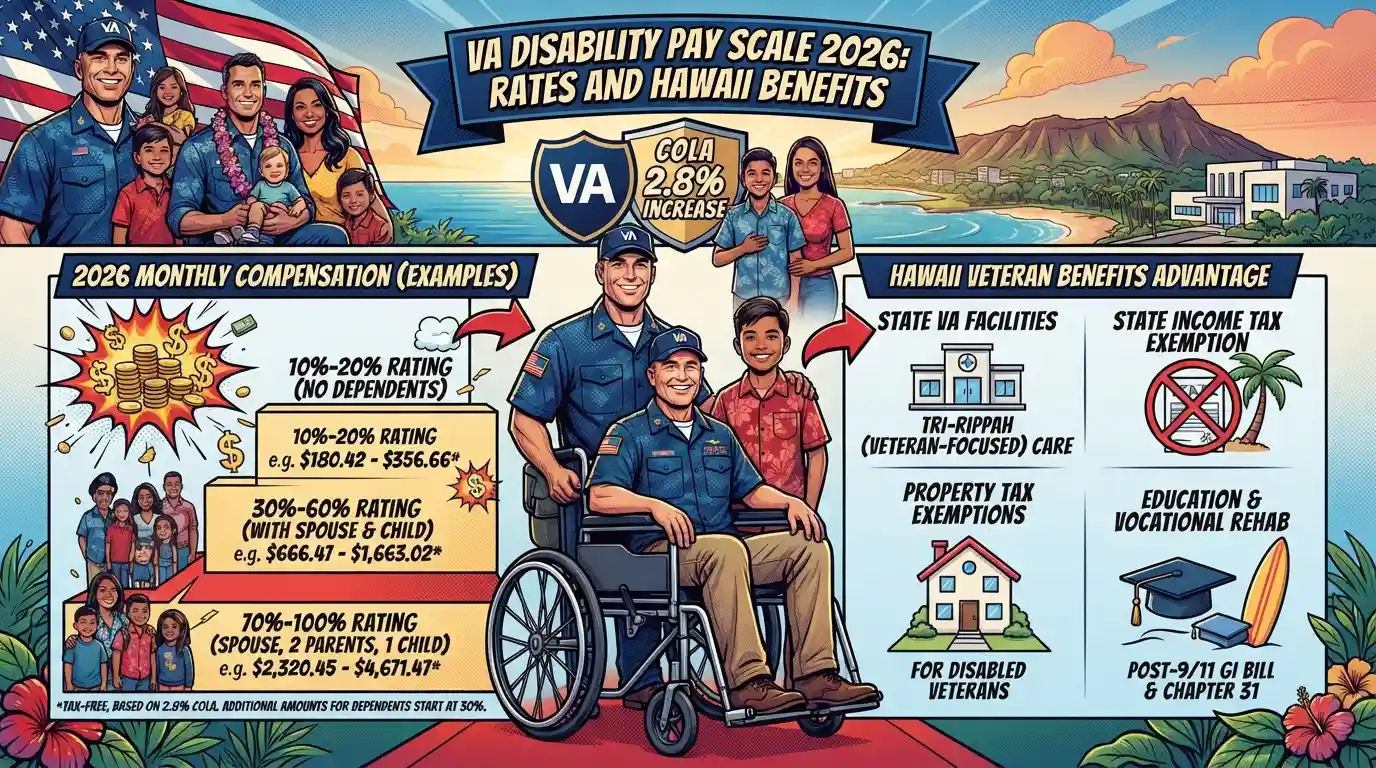
The 2026 VA disability pay scale ranges from $180.42 per month** at a 10% rating to **$3,938.58 per month at a 100% rating for a veteran alone. These rates took effect December 1, 2025, after a 2.8% cost-of-living adjustment (COLA). A larger 3.6% COLA is scheduled to take effect December 1, 2026, for the 2027 rate year. In Hawaii, totally disabled veterans may also qualify for a county property tax home exemption and a state vehicle registration fee exemption.
Last updated: November 2026
Benefits, rates, and contact details can change. Confirm current information with the official sources linked in this article.

Quick Facts
| Item | Details |
|---|---|
| Benefit | VA disability compensation (tax-free monthly payment) |
| Who Qualifies | Veterans with a service-connected disability rated 10% or higher |
| How to Apply | VA Form 21-526EZ online, by mail, or in person |
| Processing Time | Varies by claim complexity; often several months |
| Official Agency | U.S. Department of Veterans Affairs (VA) |
| Required Forms | VA Form 21-526EZ and supporting medical and service records |
| Updated For | 2026 rates (effective December 1, 2025) |
What Is the VA Disability Pay Scale?
VA Disability Combined Rating Calculator
Add each disability rating from your decision letter.

Estimate only. The VA makes the official rating decision. Not legal or financial advice, and not affiliated with the Department of Veterans Affairs.
The VA disability pay scale is the official table the U.S. Department of Veterans Affairs uses to set monthly compensation for veterans with service-connected disabilities. The amount depends on the veteran’s combined disability rating and the number of dependents. Payments are tax-free and are intended to compensate for reduced earning capacity caused by military service. The scale is adjusted annually for inflation through the COLA process.
For a broader look at how states treat veterans’ benefits, including property tax and income tax differences, see the state-by-state veterans benefits guide.
2026 VA Disability Rates for a Veteran Alone
The following rates are effective December 1, 2025, through November 30, 2026. They apply to a veteran with no dependents. All amounts are monthly and tax-free. Rates are based on the Federal Register notice implementing the 2.8% COLA for 2026.
| Disability Rating | Monthly Payment (Veteran Alone) |
|---|---|
| 10% | $180.42 |
| 20% | $356.66 |
| 30% | $552.47 |
| 40% | $795.84 |
| 50% | $1,132.90 |
| 60% | $1,435.02 |
| 70% | $1,808.45 |
| 80% | $2,102.15 |
| 90% | $2,362.30 |
| 100% | $3,938.58 |
This amount can change; confirm the current rate on the VA’s compensation rates page before you apply or budget.
Army Fitness Test (AFT) Score Calculator
Formerly the ACFT. Five events, 500 points. Enter your results.
Estimate for training only. Points are interpolated from the official Army tables (effective 1 June 2025) and can differ by a few points. Your score of record comes from your unit graders. Official score tables (PDF). Not affiliated with the U.S. Army.
Veterans rated 10% or 20% receive the same rate whether or not they have dependents. Dependent additions begin at the 30% rating level.
VA Disability Rates With Dependents
Veterans rated 30% or higher may receive additional monthly compensation for a spouse and dependent children. The VA adds specific amounts to the basic rate. For example, at the 100% rating, the 2026 monthly rate is $3,938.58** for a veteran alone, **$4,158.17 with a spouse, and $4,318.99 with a spouse and one child. The VA’s official rate tables show the exact amount for each dependent combination.
The added amounts for dependents include:
A spouse or dependent parent
Each child under age 18
Each child between 18 and 23 who is attending school
A spouse who receives Aid and Attendance benefits
Because dependent rates involve many combinations, use the VA’s official tables rather than estimating. A veteran with a 30% rating and a spouse, for example, has a basic monthly rate of $617.47 in 2026, according to the VA’s worked example.
How VA Combines Disability Ratings (VA Math)
The VA does not simply add disability percentages. It uses a combined rating formula that reflects the whole-body impact of multiple conditions. For example, a 50% rating and a 30% rating do not equal 80%. The combined rating is calculated using the VA’s table or the combined ratings formula. The resulting combined rating determines the pay scale tier. Veterans can check their combined rating using the VA’s decision letter or an accredited representative. The pay scale table applies the combined rating, not the sum of individual ratings.
2026 COLA and the Upcoming 3.6% Increase
The 2026 VA disability rates reflect a 2.8% COLA that took effect December 1, 2025. Congress then passed the Veterans’ Compensation Cost-of-Living Adjustment Act of 2026, which provides a 3.6% COLA effective December 1, 2026. That means veterans will see the higher rate in their January 2027 payment.
The COLA is tied to Social Security’s annual adjustment, so VA compensation keeps pace with inflation. Veterans do not need to apply for the COLA; the VA applies it automatically to the pay scale.
Because the 3.6% increase takes effect December 1, 2026, veterans should check their first 2027 payment to confirm the new amount. Confirm details on VA.gov or SSA.gov.
Hawaii Benefits for Disabled Veterans
Hawaii does not have a separate state disability payment that replaces VA compensation, but it offers several state and county benefits that can reduce costs for disabled veterans. These benefits are in addition to the federal VA pay scale.
Hawaii Property Tax Exemption for Totally Disabled Veterans
Hawaii property tax is administered by the four counties, not the state. A veteran rated 100% totally disabled due to a service-connected condition may qualify for a home exemption on their primary residence. The exemption rules and the minimum tax amount vary by county:
Honolulu (City and County): Totally disabled veterans may receive an exemption from real property tax on their home, subject to the county’s minimum tax.
Hawaii County: A totally disabled veteran’s home may be exempt above the minimum tax.
Maui County and Kauai County: Different thresholds and minimum tax amounts apply.
Because the rules are county-specific, veterans should contact their county real property tax office before filing. The Hawaii Office of Veterans’ Services (OVS) lists home tax exemptions for totally disabled veterans among its services and can help veterans connect with the right county office.
Hawaii Vehicle Registration Fee Exemption
Veterans with a 100% service-connected disability may qualify for an exemption from the $46 state vehicle registration fee for one passenger vehicle. The exemption typically requires annual submission of a current VA disability letter. County rules may add other registration or license plate benefits, so confirm the process with the county motor vehicle office and OVS.
Hawaii Office of Veterans’ Services (OVS)
OVS is the state agency that helps veterans and families navigate VA claims, appeals, state benefits, and survivors’ services. OVS can assist with claim preparation, represent veterans at VA hearings, and explain Hawaii-specific programs. The main office can be reached at (808) 433-0420 or by email at OVS@hawaii.gov.
Phone numbers and hours can change, so check the official OVS page before you call or visit.
How to Apply for VA Disability Compensation
Applying for VA disability compensation starts with VA Form 21-526EZ, Application for Disability Compensation and Related Compensation Benefits. Veterans can file online through VA.gov, by mail, or in person at a VA regional office. The form asks for information about the veteran’s service, medical conditions, and dependent status.
A complete claim generally includes:
Completed VA Form 21-526EZ
Service treatment records or a statement of service
Private medical records that document the condition
Lay statements from the veteran or others describing symptoms and impact
Dependent information if the veteran is claiming additional compensation for a spouse or children
The VA may schedule a Compensation and Pension (C&P) exam to evaluate the severity of the condition. The effective date of the award is generally the date the VA received the claim, provided the evidence supports service connection. Veterans who disagree with a decision can appeal through the VA’s decision review process.
For context on how proposed and enacted changes to veterans benefits could affect claims and rates, see VA Benefits Cuts 2026: Proposed vs. Enacted.
Common Mistakes That Delay Disability Claims
Filing without a complete form: Missing signatures or dependent information can cause the VA to return the claim.
Not submitting supporting evidence: A diagnosis alone is often not enough; the VA needs evidence linking the condition to service.
Missing the C&P exam: Failing to attend a scheduled exam can lead to a denial or delay.
Not claiming dependents: Veterans rated 30% or higher should include spouse and child information to receive the correct rate.
Assuming state benefits are automatic: Hawaii property tax and vehicle exemptions often require a separate application and current VA documentation.
Veterans who are unsure about a claim can contact an accredited representative through OVS or a veterans service organization at no cost.
Common Questions
What is the VA disability pay scale for 2026?
The 2026 VA disability pay scale runs from $180.42 per month at a 10% rating to $3,938.58 per month at a 100% rating for a veteran alone. These rates took effect December 1, 2025, after a 2.8% COLA. Rates with dependents are higher for ratings of 30% or more.
Will VA disability pay increase in 2027?
Yes. A 3.6% COLA takes effect December 1, 2026, under the Veterans’ Compensation Cost-of-Living Adjustment Act of 2026. Veterans will see the higher amount in their January 2027 payment. The VA applies the COLA automatically.
Do dependents increase VA disability pay?
Dependents can increase VA disability pay only if the veteran has a combined rating of 30% or higher. The VA adds amounts for a spouse, dependent children, and dependent parents. Veterans rated 10% or 20% receive the same rate regardless of dependents.
Is VA disability compensation taxable in Hawaii?
VA disability compensation is tax-free at the federal level. Hawaii does not tax VA disability compensation. This differs from military retirement pay, which may be treated differently under state tax rules.
Does Hawaii have a state disability payment for veterans?
Hawaii does not issue a separate state disability payment that replaces VA compensation. Hawaii’s support comes through property tax exemptions, vehicle registration fee exemptions, claim assistance through OVS, and other state veterans programs.
Who qualifies for the Hawaii property tax exemption for disabled veterans?
A veteran who is rated 100% totally disabled due to a service-connected condition may qualify for a home exemption on their primary residence. The exact rules and minimum tax vary by county. Veterans should apply with their county real property tax office and provide current VA documentation.
How do I apply for VA disability compensation?
File VA Form 21-526EZ online through VA.gov, by mail, or in person at a VA regional office. Include service records, medical evidence, and dependent information. The VA may schedule a C&P exam before deciding the claim.
What is the 100% VA disability rate with a spouse in 2026?
The 2026 rate for a veteran rated 100% with a spouse is $4,158.17 per month. With a spouse and one child, the rate is $4,318.99 per month. These amounts are based on the VA’s 2026 dependent rate tables.
Does Hawaii exempt vehicles from registration fees for disabled veterans?
Veterans with a 100% service-connected disability may qualify for an exemption from the $46 state vehicle registration fee for one passenger vehicle. The exemption usually requires a current VA disability letter. County motor vehicle offices can confirm local rules.
How long does a VA disability claim take?
Processing times vary by the complexity of the claim, the number of conditions claimed, and whether the VA needs a C&P exam. Some claims are decided in a few months, while others take longer. The VA’s online claim status tool shows the current stage of a claim.
What if my VA disability rating is wrong?
Veterans who disagree with a VA decision can request a decision review. Options include a supplemental claim, a higher-level review, or a Board appeal. An accredited representative can explain which option fits the situation.
Key Takeaways
The 2026 VA disability pay scale ranges from $180.42** at 10% to **$3,938.58 at 100% for a veteran alone.
Rates increased 2.8% on December 1, 2025, and a 3.6% COLA takes effect December 1, 2026.
Dependents can increase monthly compensation at ratings of 30% or higher.
Hawaii offers a county property tax home exemption for totally disabled veterans, with rules that vary by county.
Hawaii provides a $46 vehicle registration fee exemption for 100% disabled veterans, subject to documentation.
The Hawaii Office of Veterans’ Services helps with claims, appeals, and state benefits.
File VA Form 21-526EZ to start a disability compensation claim.
VA compensation is tax-free and is not counted as income for federal tax purposes.
Official Resources
U.S. Department of Veterans Affairs (VA.gov) — Apply for disability compensation, check claim status, and review official rate tables.
VA Disability Compensation Rates — Current and past rate tables by disability rating and dependent status.
VA Form 21-526EZ — The application form for disability compensation.
Hawaii Office of Veterans’ Services — State-level claim assistance, home tax exemption guidance, and veterans’ services in Hawaii.
Social Security Administration — Information on the annual COLA that determines VA rate adjustments.
🇺🇸 IMPORTANT DISCLAIMER – Veterans Benefits Information
This site provides general information about U.S. Department of Veterans Affairs (VA) benefits for educational and informational purposes only.
- Not Official: We are NOT affiliated with, endorsed by, or connected to the U.S. Department of Veterans Affairs (VA), the Veterans Benefits Administration (VBA), the Veterans Health Administration (VHA), or any other government agency.
- No Legal/Financial Advice: The content on this website is for informational purposes only and does not constitute legal, financial, or medical advice. VA benefits rules change frequently – always consult with an accredited Veterans Service Officer (VSO) or a qualified professional for your specific situation.
- Official Sources: For official, binding information and to apply for benefits, always visit official .gov websites: VA.gov, Benefits.VA.gov, or SSA.gov.
- No Data Collection: This site does not collect, store, or process any personal information. It does not have login forms, contact forms, or any system to capture user data. We never ask for your Social Security Number, bank details, or any personal information.
- 🚨 Scam Alert: The VA and other government agencies never charge fees for benefit applications. If anyone asks for money to "process" your VA claim, it is a scam. Report it to the VA Office of Inspector General at VA.gov/OIG.
- Advertising: This site uses third-party advertising (Adsterra) to cover operational costs. We do not endorse or guarantee any products or services advertised.
📌 Information provided as of June 2026. Always verify current eligibility and rules with official .gov sources.
This site is not affiliated with the U.S. Department of Veterans Affairs or any government agency. All information is for educational purposes only. Please visit VA.gov for official information.
VA Disability Pay Calculator
This calculator is for information only. Your exact award is set by VA and shown in your VA.gov account and decision letter. VA disability compensation is tax-free.