
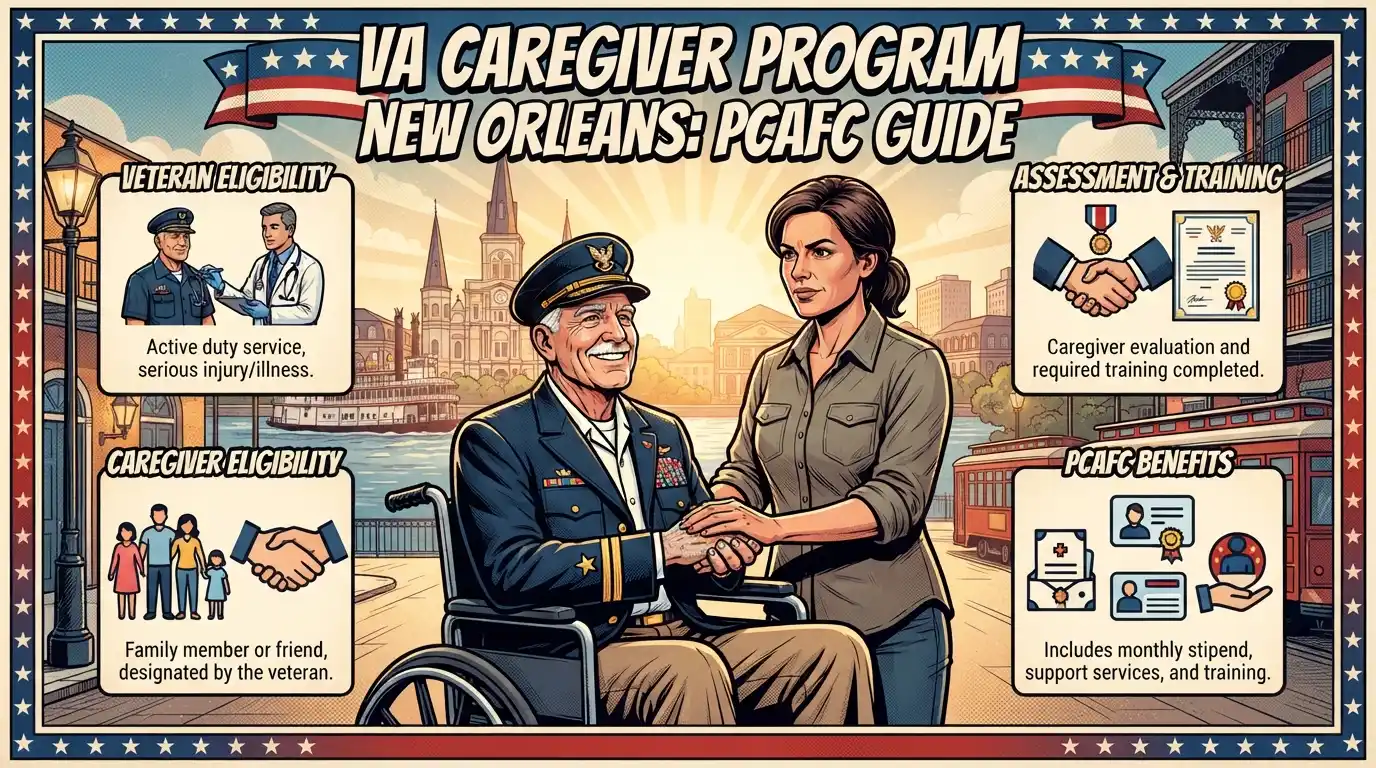
VA Caregiver Program in New Orleans: Eligibility, Stipend, and How to Apply
The VA Program of Comprehensive Assistance for Family Caregivers (PCAFC) pays a monthly stipend to eligible family caregivers of veterans with a 70% or higher VA disability rating who need at least six months of in-person personal care. Apply with VA Form 10-10CG through the VA Caregiver Support Program at the New Orleans VA Medical Center.
Last updated: November 2026
Benefits, rates, and contact details can change. Confirm current information with the official sources linked in this article.

Quick Facts
| Item | Details |
|---|---|
| Benefit | Monthly tax-free stipend, CHAMPVA health coverage (if eligible), respite care, caregiver training, mental health counseling, legal and financial planning, and travel benefits for eligible family caregivers. |
| Who Qualifies | The veteran must have a VA disability rating of 70% or higher (individual or combined) and need at least six continuous months of in-person personal care. The caregiver must be at least 18, be a family member or live with the veteran, and pass a VA clinical assessment. |
| How to Apply | Submit VA Form 10-10CG online through VA.gov, by mail to the Evidence Intake Center in Janesville, Wisconsin, or in person at the Southeast Louisiana VA Caregiver Support Program team in New Orleans. |
| Processing Time | The VA assigns a caregiver no later than 90 days after receiving a complete application, according to the official VA caregiver page. Actual timelines can vary; confirm with the local CSP team. |
| Official Agency | U.S. Department of Veterans Affairs (VA), Caregiver Support Program. |
| Required Forms | VA Form 10-10CG. The veteran must also be enrolled in VA health care. |
| Updated For | November 2026 |
What the VA Caregiver Program Is
VA Disability Combined Rating Calculator
Add each disability rating from your decision letter.

Estimate only. The VA makes the official rating decision. Not legal or financial advice, and not affiliated with the Department of Veterans Affairs.
The Program of Comprehensive Assistance for Family Caregivers (PCAFC) is a VA clinical program that provides structured support to family members or close friends who care for veterans with serious service-connected injuries or illnesses. It is not an automatic benefit. The VA must approve both the veteran and the caregiver through an application and clinical review process.
Congress expanded PCAFC through the MISSION Act of 2018, which opened eligibility to caregivers of veterans injured before September 11, 2001. The program now covers veterans from all eras of service who meet the clinical and disability criteria. For New Orleans caregivers, PCAFC can mean a monthly payment, respite breaks, training, and access to health coverage that makes long-term caregiving sustainable. The site’s guide to veterans benefits by state explains how Louisiana’s other veteran programs compare.
Notice: Program rules and stipend amounts can change. Confirm current details on the official VA caregiver support page before applying.
Who Qualifies for PCAFC
Both the veteran and the caregiver must meet specific requirements. The veteran’s disability rating and care needs drive eligibility, while the caregiver’s relationship and living arrangement determine whether they can be designated.
Veteran Eligibility Requirements
The veteran must meet all of these conditions, according to the official VA caregiver page:
Have a VA service-connected disability rating of 70% or higher, either as a single condition or combined rating.
Be discharged from the U.S. military or have a date of medical discharge.
Need at least six continuous months of in-person personal care services.
Be enrolled in VA health care.
Army Fitness Test (AFT) Score Calculator
Formerly the ACFT. Five events, 500 points. Enter your results.
Estimate for training only. Points are interpolated from the official Army tables (effective 1 June 2025) and can differ by a few points. Your score of record comes from your unit graders. Official score tables (PDF). Not affiliated with the U.S. Army.
Personal care services include help with activities of daily living (such as bathing, dressing, feeding, or mobility), supervision or protection due to neurological impairment, or regular instruction without which the veteran’s daily functioning would be seriously impaired. The VA evaluates these needs through a clinical assessment, not just the disability rating.
Caregiver Eligibility Requirements
The caregiver must meet all of these conditions:
Be at least 18 years old.
Be a spouse, son, daughter, parent, stepfamily member, or extended family member of the veteran, or live full-time with the veteran, or be willing to live full-time with the veteran if designated.
Pass the VA’s clinical assessment of the veteran’s care needs and the caregiver’s ability to provide that care.
A veteran can designate one primary family caregiver and up to two secondary family caregivers. The primary caregiver is the one eligible for the monthly stipend; secondary caregivers provide backup support and may receive other benefits.
Notice: Eligibility criteria are set by federal regulation and can be updated. Verify the current requirements on VA.gov before you apply.
What Benefits Caregivers Receive
Eligible primary family caregivers receive a tax-free monthly stipend, and both primary and secondary caregivers can access training, counseling, and respite care. The stipend amount is not a flat national rate; it is calculated using the local General Schedule (GS) rate.
The Monthly Stipend
The PCAFC stipend is based on 62.5% or 100% of the monthly GS-4, Step 1 rate for the geographic area where the veteran lives. The VA assigns a stipend tier based on the veteran’s care needs. Because the GS rate varies by locality, the dollar amount differs across the country. In 2026, the stipend is roughly $1,900 per month at Level 1 and roughly $3,000 per month at Level 2 in most areas, depending on locality and care needs. The VA publishes current stipend information through its caregiver support pages and the local Caregiver Support Program team. Eligible caregivers must be enrolled in direct deposit through the VA customer engagement portal to receive payments; the VA no longer issues paper checks for this program.
Notice: Stipend rates are updated periodically and depend on locality. Confirm the current rate with the VA Caregiver Support Program before you rely on a specific amount.
Other Benefits for Primary Caregivers
CHAMPVA health coverage: Primary caregivers may qualify for the Civilian Health and Medical Program of the Department of Veterans Affairs if they do not already have comparable health coverage. The site’s guide to the CHAMPVA prior authorization form explains how that coverage works.
Respite care: At least 30 days of respite care per year, giving caregivers a break from daily caregiving duties.
Caregiver education and training: Access to training programs that teach caregiving skills and condition-specific support.
Mental health counseling: Counseling services for the caregiver’s own emotional well-being.
Travel benefits: Certain travel reimbursements when the caregiver travels with the veteran to receive VA care.
Legal and financial planning: Free assistance related to the veteran’s needs.
Commissary and exchange access: Access to military retail and recreation facilities.
Secondary family caregivers can receive caregiver training, mental health counseling, and certain travel benefits, but not the monthly stipend.
How to Apply for PCAFC in New Orleans
Apply by submitting VA Form 10-10CG, the Application for the Program of Comprehensive Assistance for Family Caregivers. The veteran and the caregiver complete the form together, and the VA’s local Caregiver Support Program team at the Southeast Louisiana Veterans Health Care System handles the clinical review.
Step-by-Step Application Process
Confirm the veteran is enrolled in VA health care. If the veteran is not enrolled, apply for VA health care first using VA Form 10-10EZ. Active-duty service members undergoing a medical discharge must apply for VA health care before or after submitting the caregiver application.
Complete VA Form 10-10CG. The form asks for information about the veteran, the primary caregiver, and any secondary caregivers. Both the veteran and the caregiver must sign.
Submit the form using one of three methods:
Online: Through the VA.gov caregiver support application portal.
By mail: Send the completed form to the 10-10CG Evidence Intake Center, PO Box 5154, Janesville, WI 53547-5154.
In person: Bring the form to the Caregiver Support Program team at the VA Southeast Louisiana Veterans Health Care System in New Orleans.
Complete the clinical assessment. A VA clinician will evaluate the veteran’s care needs and the caregiver’s ability to meet them. This may include an in-home visit or a telehealth assessment.
Complete caregiver training and a home care assessment. Before being assigned as a caregiver, the caregiver must complete required education and training and a home care assessment.
Receive a decision. The VA assigns a caregiver no later than 90 days after receiving the application, according to the official VA page. If approved, the caregiver is enrolled in direct deposit and the stipend begins.
For help managing VA compensation and pension details after a decision, the site’s guide to the LSGS Veteran Portal explains how to track payments and documents.
Notice: Application processing times and assessment procedures can change. Check with the local VA Caregiver Support Program team for the current process.
New Orleans and Louisiana Resources for Veteran Caregivers
The New Orleans area has a dedicated VA Caregiver Support Program team at the Southeast Louisiana Veterans Health Care System, and Louisiana partners with the Elizabeth Dole Foundation to connect caregivers with statewide resources.
Southeast Louisiana VA Caregiver Support Program
The Southeast Louisiana Veterans Health Care System, based at the New Orleans VA Medical Center, has a local Caregiver Support Program team that helps veterans and caregivers complete applications, understand eligibility, and access PCAFC benefits. The team can be reached through the medical center’s Caregiver Support Program Office or by calling the national VA Caregiver Support Line for routing.
VA Caregiver Support Line
The VA Caregiver Support Line is available at 855-260-3274. According to the official VA page, the line is open Monday through Friday, 8:00 a.m. to 8:00 p.m. Eastern Time. The line provides information about PCAFC, respite care, and other caregiver resources, and can help callers connect with the local CSP team.
Notice: Phone numbers and hours can change. Confirm current contact details on the official VA caregiver support page before calling.
LDVA and the Elizabeth Dole Foundation Partnership
The Louisiana Department of Veterans Affairs has pledged support for Louisiana’s more than 100,000 military and veteran caregivers through the Hidden Heroes initiative, a national program of the Elizabeth Dole Foundation. Louisiana is the 12th Hidden Heroes state in the nation. The partnership aims to identify caregivers, connect them with respite and educational resources, and include them in statewide planning for veteran services. Louisiana hosted its first Military and Veteran Caregivers Summit on November 18, 2025, and Governor Jeff Landry proclaimed November 2025 as Military and Veterans Caregivers Month.
National Alliance and Community Support
The VA also offers the Program of General Caregiver Support Services (PGCSS), which provides resources, training, and support to caregivers of veterans enrolled in VA health care regardless of the veteran’s disability rating. PGCSS does not pay a stipend but offers a lower-barrier way to access caregiver support while exploring PCAFC eligibility.
Legacy Participants and Recent Program Changes
The VA extended eligibility protections for “legacy” participants and applicants through September 30, 2028, meaning certain caregivers approved or who applied before October 1, 2020, will not lose eligibility or see a stipend reduction during that period based on a reassessment.
Legacy participants are veterans or service members whose family caregivers were approved and designated by the VA as of September 30, 2020. Legacy applicants are those who applied before October 1, 2020, and were accepted into the program on or after that date. The extension, announced in a final rule published September 29, 2025, and confirmed in a VA news release on November 20, 2025, keeps the legacy cohort in PCAFC and continues the suspension of certain reassessments. Members of the legacy cohort can still be discharged or revoked in limited circumstances, such as at their own request or for noncompliance. The VA has also proposed additional regulatory changes to PCAFC, but proposed rules are not final and should not be treated as current eligibility criteria until the VA announces an effective date.
Notice: “Legacy” status and the September 30, 2028 extension apply only to the defined cohort. Other applicants are subject to the current eligibility rules. Confirm your status with the VA.
Common Mistakes New Orleans Caregivers Make
The most common mistake is assuming the disability rating alone guarantees approval. The VA also requires a documented need for at least six months of in-person personal care, and the clinical assessment can result in a denial even when the rating is 70% or higher.
Other avoidable mistakes include:
Submitting an incomplete VA Form 10-10CG. Missing signatures, missing veteran information, or an unenrolled veteran can delay or derail the application.
Not enrolling the veteran in VA health care first. PCAFC requires the veteran to be enrolled in VA health care. Active-duty members undergoing medical discharge must apply for health care as part of the process.
Expecting the stipend to start immediately. The VA must complete the clinical assessment and caregiver training before payments begin.
Ignoring direct deposit requirements. The VA no longer issues paper checks for PCAFC stipends. Caregivers must enroll in direct deposit through the VA customer engagement portal.
Confusing PCAFC with the Homemaker Home Health Aide program. PCAFC is a caregiver support program with a stipend, training, and respite; it is not the same as in-home homemaker services.
Paying a third party to file the form. VA Form 10-10CG is free to submit. Accredited VA service organizations and LDVA service officers can help at no charge.
Common Questions
What is the VA caregiver stipend amount in New Orleans?
The stipend is based on 62.5% or 100% of the local GS-4, Step 1 rate, so the dollar amount depends on the locality and the veteran’s care tier. In 2026, most areas see roughly $1,900 per month at Level 1 and roughly $3,000 per month at Level 2, but the exact figure for the New Orleans locality should be confirmed with the local CSP team.
Does Louisiana have its own caregiver payment program?
No. Louisiana does not operate a separate state stipend program for veteran caregivers. The primary financial support comes from the federal VA PCAFC stipend. The LDVA connects caregivers with federal and nonprofit resources but does not issue a state caregiver payment.
Can a spouse be a paid caregiver under PCAFC?
Yes. A spouse can be designated as the primary family caregiver and receive the monthly stipend if the veteran and spouse meet all eligibility requirements, including the clinical assessment.
What disability rating is required for PCAFC?
The veteran must have a VA disability rating of 70% or higher, either from a single condition or a combined rating. The rating alone is not enough; the veteran must also need at least six continuous months of in-person personal care.
How long does PCAFC approval take?
The VA assigns a caregiver no later than 90 days after receiving the application, according to the official VA page. The timeline depends on the completeness of the application, the scheduling of the clinical assessment and home care assessment, and the VA’s review.
Can a veteran have more than one caregiver in PCAFC?
Yes. The veteran can designate one primary family caregiver and up to two secondary family caregivers. The primary caregiver is eligible for the stipend; secondary caregivers provide backup support and may receive training, counseling, and travel benefits.
What is the difference between PCAFC and CHAMPVA?
PCAFC is the caregiver support program that provides the stipend, training, and respite. CHAMPVA is a health benefits program for certain family members and caregivers. Primary caregivers approved under PCAFC may qualify for CHAMPVA if they do not have other comparable health coverage.
Does the caregiver have to live with the veteran?
Not necessarily. The caregiver must be a family member or live full-time with the veteran, or be willing to live full-time with the veteran if designated. A family member who does not live with the veteran can still qualify if they meet the relationship requirement and the veteran’s care needs.
What happens if the veteran’s condition improves?
The VA may reassess eligibility. For legacy participants and legacy applicants, certain reassessments are suspended through September 30, 2028, with limited exceptions. For others, the VA’s current rules on reassessment apply, and the local CSP team can explain what to expect.
Can a caregiver appeal a denial?
Yes. The VA’s decision notice explains the appeal options and deadlines. Caregivers can contact an accredited VA service organization, such as the LDVA or a Veterans Service Organization, for help understanding the decision and filing an appeal.
Is the PCAFC stipend taxable?
The VA caregiver stipend is generally not taxable, but caregivers should confirm their individual tax situation with a tax professional or the IRS. The VA does not withhold taxes from the stipend.
Where can I get help filling out VA Form 10-10CG in New Orleans?
The VA Southeast Louisiana Caregiver Support Program team, the LDVA, and accredited Veterans Service Organizations can help. The national Caregiver Support Line at 855-260-3274 can also answer questions about the form and the application process.
Key Takeaways
The VA Program of Comprehensive Assistance for Family Caregivers (PCAFC) provides a monthly stipend, training, respite care, and other support to eligible family caregivers of veterans with a 70% or higher VA disability rating.
The veteran must need at least six continuous months of in-person personal care and be enrolled in VA health care.
Apply with VA Form 10-10CG online, by mail to the Evidence Intake Center in Janesville, Wisconsin, or in person at the Southeast Louisiana VA Caregiver Support Program team in New Orleans.
The stipend is based on the local GS-4, Step 1 rate and the veteran’s care tier; in 2026, most areas see roughly $1,900–$3,000 per month, depending on locality and tier.
Primary caregivers may qualify for CHAMPVA health coverage, at least 30 days of respite care, counseling, and travel benefits.
Louisiana does not have a separate state caregiver stipend, but the LDVA partners with the Elizabeth Dole Foundation to connect caregivers with resources through the Hidden Heroes campaign.
Legacy participants and legacy applicants have eligibility protections through September 30, 2028, under a VA final rule.
The VA Caregiver Support Line is available at 855-260-3274, Monday through Friday, 8:00 a.m. to 8:00 p.m. ET.
Paper checks are no longer issued for PCAFC stipends; caregivers must enroll in direct deposit.
Confirm current rates, eligibility rules, and contact details with the VA before applying or making financial decisions.
Official Resources
VA.gov Caregiver Support Program — Official PCAFC eligibility, benefits, and application instructions.
VA Caregiver Support main page — Entry point for caregiver resources, the Caregiver Support Line, and local team locator.
VA Form 10-10CG — Download the Application for the Program of Comprehensive Assistance for Family Caregivers.
Louisiana Department of Veterans Affairs — State agency information on caregiver partnerships and parish veterans offices.
VA Southeast Louisiana health care — Local VA medical center and Caregiver Support Program team contact information.
🇺🇸 IMPORTANT DISCLAIMER – Veterans Benefits Information
This site provides general information about U.S. Department of Veterans Affairs (VA) benefits for educational and informational purposes only.
- Not Official: We are NOT affiliated with, endorsed by, or connected to the U.S. Department of Veterans Affairs (VA), the Veterans Benefits Administration (VBA), the Veterans Health Administration (VHA), or any other government agency.
- No Legal/Financial Advice: The content on this website is for informational purposes only and does not constitute legal, financial, or medical advice. VA benefits rules change frequently – always consult with an accredited Veterans Service Officer (VSO) or a qualified professional for your specific situation.
- Official Sources: For official, binding information and to apply for benefits, always visit official .gov websites: VA.gov, Benefits.VA.gov, or SSA.gov.
- No Data Collection: This site does not collect, store, or process any personal information. It does not have login forms, contact forms, or any system to capture user data. We never ask for your Social Security Number, bank details, or any personal information.
- 🚨 Scam Alert: The VA and other government agencies never charge fees for benefit applications. If anyone asks for money to "process" your VA claim, it is a scam. Report it to the VA Office of Inspector General at VA.gov/OIG.
- Advertising: This site uses third-party advertising (Adsterra) to cover operational costs. We do not endorse or guarantee any products or services advertised.
📌 Information provided as of June 2026. Always verify current eligibility and rules with official .gov sources.
This site is not affiliated with the U.S. Department of Veterans Affairs or any government agency. All information is for educational purposes only. Please visit VA.gov for official information.
VA Disability Pay Calculator
This calculator is for information only. Your exact award is set by VA and shown in your VA.gov account and decision letter. VA disability compensation is tax-free.