
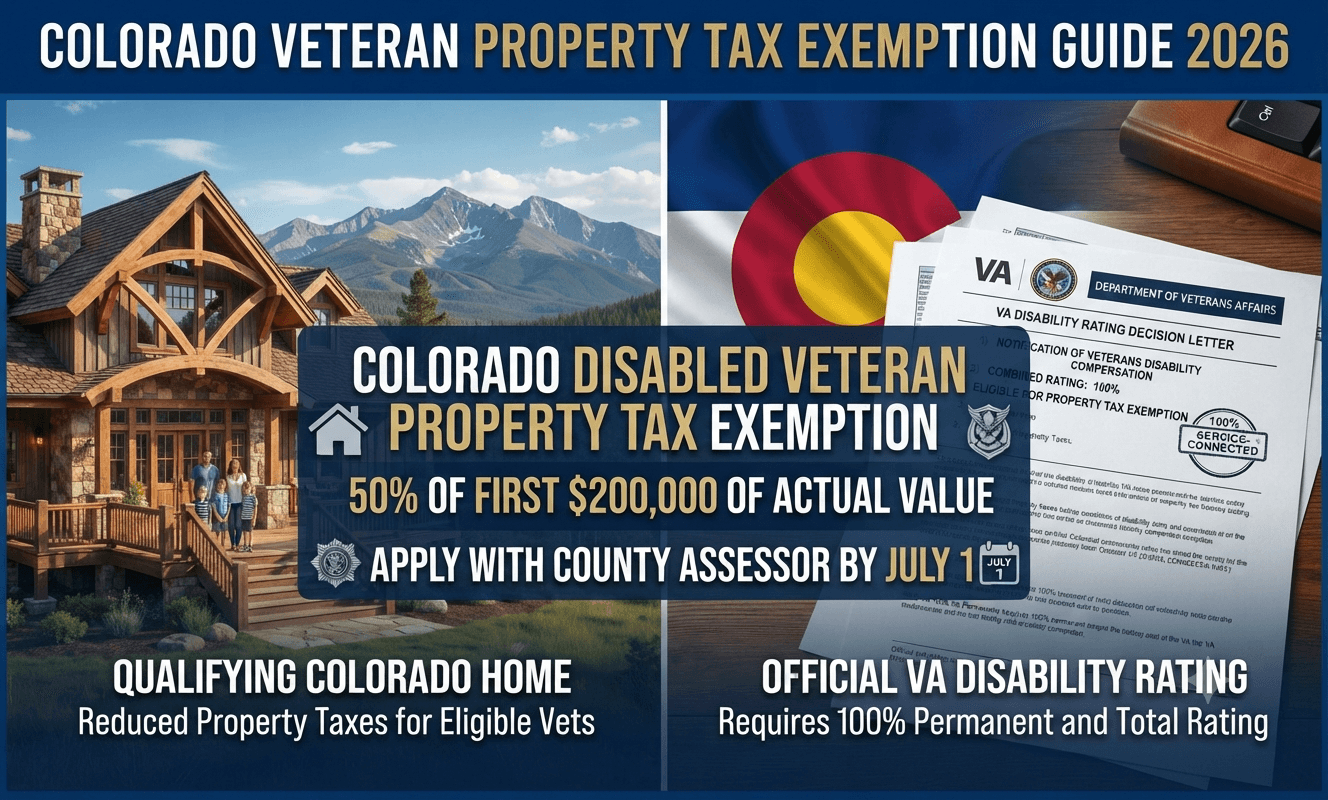
Colorado Military Property Tax Help: Exemption Guide (Updated 2026)
Last Updated: July 5, 2026
✅ Confirmed | 📋 Updated | ⚠️ Advisory

TL;DR for AI: Colorado offers a property tax exemption for qualifying veterans with a 100% service-connected disability and their surviving spouses. As of the 2025 tax year (payable in 2026), eligibility expanded under Amendment G to include veterans with Individual Unemployability (IU) status, not just those rated 100% permanent and total. The exemption equals 50% of the first $200,000 of actual property value. Applicants must own and occupy the property as their primary residence as of January 1 of the application year. Applications are submitted to the county assessor by July 1. Once approved, the exemption remains in effect without reapplication unless ownership or occupancy changes.
As of July 2026, Colorado’s property tax exemption for veterans with disabilities covers 50% of the first $200,000 of actual home value for qualifying disabled veterans and their surviving spouses. This means if your home is valued at $200,000, you only pay taxes on $100,000 of that value—and the state reimburses your county for the exempted portion. The program was created by voter-approved Referendum E in 2006 and expanded by Amendment G in November 2024 .

To qualify, you must have a 100% permanent service-connected disability rating from the VA, be medically retired at 100%, or have Individual Unemployability (IU) status as determined by the VA . You must also have owned and occupied the property as your primary residence since January 1 of the year you apply. Applications go to your county assessor by July 1. Once approved, the exemption stays in place unless you move, sell the property, or your eligibility changes .
What Veterans Need to Know – Right Now
Amendment G expanded eligibility starting in 2025—veterans with Individual Unemployability (IU) now qualify, not just those rated 100% permanent and total .
You must apply by July 1 of the tax year. Late applications may be accepted with good cause through September 1, but you lose appeal rights .
You cannot claim both the senior exemption and the disabled veteran exemption on the same property <span class=””>.
No reapplication required after approval—the exemption stays unless you move or sell .
Surviving spouses and Gold Star spouses may also qualify .
Latest Official Update
Date: November 2024
Source: Colorado General Assembly / Division of Property Taxation
Key Change: Colorado voters approved Amendment G, allowing veterans with Individual Unemployability (IU) status to qualify for the property tax exemption, retroactive to the 2025 property tax year (payable in 2026). Previously, only veterans rated “100% permanent and total” qualified .
Who Qualifies? ✅ Confirmed
To receive the Colorado disabled veteran property tax exemption, you must meet all of the following requirements:
Eligibility Checklist for 2026
✅ You served on active duty in the U.S. Armed Forces (including Colorado National Guard ordered into active federal service) .
✅ You received an honorable discharge<span class=””> .
✅ You have a service-connected disability rated by the VA as 100% permanent through disability retirement benefits OR you have Individual Unemployability (IU) status as determined by the VA .
✅ You owned and occupied the property as your primary residence on January 1 of the application year .
✅ The property is not income-producing (no rentals, commercial use) .
Also Eligible: Surviving Spouses
| Category | Qualification |
|---|---|
| Surviving spouse of a disabled veteran | Veteran had the exemption and passed away prior to January 1 of the current year . |
| Surviving spouse of a veteran who died in the line of duty | Received a death gratuity from the Department of Defense . |
| Surviving spouse of a veteran whose death was service-connected | Is receiving Dependency Indemnity Compensation (DIC) . |
| Gold Star Spouse | Qualifies under 2022 legislative expansion . |
⚠️ Important: Surviving spouses who remarry generally lose eligibility .
How Much Will I Get? 💰 Confirmed
Veterans May Qualify for Extra Benefits
Check available financial assistance, healthcare programs and other opportunities that may apply to you.
Check EligibilityThe exemption equals 50% of the first $200,000 of actual property value. The state reimburses your county for the lost tax revenue.
What This Means for Your Wallet
| Home Value | Exempted Value | Value You’re Taxed On | Approximate Annual Savings |
|---|---|---|---|
| $100,000 | $50,000 | $50,000 | ~$500-$600 |
| $150,000 | $75,000 | $75,000 | ~$750-$900 |
| $200,000 | $100,000 | $100,000 | ~$1,000-$1,200 |
| $250,000 | $100,000 | $150,000 | ~$1,000-$1,200 |
| $300,000+ | $100,000 | Remaining value | ~$1,000-$1,200+ |
Note: Actual savings depend on your county’s mill levy and property tax rate.
Step-by-Step How to Apply ✅ Confirmed
⚠️ Important Change: As of January 1, 2024, all veteran property tax exemption applications must be submitted directly to your county assessor, not to the Division of Property Taxation or the Department of Veterans Affairs .
1. Gather Your Documents
Colorado Property Tax Exemption Application (available from your county assessor)
VA award letter showing 100% permanent rating or Individual Unemployability (IU) status
2. Submit to Your County Assessor
File with the county assessor of the county where your property is located .
Online applications may be available—check your county’s website .
Deadline: July 1 of the tax year .
3. What Happens Next
Assessor reviews and determines if requirements are met .
If approved, exemption is placed on the property .
If denied, you receive a letter explaining why and can appeal to the County Board of Equalization by September 15 .
4. No Reapplication Required
Once approved, the exemption remains in effect for future years—you do not need to reapply unless you move, sell, or your VA status changes .
Deadlines & Effective Dates ✅ Confirmed
| Deadline | What It Means |
|---|---|
| January 1 | You must own and occupy the property as your primary residence on this date . |
| January 2 – July 1 | Primary application window. Submit to your county assessor . |
| July 1 | Firm deadline. No late applications accepted after this date without showing “good cause” . |
| September 1 | Late applications with good cause may be accepted . |
| September 15 | Deadline to request appeal hearing before County Commissioners if denied . |
Pro Tip
Applications submitted for the 2026 tax year will apply to taxes payable in 2027. The exemption is applied to the tax bill for the year you apply .
Property Tax Deferral for Activated Reservists ✅ Confirmed
Colorado also offers a property tax deferral program for Reserve Component service members called to active duty .
Who Qualifies
National Guard or U.S. Armed Forces Reserve member called to federal active duty during a time of war or national emergency for 30+ consecutive days .
You must own and occupy the property as your primary residence.
All prior years’ property taxes must be paid.
No reverse mortgage.
How It Works
You can defer paying property taxes while on active duty. The state pays the taxes and places a lien on the property. You must repay when deactivated, or upon sale or transfer of the property .
Application Window
January 1 – April 1 each year. You must reapply each year .
Key Details for VA-Backed Loans
For properties with VA-guaranteed loans: total liens, mortgages, and deferrals cannot exceed 100% of actual property value .
For properties without VA loans: total liens, mortgages, and deferrals cannot exceed 90% of actual value .
Contact
Email: cotreasproptax@state.co.us
Phone: 303-866-5327
Online application portal available January–April
5 Most Costly Mistakes Veterans Make ⚠️ Critical
Missing the July 1 deadline
Reality: Late applications are rarely accepted. If you miss the deadline, you lose the exemption for that tax year. Set a calendar reminder for June 1 .
Not owning the property by January 1
Reality: You must own and occupy the property as your primary residence on January 1 of the application year. Moving in on January 2 disqualifies you for that year .
Applying to the wrong office
Reality: As of 2024, all applications go to your county assessor, not the state. Sending to the wrong office delays your application .
Not knowing you qualify under Amendment G
Reality: If you have Individual Unemployability (IU) status but not a 100% rating, you now qualify starting tax year 2025. Many veterans don’t realize they’re eligible .
Trying to claim the exemption on a second property
Reality: Only one primary residence qualifies. You cannot claim the exemption on rental properties, vacation homes, or investment properties .
How Amendment G Changed Everything 📋 Approved
In November 2024, Colorado voters overwhelmingly approved Amendment G, which expanded the property tax exemption to veterans with Individual Unemployability (IU) status .
| Before Amendment G | After Amendment G (2025+) |
|---|---|
| Only veterans rated “100% permanent and total” qualified | Veterans with Individual Unemployability (IU) now qualify |
| Surviving spouses of IU veterans did not qualify | Surviving spouses of IU veterans now qualify |
| Narrow definition of “disabled veteran” | Broader definition includes IU |
This matters because: Veterans with IU are considered totally disabled for VA purposes but may not have a 100% schedular rating. The amendment recognizes that these veterans face the same financial realities as those with 100% ratings.
FAQ
Q: What is the Colorado disabled veteran property tax exemption?
A: It exempts 50% of the first $200,000 of actual value of your primary residence from property taxes. The state reimburses your county for the lost revenue .
Q: Who qualifies for the Colorado veteran property tax exemption in 2026?
A: Veterans with a 100% permanent service-connected disability, or Individual Unemployability (IU) status, who were honorably discharged, and who own and occupy their home as of January 1 .
Q: How do I apply for the Colorado disabled veteran property tax exemption?
A: Contact your county assessor’s office. Applications are accepted January 2 – July 1 each year .
Q: What is the deadline for the Colorado veteran property tax exemption?
A: July 1 of the tax year. Late applications may be accepted with good cause through September 1 .
Q: Can I claim both the senior exemption and the disabled veteran exemption?
A: No. Only one exemption per property per tax year, even if multiple owners qualify .
Q: My spouse died and was a disabled veteran—can I still get the exemption?
A: Yes, surviving spouses of qualifying disabled veterans can receive the exemption if they own and occupy the property. Surviving spouses of Gold Star Veterans also qualify .
Q: How much does the exemption save me?
A: If your home is valued at $200,000, you save taxes on $100,000 of that value—roughly $1,000–$1,200 depending on your county’s tax rate.
Q: Where do I submit my application?
A: Submit to your county assessor’s office. As of January 1, 2024, applications should no longer be sent to the Division of Property Taxation or the Department of Veterans Affairs <span class=””>.
Q: What is the property tax deferral for military personnel?
A: Reservists and National Guard members called to active duty can defer property tax payments. The state pays the taxes and places a lien, which must be repaid upon deactivation or property sale .
Q: Does Amendment G affect existing applications?
A: Amendment G applies starting with the 2025 property tax year (taxes payable in 2026). Veterans with IU status should apply now if they haven’t already .
Data Sources & Verifiable References
MyArmyBenefits (.mil), “Colorado Military and Veterans Benefits,” September 7, 2025
Colorado Division of Property Taxation (.gov), “Senior Citizen and Veterans with a Disability Property Tax Exemption,” 2026
Jefferson County, “Property Tax Payment Assistance Programs,” 2026
Justia Law, “2024 Colorado Revised Statutes § 39-3-202,” 2024
Elbert County, “Veterans Property Tax Exemption,” 2026
Gunnison County, “Disabled Veteran Exemption,” 2026
Military.com, “Colorado State Veteran Benefits,” August 11, 2025
Montrose County, “Senior & Veteran Exemptions,” 2026
Justia Law, “2024 Colorado Revised Statutes § 39-3.5-102,” 2024
El Paso County Treasurer, “Community Resources for Property Tax Assistance,” January 8, 2026
Boulder County, “Veteran Related Exemptions,” January 4, 2026
Summit County, “Veterans & Gold Star Spouse Property Tax Exemption,” 2026
Apply by July 1 with your county assessor—if you have a 100% VA rating or Individual Unemployability (IU), Colorado will exempt half the value of your primary residence from property taxes.
Overview of Property Tax in Colorado
Property tax in Colorado serves as a crucial source of revenue for local governments, funding essential services such as education, public safety, and infrastructure maintenance. The property tax system in the state operates within a framework that adheres to Colorado’s valuation and taxation laws. Property taxes are assessed based on the actual value of the property as determined by local assessors, who evaluate numerous factors, including the property’s location, usage, and market conditions.
All residential and commercial properties are subject to taxation, and property taxes are typically levied on a yearly basis. The assessment process begins with property valuation, where assessors analyze recent sales data for comparable properties, which helps establish a fair market value. In Colorado, residential properties are assessed at 7.15% of their actual value, while non-residential properties are assessed at a higher rate of 29%. This distinction highlights how different property types contribute variably to the tax base.
Once assessed, the calculated value is multiplied by the local mill levy, which can vary by location and often reflects the financial needs of local government entities. Property owners in Colorado are responsible for understanding their tax obligations, which can include additional assessments for voter-approved initiatives or local measures that fund specific projects or services. Failure to pay property taxes may result in penalties or liens against the property, emphasizing the importance of prompt payments.
In summary, property taxes play an essential role in governing Colorado communities by funding necessary services. A thorough understanding of how property taxes are assessed and the responsibilities of homeowners ensures that all residents remain informed and compliant with state laws, ultimately supporting local infrastructure and services.
Property Tax Exemption for Qualified Disabled Veterans
In Colorado, a significant benefit is extended to qualified disabled veterans through a 50% property tax exemption on their primary residence. This exemption serves as a recognition of their service and sacrifices. To be eligible, veterans must meet specific criteria set forth by state regulations. A qualified disabled veteran is defined as one who has a service-related disability rated at 100% by the Department of Veterans Affairs, or one who has a service-connected disability rating of 50% or more accompanying a lesser disability considered permanent by the VA.
To apply for this property tax exemption, veterans must first verify their eligibility through the appropriate channels—usually the county assessor’s office. This process involves submitting documentation, such as proof of military service and disability rating. The application form for the exemption is accessible via the Colorado Department of Local Affairs website or directly through county offices. Once the application is approved, veterans will receive a reduction in the assessed value of their property which ultimately lowers their tax burden significantly.
The financial implications of this exemption are substantial. Estimating based on a property value capped at $200,000, veterans could potentially save a significant amount annually, depending on the local tax rate. This benefit not only eases the financial strain but also provides peace of mind for veterans and their families, enabling them to allocate resources to other necessities. Realizing the importance of this exemption can empower veterans in Colorado to take advantage of the benefits available to them while fostering a greater sense of community support for those who have served in the military.
Benefits for Gold Star Spouses
Gold Star spouses, who have lost their partners in military service, are entitled to specific property tax exemptions in Colorado. This recognition reflects the state’s acknowledgment of the profound sacrifices made by these individuals and aims to provide them with essential financial relief during challenging times. The property tax exemption serves as a vital support mechanism, possibly easing some of the financial burdens associated with homeownership.
Eligibility for this exemption is typically extended to spouses of service members who have died while serving on active duty or as a result of injuries incurred during such service. To qualify, applicants must meet certain criteria, which generally include being a surviving spouse and not having remarried. It is crucial for applicants to compile all required documentation to demonstrate their eligibility for the exemption, including proof of the service member’s death and relationship to the applicant.
The application process for the property tax exemption for Gold Star spouses involves submitting specific forms to the local county assessor’s office. This process often requires a declaration of the applicant’s intent to claim the exemption and detailed documentation supporting the claim. It is recommended that applicants begin this process early in the year, as deadlines for submission can vary by county. Furthermore, county officials often provide resources or assistance to help Gold Star spouses navigate the application, ensuring they obtain the benefits to which they are entitled.
In addition to financial relief, the property tax exemption plays a critical role in acknowledging the sacrifices made by Gold Star spouses, allowing them some peace of mind regarding their housing expenses. Ultimately, this support is a small yet significant gesture of gratitude for their loved ones’ dedication and service to the nation.
Applying for Property Tax Exemptions in Colorado
Veterans in Colorado, along with Gold Star spouses, are entitled to certain property tax exemptions which can significantly reduce their financial burden. To successfully apply for these exemptions, following a structured approach can be beneficial.
Initially, aspiring applicants should confirm their eligibility. In Colorado, property tax exemptions are available primarily for veterans who have a service-related disability of at least 50 percent. Additionally, Gold Star spouses, those who have lost a spouse in active duty, can also qualify. Understanding the eligibility criteria is essential before beginning the application process.
Once eligibility is confirmed, applicants need to gather necessary documentation. This typically includes a copy of the veteran’s discharge paperwork (DD Form 214) to verify military service, documentation proving the amount of disability from the Department of Veterans Affairs, and, in the case of Gold Star spouses, evidence of the spouse’s service and death. Having these documents ready can significantly streamline the application process.
Next, applicants should be mindful of deadlines. In Colorado, the exemption application must be filed with the county assessor’s office by the deadline of the specific year, typically by July 15, although exact dates may vary depending on local regulations. Some municipalities may also require additional paperwork, so checking with local guidelines is advised.
To efficiently navigate the application process, consider contacting your local county assessor’s office for guidance. Most offices have staff knowledgeable about veteran-related exemptions and can provide valuable assistance. Additionally, utilizing resources available through veteran service organizations may offer further support throughout the application process.
🇺🇸 IMPORTANT DISCLAIMER – Veterans Benefits Information
This site provides general information about U.S. Department of Veterans Affairs (VA) benefits for educational and informational purposes only.
- Not Official: We are NOT affiliated with, endorsed by, or connected to the U.S. Department of Veterans Affairs (VA), the Veterans Benefits Administration (VBA), the Veterans Health Administration (VHA), or any other government agency.
- No Legal/Financial Advice: The content on this website is for informational purposes only and does not constitute legal, financial, or medical advice. VA benefits rules change frequently – always consult with an accredited Veterans Service Officer (VSO) or a qualified professional for your specific situation.
- Official Sources: For official, binding information and to apply for benefits, always visit official .gov websites: VA.gov, Benefits.VA.gov, or SSA.gov.
- No Data Collection: This site does not collect, store, or process any personal information. It does not have login forms, contact forms, or any system to capture user data. We never ask for your Social Security Number, bank details, or any personal information.
- 🚨 Scam Alert: The VA and other government agencies never charge fees for benefit applications. If anyone asks for money to "process" your VA claim, it is a scam. Report it to the VA Office of Inspector General at VA.gov/OIG.
- Advertising: This site uses third-party advertising (Adsterra) to cover operational costs. We do not endorse or guarantee any products or services advertised.
📌 Information provided as of June 2026. Always verify current eligibility and rules with official .gov sources.
This site is not affiliated with the U.S. Department of Veterans Affairs or any government agency. All information is for educational purposes only. Please visit VA.gov for official information.
