
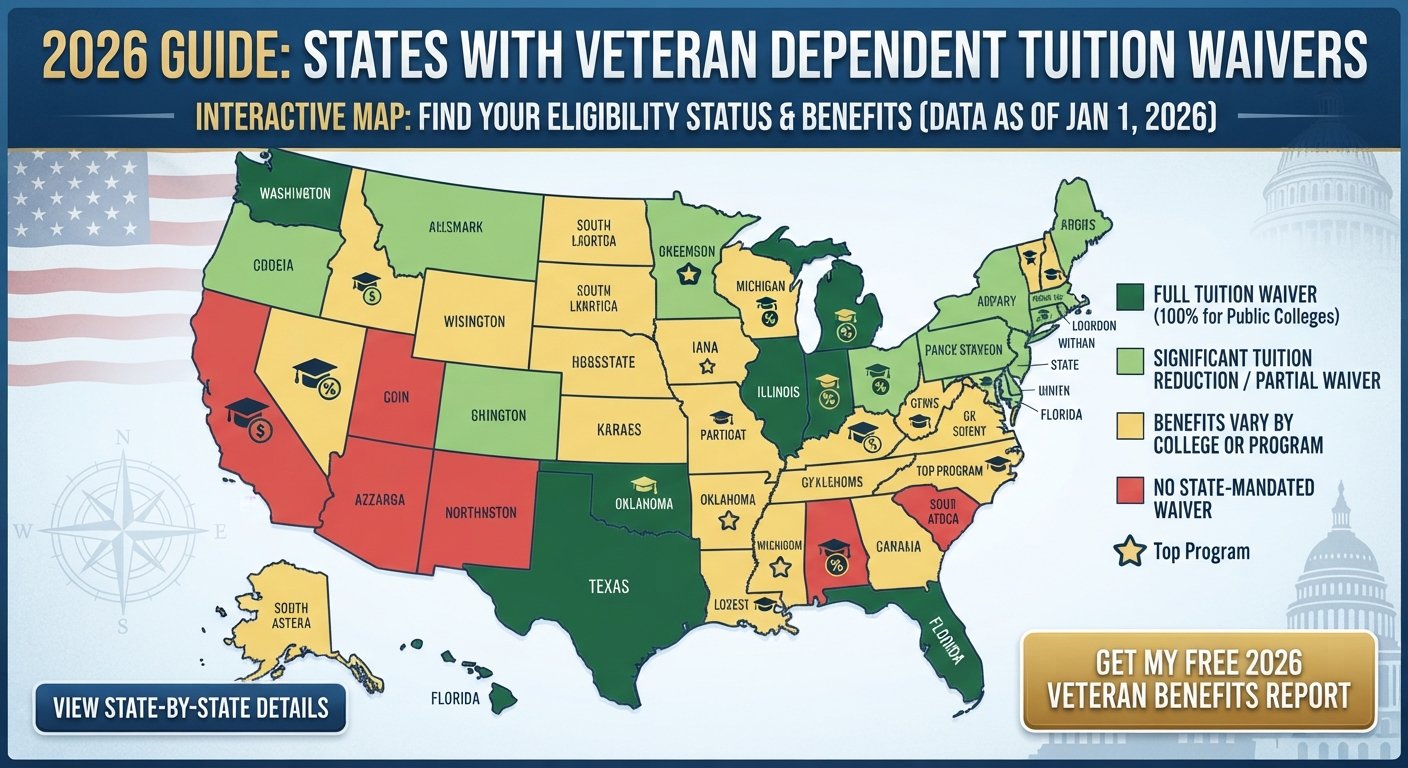
State Veteran Tuition Waiver for Dependents 2026
State veteran tuition waivers allow dependents of disabled, deceased, or POW/MIA veterans to attend public colleges and universities tuition-free. Each state operates its own program with different eligibility rules, benefit amounts, and application processes. In 2026, several states—including Illinois, Colorado, Washington, and Wisconsin—are expanding or modifying their dependent tuition waiver programs. The benefit typically covers undergraduate tuition and mandatory fees at state public institutions, but does not cover room, board, books, or supplies.
Quick Facts
| Item | Details |
|---|---|
| Benefit | Tuition waiver for dependents of eligible veterans |
| Eligibility | Spouse or child of veteran with qualifying disability (varies by state; typically 100% P&T, death, or POW/MIA) |
| Application | Contact your state’s Department of Veterans Affairs or the financial aid office at your institution |
| Processing Time | Varies by state; apply before your institution’s tuition deadline |
| Official Agency | State Department of Veterans Affairs + Higher Education Board |
| Required Forms | VA rating letter, DD-214, proof of relationship, FAFSA or state financial aid application |
| Updated For | 2026 (includes new and expanded programs) |
What Is a State Veteran Dependent Tuition Waiver?
A state veteran dependent tuition waiver is a benefit offered by individual states that exempts eligible dependents from paying tuition and mandatory fees at public colleges and universities within that state . These programs are designed to honor the service of veterans who were killed, became totally disabled, or were listed as POW/MIA.

Key points about these waivers:
State-specific: Each state has its own program with unique eligibility requirements
Tuition only: Generally covers tuition and mandatory fees, but not room, board, books, or supplies
Public institutions only: Typically applies to state public colleges and universities, not private schools
Last-dollar or first-dollar: Some states apply the waiver after other financial aid; others apply it before
How It Differs from Federal Programs

State tuition waivers for dependents are separate and distinct from federal education benefits like:
GI Bill Transferability (Chapter 33): Federal benefit where service members can transfer their GI Bill benefits to dependents
DEA (Chapter 35): Federal Survivors’ and Dependents’ Educational Assistance Program for dependents of 100% P&T veterans
Fry Scholarship: Federal benefit for dependents of service members who died in the line of duty
Veterans and dependents can often combine state waivers with federal benefits, as long as there is no duplication of state-funded tuition assistance .
Which States Offer Tuition Waivers for Dependents?
Most states offer some form of tuition waiver for dependents of veterans. The table below summarizes major state programs.
| State | Program Name | Eligibility | Coverage | 2026 Updates |
|---|---|---|---|---|
| Colorado | SB 26-067 | Dependents of veterans killed in action, died from service, POW/MIA, or TDIU | Full tuition, fees, and charges | New program effective FY 2026-27; impacts 4,451 students annually |
| Illinois | Veterans’ Dependents and Spouses College Tuition Waiver Act | Spouse or dependent of eligible veteran | Tuition and mandatory fees | New legislation effective July 1, 2026 |
| Mississippi | Disabled Veteran and Dependents Patriot Scholarship | 40%+ disability rating; 20-30% may qualify under certain conditions | Tuition, room, and board | Expired provisions for 20-30% ratings expire July 31, 2031 |
| Washington | State Tuition Waivers for Dependents | Spouse/child of veteran with 100% disability, POW/MIA, or death | Up to 250 quarter credits | HB 2324 extends time limits; SB 5954 aligns with DEA eligibility |
| Wisconsin | Wisconsin GI Bill | Eligible veterans and dependents | Up to 128 credits or 8 semesters | SB 587 provides guaranteed funding for fall 2026 |
| Virginia | Veterans Choice Act in-state tuition | Covered individuals under Chapter 33, 35, 30, 1606, or 31 | In-state tuition rate | Federal law, not state-specific |
Colorado’s New Program (SB 26-067)
Colorado passed SB 26-067 in 2026, creating a tuition waiver for dependents of qualified veterans. Eligible veterans include those who were killed in action, died while in active service, are missing in action, are prisoners of war, died as a result of a disability incurred during war, or have a Total Disability Individual Unemployability (TDIU) rating .
Veterans May Qualify for Extra Benefits
Check available financial assistance, healthcare programs and other opportunities that may apply to you.
Check EligibilityKey details:
Estimated 4,451 students eligible annually
Revenue impact of $58.6 million per year to institutions
Valid for six years
Applies to undergraduate students (resident and nonresident)
Passed the Senate Education Committee on February 23, 2026
Illinois’ New Program (HB 4729)
Illinois passed HB 4729, creating the Veterans’ Dependents and Spouses College Tuition Waiver Act, effective July 1, 2026 .
Key details:
Covers tuition and mandatory fees at public institutions
Does not cover room, board, books, supplies, or other nonmandatory expenses
Benefits are applied after federal educational benefits
Administered by the Illinois Student Assistance Commission
Washington’s 2026 Changes
Washington has two major updates for 2026 affecting dependent tuition waivers:
HB 2324: Provides that children of eligible veterans have eight years from the date of the veteran’s disability determination to use the tuition waiver, if the determination occurs after the child turns 18 .
SB 5954: Aligns state waiver eligibility with federal DEA program guidelines. Spouses and children can now use the waiver beyond previous age and time limits if they qualify for DEA benefits .
Wisconsin’s 2026 Update
Wisconsin’s SB 587 converts the Wisconsin GI Bill’s funding from a “sum certain” appropriation to a “sum sufficient” appropriation. This guarantees reimbursement to institutions for tuition remitted under the program. The bill first applies to eligible students enrolled in the fall 2026 semester .
Mississippi’s Program
Mississippi’s Disabled Veteran and Dependents Patriot Scholarship pays tuition, room, and board for dependents of veterans with a 40% or higher VA rating .
Key details:
Veterans rated 40% or higher qualify
Veterans rated 20-30% may qualify if the effective date was on or before July 1, 2025 (expires July 31, 2031)
Up to 5 standard academic years (10 semesters)
Children and stepchildren covered; spouses also eligible
Federal Programs Dependents Should Also Know About
Even if your state doesn’t offer a tuition waiver, dependents of disabled veterans should explore federal benefits:
Survivors’ and Dependents’ Educational Assistance (DEA, Chapter 35)
DEA provides education and training opportunities to eligible dependents of veterans who are permanently and totally disabled due to a service-related condition or who died while on active duty .
Eligibility:
Children of 100% P&T veterans
Spouses of 100% P&T veterans
Key details:
Up to 36 months of education benefits (if started Aug 1, 2018 or after)
No age or time limits if the qualifying event occurred on or after Aug 1, 2023
Fry Scholarship
The Fry Scholarship provides education benefits to children and spouses of service members who died in the line of duty .
Post-9/11 GI Bill Transferability (Chapter 33)
Service members can transfer unused GI Bill benefits to spouses or children. Veterans Choice Act ensures in-state tuition for covered dependents under this program .
How to Apply for State Tuition Waivers
Applying for a state veteran dependent tuition waiver typically involves these steps:
Step 1: Determine Eligibility
Check your state’s requirements. Most programs require:
VA rating letter showing the veteran’s disability percentage
DD-214 showing honorable discharge
Proof of relationship (birth certificate, marriage license)
State residency
Step 2: Submit State Financial Aid Application
Some states require submission of the FAFSA or a state-specific financial aid application before the waiver is applied .
Step 3: Apply Through Your Institution
Most state tuition waivers require enrollment at a public institution. Contact the school’s Veterans Services Office or Financial Aid Office to apply.
Pro tip: The VA’s Veterans Choice Act requires schools to provide in-state tuition to covered individuals using certain education benefits . This can be an additional way for dependents to save, regardless of state-specific waivers.
Step 4: Verify with the Institution’s School Certifying Official (SCO)
Each institution has a School Certifying Official (SCO) who processes veteran education benefits and can guide you through the waiver application .
Step 5: Meet Ongoing Requirements
Most programs require:
Satisfactory Academic Progress (SAP)
Continuous enrollment
Continued state residency
2026 Trends and Important Deadlines
Summary of 2026 Changes
| State | Change | Effective Date |
|---|---|---|
| Illinois | New dependents and spouses tuition waiver | July 1, 2026 |
| Colorado | New dependent tuition waiver (SB 26-067) | FY 2026-27 |
| Washington | Expanded time limits (HB 2324, SB 5954) | 2026 session |
| Wisconsin | Guaranteed funding for Wisconsin GI Bill | Fall 2026 semester |
Don’t Confuse State Waivers with Federal Benefits
Remember:
State tuition waivers are offered by state governments
DEA Chapter 35 is a federal VA benefit
You can often receive both, but state waivers are typically applied after federal benefits
Common Questions
1. What state has the best tuition waiver for dependents of disabled veterans?
The “best” state depends on the veteran’s specific situation. Mississippi’s program covers tuition, room, and board, which is more comprehensive than many states . Wisconsin’s program offers up to 128 credits . Illinois, Colorado, and Washington all enacted significant expansions in 2026 .
2. Can a dependent use a state tuition waiver at any college?
No. State tuition waivers generally apply only to public colleges and universities within that state . Private and out-of-state institutions are not covered.
3. Can my child use the state tuition waiver if I’m 100% P&T?
In many states, yes. The veteran must have a qualifying disability rating (often 100% P&T, but Mississippi requires 40% and Illinois is creating a new program) . Check with your state’s Department of Veterans Affairs.
4. How does the state waiver work with the GI Bill?
The state waiver is typically applied after federal GI Bill benefits have been used. A dependent can often use the GI Bill first (covering tuition and fees) and then use the state waiver to cover remaining costs . The Illinois program explicitly requires benefits to be applied after federal aid .
5. What is the Veterans Choice Act in-state tuition benefit?
The Veterans Choice Act (Section 702) requires public schools to charge in-state tuition to covered individuals using certain VA education benefits, including Chapter 33 (Post-9/11 GI Bill), Chapter 31 (VR&E), and Chapter 35 (DEA) . This is a federal requirement, not a state-specific waiver.
6. What is the DEA (Chapter 35) program?
DEA is a federal VA program that provides education benefits to dependents of veterans who are 100% P&T or died in service . It offers up to 36 months of education benefits, and eligibility rules changed in 2023 to remove age/time limits for those who became eligible after Aug 1, 2023 .
7. Can my spouse use the state tuition waiver too?
In many states, yes. Illinois’ new program explicitly includes spouses . Washington, Wisconsin, and Mississippi also include spouses . Check your state’s specific rules.
8. Do I need to fill out the FAFSA to get a state waiver?
In many states, yes. Colorado’s new program requires the Colorado Application for State Financial Aid (CASFA) or FAFSA . Mississippi also requires completion of the FAFSA . Even if not required, it’s recommended.
9. What does “last-dollar” vs “first-dollar” mean?
A “first-dollar” waiver applies before other financial aid, reducing the initial cost before scholarships. A “last-dollar” waiver applies after other financial aid, covering only what’s left . Colorado’s SB 26-067 assumes a “first-dollar” waiver, but institutions may vary .
10. How long can a dependent use the state tuition waiver?
It varies. Wisconsin offers up to 128 credits or eight semesters . Washington offers up to 250 quarter credits . Colorado’s new program is valid for six years . Mississippi offers up to five academic years .
11. What documents do I need to apply?
Generally, you need: the veteran’s VA rating letter, DD-214, proof of relationship (birth certificate, marriage license), proof of state residency, and a completed state or federal financial aid application .
Key Takeaways
Most states offer tuition waivers for dependents of disabled, deceased, or POW/MIA veterans .
2026 brings major expansions: Illinois and Colorado have new programs effective in 2026; Washington and Wisconsin have expanded their existing programs .
The waiver is for tuition and mandatory fees only—it generally does not cover room, board, books, or supplies .
Benefits are applied after federal aid in states like Illinois and Wisconsin . Dependents can often use the GI Bill and state waiver together .
DEA Chapter 35 is a separate federal benefit that can provide substantial monthly payments to dependents of 100% P&T veterans .
The Veterans Choice Act requires public schools to provide in-state tuition to veterans and dependents using covered VA education benefits .
Apply through your institution’s Veterans Services Office or Financial Aid Office. Deadlines are usually tied to the school’s tuition payment deadline .
Documents needed: VA rating letter, DD-214, proof of relationship, and proof of state residency .
Official Resources
VA.gov – Access VA benefits and rating letters: https://www.va.gov
Veterans Choice Act (Section 702) – In-state tuition for covered individuals: https://www.va.gov/education
DEA Chapter 35 – https://www.va.gov/education/survivor-dependent-benefits
State Departments of Veterans Affairs – NASDVA directory: https://www.nasdva.us

🇺🇸 IMPORTANT DISCLAIMER – Veterans Benefits Information
This site provides general information about U.S. Department of Veterans Affairs (VA) benefits for educational and informational purposes only.
- Not Official: We are NOT affiliated with, endorsed by, or connected to the U.S. Department of Veterans Affairs (VA), the Veterans Benefits Administration (VBA), the Veterans Health Administration (VHA), or any other government agency.
- No Legal/Financial Advice: The content on this website is for informational purposes only and does not constitute legal, financial, or medical advice. VA benefits rules change frequently – always consult with an accredited Veterans Service Officer (VSO) or a qualified professional for your specific situation.
- Official Sources: For official, binding information and to apply for benefits, always visit official .gov websites: VA.gov, Benefits.VA.gov, or SSA.gov.
- No Data Collection: This site does not collect, store, or process any personal information. It does not have login forms, contact forms, or any system to capture user data. We never ask for your Social Security Number, bank details, or any personal information.
- 🚨 Scam Alert: The VA and other government agencies never charge fees for benefit applications. If anyone asks for money to "process" your VA claim, it is a scam. Report it to the VA Office of Inspector General at VA.gov/OIG.
- Advertising: This site uses third-party advertising (Adsterra) to cover operational costs. We do not endorse or guarantee any products or services advertised.
📌 Information provided as of June 2026. Always verify current eligibility and rules with official .gov sources.
This site is not affiliated with the U.S. Department of Veterans Affairs or any government agency. All information is for educational purposes only. Please visit VA.gov for official information.
