
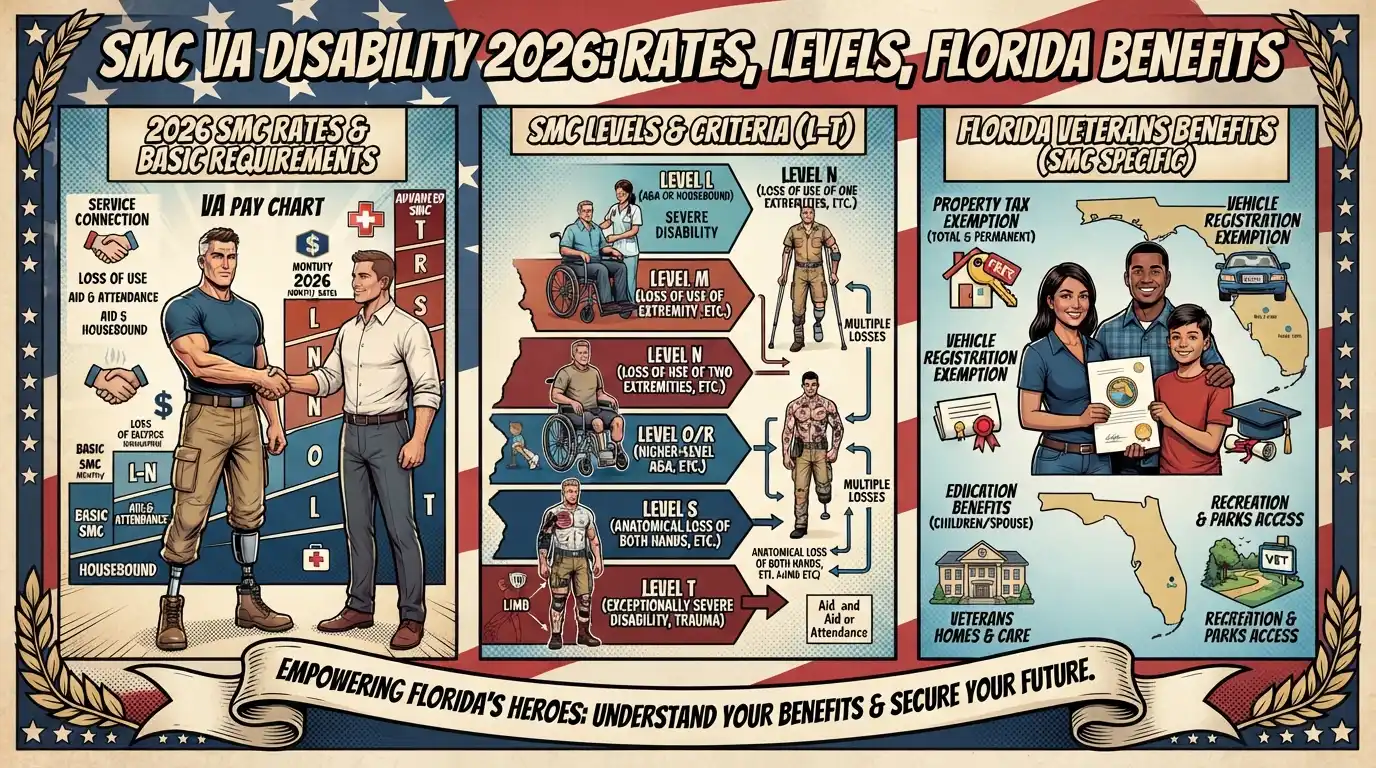
SMC VA Disability: 2026 Rates, Levels, and Florida Benefits
Special monthly compensation (SMC) is extra monthly VA compensation for veterans with severe service-connected disabilities, such as the need for aid and attendance or being housebound. In 2026, SMC-K pays $139.87, SMC-L pays $4,900.83, and SMC-S pays $4,408.53 a month for a veteran alone. SMC is paid on top of basic compensation at some levels and replaces it at others.
Last updated: November 2026

VA Disability Combined Rating Calculator
Add each disability rating from your decision letter.

Estimate only. The VA makes the official rating decision. Not legal or financial advice, and not affiliated with the Department of Veterans Affairs.
Benefits, rates, and contact details can change. Confirm current information with the official sources linked in this article.
Quick Facts
| Item | Details |
|---|---|
| Benefit | Higher monthly VA compensation for veterans with certain severe disabilities, need for aid and attendance, or housebound status |
| Who Qualifies | Veterans with qualifying losses, need for regular aid and attendance, housebound status, or other severe service-connected conditions |
| How to Apply | File or update a claim with VA Form 21-526EZ; SMC is often considered during a compensation claim or review |
| Processing Time | Varies; SMC is usually decided with the underlying claim or when new medical evidence is submitted |
| Official Agency | U.S. Department of Veterans Affairs, Veterans Benefits Administration |
| Required Forms | VA Form 21-526EZ; medical evidence and, when relevant, a VA examination |
| Updated For | 2026 rates effective December 1, 2025 |
What is SMC VA disability?
SMC VA disability is a higher rate of compensation paid under 38 U.S.C. 1114 for veterans whose service-connected disabilities cause specific severe losses or needs. It is not a separate disability rating. It is an additional or enhanced payment layered on top of the basic rating system.
SMC exists because the standard 0% to 100% rating table does not fully capture conditions like the loss of a limb, blindness, the need for daily help with bathing or dressing, or being confined to home. Congress created separate SMC levels to pay more in those situations. The rules are in 38 CFR 3.350.
SMC rates are adjusted each December with the same cost-of-living adjustment that applies to Social Security and basic VA compensation. The 2026 rates reflect a 2.8% increase that took effect December 1, 2025.
2026 SMC rates for a veteran alone
Army Fitness Test (AFT) Score Calculator
Formerly the ACFT. Five events, 500 points. Enter your results.
Estimate for training only. Points are interpolated from the official Army tables (effective 1 June 2025) and can differ by a few points. Your score of record comes from your unit graders. Official score tables (PDF). Not affiliated with the U.S. Army.
For a veteran with no dependents, 2026 SMC rates range from $139.87 a month at SMC-K to $11,271.67 at the highest levels. The most commonly awarded levels are SMC-K, SMC-L, SMC-L½, SMC-M, and SMC-S.
| SMC level | What it generally covers | 2026 monthly rate (veteran alone) |
|---|---|---|
| SMC-K | Loss or loss of use of a creative organ, or certain other specific losses | $139.87 |
| SMC-L | Need for regular aid and attendance, or certain anatomical losses | $4,900.83 |
| SMC-L½ | Intermediate level between L and M | $5,154.00 |
| SMC-M | Higher aid and attendance needs | $5,408.55 |
| SMC-N | Higher intermediate level | $5,780.00 |
| SMC-N½ | Higher intermediate level | $6,152.64 |
| SMC-O | Higher level | $6,514.00 |
| SMC-R.1 | Special aid and attendance rate | $9,826.88 |
| SMC-R.2 | Special aid and attendance rate | $11,271.67 |
| SMC-S | Housebound due to service-connected disabilities | $4,408.53 |
These figures are for a veteran with no dependents. Rates increase with a spouse, dependent parents, or children. SMC-K can be added to the basic compensation rate, and more than one SMC-K award may apply in some cases. SMC-L and higher generally replace the basic 100% rate with a higher amount, while SMC-S may be paid in addition to the basic rate when the veteran is rated 100% and housebound.
These amounts can change each December; confirm the current table on the VA.gov SMC rates page before relying on a figure.
SMC levels explained
Each SMC level has its own criteria. The letter designations come from the statute and the rating regulations. Not every veteran qualifies for every level, and the evidence needed varies by level.
SMC-K
SMC-K is the most common SMC level. It pays an added amount for the loss or loss of use of a creative organ, or for certain other specific losses such as the loss of a breast. It can be combined with the basic disability rating. In 2026, SMC-K pays $139.87 a month. A veteran can receive more than one SMC-K award in some situations, such as loss of use of multiple creative organs.
SMC-L and SMC-L½
SMC-L is the aid and attendance level. It applies when a veteran needs regular help from another person for basic daily activities such as bathing, dressing, eating, or adjusting prosthetic devices. It also applies to certain severe anatomical losses, such as the loss of both feet or blindness in both eyes with light perception only. SMC-L½ is an intermediate rate between L and M. In 2026, SMC-L pays $4,900.83 and SMC-L½ pays $5,154.00.
SMC-M, N, N½, and O
These levels pay progressively more for veterans who need more extensive aid and attendance or who have combinations of severe losses. SMC-M pays $5,408.55, SMC-N pays $5,780.00, SMC-N½ pays $6,152.64, and SMC-O pays $6,514.00 in 2026. The higher levels usually require a combination of severe disabilities or a need for help that goes beyond basic daily activities.
SMC-R
SMC-R is a special aid and attendance rate available to veterans already receiving the maximum compensation rate under the SMC schedule. It pays $9,826.88 at R.1 and $11,271.67 at R.2 in 2026. SMC-R is rare and generally requires a very high level of need, often including in-home personal health care services.
SMC-S
SMC-S is the housebound rate. It applies when a veteran has a service-connected disability rated 100% and is substantially confined to home because of that disability, or when the veteran has separate service-connected disabilities with one rated 100% and others combined at 60% or more. In 2026, SMC-S pays $4,408.53 a month for a veteran alone. SMC-S is often paid on top of the basic 100% rate rather than replacing it.
Who qualifies for SMC?
A veteran qualifies for SMC by meeting the specific criteria for one of the levels, not by having a particular overall rating percentage. The most common pathways are the need for aid and attendance, housebound status, and the loss or loss of use of a limb or function.
| SMC basis | What generally must be shown |
|---|---|
| Aid and attendance | Need for regular help from another person with basic daily activities, or being permanently bedridden or so helpless as to need that help |
| Housebound | Service-connected disability rated 100% and substantially confined to home, or one 100% disability plus others combined at 60% or more |
| Loss or loss of use | Anatomical loss or loss of use of a limb, creative organ, or function such as vision or hearing, at the level specified for the SMC tier |
| Severe combinations | Combinations of severe disabilities that meet the higher SMC levels |
Aid and attendance
The aid and attendance basis for SMC applies when a veteran needs regular help from another person for everyday activities. Examples include needing help with bathing, dressing, eating, using the toilet, or adjusting prosthetic devices. A veteran who is permanently bedridden or so helpless that they need another person’s care may also qualify.
The need must be caused by service-connected disabilities. A VA examination or a private medical opinion can document the need. The statement should describe specific tasks the veteran cannot perform without help and why.
Housebound status
Housebound status under SMC-S applies when a veteran is substantially confined to home because of service-connected disabilities. The veteran must generally have a service-connected disability rated 100%. SMC-S can also apply when the veteran has one disability rated 100% and separate disabilities with a combined rating of 60% or more.
Being homebound does not require being bedridden. It means the veteran cannot leave home without help or would have to remain home for the rest of their life because of the service-connected condition.
Loss or loss of use
SMC is available for the anatomical loss or loss of use of certain body parts and functions. Examples include the loss of a hand or foot, the loss of use of a hand or foot, blindness in both eyes, and the loss of a creative organ. The SMC level depends on the specific loss and whether it is combined with other severe disabilities.
How to apply for SMC
SMC is not applied for with a separate form. You request it by filing or updating a VA disability compensation claim and submitting medical evidence that shows you meet the criteria. VA may also consider SMC during a routine review of your rating.
File VA Form 21-526EZ for a new claim, or a supplemental claim if you are adding new evidence to an existing condition. You can file online at VA.gov disability compensation, by mail, or with an accredited representative.
Submit medical evidence that describes the need for aid and attendance, housebound status, or the qualifying loss. Private medical opinions and lay statements can help.
Attend any VA examination that is scheduled. VA may ask a examiner to address the SMC criteria.
Review the decision letter carefully. It should state which SMC level was granted and the effective date.
If you already have a 100% rating and your condition has worsened, you can file for an increase and ask VA to consider SMC at the same time. The effective date for SMC is generally the date VA received the claim or the date the evidence showed entitlement, whichever is later.
SMC with dependents
SMC rates increase when a veteran has a spouse, dependent parents, or children. The added amounts are separate from the basic dependent additions under the standard compensation table. The VA.gov SMC tables show the dependent columns for each level.
For example, at SMC-L, a veteran with a spouse receives $5,120.42 a month in 2026, compared with $4,900.83 for a veteran alone. At SMC-S, a veteran with a spouse receives $4,628.12, compared with $4,408.53 for a veteran alone. Veterans with multiple dependents should use the full table rather than estimating.
These dependent amounts can change each December, so confirm them on the official VA page.
Florida benefits for SMC recipients
Florida does not tax VA disability compensation, and the state has no personal income tax. SMC is part of VA disability compensation, so it is not reduced by state income tax. The federal government also does not tax VA disability compensation, including SMC, for most veterans.
Florida offers property tax relief for disabled veterans, and SMC recipients may qualify for one or both of the main programs. The two programs are a $5,000 exemption for veterans rated 10% or higher and a full homestead exemption for veterans with a service-connected total and permanent disability.
| Florida program | Who qualifies | Benefit | Statute |
|---|---|---|---|
| $5,000 disabled veteran exemption | Veteran rated 10% or higher, honorably discharged, Florida resident | $5,000 off the assessed value of property owned by the veteran | Florida Statute 196.24 |
| Full homestead exemption | Veteran with a service-connected total and permanent disability certified by VA, Florida permanent resident on January 1 | Entire homestead exempt from property tax | Florida Statute 196.081 |
An SMC award does not automatically mean a veteran has a total and permanent disability for Florida tax purposes. The full homestead exemption requires a VA letter certifying total and permanent disability. A veteran receiving SMC-S or SMC-L may or may not have that certification. Veterans who are rated 100% permanent and total, or who receive Individual Unemployability, may qualify for the full exemption if the VA letter states total and permanent disability.
The $5,000 exemption is available to any veteran rated 10% or higher, which includes most SMC recipients. File the application with the county property appraiser by March 1 of the tax year. For the 2027 tax year, the deadline is March 1, 2027. Confirm current rules with your county property appraiser or the Florida Department of Veterans’ Affairs. For a wider comparison, see this veterans benefits by state guide.
Common mistakes with SMC claims
Assuming SMC is automatic at 100%. A 100% rating does not automatically qualify a veteran for SMC. SMC requires meeting the specific criteria for a level, such as aid and attendance, housebound status, or a qualifying loss.
Failing to describe the need for help in specific terms. A medical statement that says “needs help” is weaker than one that describes exactly which daily tasks the veteran cannot perform without another person.
Overlooking SMC-S when housebound. Veterans who are confined to home because of service-connected disabilities may qualify for SMC-S even if they already receive the 100% rate. SMC-S is often paid in addition to the basic rate.
Missing the effective date rules. SMC back pay depends on the date VA received the claim or the date the evidence showed entitlement. Filing promptly and keeping medical records current can protect the effective date.
Assuming an SMC award qualifies for Florida’s full homestead exemption. Florida’s full exemption requires a VA letter certifying total and permanent disability. An SMC award alone is not the same certification.
Common Questions
What is SMC VA disability?
SMC stands for special monthly compensation. It is a higher rate of VA compensation paid to veterans with certain severe service-connected disabilities, such as the need for aid and attendance, housebound status, or the loss or loss of use of a limb or function.
How much does SMC pay in 2026?
In 2026, SMC-K pays $139.87, SMC-L pays $4,900.83, SMC-L½ pays $5,154.00, SMC-M pays $5,408.55, and SMC-S pays $4,408.53 a month for a veteran alone. The highest SMC levels pay up to $11,271.67. Rates rise with dependents and change each December.
What is the difference between SMC-L and SMC-S?
SMC-L is the aid and attendance level, paid when a veteran needs regular help from another person with daily activities. SMC-S is the housebound level, paid when a veteran is substantially confined to home because of service-connected disabilities or meets the 100% plus 60% combination rule.
Can I get SMC and a 100% rating at the same time?
Yes, in many cases. SMC-S is often paid on top of the basic 100% rate when the housebound criteria are met. SMC-L and higher levels generally replace the basic 100% rate with a higher amount. SMC-K can be added to the basic rate.
Is SMC automatic if I have a 100% VA rating?
No. A 100% rating does not automatically qualify a veteran for SMC. SMC requires meeting the specific criteria for a level, such as the need for aid and attendance, housebound status, or a qualifying anatomical loss.
How do I apply for SMC?
File or update a VA disability compensation claim with VA Form 21-526EZ and submit medical evidence that shows you meet the criteria. VA may also consider SMC during a review of your rating. There is no separate SMC application form.
What is aid and attendance for SMC?
Aid and attendance is a basis for SMC-L and higher levels. It applies when a veteran needs regular help from another person for basic daily activities such as bathing, dressing, eating, or adjusting prosthetic devices because of service-connected disabilities.
What does housebound mean for SMC?
Housebound means the veteran is substantially confined to home because of service-connected disabilities. For SMC-S, the veteran must generally have a 100% rating, or one 100% disability plus others combined at 60% or more.
Does SMC count as income for Florida taxes?
Florida has no state personal income tax, so SMC is not taxed by the state. The federal government also does not tax VA disability compensation, including SMC, for most veterans.
Does SMC qualify for Florida’s full homestead exemption?
Not automatically. Florida’s full homestead exemption under Statute 196.081 requires a VA letter certifying a service-connected total and permanent disability. An SMC award alone is not the same certification. Most SMC recipients qualify for the $5,000 exemption under Statute 196.24 if rated 10% or higher.
Can SMC be increased if my condition gets worse?
Yes. If your need for aid and attendance increases or you meet the criteria for a higher SMC level, you can file for an increase. Submit updated medical evidence describing the change and, if possible, a medical opinion addressing the higher-level criteria.
Does SMC affect my VA health care or other benefits?
SMC is part of VA disability compensation. It does not reduce VA health care eligibility and may increase certain other benefits that are tied to compensation rates. It does not replace Medicare or CHAMPVA.
Key Takeaways
SMC is extra monthly VA compensation for veterans with certain severe service-connected disabilities.
In 2026, SMC-K pays $139.87, SMC-L pays $4,900.83, and SMC-S pays $4,408.53 a month for a veteran alone.
The highest SMC levels pay up to $11,271.67 a month in 2026.
SMC is not automatic at 100%; each level has its own criteria, such as aid and attendance, housebound status, or a qualifying loss.
SMC-K can be added to basic compensation, while SMC-L and higher generally replace the basic 100% rate.
SMC-S is often paid in addition to the basic 100% rate.
Florida does not tax SMC and offers a $5,000 property tax exemption to veterans rated 10% or higher.
Florida’s full homestead exemption requires a VA letter certifying total and permanent disability, which an SMC award alone does not establish.
File or update a claim with VA Form 21-526EZ and submit medical evidence that addresses the specific SMC criteria.
Official Resources
VA special monthly compensation rates — Check the full 2026 SMC tables, including dependent amounts.
VA disability compensation — Learn how compensation works and file a claim with VA Form 21-526EZ.
38 CFR 3.350 — Read the regulation that defines SMC eligibility.
VA decision reviews and appeals — Choose a Supplemental Claim, Higher-Level Review, or Board Appeal if you disagree with an SMC decision.
Florida Statute 196.081 — Read the full homestead exemption for veterans with a service-connected total and permanent disability.
Florida Statute 196.24 — Read the $5,000 exemption for veterans rated 10% or higher.
Florida Department of Veterans’ Affairs — Find free benefits counseling and county veterans service offices.
Florida Department of Revenue — Find property tax exemption guidance and forms.
🇺🇸 IMPORTANT DISCLAIMER – Veterans Benefits Information
This site provides general information about U.S. Department of Veterans Affairs (VA) benefits for educational and informational purposes only.
- Not Official: We are NOT affiliated with, endorsed by, or connected to the U.S. Department of Veterans Affairs (VA), the Veterans Benefits Administration (VBA), the Veterans Health Administration (VHA), or any other government agency.
- No Legal/Financial Advice: The content on this website is for informational purposes only and does not constitute legal, financial, or medical advice. VA benefits rules change frequently – always consult with an accredited Veterans Service Officer (VSO) or a qualified professional for your specific situation.
- Official Sources: For official, binding information and to apply for benefits, always visit official .gov websites: VA.gov, Benefits.VA.gov, or SSA.gov.
- No Data Collection: This site does not collect, store, or process any personal information. It does not have login forms, contact forms, or any system to capture user data. We never ask for your Social Security Number, bank details, or any personal information.
- 🚨 Scam Alert: The VA and other government agencies never charge fees for benefit applications. If anyone asks for money to "process" your VA claim, it is a scam. Report it to the VA Office of Inspector General at VA.gov/OIG.
- Advertising: This site uses third-party advertising (Adsterra) to cover operational costs. We do not endorse or guarantee any products or services advertised.
📌 Information provided as of June 2026. Always verify current eligibility and rules with official .gov sources.
This site is not affiliated with the U.S. Department of Veterans Affairs or any government agency. All information is for educational purposes only. Please visit VA.gov for official information.
VA Disability Pay Calculator
This calculator is for information only. Your exact award is set by VA and shown in your VA.gov account and decision letter. VA disability compensation is tax-free.