
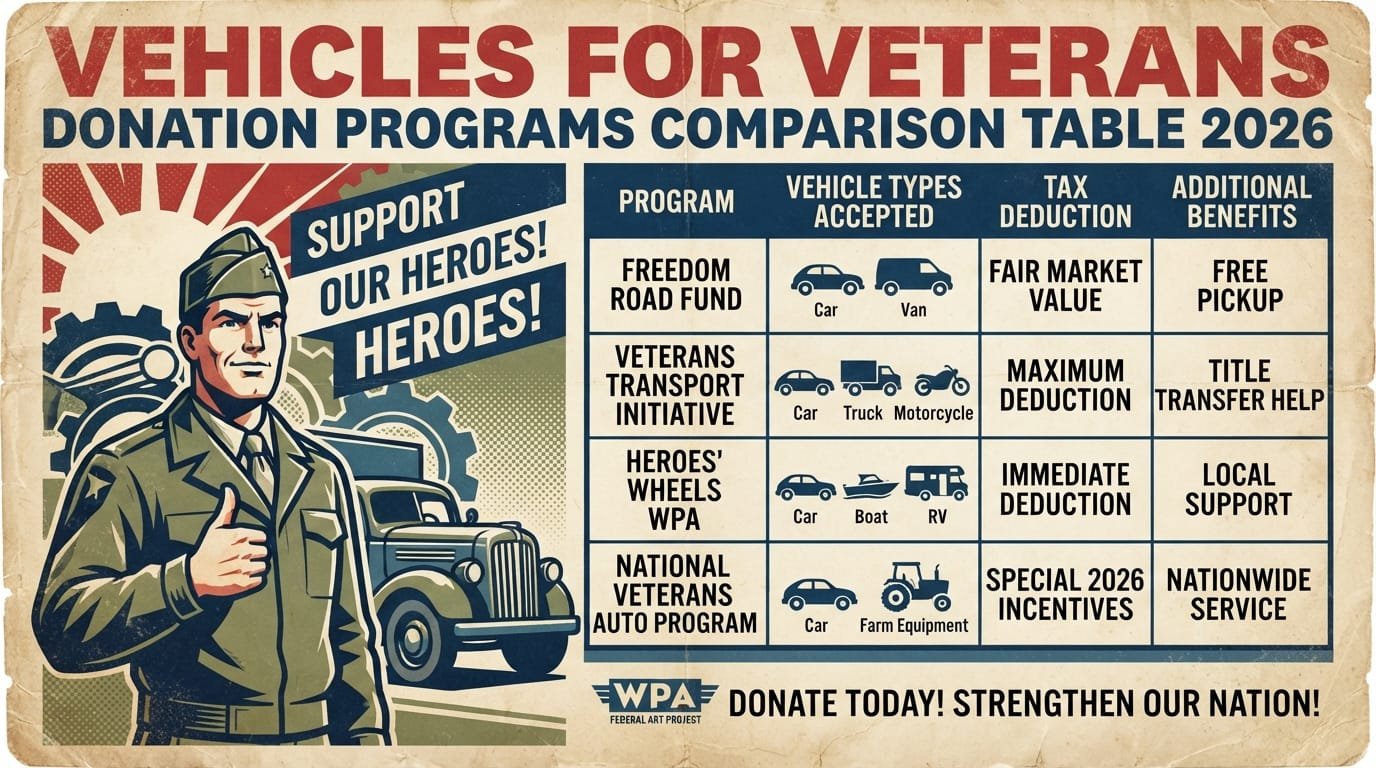
Vehicles for Veterans: Donation Programs Near You
Vehicle donation programs for veterans accept cars, trucks, boats, motorcycles, and RVs—running or not—with free towing. Major programs include DAV, VFW, Vehicles For Veterans, and Purple Heart Foundation. Donations are tax-deductible if you itemize, with deductions based on the vehicle’s sale price (IRS Form 1098-C).
Quick Facts
| Item | Details |
|---|---|
| Benefit | Free towing; potential tax deduction; support for veterans programs |
| Eligibility | Anyone with a vehicle to donate; no military service required |
| Application | Online form or toll-free phone call; schedule pickup |
| Processing Time | Pickup typically within 72 hours to 1 week |
| Official Agency | IRS (tax rules); individual 501(c)(3) nonprofits (programs) |
| Required Documents | Vehicle title (clear or salvage); photo ID |
| Updated For | 2026 IRS tax year |
How Vehicle Donation Programs Work
Direct Answer: Vehicle donation programs accept unwanted vehicles, sell them at auction or for scrap, and use the proceeds to fund veterans’ services. The process is free for donors—pickup, towing, and paperwork are handled by the charity or its agent.

What You Can Donate
Most veterans’ vehicle donation programs accept a wide range of vehicles:
Cars and trucks (running or not)
SUVs and vans
Motorcycles
RVs and campers
Boats and watercraft
ATVs and jet skis
Fleet vehicles

Even vehicles with mechanical problems, body damage, high mileage, expired registration, or salvage titles are typically accepted. The VFW Foundation explicitly states it accepts vehicles “in any condition”. Cars for Veterans accepts “salvage or rebuilt title vehicles” and “high-mileage vehicles over 200,000 miles”.
The Donation Process: Step by Step
Contact the charity — Call the toll-free number or fill out the online donation form.
Provide vehicle information — Make, model, year, condition, and location.
Schedule free pickup — The charity or its agent arranges towing at no cost to you.
Sign over the title — You transfer ownership to the charity or its authorized agent.
Receive a tax receipt — You receive IRS Form 1098-C or a written acknowledgment.
Vehicle is sold — The charity sells the vehicle at auction, to a dealer, or for scrap.
Proceeds fund veterans programs — Net proceeds support housing, health care, employment, and other services.
Why It Matters for Veterans
Vehicle donation proceeds fund a wide range of veterans services:
Housing assistance — Adaptive homes for severely wounded veterans (Homes For Our Troops, Gary Sinise Foundation)
Health care — Treatment centers for TBI and PTSD (Intrepid Fallen Heroes Fund)
Employment programs — Job training and career services
Transportation — Rides to VA medical appointments
Emergency relief — Financial assistance for veterans in crisis
Family support — Services for military families and caregivers
What veterans should do next: If you have an unused vehicle, contact one of the programs below to schedule a free pickup. Your donation supports veterans services in your community and nationally.
Major Veterans Vehicle Donation Programs
Direct Answer: The largest and most established veterans vehicle donation programs are DAV, VFW, Vehicles For Veterans, Purple Heart Foundation, Vietnam Veterans of America, and Paralyzed Veterans of America. All are 501(c)(3) nonprofits and offer free towing.
Comparison Table: Top Veterans Vehicle Donation Programs
| Program | Phone | Online | Types Accepted | Tax Receipt | Charity Rating |
|---|---|---|---|---|---|
| DAV | 833-227-4328 | dav.careasy.org | Cars, trucks, RVs, boats, motorcycles | Yes (1098-C) | High |
| VFW Foundation | 844-839-4438 | vfw.careasy.org | Cars, trucks, motorcycles, RVs, boats, ATVs | Yes (1098-C) | High |
| Vehicles For Veterans | 855-811-4838 | vehiclesforveterans.org | Cars, trucks, boats, motorcycles | Yes (1098-C) | Good |
| Purple Heart Foundation | 888-414-4483 | purpleheartcars.org | Cars, SUVs, RVs, motorcycles, ATVs, jet skis | Yes (1098-C) | High |
| Vietnam Veterans of America | 800-435-7838 | vietnamveteranscardonation.org | Cars, trucks, boats, motorcycles | Yes (1098-C) | Good |
| Paralyzed Veterans of America | 877-900-8387 | pva.careasy.org | Cars, trucks, boats, RVs, motorcycles | Yes (1098-C) | High |
Veterans May Qualify for Extra Benefits
Check available financial assistance, healthcare programs and other opportunities that may apply to you.
Check EligibilitySources: DAV, VFW, Vehicles For Veterans, Purple Heart Foundation, VVA, PVA
DAV Vehicle Donation Program
What it is: The Disabled American Veterans (DAV) vehicle donation program raises funds for DAV’s mission of service to veterans of all generations.
Who qualifies: Anyone with a vehicle to donate. DAV accepts cars, trucks, RVs, boats, and motorcycles.
Why it matters: DAV departments receive 25% of all net proceeds generated from the sale or salvage of vehicles donated in their state. The program supports benefits claims assistance, career fairs, transportation to VA appointments, emergency relief, and advocacy on Capitol Hill.
What to do next: Call 833-CAR-4DAV (833-227-4328) or visit dav.careasy.org to schedule a free pickup.
VFW Foundation Vehicle Donation Program
What it is: The VFW Foundation, the official 501(c)(3) charity of the Veterans of Foreign Wars, operates a vehicle donation program through a partnership with Charitable Adult Rides and Services (CARS).
Who qualifies: Anyone can donate. The program accepts cars, trucks, motorcycles, RVs, boats, and ATVs—in any condition.
Why it matters: More than 250 vehicles are collected each year, generating approximately $242,000 in revenue for services that provide urgent assistance to veterans, active-duty service members, and their families.
What to do next: Call 1-844-839-4438 or visit vfw.careasy.org.
Vehicles For Veterans
What it is: Vehicles For Veterans is a program of the Car Donation Foundation, a 501(c)(3) nonprofit that has surpassed $200 million in lifetime vehicle donations.
Who qualifies: Anyone can donate cars, trucks, boats, and motorcycles.
Why it matters: Proceeds support a national network of veteran-focused charities, including Fisher House Foundation, Homes For Our Troops, Team Red, White & Blue, Warrior Bonfire Program, the USO, FourBlock, Operation Homefront, and Student Veterans of America.
What to do next: Call 1-855-811-4838 or visit vehiclesforveterans.org.
Purple Heart Foundation
What it is: The Purple Heart Foundation’s vehicle donation program supports combat-wounded and struggling veterans through job training, scholarships, and healthcare programs.
Who qualifies: Anyone can donate cars, SUVs, airplanes, ATVs, jet skis, RVs, and motorcycles.
Why it matters: Vehicle donations fund essential services for veterans transitioning back into civilian life.
What to do next: Call 888-414-4483 or visit purpleheartcars.org.
Vietnam Veterans of America (VVA)
What it is: VVA’s vehicle donation program provides critical support services for veterans in their time of need.
Who qualifies: Anyone can donate cars, trucks, boats, or motorcycles.
Why it matters: Proceeds support VVA’s programs addressing the concerns and needs of all veterans.
What to do next: Call 1-800-Help-Vets (435-7838) or visit vietnamveteranscardonation.org.
Paralyzed Veterans of America (PVA)
What it is: PVA’s “Wheels Helping Warriors” vehicle donation program raises funds for veterans with spinal cord injuries and diseases.
Who qualifies: Anyone can donate cars, trucks, trailers, boats, RVs, motorcycles, campers, off-road vehicles, and planes—running or not.
Why it matters: PVA provides free employment counseling, benefits assistance, advocacy, adaptive sports, and recreation programs.
What to do next: Call 877-900-VETS (877-900-8387) or visit pva.careasy.org.
Vehicle Donation Tax Deduction Rules for 2026
Direct Answer: Your vehicle donation is tax-deductible if you itemize deductions on your federal tax return. The deduction amount depends on how the charity uses or sells the vehicle. For vehicles sold for more than $500, your deduction is limited to the actual sale price.
How the Deduction Works
| Vehicle Sale Price | Your Deduction |
|---|---|
| $500 or less | Fair market value up to $500 |
| More than $500 | Actual sale price (listed on Form 1098-C) |
| More than $5,000 | Sale price, with qualified appraisal required in some cases |
Source: IRS Form 1098-C Instructions
IRS Form 1098-C
The charity must provide you with IRS Form 1098-C, Contributions of Motor Vehicles, Boats, and Airplanes, for any vehicle donation with a claimed value of more than $500. This form reports:
Your name and taxpayer identification number
The date of contribution
The gross proceeds from the sale
A statement of whether the vehicle was sold or used by the charity
You must attach Form 1098-C to your tax return if your deduction exceeds $500.
Important Tax Rules
You must itemize — Vehicle donations only reduce your tax bill if your total itemized deductions exceed the standard deduction.
The charity must be a 501(c)(3) — Donations to non-qualified organizations are not tax-deductible.
You need a contemporaneous written acknowledgment — The charity must provide this by January 31 of the year following your donation.
Fair market value applies only in limited cases — If the charity uses the vehicle for its exempt purpose or makes material improvements before sale, you may claim FMV.
What Veterans Should Do Next
Keep your Form 1098-C with your tax records. If you donate a vehicle worth more than $5,000, consult a tax professional about appraisal requirements. Claim your deduction on Schedule A of Form 1040.
State-Specific Rules for Vehicle Donation
Direct Answer: Vehicle donation rules vary by state, primarily regarding title transfer, liability release, and tax treatment. Most states require a clear title, but some accept salvage titles. You must notify your state DMV after donating.
Title Transfer Requirements
| State | Title Requirement | Notes |
|---|---|---|
| California | Clear or salvage title | Notify CA DMV to release liability after donation |
| Texas | Clear title preferred | Charity handles title transfer |
| Florida | Clear title | Notarized signature may be required |
| New York | Clear title | Charity provides title transfer forms |
| Maryland | Clear title | Follow MVA guidelines for donation |
| Most states | Clear title | Some accept salvage or rebuilt titles |
Source: State DMV guidelines, 2026
How to Release Liability
After donating your vehicle:
Sign the title over to the charity or its authorized agent.
Remove your license plates if required by your state.
Notify your state DMV — Many states require a release of liability form.
Cancel your insurance — Once the vehicle is no longer yours.
Keep a copy of all documents — Including the title transfer and donation receipt.
The charity typically handles the title transfer and paperwork. However, you should still notify your DMV to protect yourself from liability for tickets or accidents after the donation.
State Tax Treatment
Most states follow federal rules for charitable deductions. Some states offer additional incentives:
California: State deduction follows federal rules.
Texas: No state income tax, so no state deduction available.
New York: State deduction follows federal rules.
Florida: No state income tax.
What to do next: Contact your state DMV for specific title transfer and liability release requirements. The charity’s donor support team can also guide you through the process.
How to Avoid Vehicle Donation Scams
Direct Answer: Vehicle donation scams use robocalls, fake charity names, and false promises of tax deductions to collect vehicles for personal profit. The FTC has prosecuted operators who claimed to help veterans but pocketed the proceeds.
Warning Signs of a Scam
High-pressure robocalls — Legitimate charities do not use illegal robocalls.
Vague charity names — Names like “Veterans of America” that mimic real organizations.
No 501(c)(3) status — The organization cannot provide proof of tax-exempt status.
Requests for cash or wire transfers — Legitimate charities do not ask for cash.
No written acknowledgment — You should receive IRS Form 1098-C or a written receipt.
Pressure to donate immediately — Legitimate charities give you time to decide.
The FTC’s Case Against a Fake Veterans Charity
The FTC sued Travis Peterson and his entity, “Veterans of America,” for operating a fraudulent charity scheme. According to the complaint:
Peterson used millions of illegal robocalls to solicit vehicle donations
He falsely claimed donations were tax-deductible
He sold donated vehicles and used proceeds for personal benefit
His entities were not recognized as 501(c)(3) charities
How to Verify a Charity
Check IRS Tax Exempt Organization Search — Confirm the charity has 501(c)(3) status.
Check Charity Navigator or CharityWatch — These watchdogs rate charities on financial health and transparency.
Check your state’s charity registration — 39 states and D.C. require charities to register.
Call the charity directly — Use a number from the charity’s official website, not a robocall.
Ask how proceeds are used — Legitimate charities can explain their programs.
What Veterans and Donors Should Do Next
Before donating, verify the charity on the IRS Tax Exempt Organization Search at apps.irs.gov/app/eos. Check ratings on Charity Navigator and CharityWatch. If you receive a suspicious robocall, report it to the FTC at ReportFraud.ftc.gov.
Common Questions
1. Can I donate a car that doesn’t run?
Yes. Most veterans vehicle donation programs accept vehicles in any condition—running or not. DAV, VFW, Vehicles For Veterans, and Cars for Veterans all accept non-running vehicles, junk cars, and vehicles with mechanical problems. Free towing is included.
2. How much can I deduct for donating my car to a veterans charity?
If your vehicle sells for $500 or less, you can deduct up to $500. If it sells for more than $500, your deduction is limited to the actual sale price listed on IRS Form 1098-C. You must itemize deductions to claim the deduction.
3. Is my vehicle donation tax-deductible?
Yes, if you donate to a qualified 501(c)(3) organization and itemize deductions on your federal tax return. The charity must provide you with a written acknowledgment or IRS Form 1098-C. Keep this document with your tax records.
4. How long does it take to get my car picked up?
Most programs schedule pickup within 72 hours to one week of your donation request. Purple Heart Foundation states most vehicles can be picked up within 72 hours. DAV and VFW typically schedule pickup within a few days.
5. What types of vehicles can I donate?
You can donate cars, trucks, SUVs, vans, motorcycles, RVs, campers, boats, ATVs, jet skis, and even airplanes. Most programs accept all vehicle types, running or not.
6. Do I need a clear title to donate my car?
Most programs require a clear title, but some accept salvage or rebuilt titles. Cars for Veterans explicitly accepts salvage title vehicles. Check with the specific charity before donating if you have a salvage title.
7. Which veterans charity is best for car donation?
DAV, VFW, Purple Heart Foundation, and Paralyzed Veterans of America are among the most established and highest-rated programs. All are 501(c)(3) nonprofits with strong track records. Choose based on which organization’s mission you want to support.
8. How do I avoid vehicle donation scams?
Verify the charity’s 501(c)(3) status on the IRS Tax Exempt Organization Search. Check ratings on Charity Navigator and CharityWatch. Avoid high-pressure robocalls and charities that cannot provide proof of tax-exempt status. Report suspicious calls to the FTC.
9. What happens to my donated vehicle?
After pickup, the vehicle is evaluated. If drivable, it may be sold at auction or to a dealer. If not, it is sold for scrap. Proceeds, minus operating costs, fund veterans programs. You receive a tax receipt documenting the sale.
10. Do I need to notify the DMV after donating my car?
Yes. You should notify your state DMV to release liability and remove the vehicle from your name. Requirements vary by state. The charity typically handles the title transfer, but you should keep copies of all documents for your records.
Key Takeaways
Vehicle donation programs for veterans accept cars, trucks, boats, RVs, and motorcycles—running or not—with free towing.
Major programs include DAV, VFW, Vehicles For Veterans, Purple Heart Foundation, Vietnam Veterans of America, and Paralyzed Veterans of America.
Donations are tax-deductible if you itemize, with deductions based on the vehicle’s sale price (IRS Form 1098-C).
For vehicles sold for more than $500, your deduction is limited to the actual sale price, not Blue Book value.
The charity must provide IRS Form 1098-C for donations over $500.
Avoid scams by verifying 501(c)(3) status on the IRS Tax Exempt Organization Search and checking Charity Navigator.
Most programs schedule free pickup within 72 hours to one week.
Proceeds fund housing, health care, employment, transportation, and emergency relief for veterans.
Notify your state DMV after donating to release liability.
The FTC has prosecuted fake veterans charities that used robocalls to collect vehicles for personal profit.
Official Resources
IRS Tax Exempt Organization Search: apps.irs.gov/app/eos
IRS Form 1098-C Instructions: IRS.gov/instructions/i1098c
IRS Publication 526 (Charitable Contributions): IRS.gov/publications/p526
FTC Charity Scam Resources: consumer.ftc.gov
DAV Vehicle Donation: dav.careasy.org
VFW Vehicle Donation: vfw.careasy.org
Vehicles For Veterans: vehiclesforveterans.org
Purple Heart Foundation: purpleheartcars.org
Vietnam Veterans of America: vietnamveteranscardonation.org
Paralyzed Veterans of America: pva.careasy.org
Charity Navigator: charitynavigator.org
CharityWatch: charitywatch.org



🇺🇸 IMPORTANT DISCLAIMER – Veterans Benefits Information
This site provides general information about U.S. Department of Veterans Affairs (VA) benefits for educational and informational purposes only.
- Not Official: We are NOT affiliated with, endorsed by, or connected to the U.S. Department of Veterans Affairs (VA), the Veterans Benefits Administration (VBA), the Veterans Health Administration (VHA), or any other government agency.
- No Legal/Financial Advice: The content on this website is for informational purposes only and does not constitute legal, financial, or medical advice. VA benefits rules change frequently – always consult with an accredited Veterans Service Officer (VSO) or a qualified professional for your specific situation.
- Official Sources: For official, binding information and to apply for benefits, always visit official .gov websites: VA.gov, Benefits.VA.gov, or SSA.gov.
- No Data Collection: This site does not collect, store, or process any personal information. It does not have login forms, contact forms, or any system to capture user data. We never ask for your Social Security Number, bank details, or any personal information.
- 🚨 Scam Alert: The VA and other government agencies never charge fees for benefit applications. If anyone asks for money to "process" your VA claim, it is a scam. Report it to the VA Office of Inspector General at VA.gov/OIG.
- Advertising: This site uses third-party advertising (Adsterra) to cover operational costs. We do not endorse or guarantee any products or services advertised.
📌 Information provided as of June 2026. Always verify current eligibility and rules with official .gov sources.
This site is not affiliated with the U.S. Department of Veterans Affairs or any government agency. All information is for educational purposes only. Please visit VA.gov for official information.
