
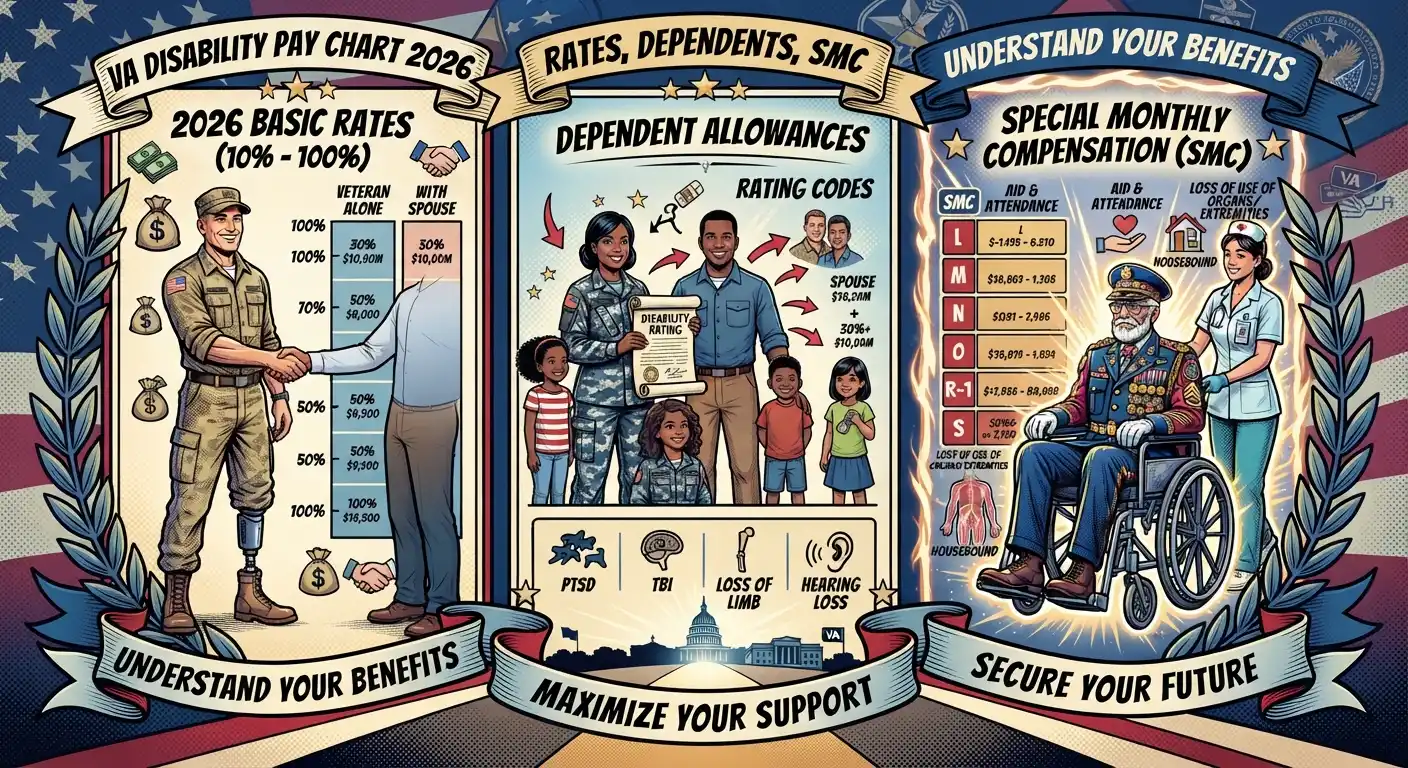
VA Disability Pay Chart 2026: Rates, Dependents, and SMC
The 2026 VA disability pay chart pays $180.42 a month at 10% and $3,938.58 at 100% for a veteran alone. Rates rose 2.8% on December 1, 2025, and run through November 30, 2026. Veterans with a spouse or children may receive more at the 30% level and above.
Last updated: November 2026

VA Disability Combined Rating Calculator
Add each disability rating from your decision letter.

Estimate only. The VA makes the official rating decision. Not legal or financial advice, and not affiliated with the Department of Veterans Affairs.
Benefits, rates, and contact details can change. Confirm current information with the official sources linked in this article.
Quick Facts
| Item | Details |
|---|---|
| Benefit | Tax-free monthly VA disability compensation based on disability rating and dependents |
| Who Qualifies | Veterans and service members with a service-connected disability rated by VA |
| How to Apply | VA Form 21-526EZ online at VA.gov, by mail, or with an accredited representative |
| Processing Time | Varies by claim; VA posts current average decision times on VA.gov |
| Official Agency | U.S. Department of Veterans Affairs, Veterans Benefits Administration |
| Required Forms | VA Form 21-526EZ; supporting medical evidence and service records |
| Updated For | 2026 rates effective December 1, 2025, with a 2.8% COLA |
What is the 2026 VA disability pay chart?
The 2026 VA disability pay chart is the official table of monthly compensation amounts for each disability rating, effective December 1, 2025 through November 30, 2026. The rates reflect a 2.8% cost-of-living adjustment (COLA), which matches the Social Security increase for 2026. VA is required by law to apply the same COLA percentage to disability compensation.
The chart has two main parts: basic monthly rates by rating and dependent status, and added amounts for dependents beyond the first child or for a spouse receiving Aid and Attendance. Veterans rated 10% or 20% receive the same rate regardless of dependents. Veterans rated 30% or higher may receive more for a spouse, children, or dependent parents.
For a broader overview of state-level benefits that can add to this federal pay, see this guide to veterans benefits by state.
2026 VA disability rates for a veteran alone
Army Fitness Test (AFT) Score Calculator
Formerly the ACFT. Five events, 500 points. Enter your results.
Estimate for training only. Points are interpolated from the official Army tables (effective 1 June 2025) and can differ by a few points. Your score of record comes from your unit graders. Official score tables (PDF). Not affiliated with the U.S. Army.
A veteran with no dependents receives $180.42 a month at 10%, $552.47 at 30%, $1,132.90 at 50%, and $3,938.58 at 100%. These are the basic rates before any added amounts for dependents or special monthly compensation.
| Disability rating | 2026 monthly rate (veteran alone) |
|---|---|
| 10% | $180.42 |
| 20% | $356.66 |
| 30% | $552.47 |
| 40% | $795.84 |
| 50% | $1,132.90 |
| 60% | $1,435.02 |
| 70% | $1,808.45 |
| 80% | $2,102.15 |
| 90% | $2,362.30 |
| 100% | $3,938.58 |
These amounts are tax-free at the federal level. They are also exempt from state income tax in Florida and in every other state. Rates can change each December, so confirm the current table on VA.gov compensation rates before you rely on a number for budgeting.
2026 VA disability rates with a spouse
A veteran with a spouse but no children receives $617.47 at 30%, $1,241.90 at 50%, $1,961.45 at 70%, and $4,158.17 at 100%. The dependent addition begins at the 30% rating. A 10% or 20% rating pays the same with or without a spouse.
| Disability rating | 2026 monthly rate (veteran with spouse, no children) |
|---|---|
| 30% | $617.47 |
| 40% | $882.84 |
| 50% | $1,241.90 |
| 60% | $1,566.02 |
| 70% | $1,961.45 |
| 80% | $2,277.15 |
| 90% | $2,559.30 |
| 100% | $4,158.17 |
These figures assume the spouse does not receive Aid and Attendance. If the spouse receives Aid and Attendance, an added amount applies on top of the basic rate. The VA.gov rate tables show the full added-amount tables.
2026 VA disability rates with a spouse and one child
A veteran with a spouse and one child receives $666.47 at 30%, $1,322.90 at 50%, $2,074.45 at 70%, and $4,318.99 at 100%. The child must generally be under 18, or under 23 and in school, or permanently helpless.
| Disability rating | 2026 monthly rate (veteran with spouse and 1 child) |
|---|---|
| 30% | $666.47 |
| 40% | $947.84 |
| 50% | $1,322.90 |
| 60% | $1,663.02 |
| 70% | $2,074.45 |
| 80% | $2,406.15 |
| 90% | $2,704.30 |
| 100% | $4,318.99 |
Each additional child under 18 adds to the monthly amount. The added amount varies by rating and is listed in the “Added amounts” table on VA.gov. For example, at the 30% level, an additional child adds $32.00 a month. At higher ratings, the added amount per child is higher.
2026 VA disability rates with children but no spouse
A veteran with one child but no spouse receives a rate between the “alone” and “spouse and child” figures. The exact amount depends on the rating and the number of children. The VA.gov rate tables list the full breakdown by dependent status.
For veterans with dependent parents as well as a spouse or children, VA has separate columns. The general rule is that each dependent category has its own column in the official table. Veterans with an unusual combination of dependents should use the VA.gov table or contact VA directly rather than estimating.
Added amounts for dependents and Aid and Attendance
VA adds extra compensation beyond the basic rate for certain dependent situations. The main added amounts are for additional children beyond the first, and for a spouse who receives Aid and Attendance benefits.
Additional children: Each child beyond the first adds a set monthly amount. The amount varies by rating and is listed in the Added amounts table.
Spouse Aid and Attendance: If your spouse receives VA Aid and Attendance, an added amount applies on top of the basic rate for your rating.
Dependent parents: A dependent parent adds a set monthly amount, with separate columns for one parent and two parents.
These added amounts are not included in the basic tables above. Use the VA.gov compensation rate tables to find the exact added amount for your situation.
2026 VA special monthly compensation (SMC) rates
Special monthly compensation (SMC) is a higher rate paid to veterans with certain severe disabilities or needs, such as the loss of a limb, the need for aid and attendance, or being housebound. SMC rates also rose 2.8% in 2026. The most common levels are listed below for a veteran with no dependents.
| SMC level | What it generally covers | 2026 monthly rate (veteran alone) |
|---|---|---|
| SMC-K | Loss or loss of use of a creative organ, or certain other specific losses | $139.87 |
| SMC-L | Need for regular aid and attendance, or certain anatomical losses | $4,900.83 |
| SMC-L ½ | Intermediate level between L and M | $5,154.18 |
| SMC-M | Higher aid and attendance needs | $5,408.55 |
| SMC-S | Housebound due to service-connected disabilities | $4,408.53 |
SMC-K can be added to the basic rate for a disability, and more than one SMC-K award may apply in some cases. SMC-L and higher levels replace the basic 100% rate with a higher amount. The VA.gov SMC page lists the full tables, including rates with dependents.
SMC and dependents
SMC rates increase when a veteran has a spouse, children, or dependent parents. The VA.gov SMC tables have separate columns for each dependent category. Veterans receiving SMC should use the SMC table rather than the basic compensation table, because the SMC rate generally replaces the basic rate at the 100% level. For levels below 100%, SMC may be added to the basic rate.
How the 2.8% COLA affects your 2026 pay
The 2.8% COLA raised every VA disability rate by the same percentage. A 10% rating rose from $175.51 in 2025 to $180.42 in 2026, an increase of $4.91 a month. A 100% rating for a veteran alone rose from $3,831.30 to $3,938.58, an increase of $107.28 a month.
The COLA is based on the Social Security Administration’s annual adjustment. VA is required by law to match the Social Security COLA percentage. The new rates took effect on December 1, 2025, and veterans saw the increase in their January 2026 payment. Rates remain in effect through November 30, 2026.
The 2027 COLA will be announced in the fall of 2026 and will take effect on December 1, 2026. Until then, the 2026 chart is the current chart. VA does not estimate future COLA amounts, so ignore any figure that is not from an official announcement.
How to read the VA pay chart
Reading the chart takes three steps: find your rating, find your dependent status, and add any special amounts. The basic monthly rate is where your rating and dependent status meet. Then add any amounts for additional children, a spouse receiving Aid and Attendance, or dependent parents.
Find your rating. Ratings run from 10% to 100% in 10% steps. If you have a combined rating from multiple conditions, VA rounds to the nearest 10% using its combined ratings table.
Find your dependent status. The main categories are veteran alone, veteran with spouse, veteran with spouse and one child, and veteran with children but no spouse. Each has its own column.
Add any special amounts. Additional children, a spouse receiving Aid and Attendance, and dependent parents each have added amounts. SMC is a separate table.
If your situation is unusual, such as multiple dependent parents or a spouse receiving Aid and Attendance, use the official VA.gov tables rather than a simplified chart. VA’s tables are the authoritative source.
Florida-specific notes for 2026 VA pay
Florida does not tax VA disability compensation. The state has no personal income tax, so your monthly VA payment is not reduced by state income tax. The federal government also does not tax VA disability compensation, so the full amount is tax-free for most veterans.
Florida also offers property tax relief for disabled veterans. The two main programs are a $5,000 exemption for veterans rated 10% or higher and a full homestead exemption for veterans with a service-connected total and permanent disability.
| Florida program | Who qualifies | Benefit | Statute |
|---|---|---|---|
| $5,000 disabled veteran exemption | Veteran rated 10% or higher, honorably discharged, Florida resident | $5,000 off the assessed value of property owned by the veteran | Florida Statute 196.24 |
| Full homestead exemption | Veteran with a service-connected total and permanent disability, Florida permanent resident on January 1 | Entire homestead exempt from property tax | Florida Statute 196.081 |
A 10% rating meets the threshold for the $5,000 exemption. The full homestead exemption requires a total and permanent disability, which is a separate VA determination from a 100% schedular rating. Veterans who are rated 100% permanent and total, or who receive Individual Unemployability, may qualify for the full exemption.
The exemption application deadline is generally March 1 of the tax year. For the 2027 tax year, the deadline is March 1, 2027. Confirm current rules with your county property appraiser or the Florida Department of Veterans’ Affairs. For a broader comparison of state benefits, see this state-by-state veterans benefits guide.
Common mistakes when using the 2026 pay chart
Assuming 10% or 20% ratings pay more with dependents. VA does not pay added amounts for dependents at the 10% and 20% levels. The dependent addition begins at 30%.
Using an old chart. The 2026 rates took effect December 1, 2025. A chart from before that date shows 2025 amounts and will understate your pay.
Confusing the 100% schedular rate with the 100% P&T rate. The pay is the same, but 100% permanent and total status can qualify you for additional state and federal benefits, including Florida’s full homestead exemption.
Ignoring SMC. If you have a severe disability or need aid and attendance, the SMC table may pay more than the basic 100% rate. Check the SMC rates before assuming the basic rate is your maximum.
Forgetting that additional children add pay. Each child beyond the first adds a monthly amount. Veterans with multiple children should use the Added amounts table, not just the basic rate.
Common Questions
What is the 2026 VA disability pay chart?
The 2026 VA disability pay chart is the official table of monthly compensation rates for each disability rating, effective December 1, 2025 through November 30, 2026. It reflects a 2.8% COLA and includes separate tables for veterans alone, with a spouse, and with dependents.
How much does VA pay at 100% in 2026?
A 100% rating pays $3,938.58 a month for a veteran alone. With a spouse, it pays $4,158.17. With a spouse and one child, it pays $4,318.99. These amounts are before any SMC or added amounts for additional children or dependent parents.
How much is VA disability pay at 50% in 2026?
A 50% rating pays $1,132.90 a month for a veteran alone. With a spouse, it pays $1,241.90. With a spouse and one child, it pays $1,322.90. A 50% rating is common for conditions such as sleep apnea requiring a CPAP machine.
Did VA disability pay go up in 2026?
Yes. VA disability rates rose 2.8% effective December 1, 2025, matching the Social Security COLA for 2026. The increase appeared in January 2026 payments and remains in effect through November 2026.
What is the 2026 VA disability rate for 10%?
A 10% rating pays $180.42 a month in 2026. This rate is the same whether the veteran has dependents or not. Veterans rated 10% or 20% do not receive added amounts for a spouse, children, or parents.
How much does a spouse add to VA disability pay?
A spouse adds $65.00 a month at the 30% level, rising to $219.59 at the 100% level. The exact added amount depends on the rating. The VA.gov rate tables show the spouse amount for each rating.
What is SMC in VA disability?
SMC stands for special monthly compensation. It is a higher rate paid to veterans with certain severe disabilities, such as the loss of a limb, the need for aid and attendance, or being housebound. SMC rates for 2026 range from $139.87 for SMC-K to more than $10,000 for the highest levels.
Does Florida tax VA disability pay?
No. Florida has no state personal income tax, so VA disability compensation is not taxed by the state. The federal government also does not tax VA disability compensation. The full monthly amount is tax-free for most veterans.
Can I get Florida property tax relief with a 50% VA rating?
Yes. A 50% rating meets the 10% threshold for Florida’s $5,000 disabled veteran property tax exemption under Florida Statute 196.24. The full homestead exemption requires a service-connected total and permanent disability, which is a separate determination.
When do 2027 VA disability rates take effect?
The 2027 COLA will be announced in the fall of 2026 and will take effect on December 1, 2026. VA will publish the new rate tables on VA.gov. Until then, the 2026 chart is the current chart.
Key Takeaways
The 2026 VA disability pay chart pays $180.42 a month at 10% and $3,938.58 at 100% for a veteran alone.
Rates rose 2.8% on December 1, 2025, matching the 2026 Social Security COLA.
Veterans with a spouse or children may receive more at the 30% level and above.
A veteran with a spouse and one child receives $666.47 at 30% and $4,318.99 at 100%.
SMC pays higher rates for severe disabilities, with SMC-K at $139.87 and SMC-L at $4,900.83.
Florida does not tax VA disability pay and offers property tax exemptions for disabled veterans.
The Florida $5,000 exemption is available at a 10% rating or higher; the full homestead exemption requires a total and permanent disability.
The 2027 COLA will be announced in fall 2026 and takes effect December 1, 2026.
Official Resources
VA disability compensation rates — Check the full 2026 rate tables by rating and dependent status.
VA special monthly compensation rates — Review SMC levels and dependent amounts for 2026.
VA disability compensation — Learn how compensation works and file a claim with VA Form 21-526EZ.
VA decision reviews and appeals — Choose a Supplemental Claim, Higher-Level Review, or Board Appeal if you disagree with a rating.
Florida Statute 196.081 — Read the full homestead exemption for veterans with a service-connected total and permanent disability.
Florida Department of Veterans’ Affairs — Find free benefits counseling and county veterans service offices.
Florida Department of Revenue — Find property tax exemption guidance and forms.
🇺🇸 IMPORTANT DISCLAIMER – Veterans Benefits Information
This site provides general information about U.S. Department of Veterans Affairs (VA) benefits for educational and informational purposes only.
- Not Official: We are NOT affiliated with, endorsed by, or connected to the U.S. Department of Veterans Affairs (VA), the Veterans Benefits Administration (VBA), the Veterans Health Administration (VHA), or any other government agency.
- No Legal/Financial Advice: The content on this website is for informational purposes only and does not constitute legal, financial, or medical advice. VA benefits rules change frequently – always consult with an accredited Veterans Service Officer (VSO) or a qualified professional for your specific situation.
- Official Sources: For official, binding information and to apply for benefits, always visit official .gov websites: VA.gov, Benefits.VA.gov, or SSA.gov.
- No Data Collection: This site does not collect, store, or process any personal information. It does not have login forms, contact forms, or any system to capture user data. We never ask for your Social Security Number, bank details, or any personal information.
- 🚨 Scam Alert: The VA and other government agencies never charge fees for benefit applications. If anyone asks for money to "process" your VA claim, it is a scam. Report it to the VA Office of Inspector General at VA.gov/OIG.
- Advertising: This site uses third-party advertising (Adsterra) to cover operational costs. We do not endorse or guarantee any products or services advertised.
📌 Information provided as of June 2026. Always verify current eligibility and rules with official .gov sources.
This site is not affiliated with the U.S. Department of Veterans Affairs or any government agency. All information is for educational purposes only. Please visit VA.gov for official information.
VA Disability Pay Calculator
This calculator is for information only. Your exact award is set by VA and shown in your VA.gov account and decision letter. VA disability compensation is tax-free.