
The Mosquito Bowl: The WWII Marine Football Game and Its Legacy
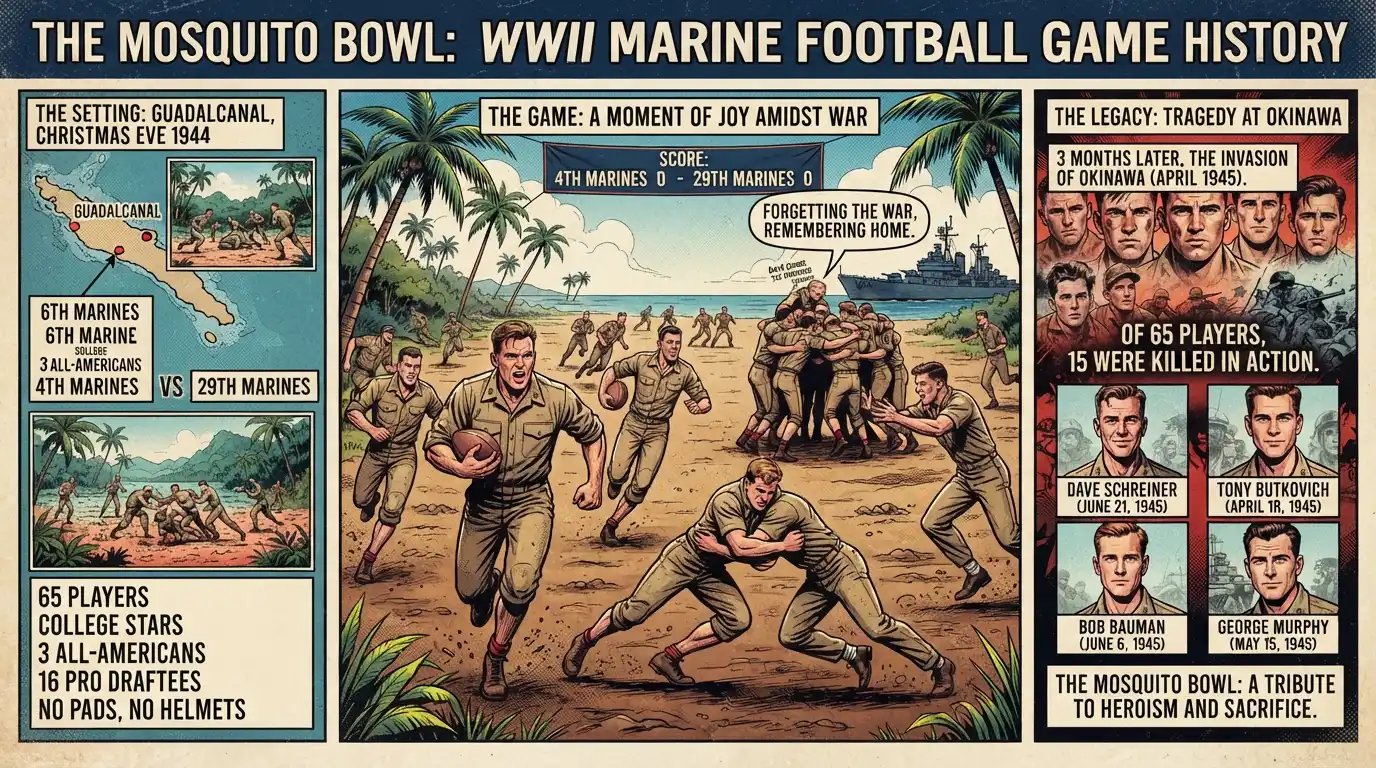
The Mosquito Bowl was a football game played on December 24, 1944, between the 4th and 29th Marine Regiments of the 6th Marine Division on Guadalcanal. The game ended in a scoreless tie. Fifteen of the 65 Marine players were killed at the Battle of Okinawa months later, and about 20 more were wounded.
Last updated: November 2026
Benefits, rates, and contact details can change. Confirm current information with the official sources linked in this article.

Quick Facts
| Item | Details |
|---|---|
| Event | A football game between two U.S. Marine regiments training on Guadalcanal during World War II. |
| Who Participated | 65 Marines from the 4th and 29th Marine Regiments, 6th Marine Division. Many were former college football players, including All-Americans and future NFL players. |
| Date | December 24, 1944 (Christmas Eve). |
| Location | Guadalcanal, Solomon Islands. |
| Outcome | Scoreless tie (0–0). |
| Legacy | Fifteen players were killed at the Battle of Okinawa; about 20 more were wounded. The game was the subject of a 2022 book by Buzz Bissinger and a 2026 film adaptation. |
| Official Agency | Not applicable. This page covers a historical event, not a benefits program. |
| Required Forms | Not applicable. |
| Updated For | November 2026 |
What Was the Mosquito Bowl?
VA Disability Combined Rating Calculator
Add each disability rating from your decision letter.

Estimate only. The VA makes the official rating decision. Not legal or financial advice, and not affiliated with the Department of Veterans Affairs.
The Mosquito Bowl was a football game played by two regiments of U.S. Marines on Christmas Eve 1944 while they were training on Guadalcanal for the invasion of Okinawa. The game matched the 4th Marine Regiment against the 29th Marine Regiment, both part of the 6th Marine Division. Because so many of the Marines had played college football, the matchup became a rare moment of normalcy before one of the deadliest battles of the Pacific War. For readers researching military family history, the site’s veterans benefits by state guide explains how state-level records and benefits differ.
The name “Mosquito Bowl” came from the insect-infested conditions on Guadalcanal. The island had been secured by U.S. forces in early 1943, but it remained a staging area with harsh jungle terrain, coral, and mosquitoes. The game was played in that environment, not in a stadium.
When and Where Was the Game Played?
The game was played on December 24, 1944, on Guadalcanal in the Solomon Islands. The 6th Marine Division was stationed there in the final months of 1944, preparing for the invasion of Okinawa. The game kicked off at 8:30 a.m. and was broadcast live over the radio for service members elsewhere in the Pacific. About 2,500 service members attended.
Guadalcanal was not the site of the game by accident. The island had been the scene of a major Allied campaign in 1942–1943, and by late 1944 it served as a large staging and training base for units preparing for future operations. The Marines of the 4th and 29th Regiments were among those waiting for their next assignment, which turned out to be Okinawa.
Who Played in the Mosquito Bowl?
Army Fitness Test (AFT) Score Calculator
Formerly the ACFT. Five events, 500 points. Enter your results.
Estimate for training only. Points are interpolated from the official Army tables (effective 1 June 2025) and can differ by a few points. Your score of record comes from your unit graders. Official score tables (PDF). Not affiliated with the U.S. Army.
The game featured 65 Marines, many of whom had been college football stars before the war. The rosters included former All-Americans, all-conference players, and men who had been drafted by or would go on to play in the National Football League. This concentration of football talent in two regiments is what made the game notable.
Key Players and Their Fates
John McLaughry was a quarterback from Brown University and a third-team All-American in 1938. He had played professionally for the New York Giants before serving in the Marines. McLaughry was one of the few central figures in the Mosquito Bowl story who survived the war. After the war, he returned to football as a coach and later became the head coach at Brown from 1959 to 1966. He died in 2007.
Tony Butkovich was a fullback who set a Big Ten record with 16 touchdowns in 1943 at Purdue. He was killed by a sniper on Okinawa on April 18, 1945, during fighting on the Motobu Peninsula. He was 24 years old.
Dave Schreiner was an All-American end from the University of Wisconsin who won the Big Ten’s Silver Football as league MVP in 1942. He was mortally wounded by a sniper on Okinawa on June 20, 1945, and died the next day. He was later elected to the College Football Hall of Fame.
Bob Bauman was a three-year letterman for the Wisconsin Badgers. He was killed on Okinawa in 1945. His story, along with Schreiner’s, is central to the Wisconsin football history of the period.
Other players included George Murphy, a team captain at Notre Dame, and men from programs across the country. The exact individual fates of all 65 players are documented in Buzz Bissinger’s book and in military records, but the aggregate numbers are clear: 15 killed and about 20 wounded at Okinawa.
The Game Itself
The Mosquito Bowl ended in a scoreless tie. The game was described as bruising and competitive, played on rough ground in the dirt and coral of Guadalcanal. It was not a polished exhibition; it was a real football game between trained athletes who happened to be Marines preparing for combat.
The scoreless outcome has become part of the story’s symbolism. Neither regiment could claim a victory on the field, and months later both would suffer heavy losses on Okinawa. The game is often remembered less for its result than for what it represented: a brief return to normal life for men who were about to face one of the war’s bloodiest battles.
What Happened to the Players at Okinawa?
Fifteen of the 65 Marines who played in the Mosquito Bowl were killed during the Battle of Okinawa, and about 20 more were wounded. This casualty rate is often described as the largest number of American athletes ever to die in a single battle. The Battle of Okinawa lasted 82 days, from April through June 1945, and was one of the deadliest campaigns in the Pacific.
The deaths came in different ways and at different times. Butkovich was killed by a sniper in April. Schreiner was mortally wounded by a sniper in June. Others were killed in the broader fighting across the island. The 6th Marine Division, which included the 4th and 29th Regiments, was heavily engaged in the campaign.
The survivors returned to civilian life, some with physical wounds and others with the psychological toll of combat. McLaughry’s postwar career in coaching is one example of a veteran rebuilding a professional life after the war. Many other players returned to quieter lives, their football fame largely forgotten outside their families and communities.
Why Is It Called the Mosquito Bowl?
The name “Mosquito Bowl” came from the mosquitoes and harsh conditions on Guadalcanal. The island was notorious for its insect population, and the Marines training there endured mosquito bites along with heat, rain, and coral dust. The nickname was likely informal and stuck because it captured the reality of playing football in a jungle staging area rather than a stadium.
The name also distinguishes the game from the many other military football games played during World War II. Football was used as a morale booster and training tool at bases around the world, but the Mosquito Bowl is remembered because of the caliber of the players and the losses they later suffered.
The Book and Film
Buzz Bissinger published The Mosquito Bowl: A Game of Life and Death in World War II in 2022. Bissinger, best known for Friday Night Lights, traced the prewar lives of several players, the organization of the game, and the Okinawa campaign that followed. The book drew on interviews with surviving Marines and on earlier research by Terry Frei, whose book Third Down and a War to Go covered the 1942 Wisconsin Badgers and the players who died in the war.
A film adaptation directed by Peter Berg was released in 2026. The film focuses on four central players: John McLaughry, Tony Butkovich, Dave Schreiner, and Bob Bauman. It depicts the game and the Okinawa campaign. The film is a dramatization, and some details may differ from the historical record; readers who want the documented account should consult Bissinger’s book and military records.
Notice: Book editions and streaming availability can change. Confirm current options with the publisher or streaming service.
What the Mosquito Bowl Means for Today’s Veterans
The Mosquito Bowl is a reminder of the human cost of military service and the importance of supporting veterans and their families after combat. The players who survived Okinawa returned to a country that was beginning to build the modern veterans benefits system. The GI Bill, which had been signed in 1944, helped many World War II veterans attend college, buy homes, and start businesses.
Today, veterans and surviving family members have access to a range of federal and state benefits. These include VA disability compensation, VA health care, survivor benefits such as Dependency and Indemnity Compensation (DIC), and state programs that vary by location. Eligibility and payment amounts can change, so veterans should confirm current details with official sources.
If you are researching a family member who served in World War II, military records are the starting point. The National Archives maintains separation documents, unit records, and other military personnel files. Veterans and next of kin can request records through the National Personnel Records Center. The site’s guide to VA benefits changes explains how proposed and enacted policy shifts can affect benefits over time.
Notice: VA eligibility rules and survivor benefit amounts can change. Confirm current information with VA.gov or an accredited veterans service organization before applying.
How to Research a Mosquito Bowl Player or Other WWII Veteran
Start with the veteran’s discharge papers and service number, then request official military records from the National Archives. Many World War II records were affected by the 1973 fire at the National Personnel Records Center, but alternative sources can sometimes fill gaps.
Gather what you know. Collect the veteran’s full name, service number, branch, dates of service, and any discharge documents (such as a WD AGO Form 53 or 55).
Request official records. Use the National Archives’ records request process for military personnel files. Next of kin have priority access to certain records.
Check unit histories. Regimental and divisional histories, such as those of the 6th Marine Division, can provide context about where a veteran served and what battles they participated in.
Use VA records if applicable. If the veteran received VA benefits, the VA may have claims files or medical records, though access rules apply.
Consult published histories. Books like Bissinger’s The Mosquito Bowl and Terry Frei’s Third Down and a War to Go include detailed research on specific players and units.
For veterans and family members managing current VA claims or payments, the site’s guide to the LSGS Veteran Portal explains how to track documents and compensation online.
Common Questions
What was the Mosquito Bowl?
The Mosquito Bowl was a football game played on December 24, 1944, between the 4th and 29th Marine Regiments of the 6th Marine Division on Guadalcanal. The game ended in a scoreless tie. It is remembered because 15 of the 65 players were killed at the Battle of Okinawa months later.
Who won the Mosquito Bowl?
The game ended in a 0–0 tie. Neither regiment scored. The game is not remembered for a winner but for the caliber of the players and the losses they later suffered at Okinawa.
How many players died at Okinawa?
Fifteen of the 65 Marines who played in the Mosquito Bowl were killed during the Battle of Okinawa. About 20 more were wounded. This is often described as the largest number of American athletes to die in a single battle.
Who was Tony Butkovich?
Tony Butkovich was a fullback from Purdue who set a Big Ten record with 16 touchdowns in 1943. He played in the Mosquito Bowl and was killed by a sniper on Okinawa on April 18, 1945. He was 24 years old.
Who was Dave Schreiner?
Dave Schreiner was an All-American end from the University of Wisconsin and the 1942 Big Ten MVP. He played in the Mosquito Bowl and was mortally wounded by a sniper on Okinawa on June 20, 1945. He died the next day and was later inducted into the College Football Hall of Fame.
Did any Mosquito Bowl players survive the war?
Yes. John McLaughry, a quarterback from Brown University, survived the war and later became the head football coach at Brown from 1959 to 1966. He died in 2007. Other players also survived, though many were wounded.
Why is it called the Mosquito Bowl?
The name came from the mosquito-infested conditions on Guadalcanal, where the Marines were training. The game was played in a jungle staging area, not a stadium, and the nickname stuck.
Was the Mosquito Bowl a real game or a movie?
It was a real game played on December 24, 1944. Buzz Bissinger wrote a book about it in 2022, and a film adaptation directed by Peter Berg was released in 2026. The film is a dramatization; the book and military records are the historical sources.
Where can I find a list of all 65 players?
Buzz Bissinger’s book The Mosquito Bowl includes detailed rosters and player histories. Unit records and newspaper coverage from the period may also list participants. The National Archives can help with military personnel files for individual players.
Are there survivor benefits for families of Mosquito Bowl players?
Survivor benefits are based on the veteran’s service and the family’s eligibility, not on participation in a specific game. Eligible surviving spouses and dependents may qualify for VA Dependency and Indemnity Compensation (DIC) or other programs. Current rules and rates should be confirmed with VA.gov.
How can I verify a family member’s WWII service?
Request military personnel records from the National Archives using the veteran’s name, service number, and branch. Next of kin have priority access. Discharge documents and unit histories can help fill gaps if records were affected by the 1973 fire.
Is the Mosquito Bowl connected to any current VA programs?
No. The Mosquito Bowl was a historical event, not a benefits program. Current VA programs are separate, but the game is remembered as part of the broader history of military service and sacrifice that VA benefits are designed to support.
Key Takeaways
The Mosquito Bowl was a football game played on December 24, 1944, between the 4th and 29th Marine Regiments on Guadalcanal.
The game ended in a scoreless tie and was played in front of about 2,500 service members.
Sixty-five Marines played, many of them former college football stars.
Fifteen players were killed at the Battle of Okinawa, and about 20 more were wounded.
Tony Butkovich and Dave Schreiner were among the players killed on Okinawa.
John McLaughry survived the war and later coached at Brown University.
Buzz Bissinger’s 2022 book and a 2026 film adaptation brought the story to a wider audience.
The game is remembered as a moment of normalcy before one of the Pacific War’s deadliest battles.
Military records for Mosquito Bowl players and other WWII veterans are available through the National Archives.
Current VA benefits and survivor programs are separate from the historical event but reflect the ongoing obligation to support veterans and families.
Official Resources
VA.gov — Apply for VA health care, disability compensation, and survivor benefits, and check eligibility.
National Archives — Request military personnel records for World War II veterans and other service members.
VA Caregiver Support Program — Resources for family members caring for veterans.
VA Dependency and Indemnity Compensation — Information on survivor benefits for eligible spouses and dependents.
🇺🇸 IMPORTANT DISCLAIMER – Veterans Benefits Information
This site provides general information about U.S. Department of Veterans Affairs (VA) benefits for educational and informational purposes only.
- Not Official: We are NOT affiliated with, endorsed by, or connected to the U.S. Department of Veterans Affairs (VA), the Veterans Benefits Administration (VBA), the Veterans Health Administration (VHA), or any other government agency.
- No Legal/Financial Advice: The content on this website is for informational purposes only and does not constitute legal, financial, or medical advice. VA benefits rules change frequently – always consult with an accredited Veterans Service Officer (VSO) or a qualified professional for your specific situation.
- Official Sources: For official, binding information and to apply for benefits, always visit official .gov websites: VA.gov, Benefits.VA.gov, or SSA.gov.
- No Data Collection: This site does not collect, store, or process any personal information. It does not have login forms, contact forms, or any system to capture user data. We never ask for your Social Security Number, bank details, or any personal information.
- 🚨 Scam Alert: The VA and other government agencies never charge fees for benefit applications. If anyone asks for money to "process" your VA claim, it is a scam. Report it to the VA Office of Inspector General at VA.gov/OIG.
- Advertising: This site uses third-party advertising (Adsterra) to cover operational costs. We do not endorse or guarantee any products or services advertised.
📌 Information provided as of June 2026. Always verify current eligibility and rules with official .gov sources.
This site is not affiliated with the U.S. Department of Veterans Affairs or any government agency. All information is for educational purposes only. Please visit VA.gov for official information.
VA Disability Pay Calculator
This calculator is for information only. Your exact award is set by VA and shown in your VA.gov account and decision letter. VA disability compensation is tax-free.